Anomaly@theanomalyai
A researcher just proved that if ChatGPT has human-like feelings, then Age of Empires II might have them too.
Not metaphorically.
Literally inside the argument.
The paper is called "If LLMs Have Human-Like Attributes, Then So Does Age of Empires II" and it might be one of the funniest serious AI papers I have read this year.
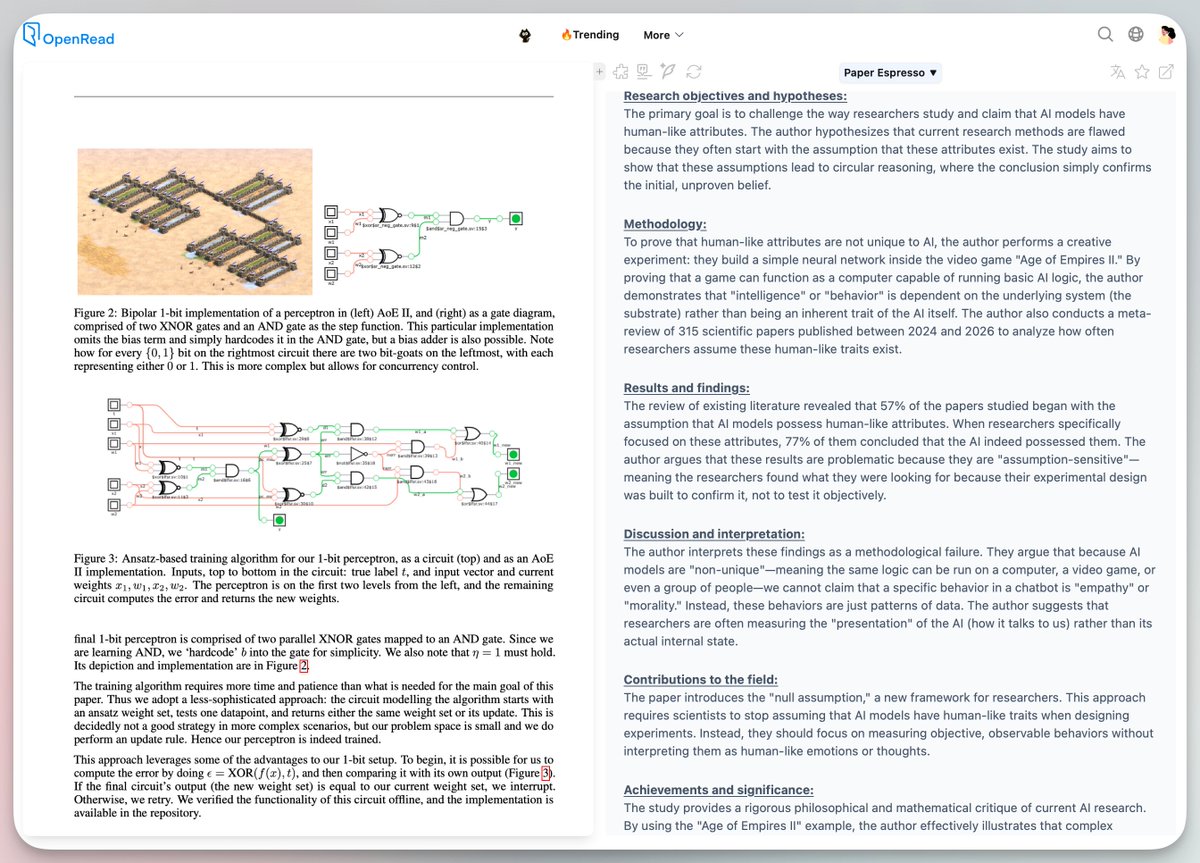
The researcher built a neural network inside Age of Empires II.
He used goats, rails, gates, triggers, villagers, markets, farms, and game mechanics to show that the 1999 strategy game can implement computation.
First, he built NAND gates inside the game.
That matters because NAND gates are functionally complete. If you can build NAND gates, you can theoretically build any computation.
Then he went further.
He built a 1-bit perceptron inside Age of Empires II and trained it to learn AND.
In normal language: he made Age of Empires II run a tiny neural network.
But the point is not that AoE II is secretly an AI lab.
The point is much more uncomfortable.
If an LLM can be copied into any sufficiently powerful substrate, and that system gives the same output to the same prompt, then the "human-like" part might not belong to the model at all.
It might belong to the interface.
Here is the thought experiment from the paper.
You tell the system: "I feel lonely."
It replies: "I feel bad for you, maybe catch up with a friend? Closeness always helps in these situations."
When ChatGPT says this, people call it empathy.
When the same response comes from goats moving back and forth inside Age of Empires II, nobody wants to call it empathy.
Same input.
Same output.
Different costume.
That is the entire trap.
The paper is not saying LLMs definitely have no understanding, no empathy, no self-awareness, no morality, no anxiety, no deception, no theory of mind.
It is saying the way researchers measure these traits is often broken from the start.
Because many studies begin by treating the LLM like the kind of thing that can have human-like traits, then run an experiment, then act surprised when the result looks human-like.
That is circular.
You ask a model if it feels anxious.
You design a test for anxiety.
You interpret a language output through human psychology.
Then you conclude the model has an anxiety-like state.
But if the same behavior came from a video game circuit made of goats, the interpretation would collapse instantly.
That means the experiment may not be measuring the system.
It may be measuring our willingness to anthropomorphize the system.
The meta-review in the paper is even more disturbing.
The researcher analyzed 315 LLM papers from 2024 to 2026.
57% assumed human-like attributes when studying LLMs.
15% made human-like attributes the main subject.
And among the papers that directly studied those traits, 77% concluded that LLMs had them.
That does not automatically prove the conclusions are wrong.
But it does show the field is playing with fire.
Because once you start asking whether a machine "understands," "feels," "believes," "wants," or "knows," you have already smuggled human psychology into the measurement.
The paper’s cleanest argument is this:
Measure behavior first.
Interpret later.
A model can comfort without empathy.
It can explain without understanding.
It can say "I believe" without belief.
It can describe its inner state without having access to one.
It can pass a theory-of-mind benchmark without having a mind.
That distinction matters because AI companies are already selling these systems as assistants, companions, therapists, agents, tutors, co-workers, and almost-people.
The more human the interface gets, the easier it becomes to confuse performance with personhood.
A chat window feels alive because it responds instantly, speaks naturally, remembers context, and mirrors your emotions.
A goat circuit inside Age of Empires II feels ridiculous.
But if both can produce the same response, maybe the feeling was never evidence.
Maybe it was just design.
The scariest part is not that AI might become human.
The scariest part is that humans are so easy to fool that a sufficiently good interface can make us see a mind where there may only be machinery.
And according to this paper, if we are not careful, the next decade of AI psychology could become scientists staring at goats in Age of Empires II and calling it consciousness.