

De Feits
60.2K posts
De Feits
@de_feits
Politieke veelvraat, eigenzinnig, nuchter, factchecker, anti frame en anti woke, principieel, altijd positief, ❤️NL
Netherlands Beigetreten Nisan 2012
182 Folgt702 Follower
@DevliegerErik Hugo de Jonge is na zijn achterlijk desastreuze beleid natuurlijk verbannen uit de politiek… Of toch niet?😳🤔😬
Nederlands


Hoe gek zijn ze. Alleen boeren pesten..
Kabinet verhoogt natuurdoelen boven EU-eis, terwijl onderbouwing ontbreekt nieuwrechts.nl/110221-kabinet…
Nederlands
De Feits retweetet

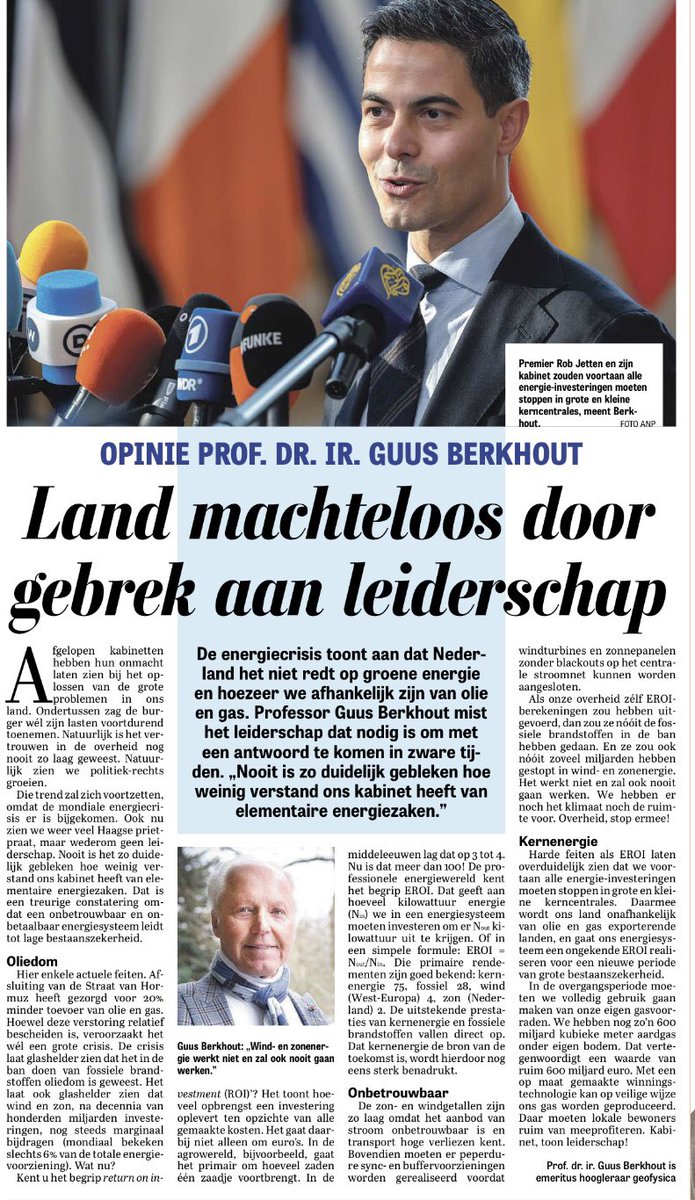
Land machteloos door gebrek aan leiderschap. En kennis! De primaire rendementen zijn goed bekend: kernenergie 75, fossiel 28, wind (West-Europa) 4, zon (Nederland) 2. En wat doet Kabinet? Investering in wind 4 en zon 2. Lees s.v.p. hele artikel om te begrijpen hoe dom ze zijn.
Nederlands
De Feits retweetet

In juli en augustus 2025 werd vijf keer het antibioticum nitrofuran aangetroffen in Oekraïense eieren. Daarnaast waren er sporen van chloramfenicol in melkpoeder en metronidazol in eieren. Het gaat om stoffen die in de EU verboden zijn vanwege hun genotoxische en kankerverwekkende eigenschappen. Vijf meldingen in twee maanden is geen incident meer, dat is structureel,” besluit Sander Smit.
bbb-europa.eu/bbb-geschokt-d…
Nederlands
De Feits retweetet

Moslims slachten nu massaal christenen af in Congo. Honderden slachtoffers zijn gemeld.
Waar is de westerse media?
Aan linkse zelfhaters; dit is jullie voorland
Nederlands
Beste @wierdduk . Mag ik je om een gunst vragen? Zou je dit willen delen a.u.b.? facebook.com/share/p/14ZC1j…
Dank!
Nederlands
De Feits retweetet
“Bereidt u zich maar voor op stroomstoringen” zegt staatssecretaris de Bat. Waarom accepteert Nederland dat we door dit soort nitwits bestuurd worden? Hou de kolencentrales langer open, hervat de gaswinning en erken eens dat jullie er een enorme teringzooi van gemaakt hebben.
Sven op 1@Sven_op_1
Staatssecretaris Jo-Annes de Bat van Klimaat en Groene Groei zoekt naar de grens voor wat acceptabel is wat betreft de tijd dat mensen eventueel zonder stroom zouden komen te zitten in de toekomst. "Als dat een uur is, zou je zeggen: dat kunnen mensen best hebben, maar zijn ook mensen die afhankelijk zijn van stroom voor allerlei medische apparatuur." #WNL
Nederlands
De Feits retweetet
Cijfers tonen aan dat de plantaardige ‘eiwittransitie’ op zijn retour is. En dan zouden kabinet en #schijfvanvijf ons op klimaatdieet zetten? Trekken aan dood paard: de mensen willen het niet en gooien de kont tegen de krib. @WyniasWeek wyniasweek.nl/cijfers-tonen-… #Eiwittransitie
Nederlands
De Feits retweetet

MUST READ: "Evident is dat Vluchtelingenwerk lijntjes heeft met Den Haag en met de regering onder leiding van D66 al helemaal: voormalig D66-Kamerlid Sjoerd Warmerdam is nu directeur Public Affairs en Strategie van Vluchtelingenwerk en nog steeds lid van D66. Voormalig D66-minister van Justitie en voormalig Staatsraad Winnie Sorgdrager is voorzitter van de Raad van Toezicht. Naast de politieke lijntjes heeft Vluchtelingenwerk ook steun van grote asiel- en mensenrechtenadvocaten om het gewenste asielbeleid, als de politiek niet meewerkt, via de rechter af te dwingen": wyniasweek.nl/achter-het-rui… #Asiel #Lobbycratie
Nederlands
De Feits retweetet
Dit zet allemaal weinig zoden aan de dijk. Er zijn nu dringend structurele ingrijpende maatregelen nodig. Er moet stevig gesnoeid worden in de overdaad aan instanties, planbureaus en ambtelijke organisaties. Ze hebben anders zo weer 500 (of meer) nieuwe regeltjes verzonnen.
Henri Bontenbal@HenriBontenbal
Regels helpen de samenleving goed functioneren, maar kunnen ook creativiteit en eigen initiatief ontmoedigen. Daarom is het goed dat we onnodige regels schrappen en de samenleving zuurstof geven. Een belangrijke opdracht voor dit kabinet. telegraaf.nl/politiek/kabin…
Nederlands
Ever seen the insane effort it takes to “build green”?
Just watch how they pour a SINGLE wind turbine foundation: 600–1,000 TONS of concrete, massive excavation, endless rebar, and heavy machinery tearing up the land for days.
And that’s only the base.
The blades? Made with balsa wood stripped from the Amazon rainforest, straight-up deforestation in the name of “saving the planet”.
Then add:
• Concrete
• Carbon fiber
• Steel
• Cast iron
• Copper
• Aluminum
• Plus boron, chromium, cobalt, manganese, molybdenum, nickel & rare earth elements
All mined, refined, and shipped with massive energy & pollution.
These things last 25 years max.
By 2050 the world will be drowning in 43 million tons of worn-out blades, that’s the weight of 215,000 locomotives headed for landfills (most can’t even be recycled).
Oh, and here’s the rest of the ridiculous list:
- They slaughter hundreds of thousands of birds & bats every year
- They only spin when the wind feels like it (so we still need gas/coal plants on standby)
- They chew up huge chunks of land and ruin views for miles
- They’re noisy, expensive to maintain, and require giant subsidies to even exist
This is “green” energy?
We’re destroying rainforests, mining toxic rare earths, pouring planet-warming concrete, and creating mountains of non-recyclable waste… to fight climate change?
It’s completely ridiculous. A multi-trillion-dollar environmental own-goal sold as virtue.
English
@lidewij_devos @fmeeus1 Naïeve, ideologische, wereldvreemde, in een bubbel levende, niet ih belang van Nederland handelende @SvVeldhoven heeft haar antwoord al gegeven
Nederlands

Zojuist heb ik een motie ingediend om de Groningers te compenseren, het gebied bevingsbestendig te maken en de gaswinning in Groningen te hervatten. Goedkope en betrouwbare energie voor heel Nederland. Volgende week dinsdag komt mijn voorstel in stemming!
Nederlands
De Feits retweetet

Het terugtrekkende ijs van de Mendenhall-gletsjer in Alaska legt oude boomstronken bloot. Dit laat duidelijk zien dat het klimaatverandering van alle tijden is. We hebben dus geen klimaatcrisis maar wel last van klimaathysterie.
Electroverse@Electroversenet
Retreating ice at Alaska's Mendenhall Glacier is exposing ancient tree stumps. Carbon dating places the stumps at around 1,000 to 2,000 years old. Forests once grew where ice now sits. Glaciers have been gradually pulling back since the end of the Little Ice Age, since the 1800s. As they recede, they're exposing land that was previously ice-free as recently as 1,000 years ago (when CO2 levels were far lower than they are today). We see this not only in Alaska, but across the Arctic. Retreating ice is uncovering soils, wood, and organic material. In Greenland, buried soils, plant remains, and insects have also been found beneath the ice. These are direct physical records of far warmer temperatures in the recent past. Warmth brings vegetation and biodiversity. Cold brings hardship and advancing ice sheets. It is obvious which conditions life prefers.
Nederlands

Gemeente Amsterdam betaalde €15.000 voor grofvuil-bakfietsen die niemand gebruikt, wil toch door met proef geenstijl.nl/5189318/hele-d…
Nederlands
@harmbeertema Mag ik de beste minister van onderwijs die Nederland spijtig genoeg nooit zal hebben vragen deze dame een zetje in de rug te geven door haar hulp voor kinderen met examenstress aan te prijzen? Bvd! facebook.com/share/r/1KkjwV…
Nederlands
De Feits retweetet

Binnenkort horen we op welke middelbare school onze oudste is ingeloot. De zoektocht was ontluisterend. We sloten niets uit.
Van scholen met alleen moslims en Islamitische feesten, tot scholen waar slechts Engels gesproken mag worden ('we bereiden kinderen voor op de toekomst') en een Greta Thunbergvideo vanwege 'de klimaatverandering', tot scholen waar 60% zijn diploma haalt, die volhing met camera's en een school met 'steekincidenten' (een paar maar).
Van scholen met lesmaterialen vol spelfouten, tot lessen waarin rechtse politici als Wilders en Trump werden geframed (!) en grote onzin verspreid over 'de bezetters in palestina'.
Van scholen met grote SDG vlaggen en kindjes met regenboogjes op hun wang, tot een directeur die groot fan bleek van XR terreur (??) en een aardige docent die uit wanhoop de boekenlijst maar had afgeschaft. Want tja, ze lezen echt niet meer hè.
Ondertussen wordt er een inclusieve taalgids gemaakt met 1984 achtige nieuwspraak bij OCW in Den Haag.
Wanneer gaat OCW het onderwijs in Nederland op orde brengen? 🤬
Nederlands
De Feits retweetet

Maxima bezocht gister een buurtcentrum in Amsterdam-Noord waar het o.a. ging over vrouwenemancipatie.
Een vrouw in chador met een niqabi naast haar zegt; "Vrouwen van de wijk willen gezien worden", de niqabi knikt haar hoofd instemmend.
Is dit De Speld?? 😵💫🤣
Nederlands