
Lonny Eachus

336.4K posts

Lonny Eachus banner
Lonny Eachus

Lonny Eachus

@eachus

Software Engineer. RoR Developer. Picture is a ferret named Fred Weasley. "Likes" are just things to read later, and RTs are not endorsement.

USA Beigetreten Kasım 2008
592 Folgt1.8K Follower
Angehefteter Tweet
Lonny Eachus
Lonny Eachus@eachus·
NOTICE TO FOLLOWERS: I intend to keep this account active, but I will be moving most of my activity to my premium account: @Mister_E_36. Follow me there, and over time I will be following back the people I already follow here.
English
0
1
24
2.5K
Lonny Eachus
Lonny Eachus@eachus·
@PNWForestKing Don't misunderstand me. I am not a fan of the law. I am not trying to "defend" it. But sadly, AFAIK it's legit.
English
0
0
0
1
Lonny Eachus
Lonny Eachus@eachus·
@PNWForestKing The law passed in WA doesn't discriminate. It specifically says it applies to all law enforcement. So your case law does not apply.
English
1
0
0
4
PNWForestKing
PNWForestKing@PNWForestKing·
POPPYCOCK: Here's the law (below) versus opinion (the REPOST)... Federal law enforcement officers do not have to follow state laws that dictate attire, uniforms, or related requirements (such as prohibitions on face coverings/masks while on duty). Federal law enforcement answers to federal standards and the U.S. Constitution, not state-level dress codes or attire dictates. If a state law directly conflicts with federal operations or authority, it generally cannot be enforced against federal officers. Federal agencies like the FBI, ICE, CBP, U.S. Marshals, and others set their own policies on uniforms, dress codes, grooming, and protective gear (including whether masks or face coverings are permitted for officer safety, anonymity in certain operations, or other mission needs). These are governed by federal regulations, agency directives, and operational necessities—not state mandates. Key Supreme Court cases most frequently cited in legal arguments and court filings when addressing whether federal law enforcement must comply with state laws on attire, uniforms, masks, or related operational regulations. These cases establish foundational principles under the Supremacy Clause (U.S. Const. art. VI, cl. 2), intergovernmental immunity, and federal supremacy over state attempts to regulate federal operations or officers. McCulloch v. Maryland, 17 U.S. (4 Wheat.) 316 (1819) This is the foundational case. Chief Justice Marshall held that states cannot tax or otherwise burden federal instrumentalities (here, a national bank), famously stating that states have no power "to retard, impede, burden, or in any manner control, the operations of the constitutional laws enacted by Congress." This principle is routinely invoked to argue that states cannot dictate federal uniforms, attire, or operational policies (e.g., masking for safety or anonymity), as it would control federal government functions. Mayo v. United States, 319 U.S. 441 (1943) The Court reinforced that "the activities of the Federal Government are free from regulation by any state." This has been cited in modern contexts (including federal complaints against state mask bans) to support that states lack authority to impose attire or identification requirements on federal agents performing federal duties. North Dakota v. United States, 495 U.S. 423 (1990) (plurality opinion) The intergovernmental immunity doctrine prohibits state laws that "regulate[] the United States directly or discriminate[] against the Federal Government or those with whom it deals." Recent federal arguments against discriminatory state laws (e.g., mask bans exempting state officers but targeting federal ones) rely heavily on this. In re Neagle, 135 U.S. 1 (1890) A federal marshal was immune from state murder charges for killing someone while protecting a Supreme Court Justice. The Court established a two-prong test for Supremacy Clause immunity: (1) the act was authorized by federal law, and (2) it was "necessary and proper" to federal duties. This protects federal officers from state criminal laws conflicting with their operations, including potentially attire-related rules if masking is deemed necessary for safety or mission needs. Lower courts still apply this test. Johnson v. Maryland, 254 U.S. 51 (1920) A federal postal driver could not be required to obtain a state driver's license, as states cannot impose licensing/qualification burdens on federal employees performing duties. Cited in recent mask-ban litigation as an example of invalid "direct regulation" of federal operations (analogous to state rules on federal attire or identification). Arizona v. United States, 567 U.S. 387 (2012) Federal immigration law preempted parts of Arizona's state law attempting to regulate immigration enforcement, emphasizing that states cannot undermine federal priorities or operations.
Lonny Eachus@eachus

@PNWForestKing @BBMagaMom No, it doesn't. The Supremacy Clause says Federal laws supersede State laws where they directly conflict. Face masks are department policy, not law. State law overrules. Federal agencies MUST obey State laws, just like everyone else, except where the Supremacy Clause kicks in.

English
1
0
2
118
Bethany O’Leary 🇺🇸 🦅
🚨 BREAKING: Washington State Gov. Bob Ferguson just signed a bill BANNING ICE agents from wearing masks on duty, the first state in the country to do it. COWARD POS!
English
1.8K
256
787
100.1K
lakeside227
lakeside227@lakeside227·
Dude. You're wrong. In order to make laws in a state, the power to do so CANNOT have ALREADY been delegated to the federal govt. This is the 10thA - all powers NOT delegated by the Constitution to the federal govt...are reserved to the people & the states. The Constitution has delegated the power to make laws, rules, regs for federal agents to the FEDERAL GOVT. This delegation of power to ONLY the feds is found in the N&P clause. This is the last clause in Article I Section 8 - Congress has the power to make all laws necessary & proper for carrying INTO EXECUTION the foregoing powers (the powers preceding this clause) & all other powers vested by this Constitution in the govt of the US or in any dept or officer thereof. The Executive Branch EXECUTES the laws made by Congress. It hired agents to do this. All power over these FEDERAL agents belongs to the federal govt - which I just showed you. States have ZERO authority to make laws regulating the conduct or attire of federal agents because THAT power was Constitutionally delegated to ONLY the FEDERAL GOVT. And YES federal policy for federal agents does in fact supercede any state law trying to regulate federal agents. Because states have NO power in this area. Now, the state laws that fed agents have to follow are the regular local & state laws that EVERYONE has to follow! States MUST have the power before they can make a law. Power over federal agents was delegated to ONLY the FEDERAL govt by the CONSTITUTION. Literally the 10thA - a state can only exercise power if the Constitution DOESN'T delegate it to the feds and the Constitution doesn't forbid states from exercising it. Power over federal agents is CONSTITUTIONALLY delegated to ONLY the federal govt.
English
1
0
0
4
lakeside227
lakeside227@lakeside227·
Wrong. A federal agent's uniform is regulated by their federal dept. The Constitution delegates to the FEDERAL govt the AUTHORITY to make all laws necessary to carry into execution the powers delegated by the Constitution. This is a DIRECT DELEGATION of POWER to the FEDS! Only the federal govt may make laws & regs for their federal agents - including their ATTIRE! That means STATES HAVE NO POWER IN THIS AREA! States are BARRED by the 10thA from regulating anything to do with federal agent attire! Because the Constitution ALREADY gave this power to the federal govt. No state can regulate federal agent attire. PERIOD.
English
1
0
0
5
Lonny Eachus
Lonny Eachus@eachus·
@lakeside227 @PNWForestKing @BBMagaMom Wrong. Federal agents MUST follow State laws, JUST LIKE EVERYONE ELSE, unless Federal a Federal law directly conflicts with a State law. Face masks are department policy, not law. The State law is supreme in that case. Don't take my word for it. Look it up.
English
3
0
0
11
Lonny Eachus
Lonny Eachus@eachus·
@PNWForestKing @BBMagaMom No, it doesn't. The Supremacy Clause says Federal laws supersede State laws where they directly conflict. Face masks are department policy, not law. State law overrules. Federal agencies MUST obey State laws, just like everyone else, except where the Supremacy Clause kicks in.
English
0
0
0
128
Lonny Eachus
Lonny Eachus@eachus·
@lakeside227 @PNWForestKing @BBMagaMom Wrong. "Federal agencies" do not make laws. States do. Repeat: Federal agents MUST follow State laws, except where the directly contradict Federal LAWS. Not rules. Look it up.
English
1
0
0
7
lakeside227
lakeside227@lakeside227·
@eachus @PNWForestKing @BBMagaMom This is incorrect. States have zero authority over what federal agents WEAR in the commission of their federal duties. That is set by their federal agency.
English
1
0
0
8
PNWForestKing
PNWForestKing@PNWForestKing·
@BBMagaMom They signed a Bill banning STATE, COLNTY, and LOCAL LEO's from wearing masks. No State has the authority to regulate FEDERAL LAW ENFORCEMENT, period.
English
2
2
52
428
Lonny Eachus retweetet
EFF
EFF@EFF·
Face recognition is "a dangerous, error-prone, discriminatory technology,” EFF’s Adam Schwartz told @GVWire, and it's “especially inappropriate as a means to screen members of the public seeking to participate in democratic self-government.” gvwire.com/2026/03/17/fir…
English
5
61
111
3.5K
Lonny Eachus retweetet
I Meme Therefore I Am 🇺🇸
🚨BREAKING: Code Pink leftist activists are heading to Cuba to tell people living under communism how terrible Trump and America are. I wish Cuba would keep them.
English
6.2K
4.8K
21K
999.6K
Lonny Eachus
Lonny Eachus@eachus·
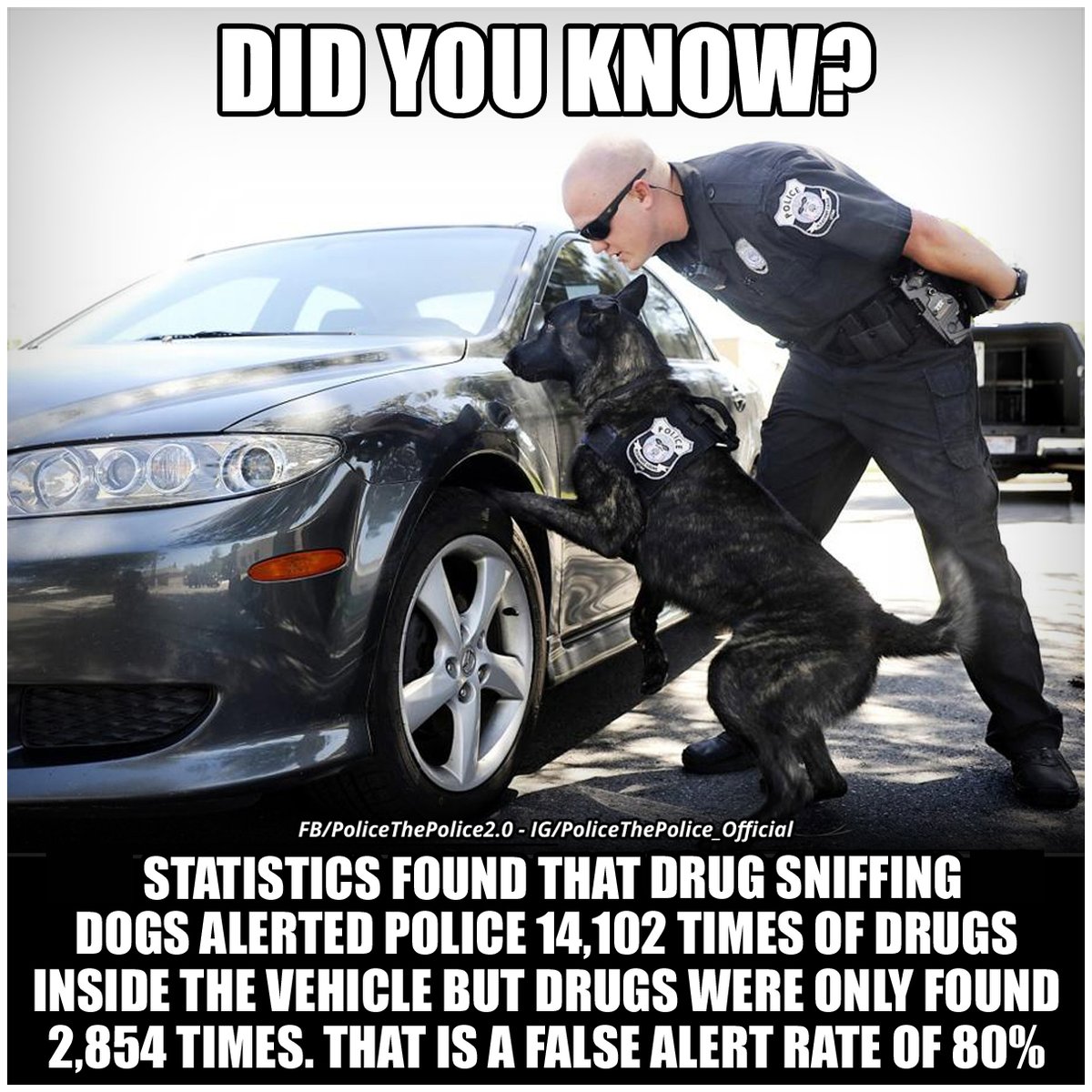
@Fatal6987 @PoliceThePolic1 @horsyguy The dogs probably COULD smell drugs. But they were indifferent to them. They responded instead to subtle human signals. Which means a fundamental failure in the way they were trained. Likely trainers knew where the drugs were and subtle behaviors gave it away.
English
0
0
0
15
Lonny Eachus
Lonny Eachus@eachus·
@Fatal6987 @PoliceThePolic1 @horsyguy In the only scientific study I know of, drug-sniffing dogs were found to be objectively useless for detecting drugs. Close to zero correlation with the presence of actual drugs. Instead, they found that the dogs were reacting to possibly unintentional cues from handlers. 1/
English
2
1
4
50
Police The Police 2.0
Police The Police 2.0@PoliceThePolic1·
Not to mention cues by the officer to alert false hits...
Police The Police 2.0 tweet media
English
67
376
1.3K
10.5K
Lonny Eachus retweetet
John Ʌ Konrad V
John Ʌ Konrad V@johnkonrad·
This is your monthly reminder that congress gave @PeteButtigieg $2 TRILLION to fix infrastructure and nobody knows where the money all went. That’s 135 nuclear aircraft carriers worth of cash. Poof.
Steve Ferguson@lsferguson

I suspect our entire almost 40 trillion dollar national debt is due to fraud. I actually suspect the amount stolen from us is way higher. We are being robbed blind and absolutely nothing is done about it

English
692
9K
28.8K
596.5K