Eric Halverson
1.6K posts

Eric Halverson
@elhalvers
Ruby/Rails Engineer | Interests: coding, chess, hiking, biking, paddling, birding, art, movies, writing 🙂
Portland, OR Beigetreten Ağustos 2009
2.2K Folgt1.1K Follower

I didn't realize until recently that we've done over 2M deployments with Hatchbox. 📈
Hatchbox.io@hatchboxio
We've been around since 2016. Which is an amazing thing to be able to say. Over 2 million deployments across 24,000+ apps. If you're building something you want to still be running in the years to come, deploy with a platform that will be too. Hatchbox.io
English

As sad as I am to leave Bangkok so soon, I’m v excited and ready for my next destination — a place that has always lived deep in my soul thanks to my grandma who raised me and told me stories about it.
Turns out, my life has ended up a lot like my grandma’s in so many ways. 😅
English
Some people may not be aware that I’ve been on a sort of personal ~journey~ since December.
I left SF and spent 2 months living in Portugal, trying to reconnect with myself.
Was back in SF for a bit and now I’ll be in Asia for a while. Today ends a week spent in Bangkok…

English
Pretty great deal! Pay what you want : ) <em>LLM Engineer's Handbook</em> & help charity! humblebundle.com/books/llm-and-… via @humble
English
This is a big world we’re in. I’m happy to want to play and be a part of the conversation! : )
Andrew Ng@AndrewYNg
Separate reports by the publicity firm Edelman and Pew Research show that Americans, and more broadly large parts of Europe and the western world, do not trust AI and are not excited about it. (Links in original text, below.) Despite the AI community’s optimism about the tremendous benefits AI will bring, we should take this seriously and not dismiss it. The public’s concerns about AI can be a significant drag on progress, and we can do a lot to address them. According to Edelman’s survey, in the U.S., 49% of people reject the growing use of AI, and 17% embrace it. In China, 10% reject it and 54% embrace it. Pew’s data also shows many other nations much more enthusiastic than the U.S. about AI adoption. Positive sentiment toward AI is a huge national advantage. On the other hand, widespread distrust of AI means: - Individuals will be slow to adopt it. For example, Edelman’s data shows that, in the U.S., those who rarely use AI cite Trust (70%) more than lack of Motivation and Access (55%) or Intimidation by the technology (12%) as an issue. - Valuable projects that need societal support will be stymied. For example, local protests in Indiana brought down Google’s plan to build a data center there. Hampering construction of data centers will hurt AI’s growth. Communities do have concerns about data centers beyond the general dislike of AI; I will address this in a later letter. - Populist anger against AI raises the risk that laws will be passed that hamper AI development. To be clear, all of us working in AI should look carefully at both the benefits and harmful effects of AI (such as deepfakes polluting social media and biased or inaccurate AI outputs misleading users), speak truthfully about both benefits and harms, and work to ameliorate problems even as we work to grow the benefits. But hype about AI’s danger has done real damage to trust in our field. Much of this hype has come from leading AI companies that aim to make their technology seem extraordinarily powerful by, say, comparing it to nuclear weapons. Unfortunately, a significant fraction of the public has taken this seriously and thinks AI could bring about the end of the world. The AI community has to stop self-inflicting these wounds and work to win back society’s trust. Where do we go from here? First, to win people’s trust, we have a lot of work ahead to make sure AI broadly benefits everyone. “Higher productivity” is often viewed by general audiences as a codeword for “my boss will make more money,” or worse, layoffs. As amazing as ChatGPT is, we still have a lot of work to do to build applications that make an even bigger positive impact on people’s lives. I believe providing training to people will be a key piece of the puzzle. DeepLearning.AI will continue to lead the charge on AI training, but we will need more than this. Second, we have to be genuinely worthy of trust. This means every one of us has to avoid hyping things up or fear mongering, despite the occasional temptation to do so for publicity or to lobby governments to pass laws that stymie competing products (such as open source). I hope our community can also call out journalism that spreads hype. For example, Nirit Weiss-Blatt wrote a remarkable article about how 60 Minutes’ coverage of an Anthropic study in which Claude, threatened with being shut down, resorted to “blackmail,” was highly misleading. The study carried out a red-teaming exercise in which skilled researchers, after a lot of determined work, finally pushed an AI system into a corner so it demonstrated “blackmailing” behavior. Unfortunately, news reports distorted this and led many to think the “blackmail” behavior occurred naturally rather than only because skilled researchers engineered it to happen. The reports left many with a wildly exaggerated picture of how often AI actually “schemes.” Red-teaming exercises are important to test vulnerabilities of systems, but this particular piece of hype, which was widely circulated, will hurt AI for a long time. Living in Silicon Valley, I realize I live in a bubble of AI enthusiasts, which is great for exchanging ideas and encouraging each other to build! At the same time, I recognize that AI does have problems, and the AI community needs to address them. I frequently speak with people from many different walks of life. I’ve spoken with artists concerned about AI devaluing their work, college seniors worried about the tough job market and whether AI is exacerbating their challenges, and parents worried about their kids being addicted to, and receiving harmful advice from, chatbots. I don’t know how to solve all of these problems, but I will work hard to solve as many as I can. And I hope you will too. It will only be through all of us doing this that we can win back society’s trust. [Original text, with links: deeplearning.ai/the-batch/issu… ]
English
@zicokolter Cool! Looking forward to working through the online material when available! : )
English

I'm teaching a new "Intro to Modern AI" course at CMU this Spring: modernaicourse.org. It's an early-undergrad course on how to build a chatbot from scratch (well, from PyTorch). The course name has bothered some people – "AI" usually means something much broader in academic contexts – but I think the time has come where the first thing that many students interested in AI should see is how the AI they are familiar with actually works (because it's really simple!) The more people who understand it the better.
I'll be trying to put as much material as I can that we develop online (assignments + autograding, hopefully lecture videos), though as a first-time course there are also likely to be some bumps along the way. Hopefully it becomes a good resource over time, though.
Feedback welcome.
English
Loving Andrew Ng’s courses! : )
Andrew Ng@AndrewYNg
DeepLearning.AI Pro is now generally available -- this is the one membership that keeps you at the forefront of AI. Please join! There has never been a moment when the distance between having an idea and building it has been smaller. Things that required months of work for teams can now be built by individuals using AI, in days. This is why we built DeepLearning.AI Pro. I'm personally working hard on this membership program to help you to build applications that can launch or accelerate your career, and shape the future of AI. DeepLearning.AI Pro gives you full access to 150+ programs, including my recently launched Agentic AI course, the new Post-Training and PyTorch courses by Sharon Zhou and Laurence Moroney (just released this week), and all of DeepLearning.AI's top courses and professional certificates. All course videos remain free. Pro membership adds hands-on learning: labs to build working systems, practice questions to hone your understanding, and certificates to share your skills. I'm also building new tools to help you create AI applications and grow your career (and have fun doing so!). Many will be available first to Pro members. Try out DeepLearning.AI Pro free, and let me know what you build! Join here: learn.deeplearning.ai/membership
English
Eric Halverson retweetet

Who needs a staff level rails developer for ongoing contract work?
Looking for 10-20hrs a week (nights and weekends). Prefer Hotwire/fullstack projects that are long term whether it’s a brand new project or staff aug on existing.
Expertise: fintech, security, hotwire, pairing.
English

hi, i'm giving my first conference talk in over two years at Rails World. it's just a lightning talk, but i'm very excited for it
hope to see you there
12:15pm on friday
#RailsWorld
English

🤔🚀 Comment your answers below! 👇
#python #programming #developer #programmer #coding #coder #softwaredeveloper #computerscience #webdev #webdeveloper #webdevelopment #pythonprogramming #pythonquiz #ai #ml #machinelearning #datascience

English
How I feel after someone accidentally cut the fiber line to our house this afternoon.
GIF
English

@TivadarDanka Anything for those who just want to learn maths but started bit late in life. Like 26-27 yr olds.
English

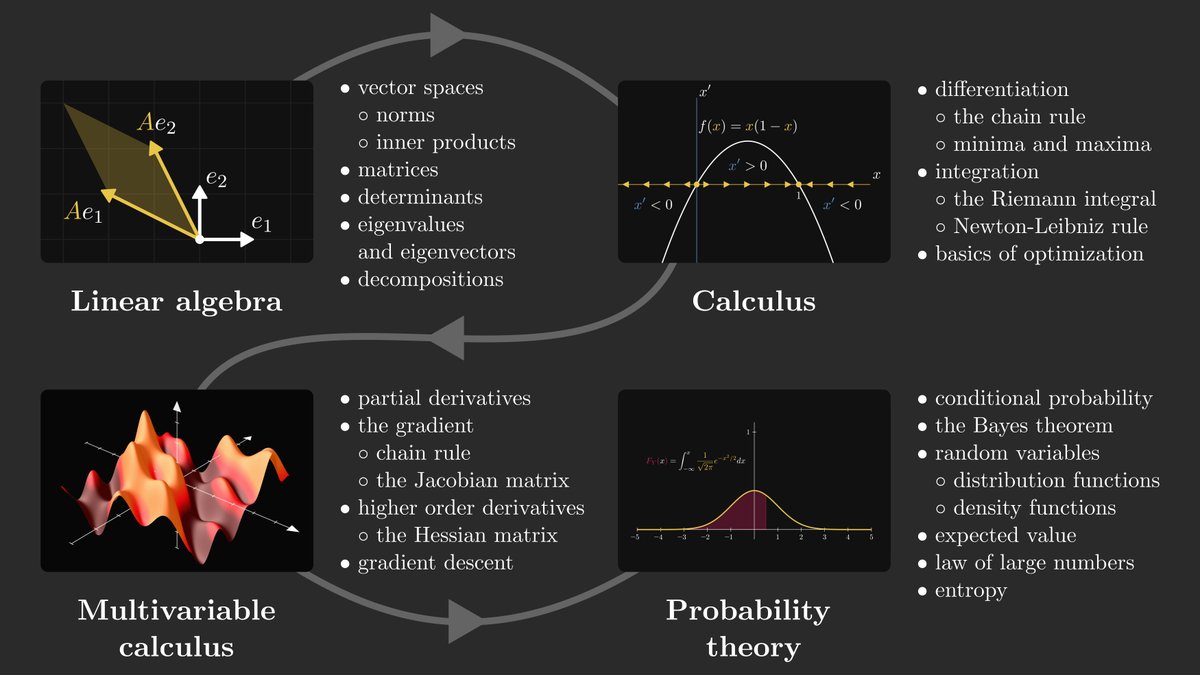
If I had to learn Math for Machine Learning from scratch, this is the roadmap I would follow:
English
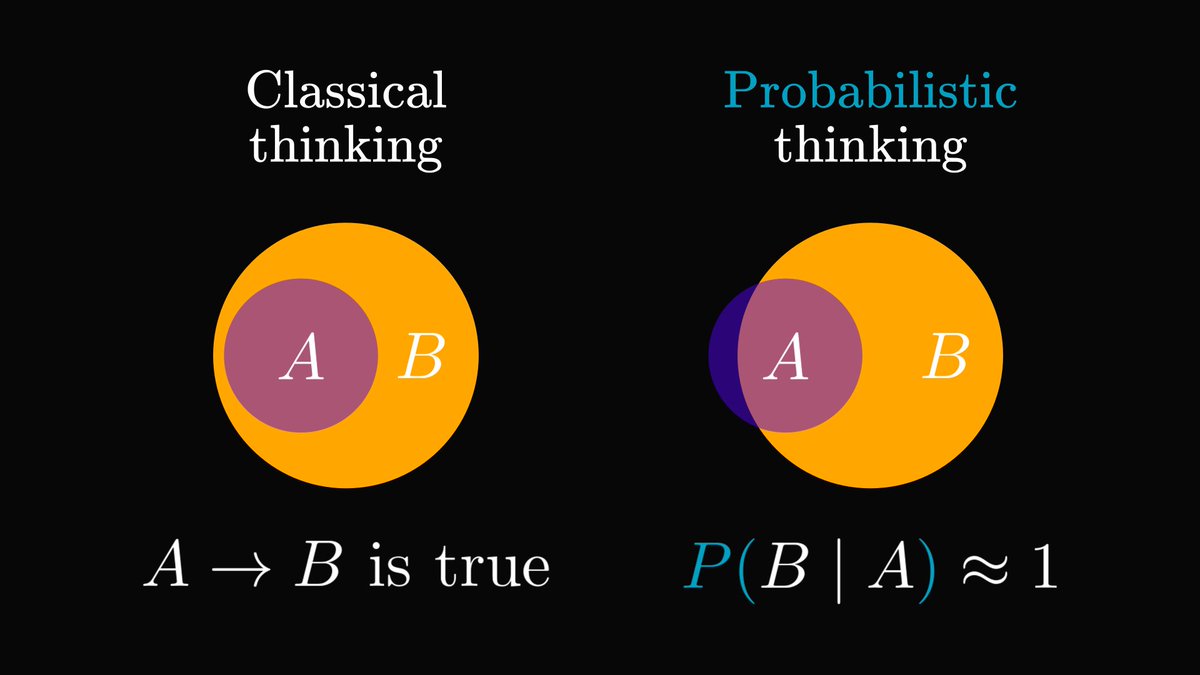
"Probability is the logic of science."
There is a deep truth behind this conventional wisdom: probability is the mathematical extension of logic, augmenting our reasoning toolkit with the concept of uncertainty.
In-depth exploration of probabilistic thinking incoming.
English

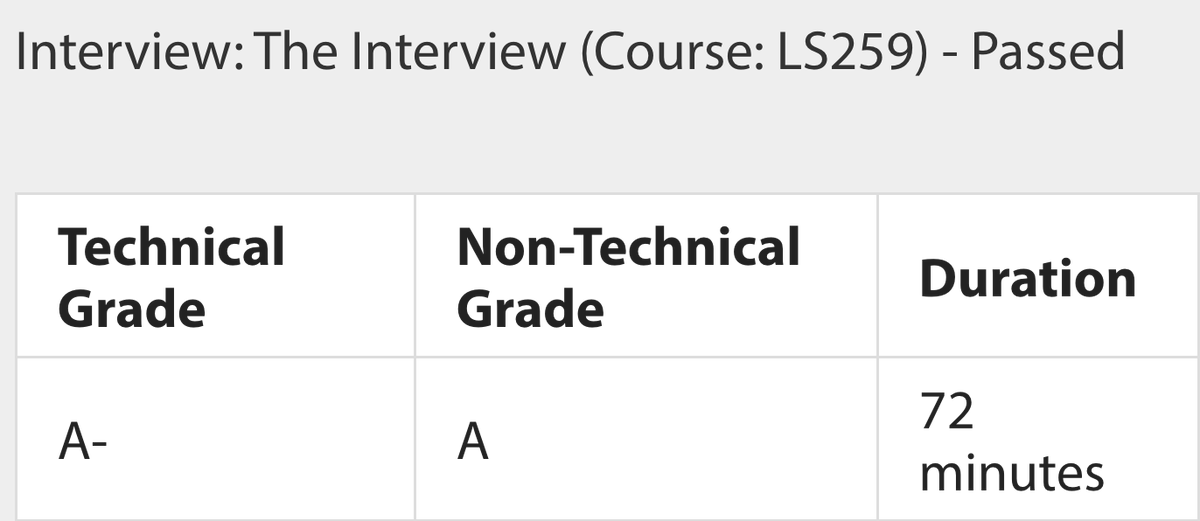
I PASSED!!
I passed the DSA interview exam at @launchschool 🎉🥳
This was by far the hardest course out of the entire Launch School curriculum and I was happy to get it done after spending so much time on studying DSA.
The interview went well, but I got some incredibly valuable feedback from the interviewer on areas I could improve on.
Here are some reflection on that feedback and my experience:
Hoping this helps others avoid some common interviewing mistakes 👇
1️⃣ Stay calm and don't panic
At one point I felt like I was running out of time (the time limit for solving the problem was 45 minutes), so I began to rush a bit and for a brief period started to hack 'n' slash a solution.
Turns out, I had waaay more time than I felt like I had.
I skipped some testing because of this slight stress and I could've mitigated an "off-by-1" error that lead to a less efficient solve time and got me into hacking 'n' slashing.
Panic leads to you not communicating as clear and working less logically.
Luckily, I didn't hack 'n' slash for long, which leads me to my next point (something I did well, but could've done better):
2️⃣ When in doubt, go back to the logic
Soon enough, I recognized this internal stress and decided to take a deep breath and go back to the logical part of the problem.
The problem isn't your coding skills, it's the logic.
I communicated that I needed to revisit the logic and did so.
Running through the pseudo-code algorithm I had written up, I caught the error in my logic, edited my algorithm and then implemented that change in code.
3️⃣ Test Frequently
It's tempting to not test when you think you don't have the time.
In reality, you have more time than you think AND the fact that you're staying in control of your code is a lot more valuable than solving a problem with the MOST efficient time.
When I got panicked about the time I skipped a few valuable tests I should've done while writing the code for my solution.
This lead to having to debug more and using up even more time.
There's more value in you being thorough and testing frequently for a few reasons:
- It demonstrates a calm demeanour when faced with a challenge
- It mitigates bugs that could use up even more time in solving the problem
- It shows that you're in control of the code you're writing
- It shows good due-diligence in your coding practice
-----
Other than these points, I did good on the rest of the problem. The solution passed all test cases, I wrote up the correct test cases, and my break down and inquiry towards the problem was good.
Super thankful to have passed this assessment!
Thanks to everyone who helped me study DSA and who encouraged me throughout, this was a hard course and I needed it! 😅
Also, shoutout to Zane (an LS student who's in the Capstone program right now) for frequently helping me prep for this assessment and taking the time to give me solid feedback and motivation.
Now I'm moving onto the Object Oriented JavaScript course at Launch School, getting me 1 step closer to my goal of becoming a Capstone grad 👊
🚀 DAYS 695 & 696 OF #1000DaysOfCode
⏰ 2.5 Hours
#DSA #100DaysOfCode #LearnInPublic
English


10 GitHub repos that will set you up for a career in AI engineering (100% free):
English

Best skills to build in 2025: AI & ML
Complete roadmap w/ all free resources:

English
Khan Academy is great! : ) donate.khanacademy.org/campaign/58066… donate.khanacademy.org/campaign/69385…
English
“Machine Learning using Python”
This 366 pages text book for engineering students is available FREE.

English