Evan Powell (🛡️, ☮️)

12.8K posts

Evan Powell (🛡️, ☮️) banner
Evan Powell (🛡️, ☮️)

Evan Powell (🛡️, ☮️)

@epowell101

Many time CEO of exited enterprise software companies. Friend to founders. AI hacker, Skidaway (stealth cyber)


San Mateo, CA Beigetreten Haziran 2008
2.9K Folgt7.2K Follower
Evan Powell (🛡️, ☮️) retweetet
Snowflake
Snowflake@Snowflake·
The AI era means threat actors are changing the rules to get past legacy security. 🚨 @DeepTempo_AI, a Snowflake Ventures portfolio company, flips the script. CEO @epowell101 shares how their deep learning platform runs right on the Snowflake AI Data Cloud, giving you a predictive defense. Watch the full convo here 👉🏻 bit.ly/48bBPbr
English
1
2
8
927
Evan Powell (🛡️, ☮️) retweetet
Joseph Sieczkowski
Joseph Sieczkowski@JoeSieczkowski·
By engaging with cutting-edge companies such as DeepTempo, we have earlier insight to solutions that address challenges and convey competitive advantages businesswire.com/news/home/2025…
English
0
1
0
167
Evan Powell (🛡️, ☮️) retweetet
Sean Kelly
Sean Kelly@seanpk·
This approach aligns with NVIDIA's innovative culture and Jensen Huang's hands-on leadership style:
Sean Kelly tweet media
English
11
113
1.8K
261.8K
Evan Powell (🛡️, ☮️) retweetet
Daniel Eth (yes, Eth is my actual last name)
Dario Amodei, CEO of Anthropic, calls out companies that claim they'll leave California if SB1047 passes, "That's just theater, that's just negotiating leverage, it bears no relationship to the actual content of the bill"
English
7
27
196
62.5K
Evan Powell (🛡️, ☮️) retweetet
Steve Hou
Steve Hou@stevehou·
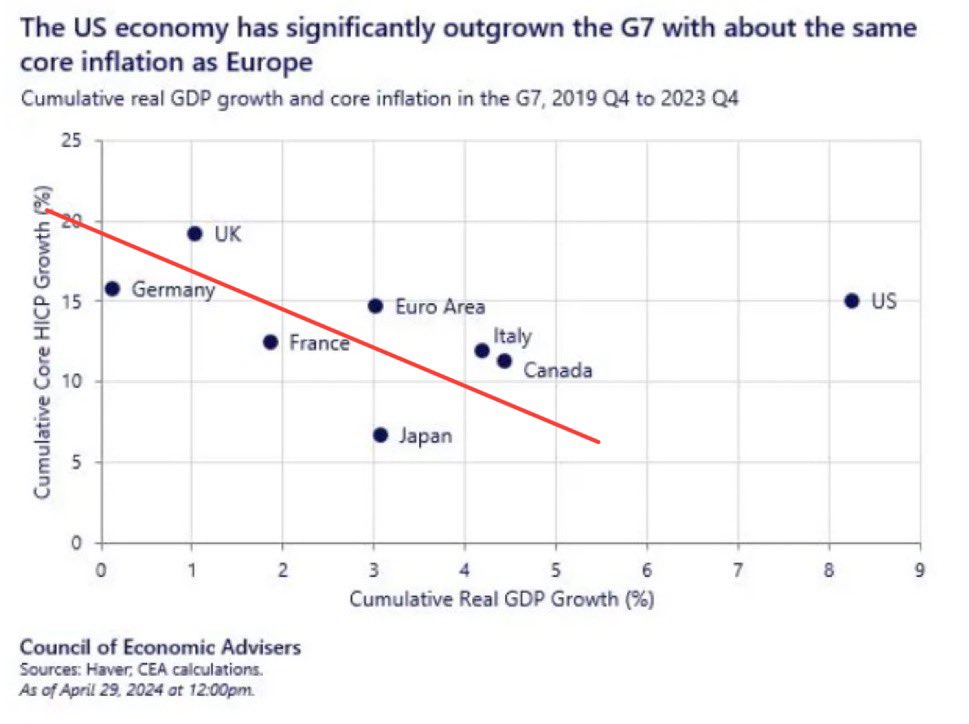
Thinking about this chart from @econjared46 this morning. The puzzle is why the US managed to grow so much more than other advanced economies despite having experienced similar amounts of total inflation (and not charted here similar amounts of fiscal deficits). The red line is mine and it wants to suggest a certain trade off btwn inflation and real GDP growth. Is this relationship real? And why has the US uniquely bucked the trend? What did the US do differently during the pandemic? And what sets the US apart in general that makes its economy react differently to the same shock? These are questions that I think economists should seek to answer in coming years from this whole episode. A few things that spring to my mind: 1) Aggregate supply elasticity: the U.S. has a relatively flexible economy in which firms and workers form and sever relationships relatively easily (certainly compared to other AEs). I think this is both cultural and enabled by economic institutions. During the pandemic, instead of preserving a lot of employment relationship, the U.S. provided direct cash infusion (generous UI) to allow new economic relationships, new business start ups to form as people individually find the best way to work and provide value in a post-pandemic economy where demand may have shifted. (“Teachers becoming truckers” etc.) General ease of setting up new businesses: relatively light regulatory burden to start a new business, finding physical space and buildings to begin output, hiring the right workers (informally). I think this just speaks to what I call an overall greater aggregate supply elasticity of the US economy. That given additional demand it’s able to autonomously adjust and increase supply to meet the demand. In a nutshell this is a reflection of the US being more of a “free market economy”. 2) Demographics, immigration and energy independence I think these are the other major related factors. To the extent that the US economy is institutionally and culturally flexible to respond to shocks (COVID supply disruption and fiscal stimulus driven income demand shocks) using existing resources, I think the country’s ability to find new production input is also important. We seem to keep finding a lot more new workers to enter the workforce (prime age workforce rate keeps rising). I’m sure all the (illegal) immigration probably added to the workforce and available labor as well. Finally, the US has cheap and abundant energy resources to enable the scaling up of output. 3) Innovation There is no doubt that the US is very innovative judging by the sheer amount of innovation that has occurred. But I also tend to believe that people in many other countries are very innovative as well. I think innovation as a contributing factor is better enabled in the US given the two points above and the size of the US market and financial markets to deploy an innovative idea. 4) “the dollar” I’ve seen many mention the unique status of the USD as a global reserve currency. The idea is loosely that the US can uniquely “print” wealth and command the RoW to work for it or something. But the truth is the US still did produce (and consumed) a lot more, most of which domestic, as the US it’s mostly a large closed economy that trades a lot within itself. I think the “dollar” mattered insofar as it reflects the dominance of US financial sector and its ability to financing economic projects, cheaply. It helps US businesses to be closer to the “dollar” system, which is also the technology undergirding the global financial system. The entire globe’s financial capital funnels through the US financial system/the dollar. I don’t know how much this last factor matters. I suspect it’s second order but could be convex esp when added together across all the individual instances.
Steve Hou tweet media
English
41
19
127
58.1K
Evan Powell (🛡️, ☮️) retweetet
Vinod Khosla
Vinod Khosla@vkhosla·
I am awe struck at the rate of progress of AI on all fronts. Today's expectations of capability a year from now will look silly and yet most businesses have no clue what is about to hit them in the next ten years when most rules of engagement will change. It's time to rethink/transform every business in the next decade. Read "situational-awareness.ai" by @leopoldasch. I buy his assertion only a few hundred people know what is happening.
Vinod Khosla tweet media
English
136
541
3.5K
1.5M
Evan Powell (🛡️, ☮️) retweetet
ZachXBT
ZachXBT@zachxbt·
1/ Recently a team reached out to me for assistance after $1.3M was stolen from the treasury after malicious code had been pushed. Unbeknownst to the team they had hired multiple DPRK IT workers as devs who were using fake identities. I then uncovered 25+ crypto projects with related devs that have been active since June 2024.
ZachXBT tweet mediaZachXBT tweet media
English
635
1.8K
10.6K
2.6M
Evan Powell (🛡️, ☮️)
Evan Powell (🛡️, ☮️)@epowell101·
Today was my far better half’s birthday She is everything to me Passionate Sharp Caring Deeply technical A great Mom Organizer, coach, leader Inspiring me to do better And to try to be a better person 🎂❤️😘
English
0
0
2
123
Evan Powell (🛡️, ☮️)
Evan Powell (🛡️, ☮️)@epowell101·
Nice blast from the past; we put on the first one afaik 15 years ago; still a trend
theCUBE@theCUBE

It’s happening today! #theCUBE will soon be live for @Supermicro_SMCI's #OpenStorageSummit 📺 thecube.net/events/supermi… Our analysts are in-studio with industry insiders to discuss the latest in enterprise AI, what it means for the future cloud platforms, and the crucial role of modern computing infrastructure. 📣 Tune in today, starting at 10:00 a.m. PT, for the inaugural session, “Enabling AI Data Pipelines: Optimized Storage for AI.” We’ll hear from William Li, director of solution management at Supermicro; Rob Davis, VP of storage technology at @nvidia; Steve Hanna, head of product management for High Capacity NVMe SSDs at @MicronTech; @shimonbd, CTO at @WekaIO and Jon Toor, CMO at @CloudianStorage. 👉 Don't miss our exclusive coverage, and join the conversations! thecube.net/events/supermi… #EnterpriseTechNews #CloudComputing #StorageSolutions #AIinfra #LiveAnalysis


English
0
0
1
467
Evan Powell (🛡️, ☮️) retweetet
Santiago
Santiago@svpino·
The single most undervalued fact of linear algebra: Matrices are graphs, and graphs are matrices. Encoding matrices as graphs is a cheat code, making complex behavior simple to study. Let me show you how!
Santiago tweet media
English
144
1.6K
13K
1.7M