Matheus Ferraz

16.4K posts

Matheus Ferraz banner
Matheus Ferraz

Matheus Ferraz

@eumathius

Computational protein design and AI @nec 🇳🇴 🇩🇪 From Brazil; based in Germany, but sometimes in Norway.

Mannheim, Germany Beigetreten Ocak 2015
1.2K Folgt572 Follower
Angehefteter Tweet
Matheus Ferraz
Matheus Ferraz@eumathius·
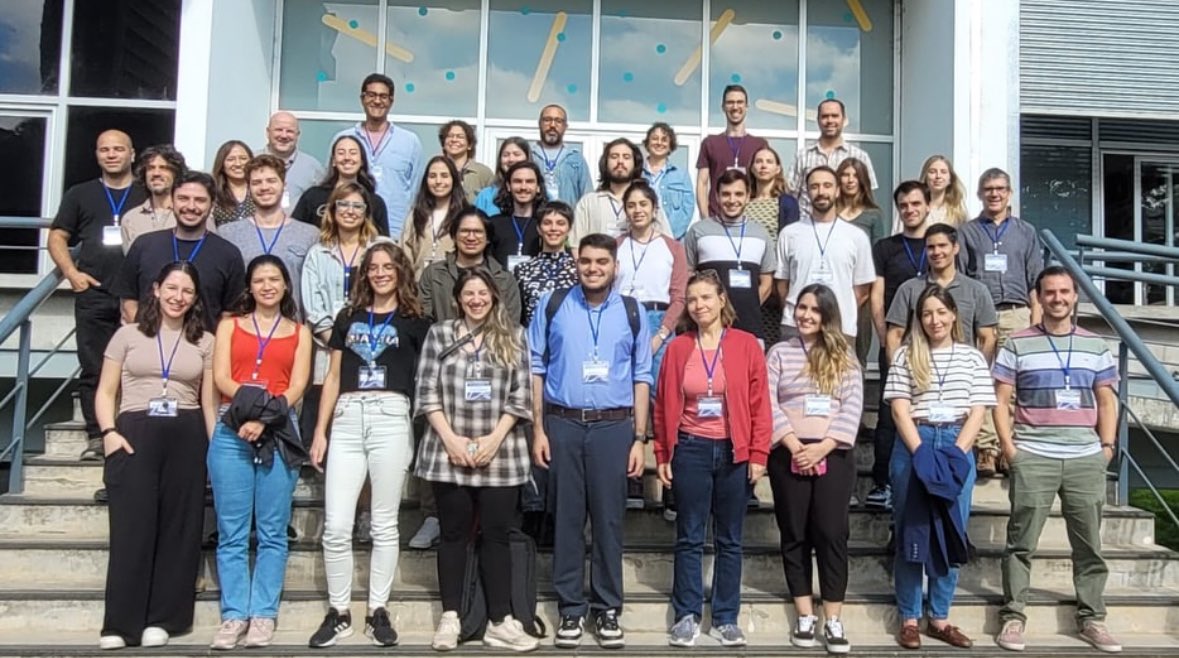
Had a lot of fun lecturing on AI-based protein structure prediction at the STRUCTURAL BIOLOGY 2.0 workshop at the institute Pasteur Montevideo. It was great connecting with so many talented experimental and comp structural biologists @red_cebem @IUCr @ICGEB @IPMontevideo 🇺🇾
Matheus Ferraz tweet media
English
1
1
8
848
Matheus Ferraz retweetet
Christian Seitz
Christian Seitz@chem_christian·
Hello everyone, I am looking for my next role in the computational chemistry/biophysics space 🛫 I have 12 years of experience in protein simulations/SBDD, looking for national lab/industry positions anywhere in the world. Any connections/leads welcomed - thanks in advance! 🙏🏻
English
0
2
4
212
Matheus Ferraz retweetet
JNS
JNS@_devJNS·
developers mfs removing the "🚀💥❌✅🔥—" from their code before submitting the pr..
JNS tweet media
English
138
659
12.9K
260.7K
Matheus Ferraz retweetet
Samrat Mukhopadhyay
Samrat Mukhopadhyay@SamratLabMohali·
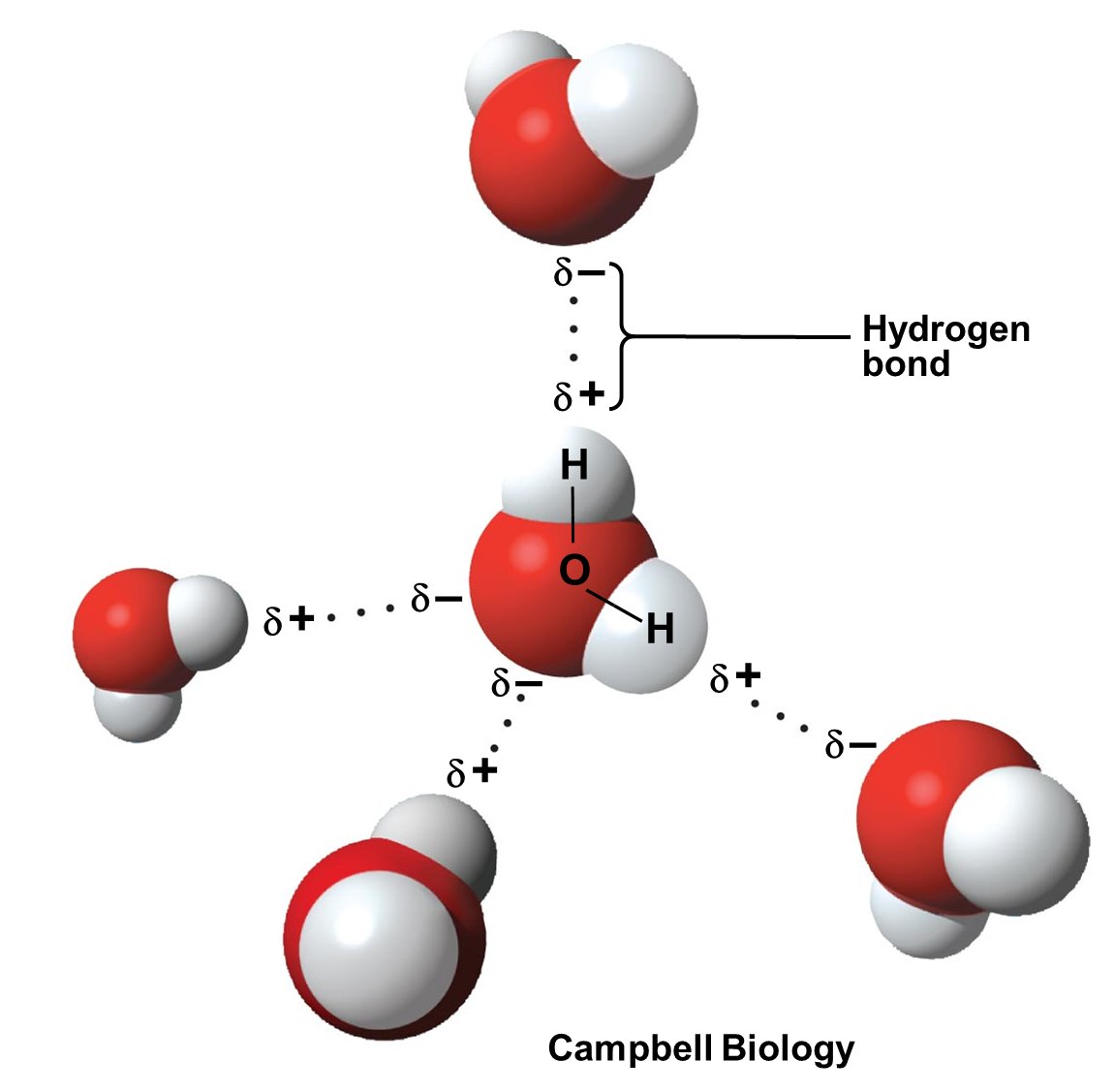
1/ In my BIO101 class, I taught water, the solvent of life, unusual properties of which arise due to hydrogen bonding between deceptively simple water molecules. Our existence is inseparably bound up with hydrogen bonding. Want to know the history of H-bonding? Read the thread.👇
Samrat Mukhopadhyay tweet media
English
6
35
203
17.3K
Matheus Ferraz
Matheus Ferraz@eumathius·
@ViktorZaverkin @TimothyDuignan @XirtamEsrevni For ML potentials, I guess that the equivalent step could be to develop systematic pathways, which is not so clear yet, that connect training-set errors to simulation outcomes so that we can learn systematically why and when they work
English
1
0
4
87
Matheus Ferraz
Matheus Ferraz@eumathius·
@ViktorZaverkin @TimothyDuignan @XirtamEsrevni That's an interesting discussion. Thanks for having brought this up. Classical FFs indeed advanced by “take and run” strategies, but I feel like what made them stick were the heuristics that  became community standards. +
English
1
0
3
93
Matheus Ferraz retweetet
Biology+AI Daily
Biology+AI Daily@BiologyAIDaily·
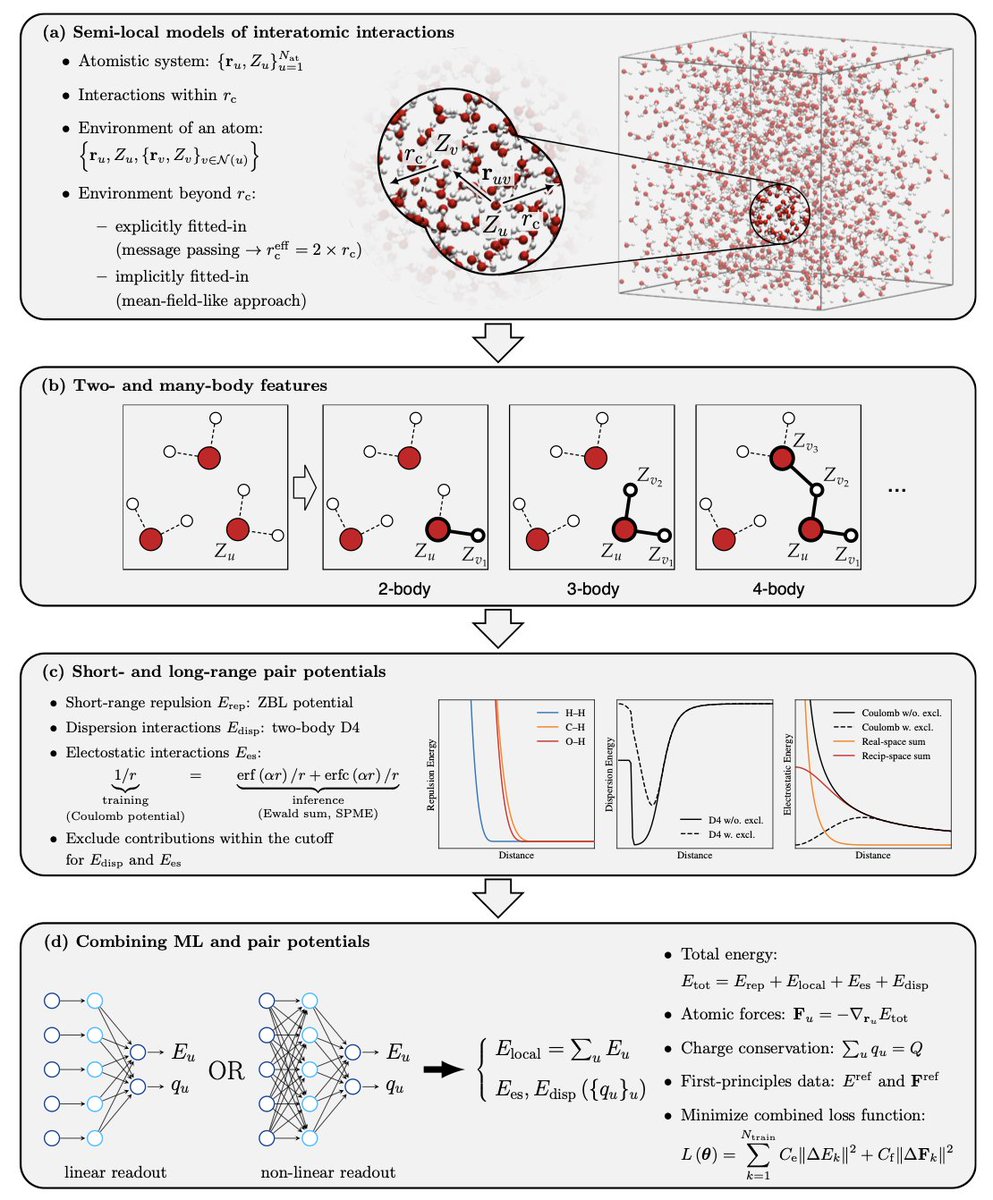
Performance of universal machine-learned potentials with explicit long-range interactions in biomolecular simulations 1. This study systematically evaluates the performance of machine-learned (ML) potentials in biomolecular simulations, focusing on their accuracy and applicability compared to traditional classical force fields (FFs). The research highlights the potential of ML potentials to offer accuracy comparable to first-principles methods at a lower computational cost, but also identifies challenges in their generalization to biomolecular systems. 2. The study uses equivariant message-passing architectures trained on the SPICE-v2 dataset, with and without explicit long-range dispersion and electrostatics. It assesses the impact of model size, training data composition, and electrostatic treatment on both benchmark datasets and molecular simulations of various biomolecules, including alanine tripeptide, Trp-cage, and Crambin. 3. Key findings include the observation that larger models improve accuracy on benchmark datasets but do not consistently extend this trend to properties obtained from simulations. The composition of the training dataset significantly influences predicted properties, and the inclusion of explicit long-range electrostatics does not systematically improve accuracy across all systems. 4. For Trp-cage, the inclusion of explicit long-range interactions yields increased conformational variability, suggesting that these interactions may be important for capturing the full conformational landscape of certain biomolecules. However, the study also highlights the challenges of imbalanced datasets and immature evaluation practices in the current application of universal ML potentials to biomolecular simulations. 5. The study concludes that while ML potentials show promise, there is a need for more balanced and comprehensive training datasets, as well as improved evaluation methods, to enhance their reliability and applicability in realistic biomolecular settings. The results suggest that smaller models may be more efficient for certain applications, and that further research is needed to optimize their accuracy. 📜Paper: arxiv.org/abs/2508.10841… #MachineLearning #BiomolecularSimulations #MLPotentials #ComputationalBiology
Biology+AI Daily tweet media
English
0
5
10
1K
Matheus Ferraz retweetet
Viktor Zaverkin
Viktor Zaverkin@ViktorZaverkin·
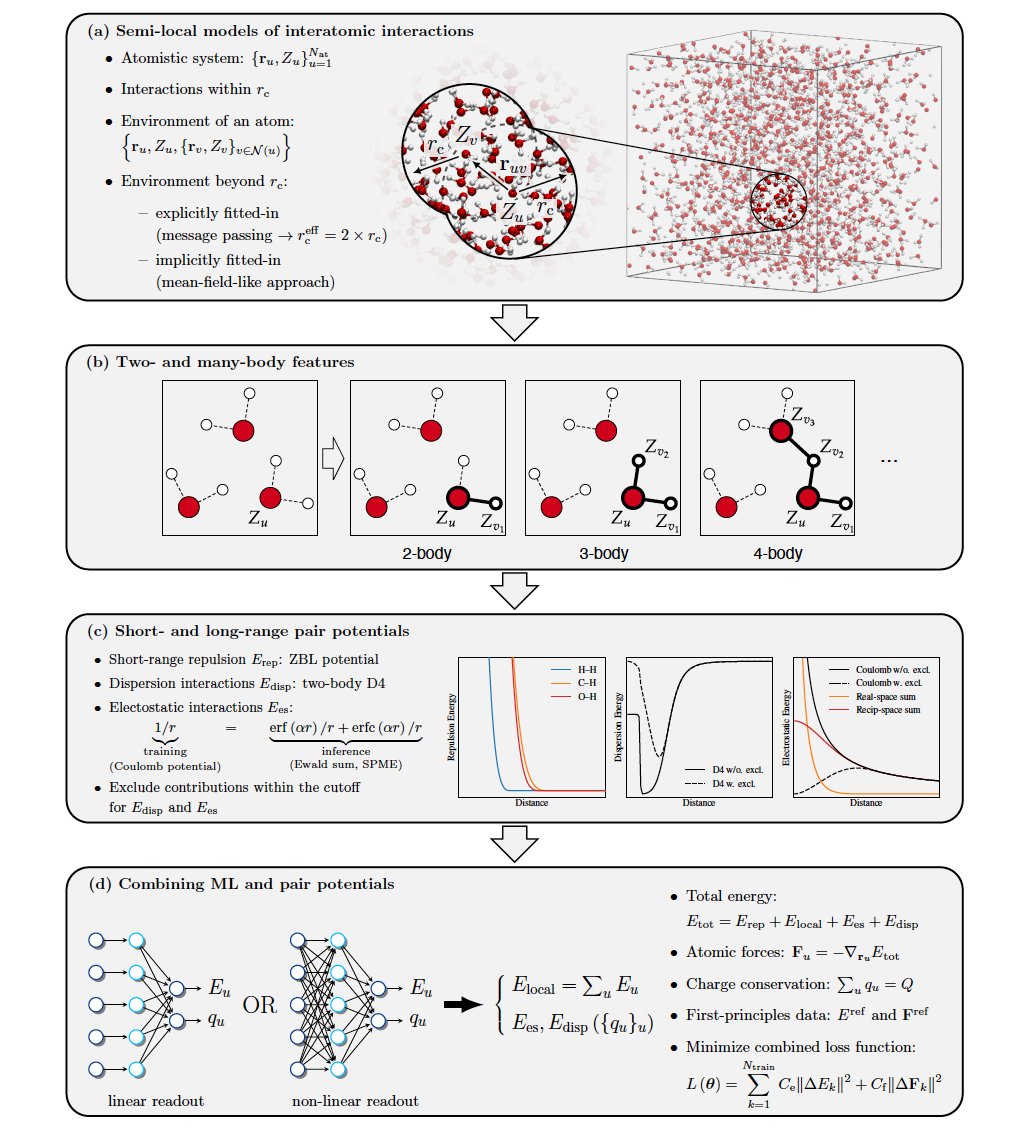
🚨 New preprint: How well do universal ML potentials perform in biomolecular simulations under realistic conditions? There's growing excitement around ML potentials trained on large datasets. But do they deliver in simulations of biomolecular systems? It’s not so clear. 🧵 1/
Viktor Zaverkin tweet media
English
2
13
90
8.5K
Matheus Ferraz retweetet
Gang Liu
Gang Liu@gliu0329·
Introducing🔥torch-molecule🔥: A single line of code for molecular property prediction, generation & representation learning: > 30 deep learning methods + models, sklearn-style. All available at: `pip install torch-molecule` Code: github.com/liugangcode/to…
Gang Liu tweet media
English
5
47
297
19.8K
Matheus Ferraz retweetet
Biology+AI Daily
Biology+AI Daily@BiologyAIDaily·
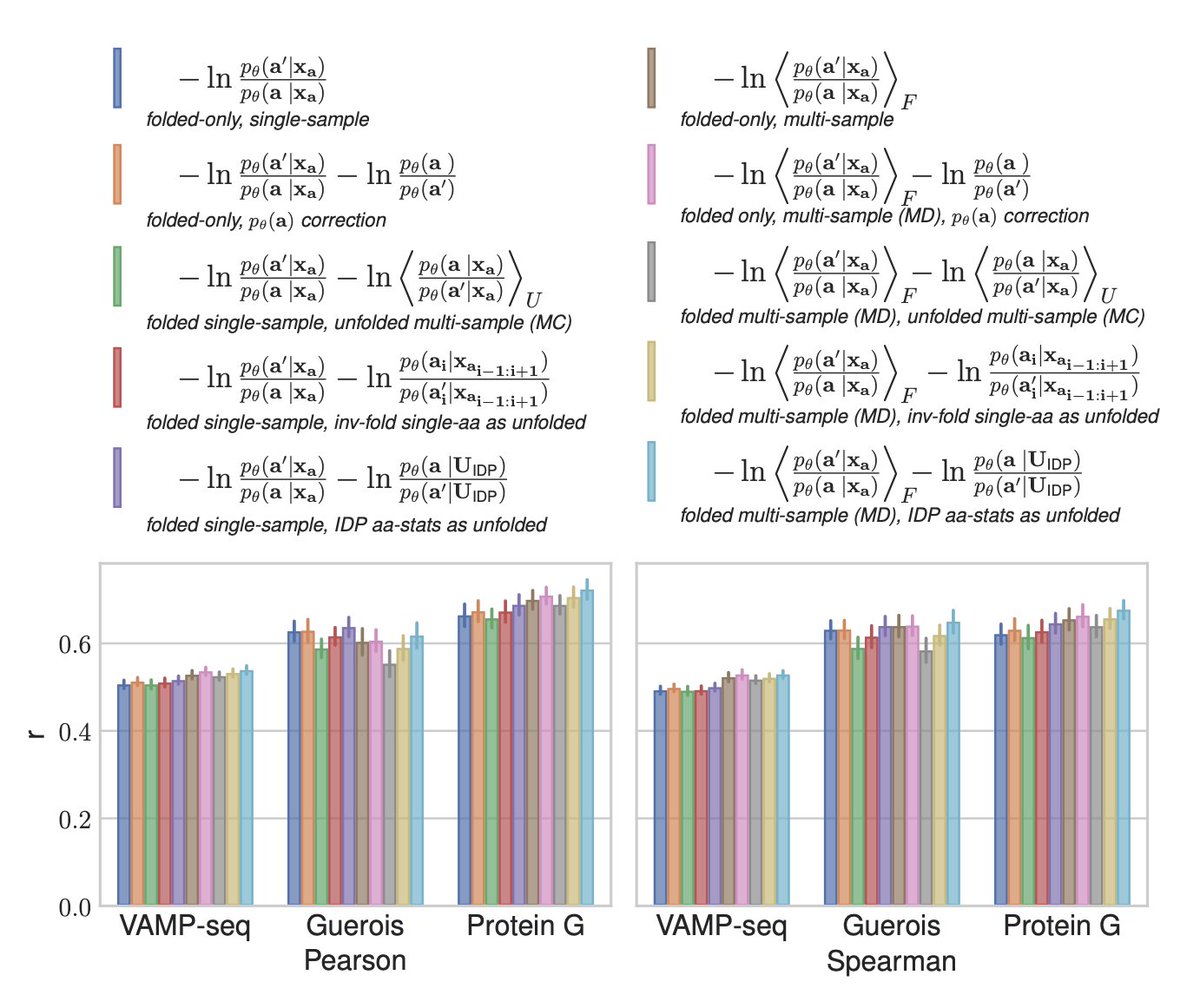
Zero-shot protein stability prediction by inverse folding models: a free energy interpretation 1.The paper establishes a formal theoretical link between inverse folding model likelihoods and protein thermodynamic stability, explaining why inverse folding models can predict stability changes in a zero-shot manner. 2.It derives that the common practice of using log-ratio likelihood scores to estimate stability changes corresponds to a simplified single-sample Monte Carlo approximation of a free energy difference between folded and unfolded states. 3.The authors introduce improved estimation methods that consider better approximations of structural ensembles for folded and unfolded protein states, enabling more accurate zero-shot stability predictions. 4.They show the unfolded state can often be approximated by simple amino acid frequency statistics derived from intrinsically disordered proteins, which surprisingly improves performance over more complex unfolded-state modeling. 5.The study demonstrates that using multiple structural samples from molecular dynamics simulations for the folded state ensemble further enhances prediction accuracy compared to single structure approaches. 6.A hybrid framework combining sequence-based models for unfolded states and structure-based inverse folding models for folded states is proposed, providing practical flexibility and better estimates of stability changes. 7.Empirical evaluation on multiple datasets including Protein G, Guerois, and VAMP-seq confirms that these refined approaches outperform the standard log-odds baseline, especially when including the unfolded state contribution and ensemble averaging. 8.The work also clarifies that ranking protein variants by these inverse folding model-based metrics preserves correct stability orderings, justifying the strong correlation with experimental stability data despite simplified assumptions. 9.While focused on protein stability, the theoretical framework generalizes to other applications such as binding affinity prediction, indicating broad utility for inverse folding and generative protein models. 10.The paper contributes to the interpretability of machine learning models in protein science by grounding inverse folding predictions in physical free energy concepts, helping bridge AI and biophysics. 📜Paper: arxiv.org/abs/2506.05596… #ProteinStability #InverseFolding #FreeEnergy #MachineLearning #ProteinDesign #ComputationalBiology #ZeroShotPrediction #StructuralBiology
Biology+AI Daily tweet media
English
2
11
74
9.7K
Matheus Ferraz retweetet
Biology+AI Daily
Biology+AI Daily@BiologyAIDaily·
Computational nanobody design using graph neural networks and Metropolis Monte Carlo sampling 1.This study presents a novel computational framework integrating graph neural networks (GNNs) with Metropolis Monte Carlo sampling for the design of nanobodies with enhanced binding affinity. 2.A key innovation is the AiPPA model, a GNN that predicts protein-protein binding free energy (BFE) without requiring the complex structure of the protein pair, achieving a Pearson correlation of 0.62 on the Kastritis benchmark. 3.AiPPA models two proteins as separate graphs and learns their interaction features to estimate BFE, bypassing the need for costly and often inaccurate protein complex structure prediction. 4.The method uses Monte Carlo Metropolis sampling to stochastically explore sequence variants within the complementarity-determining regions (CDRs) of a template nanobody, guided by AiPPA’s BFE predictions to find low-energy, high-affinity candidates. 5.In silico designed variants focus on the CDR loops with length and amino acid distributions constrained by natural nanobody sequence statistics, improving biological plausibility and expression solubility. 6.The approach was applied to design nanobodies targeting TL1A, a cytokine involved in autoimmune diseases; experimental validation confirmed two designed nanobodies bind TL1A with dissociation constants near 2.0 µM. 7.Designed nanobodies also showed slightly improved thermal stability compared to the template, indicating affinity maturation did not compromise protein robustness. 8.Structural analysis revealed hydrogen bonding and hydrophobic interactions, especially involving the CDR3 loops, as the main contributors to the enhanced binding affinities. 9.This physics-informed deep learning framework allows for large-scale exploration of nanobody sequence space, including length variations in CDR loops, enabling broader design possibilities than traditional point mutation methods. 10.The method addresses major challenges in antibody design by removing the bottleneck of complex structure prediction and enabling efficient, scalable computational affinity maturation. 11.While AiPPA’s prediction accuracy could improve with larger high-quality affinity datasets, it already outperforms several existing models, especially on flexible protein complexes. 12.This study establishes a new strategy for computational protein therapeutic development, with potential extensions to traditional antibodies and other protein types beyond nanobodies. 💻Code: github.com/hfqian/AiPPA-M… 📜Paper: biorxiv.org/content/10.110… #NanobodyDesign #GraphNeuralNetworks #ProteinTherapeutics #ComputationalBiology #DeepLearning #MetropolisSampling
Biology+AI Daily tweet media
English
0
13
85
3.9K