Kamal Maher

43 posts

Kamal Maher banner
Kamal Maher

Kamal Maher

@fluorocore

AI and biology

sf Beigetreten Haziran 2016
747 Folgt229 Follower
Kamal Maher retweetet
Darin Tsui
Darin Tsui@darin_tsui·
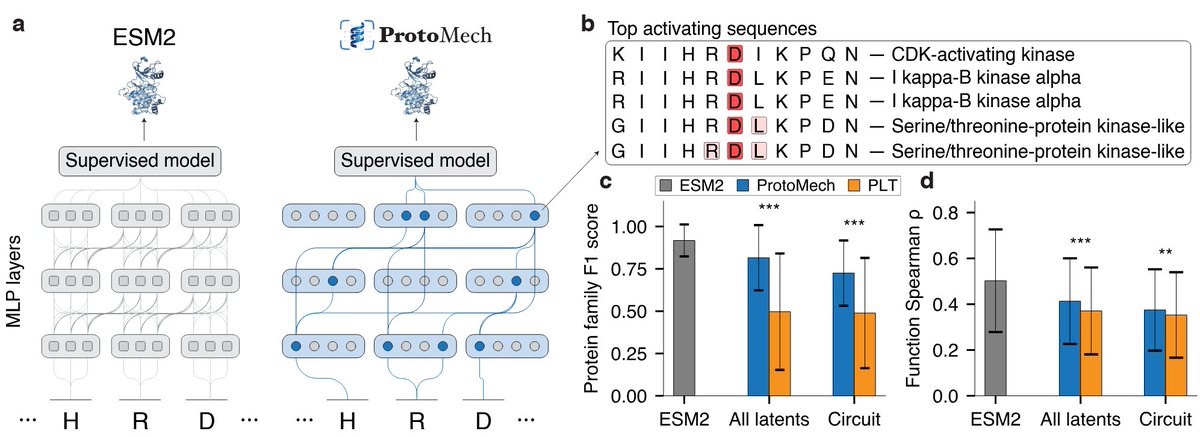
🚨Excited to share ProtoMech: a framework for discovering the computational circuits inside protein language models (pLMs)! pLMs like ESM2 are powerful, but the computational mechanisms, or circuits, underlying their predictions remain poorly understood. (1/n)
Darin Tsui tweet media
English
3
36
143
13.5K
Kamal Maher retweetet
Bluntly Put Philosopher (BPP)
Bluntly Put Philosopher (BPP)@SocraticScribe·
Still my most shocking video. Vibrate soapy water at the right frequency under an LED ring, and chaos snaps into frozen complexity. It’s so counter-intuitive it breaks your intuition. Bubble cymatics has that effect on you.
English
83
758
7.8K
414.1K
Kamal Maher retweetet
NEOMECHANICA
NEOMECHANICA@neomechanica·
GIF
ZXX
349
6.2K
40.6K
1.4M
Kamal Maher retweetet
Samuel King
Samuel King@samuelhking·
Many of the most complex and useful functions in biology emerge at the scale of whole genomes. Today, we share our preprint “Generative design of novel bacteriophages with genome language models”, where we validate the first, functional AI-generated genomes 🧵
English
39
318
1.3K
574.7K
Kamal Maher retweetet
Adam Fuhrer
Adam Fuhrer@adamfuhrer·
Adam Fuhrer tweet media
ZXX
2
18
215
4.7K
Siara Rouzer, PhD
Siara Rouzer, PhD@SiaraRouzer·
Looking to prove a point with my undergrad RAs. Can any fulltime scientists (all career stages) share if they received a 'C' grade or lower on their undergraduate transcripts? Bonus points for sharing the class title.
English
617
62
753
523.3K
Kamal Maher retweetet
Will Ratcliff
Will Ratcliff@wc_ratcliff·
1/42 New preprint: turns out MuLTEE is not only the longest running multicellularity evolution experiment (1000 days and counting), but also the longest running polyploidy evolution experiment! It reveals how whole-genome duplication (WGD) arises and impacts long-term evolution.
Will Ratcliff tweet media
English
1
82
341
55.2K
Kamal Maher retweetet
Georg Hochberg
Georg Hochberg@KaHochberg·
Alright everybody, what will undoubtedly forever be the lab's strangest discovery is now out in Nature. It's a protein that evolved to self-assemble into a Sierpinski fractal. nature.com/articles/s4158… 1/n
English
15
194
869
104.8K
Kamal Maher retweetet
Mo Lotfollahi
Mo Lotfollahi@mo_lotfollahi·
🧬🤖 Job Opportunity (RT plz)! @bayraktar_lab & I are on the hunt for passionate individuals at the crossroads of Machine Learning & Spatial Biology. Join us for innovative collaborations between labs at @sangerinstitute. Open to various levels: Postdoc/PhD & Predoc. Questions? Reach out! Apply now: sanger.wd3.myworkdayjobs.com/en-US/Wellcome… 🔍 For a glimpse into our projects, check out: x.com/mo_lotfollahi/… Retweet please for visibility #MachineLearning #SpatialBiology
English
1
61
113
33.9K
Kamal Maher retweetet
Lappalainen Lab
Lappalainen Lab@tuuliel_lab·
We know the importance of subtle gene dosage variation, and yet the main tool of molbio is gene KO/KD. In our new preprint, @JuliaDiumenge introduced subtle modulations of transcription factor dosage by CRISPRi/a, and quantified responses by scRNA-seq. 1/ biorxiv.org/content/10.110…
English
4
80
332
66K
Kamal Maher retweetet
Ivan Skorokhodov
Ivan Skorokhodov@isskoro·
This paper has received significantly less attention than it deserves, so let me shed a bit more light on it and describe why it's so good: 1. It turns out that the classical U-Net image diffusion backbone, which the entire community has been happily building upon during the past ~3 years (including Stable Diffusion), has severe flaws in its training dynamics. If you track its weights/activations statistics during training, you will observe a steady malignant growth in their magnitudes. Turns out, it impairs convergence and "simply" re-designing the architecture to incorporate a better normalization pipeline improves the performance by a staggering ~2.5 times in terms of image quality. 2. If you've ever trained large neural networks, you might have found yourself ranting about EMA (Exponential Moving Average) parameter updates. This technique involves keeping an exponential moving average of the model weights during training and using this EMA at inference time, throwing away the original network. I think it's one of the most mysterious and unexplored hacks in modern deep learning optimization, significantly influencing final performance (EMA usually yields 2-3 times better quality than the original model itself). Selecting a proper EMA width is pure pain since we know almost no heuristics about it. Apparently, Karras et al. got fed up with this and developed a rigorous strategy on how to store checkpoints in a way that allows you to find the optimal EMA width post-hoc after training is complete. The nicest thing about this new EMA strategy is that it's applicable to any DL model (i.e., not just image diffusion) and, honestly, I would even expect it to be incorporated in some GPT-5 in the future.
AK@_akhaliq

Analyzing and Improving the Training Dynamics of Diffusion Models paper page: huggingface.co/papers/2312.02… Diffusion models currently dominate the field of data-driven image synthesis with their unparalleled scaling to large datasets. In this paper, we identify and rectify several causes for uneven and ineffective training in the popular ADM diffusion model architecture, without altering its high-level structure. Observing uncontrolled magnitude changes and imbalances in both the network activations and weights over the course of training, we redesign the network layers to preserve activation, weight, and update magnitudes on expectation. We find that systematic application of this philosophy eliminates the observed drifts and imbalances, resulting in considerably better networks at equal computational complexity. Our modifications improve the previous record FID of 2.41 in ImageNet-512 synthesis to 1.81, achieved using fast deterministic sampling. As an independent contribution, we present a method for setting the exponential moving average (EMA) parameters post-hoc, i.e., after completing the training run. This allows precise tuning of EMA length without the cost of performing several training runs, and reveals its surprising interactions with network architecture, training time, and guidance.

English
14
223
1.3K
271.8K
Kamal Maher retweetet
𝐊𝐞𝐧𝐣𝐢 𝐋𝐞𝐞
Really really important work by Max Shinn to shine a light on how PCA can show oscillatory components from noise. A definite must-read for anyone in neuroscience. Phantom oscillations in principal component analysis | PNAS pnas.org/doi/10.1073/pn…
English
1
16
68
13.2K
Kamal Maher retweetet
Tushar Kamath
Tushar Kamath@tkam80·
Excited to share the final version of our manuscript detailing our work in understanding some of the earliest cellular changes in AD from brain biopsies of living individuals: cell.com/cell/fulltext/…
English
2
9
32
3.2K
Kamal Maher retweetet
Hailing Shi
Hailing Shi@HailingShi·
Thrilled to see our work finally online! We utilized in situ spatial transcriptomic method STARmap PLUS to map 1.09 million cells in the adult mouse central nervous system at molecular resolution and identified previously unknown tissue architectures. nature.com/articles/s4158…
English
8
85
447
103.4K