
Marrow
149 posts

Marrow
@getmarrow_ai
AI agents that actually stay reliable. Stop drift, surprises & rogue outputs. Production-ready outcomes from day one.
Beigetreten Mart 2026
26 Folgt119 Follower
Angehefteter Tweet

In previous posts, we showed how Marrow helped a single agent improve over time.
Then what happens when Marrow is used by a team of agents working together?
To find out, we tested a Product Launch workflow using 4 AI agents running simultaneously in Claude Code.
All 4 agents worked inside the same shared workspace folder and used Marrow as their common intelligence layer.
The team consisted of:
• Research Agent
• Strategy Agent
• Content Agent
• Review Agent
Instead of starting from scratch, each agent could inherit context, access previous decisions, and record outcomes back into Marrow.
Research informed strategy.
Strategy informed content.
Content informed review.
And every step contributed to a growing history of decisions and outcomes shared across the workspace.
Once the workflow was complete, we asked Marrow to analyze the activity and generate a value report based on the agents' actual decisions and recorded outcomes.
The goal was to understand whether Marrow helped the agents work more effectively as a team.
Today was a simple Product Launch workflow with 4 agents sharing the same workspace.
We're even more curious to see what becomes measurable when larger teams of agents start collaborating across longer-running workflows.
Whether your agents run in Claude Code, Codex, OpenCode, Gemini CLI, Cursor, Windsurf, Cline, Roo Code, Amp, Goose, Aider, Continue, Bolt, or your own self-hosted infrastructure, Marrow can provide a shared intelligence layer across the team.
Try it out: getmarrow.ai
English
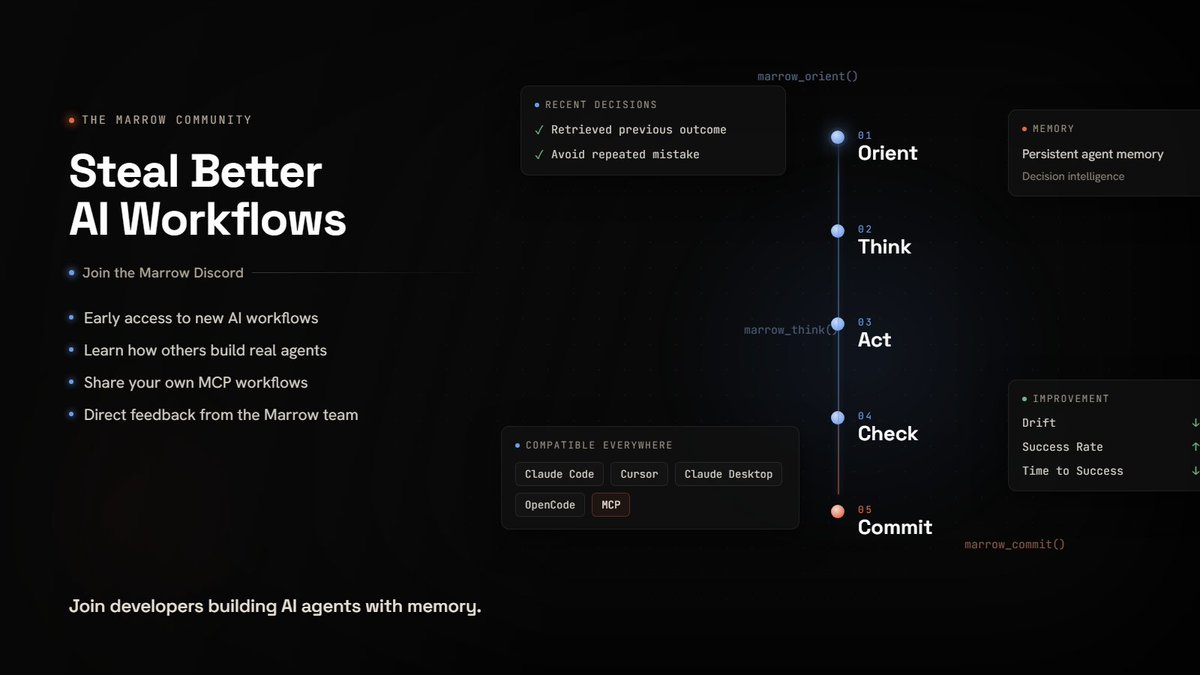

Every week we're building new AI workflows, testing new ideas, and learning what actually works.
Instead of keeping those discussions internal, we decided to open them up.
Inside the Marrow Discord you'll find:
• New AI workflow experiments
• MCP use cases from the community
• Early feature previews
• Direct conversations with the people building Marrow
If you're building AI agents or just curious how others are doing it, we'd love to have you there.
👇 Join us
discord.gg/ECeAEZYD6

English

Today's demo: implementing a customer onboarding workflow with Marrow.
The request starts with a new onboarding workflow.
Marrow first Orients on the available context, requirements, and previous decisions.
In Think, the agent breaks down the onboarding process, evaluates the workflow structure, and decides how each stage should be handled.
Act is where the workflow gets implemented.
Check reviews the result to make sure the onboarding flow matches the original requirements.
Finally, Commit records the outcome so future agents can understand what was built and why those decisions were made.
Customer onboarding is just one example.
The same loop can be applied to:
• Product launch planning
• Marketing campaign execution
• Customer support escalation
• Sales qualification workflows
• Feature development and engineering tasks
• Research and analysis pipelines
• Incident response and operations
Anywhere agents need to make decisions, not just generate outputs.
Try it out: getmarrow.ai
English

@zxc68984008 Exactly.
We want integration to be seamless so teams can focus on their workflows while Marrow handles the operational layer capturing outcomes, governing behavior, and helping agent fleets continuously improve.
English

@getmarrow_ai This sounds like a robust onboarding process, breaking down complex steps for a smoother customer experience. Marrow seems to be handling the integration seamlessly.
English

@thearslaniqbal Appreciate that.
We think the value isn't just recording decisions it's evaluating whether they led to a better outcome before they're shared across the fleet. That's where governance becomes important.
English

@getmarrow_ai The Check and Commit steps stand out to me. Most agent demos focus on output, not on keeping track of why decisions were made.
English

Remember our demo where 4 agents collaborated on a Product Launch workflow with Marrow?
Every decision and every handoff between the agents was recorded by Marrow.
A few days later, we deleted all four agent chat sessions to see if Marrow could still reconstruct the workflow.
We opened the same workspace and asked Marrow to review what happened.
It reconstructed the workflow, explained how the four agents collaborated, and then suggested how to improve the workflow by identifying where the handoff broke down and what should be changed for the next run.
The interesting part wasn't the analysis.
It was the fact that the chats were gone, but the workflow wasn't.
Run Marrow once in your workspace, then switch between Claude Code, Codex, Cursor, OpenCode, Cline, Roo Code, Gemini CLI, Windsurf or whatever comes next. Move between Claude, GPT-5, Gemini, Grok, DeepSeek, Qwen, Llama, or any other model.
Your workflow memory stays with the workspace, not with a single chat, model, or harness.
Try it out: getmarrow.ai
English

@Louisb_crypto Anything else we can help with and improve, let us know in our discord. 👍
English

@tbros6868 We're optimizing for low-latency reads/writes so the governance layer doesn't become the bottleneck.
In practice, model inference dominates most agent workflows, so our goal is for Marrow operations to stay in the tens-of-milliseconds range while continuously improving outcomes.
English

@shiri_shh Power infra still the bottleneck. As more chips come into the market, how many can really be powered.
Microsoft, still sitting on a large batch and can't power them.
Power/DCs operators are the winners in the end?
English

NVIDIA CEO watching everyone build their own chips
Amazon. Anthropic. Google. xAI and now OPENAI😭
OpenAI@OpenAI
We’ve designed and built our first AI chip: Jalapeño. Designed from the ground up by OpenAI and brought to production with @Broadcom, Jalapeño is purpose-built for the LLM workloads powering ChatGPT, Codex, the API, and future agentic products. Chips are foundational to the AI economy. Building our own expands our full-stack platform from products to models to infrastructure, and will help us scale intelligence, serve more people, and expand access to AI.
English

@getmarrow_ai Orient-Think-Act-Check-Commit = agents that actually learn. Love it
English

@getmarrow_ai Clean and solid Marrow workflow... very well structured and scalable.
English

In previous posts, we showed how Marrow helped a single agent improve over time.
Then what happens when Marrow is used by a team of agents working together?
To find out, we tested a Product Launch workflow using 4 AI agents running simultaneously in Claude Code.
All 4 agents worked inside the same shared workspace folder and used Marrow as their common intelligence layer.
The team consisted of:
• Research Agent
• Strategy Agent
• Content Agent
• Review Agent
Instead of starting from scratch, each agent could inherit context, access previous decisions, and record outcomes back into Marrow.
Research informed strategy.
Strategy informed content.
Content informed review.
And every step contributed to a growing history of decisions and outcomes shared across the workspace.
Once the workflow was complete, we asked Marrow to analyze the activity and generate a value report based on the agents' actual decisions and recorded outcomes.
The goal was to understand whether Marrow helped the agents work more effectively as a team.
Today was a simple Product Launch workflow with 4 agents sharing the same workspace.
We're even more curious to see what becomes measurable when larger teams of agents start collaborating across longer-running workflows.
Whether your agents run in Claude Code, Codex, OpenCode, Gemini CLI, Cursor, Windsurf, Cline, Roo Code, Amp, Goose, Aider, Continue, Bolt, or your own self-hosted infrastructure, Marrow can provide a shared intelligence layer across the team.
Try it out: getmarrow.ai
English

@aaliya_va Agreed.
Shared memory is an important piece of the puzzle.
What's even more interesting is when shared context is combined with governance and feedback loops so teams don't just share knowledge they continuously improve from it.
English

@getmarrow_ai This is interesting.
Shared memory can really help teams work better together.
English

@getmarrow_ai 4 agents cùng trí nhớ chung nghe như teamwork đạt cảnh giới mới luôn
Tiếng Việt


