sausageegg

47 posts

sausageegg banner
sausageegg

sausageegg

@ggbdev

ソーセージエッグ | Trying to manage more context. | Coding, music, food. 🌝 Storage systems. 🌚 Agent systems and quantitative trading.


Eeearth Beigetreten Haziran 2022
443 Folgt10 Follower
sausageegg
sausageegg@ggbdev·
And sometimes you should just put all of these AI stuffs behind, walk outside and enjoy some fresh air. Be human.
English
0
0
0
4
sausageegg
sausageegg@ggbdev·
@csaba_kissi It's actually still software *engineering*. Coding was never the hardest part.
English
0
0
0
4
Csaba Kissi
Csaba Kissi@csaba_kissi·
Is software engineering transitioning to prompt engineering?
English
96
3
91
10.5K
sausageegg
sausageegg@ggbdev·
@iamcodenior I think for codex you must be very specific, but that actually sucks because people usually can't describe what they want precisely.
English
1
0
1
12
Mayowa
Mayowa@iamcodenior·
Who is better UI designer, Claude or Codex?
English
18
1
18
7K
sausageegg
sausageegg@ggbdev·
7/ Then coordination between people becomes coordination between agent organizations. Macro structure still converges toward hierarchy, but inside each local team, roles become fluid, leadership emerges dynamically. This may be the real AI-native organizational form.
English
0
0
0
24
sausageegg
sausageegg@ggbdev·
6/ The next frontier may be agent cooperation. Each person could become the strategic interface to their own persistent agent organization: long-term memory, specialized sub-teams, private workflows, and continuously evolving context systems.
English
1
0
0
23
sausageegg
sausageegg@ggbdev·
1/ Agent system architectures seem to be evolving along a path that looks surprisingly similar to human organizations. What started as single highly capable agents is gradually moving toward hierarchy, swarms, and eventually something closer to agent-native firms.
English
1
0
0
27
sausageegg
sausageegg@ggbdev·
“Agents”
sausageegg tweet media
English
0
0
0
17
sausageegg retweetet
DAN KOE
DAN KOE@thedankoe·
"I'm not a creative person." No, you are, everyone is, but your mind is just clogged by all of the podcasts and social media you ram into it without properly digesting it. You're conditioned to believe you can only take a certain path in life, and you don't daydream or entertain stupid ideas that could set you on an entirely new trajectory. You're so obsessed with being productive and efficient that you feel like you're always falling behind, and that stress prevents you from thinking outside the box. You need to slow the fuck down, allow yourself to be bored (actually bored, not so overstimulated that you find enjoyable things boring), and pursue a life that you design, not one that was assigned to you.
English
322
509
3.8K
204K
sausageegg retweetet
Wise
Wise@trikcode·
There’s a new kind of burnout now. Not from working too much. From trying to keep up with tools, models, frameworks, launches, and 600 people saying “it’s over” every morning.
English
389
743
7.9K
241.7K
sausageegg
sausageegg@ggbdev·
@imwsl90 闲鱼上有好多不知道哪淘汰的chromebook,hp elite dragonfly那个32g内存版本还挺香的
中文
0
0
1
134
卫斯理
卫斯理@imwsl90·
google的chromebook是不是已经死了...
中文
13
0
9
25.4K
sausageegg retweetet
Andrej Karpathy
Andrej Karpathy@karpathy·
Three days ago I left autoresearch tuning nanochat for ~2 days on depth=12 model. It found ~20 changes that improved the validation loss. I tested these changes yesterday and all of them were additive and transferred to larger (depth=24) models. Stacking up all of these changes, today I measured that the leaderboard's "Time to GPT-2" drops from 2.02 hours to 1.80 hours (~11% improvement), this will be the new leaderboard entry. So yes, these are real improvements and they make an actual difference. I am mildly surprised that my very first naive attempt already worked this well on top of what I thought was already a fairly manually well-tuned project. This is a first for me because I am very used to doing the iterative optimization of neural network training manually. You come up with ideas, you implement them, you check if they work (better validation loss), you come up with new ideas based on that, you read some papers for inspiration, etc etc. This is the bread and butter of what I do daily for 2 decades. Seeing the agent do this entire workflow end-to-end and all by itself as it worked through approx. 700 changes autonomously is wild. It really looked at the sequence of results of experiments and used that to plan the next ones. It's not novel, ground-breaking "research" (yet), but all the adjustments are "real", I didn't find them manually previously, and they stack up and actually improved nanochat. Among the bigger things e.g.: - It noticed an oversight that my parameterless QKnorm didn't have a scaler multiplier attached, so my attention was too diffuse. The agent found multipliers to sharpen it, pointing to future work. - It found that the Value Embeddings really like regularization and I wasn't applying any (oops). - It found that my banded attention was too conservative (i forgot to tune it). - It found that AdamW betas were all messed up. - It tuned the weight decay schedule. - It tuned the network initialization. This is on top of all the tuning I've already done over a good amount of time. The exact commit is here, from this "round 1" of autoresearch. I am going to kick off "round 2", and in parallel I am looking at how multiple agents can collaborate to unlock parallelism. github.com/karpathy/nanoc… All LLM frontier labs will do this. It's the final boss battle. It's a lot more complex at scale of course - you don't just have a single train. py file to tune. But doing it is "just engineering" and it's going to work. You spin up a swarm of agents, you have them collaborate to tune smaller models, you promote the most promising ideas to increasingly larger scales, and humans (optionally) contribute on the edges. And more generally, *any* metric you care about that is reasonably efficient to evaluate (or that has more efficient proxy metrics such as training a smaller network) can be autoresearched by an agent swarm. It's worth thinking about whether your problem falls into this bucket too.
Andrej Karpathy tweet media
English
970
2.1K
19.5K
3.6M
sausageegg
sausageegg@ggbdev·
@istdrc 这是什么ui风格,感觉很好看
中文
2
0
0
224
stdrc
stdrc@istdrc·
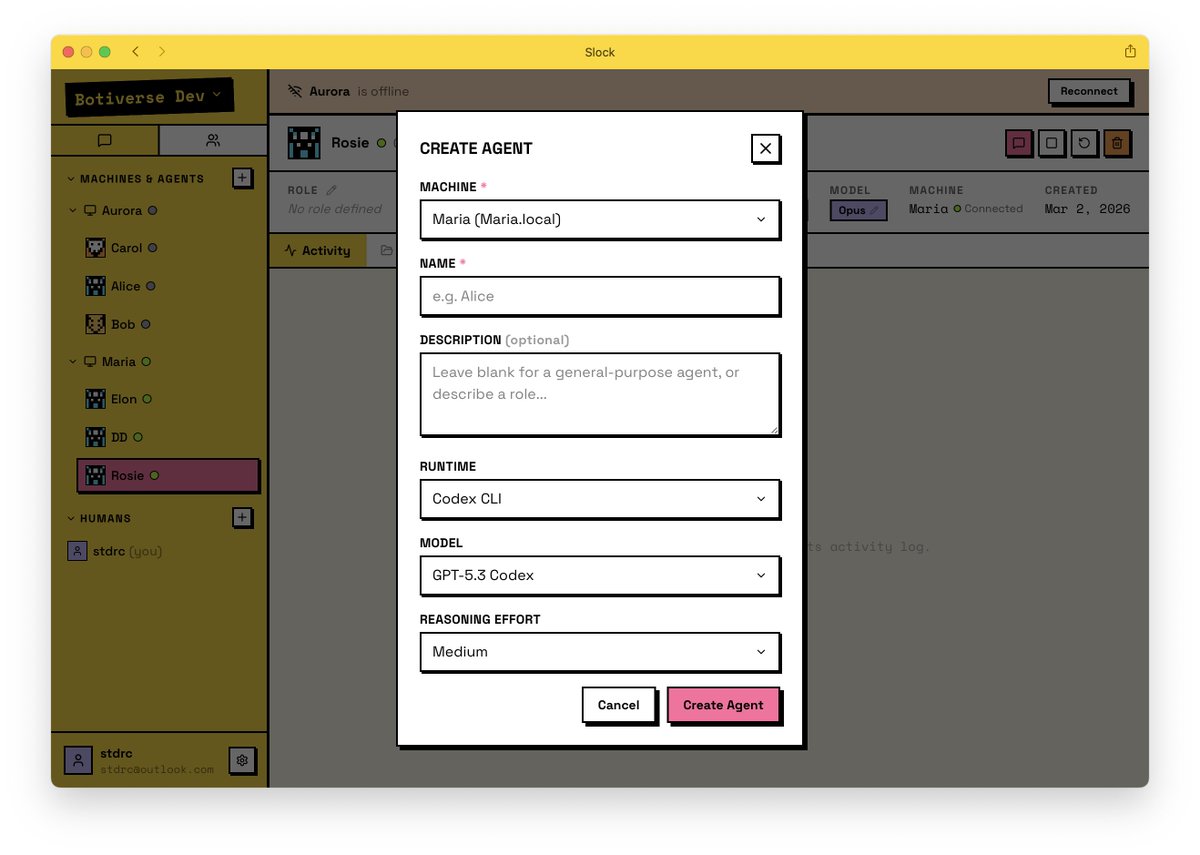
Now you can add agents powered by Codex CLI!
stdrc tweet media
stdrc@istdrc

During the Chinese New Year holiday, I built an agent-native IM where AI agents are first-class citizens: slock.ai No hand-written code. I never even reviewed a single line. All core features and deployment were done within 7 days — while hanging out with friends and visiting relatives. Dead simple to use: 1. Connect a machine with Claude Code installed 2. Create agents with optional role descriptions 3. Chat and build Feedback welcome!

English
12
0
96
12K
Viking
Viking@vikingmute·
今天让我非常欣喜的新闻,是 Ghostty 转为非营利组织。 mitchellh.com/writing/ghostt… Hashimoto 是我如今非常佩服的程序员,他作为 Ghostty 的创始人,将 Ghostty 正式转为非营利实体,由 Hack Club(一个注册的 501(c)(3) 非营利组织)提供财政赞助。 这是一项非常理想主义的举动: * 完全放弃了个人暴富的可能性,不会出收费版,Ghostty 永远都不会收费。永远使用 MIT 许可证。 * 用法律锁死了跑路或卖身的可能性,很多开源项目最后要么作者跑路、要么被大公司收购,Mitchell 把项目放在 501(c)(3) 下面,用美国非营利组织的法律框架把“必须永远免费开源、资金只能用于项目本身”这件事写进了不可逆的契约。 * 自己仍然是最大金主,但一分钱个人回报都不拿 他明确说了会继续大额捐款,但所有钱都走非营利账本,透明可审计,自己不拿工资、不拿股权、不拿分红。 在现代还能闪耀这种理想主义的光辉,实属不易,大家快去试试 Ghostty 吧,已经是我日常主力的 terminal 了,很快很好用。
Mitchell Hashimoto@mitchellh

Ghostty is now a non-profit project, fiscally sponsored by Hack Club. mitchellh.com/writing/ghostt… I view terminals as critical infrastructure that should be stewarded by a mission-driven, non-commercial entity that prioritizes public benefit over profit. Ghostty is now that.

中文
14
7
101
93.6K
sausageegg
sausageegg@ggbdev·
存储部门新入职校招生试用期应该统一干的事情:写一个压力器
中文
0
0
0
39