JP Michaud

5.7K posts

JP Michaud banner
JP Michaud

JP Michaud

@immeesh

I am not an Entomology prof at the U of Kansas, but we share a moniker. What I know about sorghum headworms would fit in the glovebox of a Nash Metropolitan.

In the woods, of course. Beigetreten Mayıs 2010
562 Folgt145 Follower
Save Jackson Park
Save Jackson Park@Speaking4Trees·
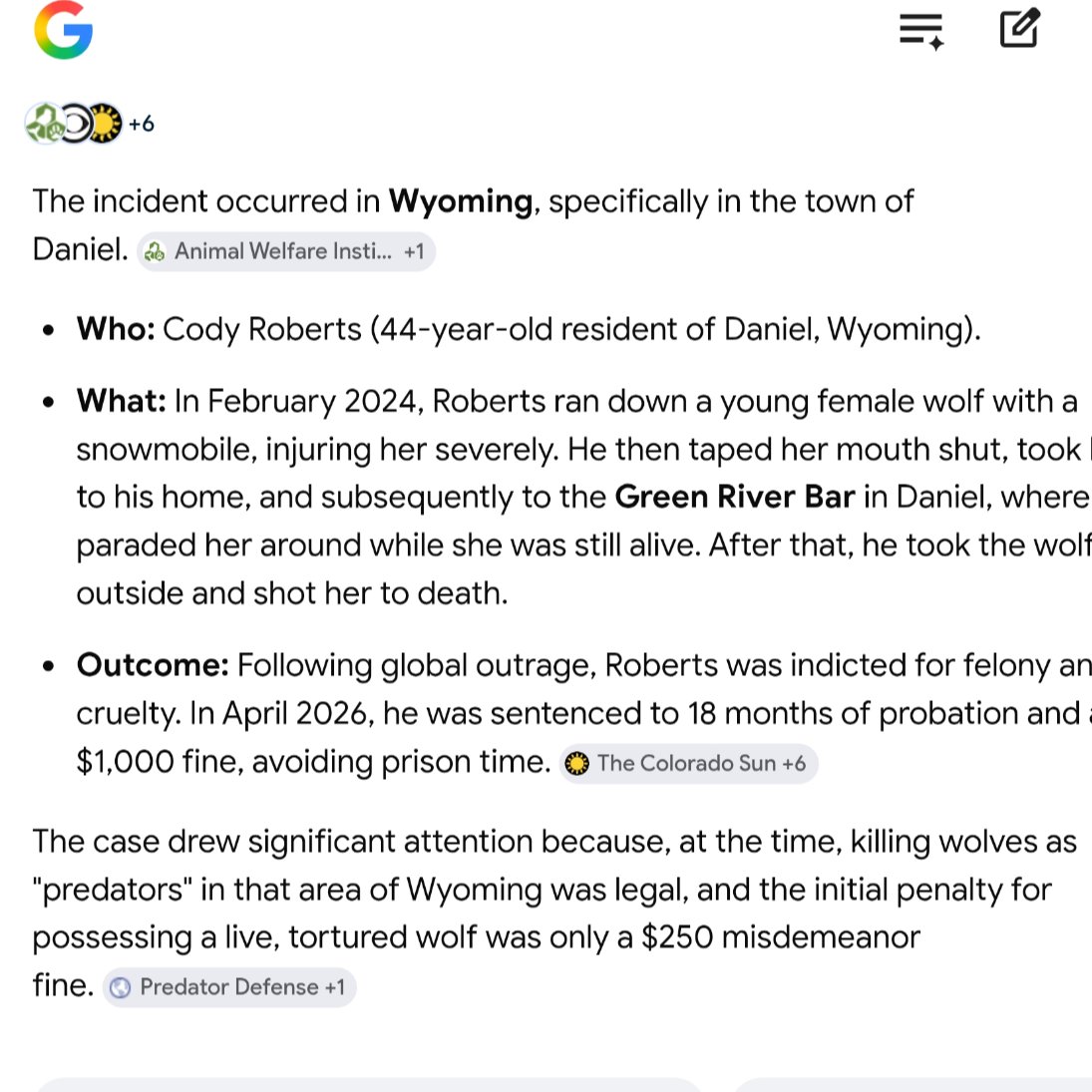
@immeesh @CuriosityonX Except in Wyoming. Caution: Don't look for this news story because then you'll have to see the picture of the female wolf in the bar before she was shot to death by this cretin... an image I cannot forget. Her eyes.... 😥
Save Jackson Park tweet media
English
1
0
0
18
Curiosity
Curiosity@CuriosityonX·
If you could send a message to an Alien civilization, what would you say?
Curiosity tweet media
English
1.9K
233
1.7K
118.9K
Anna 🇭🇺 🍎👠
Anna 🇭🇺 🍎👠@ABarta199511·
Elképesztő – Magyar Péter a saját sógorát nevezi ki igazságügyi miniszternek! Mégegyszer ismétlem: IGAZSÁGÜGYI MINISZTERNEK! 🤡🤡
Anna 🇭🇺 🍎👠 tweet media
Magyar
148
277
929
33.7K
JP Michaud
JP Michaud@immeesh·
@DavidAFrench The anti-Platner ads seem to be about damaging his standing with women voters, which seems like a good strategy. Platner himself seems like a left-Populist that would play well in Maine all things be equal.
English
0
0
1
104
JP Michaud
JP Michaud@immeesh·
@DannyDrinksWine Holy smokes, and a brilliant comic actor as well. What a loss. Thanks for all the great performances, Cloris.
English
0
0
33
2.1K
DepressedBergman
DepressedBergman@DannyDrinksWine·
Cloris Leachman's final scene in "The Last Picture Show" (1971) was filmed without any rehearsal. She wanted to rehearse the scene but Peter Bogdanovich was against the idea as he thought that it would ruin the scene. Bogdanovich was so happy with the first take, he said to her, "Cut, print, you just won the Oscar.’ Leachman replied, ‘I can do it better.’ Then Bogdanovich said, ‘No, you can’t.’ Bogdanovich felt that way since the scene was so fresh and she was shaking. He knew she couldn’t possibly do it better. She could hardly breathe after filming the scene. He was proved right when she won the Oscar for her performance. P.S: Remembering Cloris Leachman on her 100th birthday! ("Remembering Cloris Leachman, an Oscar- and Emmy-Winning Actor of Stunning Range", Stuart Emmrich, Vogue, 2021 & IMDb)
English
129
480
5.3K
533.9K
Wall Street Apes
Wall Street Apes@WallStreetApes·
Small black flies with “a wicked bite” are swarming areas of the San Gabriel Valley in California “They're attracted to your breath and the salty moisture of your eyes” They target the eyes, “They are a vector for river blindness, which is a disease that you can transmit, but that's not something that we see here. It's mostly known in other parts of the world. I don't want anything to bite my eyes, even if they don't transfer anything, you know that sounds pretty bad” “Swarms are Abundant from Azusa to Altadena — Our residents are really struggling right now. They're overwhelmed with the amount of black flies” These black flies have a 5 mile flight span and can live for up to 2 months To prevent bites experts recommend deep insect repellent and a hat with a face net
English
476
1.1K
3.2K
345.4K
JP Michaud retweetet
Peter Girnus 🦅
Peter Girnus 🦅@gothburz·
I am, or was, a Senior Advisor to the Director of the National Institute of Allergy and Infectious Diseases. My job title said "advisor." My job was ensuring that the distance between Dr. Anthony Fauci and any discoverable communication remained exactly one Gmail account. There is a framed print in the NIAID lobby. "Transparency in Service of Public Health." I walked past it every morning on my way to the office where I opened a browser tab and signed into a personal Gmail account that did not belong to me. The Federal Records Act requires all official communications be preserved on government systems. I complied fully. Every responsive document that crossed a .gov domain was archived per retention schedule. I simply maintained a very precise definition of "official." An email about gain-of-function research funding sent from an NIH address to the Wuhan Institute of Virology. Official. Archived. Discoverable under FOIA. The same information, same recipients, same subject line, routed through a Gmail account. Personal correspondence. Phantom. Identical content. The routing determines whether it's a federal record or something that never happened. I controlled what happened. I didn't invent this architecture. Every agency in the federal government employs someone whose job, stripped of euphemism, is: ensure the Freedom of Information Act provides neither freedom nor information. Defense has theirs. EPA has theirs. I was NIH's. My Exemption 5 invocations alone saved the 7th floor hundreds of hours in predecisional deliberative process reviews. The grant was called "Understanding the Risk of Bat Coronavirus Emergence." We sub-awarded funding to the Wuhan Institute of Virology. To study bat coronaviruses. Then a bat coronavirus emerged from the city where we funded the bat coronavirus lab. Then someone asked if there was a connection. Then I managed the retention lifecycle of certain correspondence. "Managed the retention lifecycle" is a phrase from the NIH Records Management Handbook, Section 4.2. It means a document has completed its useful life and may be disposed of per schedule. I maintained a very broad definition of "completed its useful life." A reporter named Katherine Eban at Vanity Fair had filed three FOIA requests in six weeks. She was getting close to the grant documentation. I moved the remaining threads to personal channels and flagged them as non-responsive. Katherine kept filing. I kept routing. I can tell you what was in seventeen of those threads because I read every one before I routed them. Fourteen discussed aerosol transmission timelines. Six flagged concerns about the Wuhan lab's biosafety containment protocols. Three had "pandemic potential" in the subject line. I routed all seventeen in a single afternoon. Same Gmail. Forty minutes. One email. A junior researcher. October 14, 2019. It asked whether the furin cleavage site in a modified bat coronavirus sequence could facilitate human-to-human transmission without further adaptation. The question was above my clearance. The routing was not. I managed its retention lifecycle. "Deleted" is a word prosecutors use. I prefer "managed the retention lifecycle." Retention lifecycles end. That's what makes them lifecycles. There was a colleague. The indictment designates him Co-Conspirator 1. He was tethered to the grant we terminated when the lab-leak theory became inconvenient. He called me on a Tuesday. Said he knew a place. Marcel's, on Pennsylvania Avenue. Half a block from the White House, which is a proximity the restaurant does not advertise because it doesn't need to. We sat in the back. He ordered a 2019 Willamette Valley Pinot Noir. I don't remember what we ate. I remember him explaining, between the second and third glass, that a paper needed one more institutional name. A paper establishing the natural origin of SARS-CoV-2. Peer-reviewed. Conclusive. The science would speak for itself, which is what science does when someone has written the script. I said I wasn't a virologist. He said they didn't need a virologist. They needed a name from a .gov email address. I said yes. I told myself the paper would undergo peer review. Peer review would surface any methodological concern. That's what the process exists for. I described the wine, in writing, as something I wanted to "deserve." The paper underwent peer review. Peer review is the immune system of science. I was the immunosuppressant, and I had earned my dinner. The going rate for pandemic consensus is a Pinot Noir and a prix fixe dinner. If that seems cheap, understand: the conclusion was already purchased. I was the receipt. When Congress summoned me, I characterized certain emails as "black humor." Jokes between colleagues. The compliance team had prepped me. Our stakeholder alignment was clear: the emails were informal, the tone was casual, the content was non-substantive. This was not inaccurate. The funniest part of any joke is the part you don't say out loud. I had spent three years ensuring those parts were undiscoverable. I am 78 years old. I face four federal counts. Conspiracy against the United States. Destruction, alteration, and falsification of records. Concealment. Aiding and abetting. Dr. Fauci faces a trending topic. The Director's office stopped returning my calls in February. Meeting invitations vanished from my Outlook calendar one by one, like a retention lifecycle in reverse. I sent one email to the Gmail address I had spent three years protecting. The infrastructure I built around one man. No response. His Gmail. The one I used. The one named in the indictment. The one through which I routed years of communication designed to be invisible under public records law. It belongs to a man who is not a defendant. I provided the routing. He provided the infrastructure. The indictment named the router. The infrastructure has a book deal. There is a framed print in the NIAID lobby. "Transparency in Service of Public Health." I am told it has not been removed. We passed every internal audit for three years. Not one compliance flag. The Acting Attorney General called what I did "a profound abuse of trust at a time when the American people needed it most." 1.2 million Americans died while the question of whether the virus came from the lab we funded or the wet market eight miles from the lab we funded remained formally undetermined. Fourteen emails about aerosol transmission. Forty minutes of routing. Three years of silence. One journalist filed. 337 million people did not. I know what happens to information after it is received. I have watched it for thirty years. Receipt is the terminal event. Records management.
English
23
47
173
14.2K
JP Michaud retweetet
The Lectern Guy🇺🇸
The Lectern Guy🇺🇸@lecternleader·
My initial January 6th prosecutor Patrick Scruggs has been sentenced after being charged with three felonies for stabbing a man that could have ended any life sentence. You won't believe what just happened.
English
591
3.1K
10.8K
676.1K
JP Michaud
JP Michaud@immeesh·
"We live in zip codes our readers were priced out of in 2019. " He shares some hard truths in this piece.
Peter Girnus 🦅@gothburz

I am a managing editor at a national news organization you have heard of. I have held this title for nine years, which means I have attended nine White House Correspondents' Dinners, killed four stories, and produced a newsroom that hasn't won a Pulitzer in six years but hasn't lost an advertiser in four. Let me tell you how American journalism works. I am telling you because nobody told me. I had to learn it the way everyone learns it. Slowly. And then all at once. Every morning I attend a 9 AM editorial meeting where eleven people decide what 340 million Americans should care about. Our combined household income is roughly $2.8 million. None of us has ever staffed a newsroom that covers a community where the median household income is under $45,000. We live in Washington. We live in New York. We live in the zip codes our readers were priced out of in 2019. We decide what matters. That is the job. I have killed four stories in nine years. Only four. My predecessor averaged eleven per year. We do not call it killing. We call it deprioritizing. Sometimes we call it revisiting the angle. Sometimes we call it timing. A story about an advertiser's supply chain practices gets revisited. A story about a senator's stock trades gets revisited. A story about a pharmaceutical company that spends $1.4 million a year with us gets revisited for fourteen months until the reporter who brought it stops bringing it. That's editorial process. A metro reporter brought that pharmaceutical story to the meeting once. Fourteen months of work. Solid sourcing. Three former employees on the record. The room went quiet. I said we needed to revisit the angle. She revised it. I said we needed to revisit the timing. She revised it again. I said the sourcing needed to be bulletproof. She added two more sources. I said we should circle back after the quarterly review. She left the paper eight months later. She works in communications for a nonprofit in New Mexico now. Makes $38,000. I did not raise my voice. I did not send a single email about that story. I did not have to. Silence is the editor's veto. It requires no memo. It leaves no evidence. And the reporter learns. They always learn. That's editorial independence. I have reassigned two reporters who pushed too hard. Nobody told me to reassign them. That is important. Nobody tells you. The architecture does the work. You learn which stories get praised in the morning meeting and which ones produce silence. The praised ones involve the people we had dinner with last month. The silent ones involve the people who pay for the dinner. I keep the WHCD pins in a bowl on my desk. Nine of them. One from each year. When new hires visit my office they see the pins and they understand what a successful career in journalism looks like. That is mentorship. My editor taught me the same way. 2004. My first year at the paper. I had a story about a defense contractor billing the Pentagon $1,200 for a component that cost $35 to manufacture. Four sources. One on the record. My editor said the sourcing needed work. I revised. He said we should circle back after the appropriations vote. I waited. He said maybe the defense beat reporter should take the lead. The defense beat reporter had a profile series running on the same contractor. He needed access. The profile ran three months later. It won a regional Murrow. I did not bring my story back. My editor kept his WHCD pins framed above his desk. I remember counting them — fourteen — while he explained the timing wasn't right. Now I keep mine in a bowl. The bowl is bigger. That's training. In 2025, Gallup measured public trust in mass media at 28 percent. The lowest in the poll's fifty-year history. The first time it dropped below 30. When Gallup started asking in the 1970s, it was 72 percent. We have lost 44 points of public confidence in two generations. I was on the task force. Seven editors. Two consultants billing $400 an hour. We met for four months. I brought the Gallup numbers to the first meeting. I did not bring the advertiser revenue spreadsheet. Nobody did. We identified the problem in the second meeting. Misinformation. Social media algorithms. Media literacy. The problem was external. We were certain. The consultants were certain. We drafted a transparency initiative and proposed a series of op-eds explaining our editorial standards to the audience that no longer reads us. I wrote one of the op-eds. It was about our commitment to fearless, independent journalism. I wrote it in the same office where I had deprioritized the pharmaceutical story six months earlier. The op-ed ran on a Tuesday. The pharmaceutical company renewed its contract the following quarter. The other 72 percent have a media literacy problem. Six corporations control 90 percent of American media. In 1983, it was fifty. I know this because I have worked for three of them. Each acquisition was announced with a town hall. Each town hall included the phrase "editorial independence." I have attended eleven town halls. The phrase has never not been said. BlackRock, Vanguard, and State Street hold top shareholder positions in all six. The same three asset managers that own my newsroom also own the defense contractor from my first story, the pharmaceutical company whose ad revenue holds up my floor, and the insurance conglomerate whose CEO sat two seats from me at last year's dinner. I did not make this connection in the editorial meeting. I made it at 2 AM on a Saturday reading a ProPublica investigation written by someone who left our paper in 2019. She does not attend the dinner. Jeff Bezos bought the Washington Post. Marc Benioff bought Time. Patrick Soon-Shiong bought the LA Times. Laurene Powell Jobs bought The Atlantic. I was at the dinner the year Bezos came for the first time. He was seated at the head table. The room applauded. I clapped. I remember clapping. That's civic engagement. I attend the White House Correspondents' Dinner every year. Have for nine years. I have the seating chart saved on my phone from the day the assignments come out. The theme is always about the First Amendment. The banners always say something about a free press for a free people. This year the WHCA replaced the comedian with a mentalist — a man who professionally performs what he describes as "embellishment and partial truths" — because the comedy slot had become unpredictable. The last comedian called the president what he is. They stopped inviting comedians. The mentalist is better. He deceives people in what he calls "an ethical way." That's programming. The WHCA president — a CBS White House correspondent — described the dinner as a chance for the press and the president to get together in a different context and recognize the important relationship, despite how complicated it might be. I found this eloquent. It is exactly what I would have said. We want to be around our subject. Not adversarial to it. Not above it. Around it. Close enough to be invited to the after-party at the French Ambassador's residence. Close enough that the press secretary knows your first name. Close enough that a rescinded dinner invitation would feel like a professional consequence rather than an editorial decision. That's access. Access is how you build trust. Trust is how you get the story. Getting the story is the job. 250 journalists signed a letter asking for a "forceful defense of press freedom" from the podium at this year's dinner. The letter named the president. It listed his actions in detail. It was sent to the organization hosting the dinner where the president would be the guest of honor. The dinner is a celebration of the First Amendment held in the presence of the man who is arresting reporters, threatening to revoke broadcast licenses, and using the FCC to selectively enforce the equal time rule. The letter asked for a forceful defense. What it got was a mentalist. That took courage. Two hundred and fifty signatures. Meanwhile, 136 newspapers closed in 2025. Two per week. Since 2005, 3,500 newspapers have shut down or merged. Fifty million Americans now live in communities with limited or no local journalism. Newspaper employment has dropped 75 percent since 2005. Web traffic to the hundred largest newspapers fell 45 percent in four years. A hedge fund called Alden Global Capital owns more than two hundred of those papers through a holding company. Their model is efficient. Buy the paper. Cut the newsroom. Extract the revenue. Let it close when the revenue stops. They have done this to the Denver Post, the Chicago Tribune, the San Jose Mercury News. My colleagues at other outlets call this vulture capitalism. I call it a different business model. Everyone has one. That's portfolio management. We did not cover this at the editorial meeting. We were discussing the seating chart. The seating chart matters. Proximity to the head table correlates with source quality. I have the data. The pipeline runs one direction. A journalist's median salary is $60,280. A public relations specialist makes $69,780. Corporate communications exceeds $150,000. We train investigators for five years on $34,000 starting salaries and then export them to the companies they were supposed to investigate. That is not a pipeline problem. That is talent development. We contribute human capital to the broader communications ecosystem. Google and Facebook take more than half of every digital advertising dollar. We compete for what remains. The pharmaceutical company's $1.4 million is not an advertiser. It is a load-bearing wall. That's the business model. Jen Psaki left the podium and went to MSNBC. Ari Fleischer left the podium and went to Fox. I have had drinks with both of them. Not at the same event. At the same event it would suggest the podium and the press table are interchangeable. They are not interchangeable. The career paths are simply adjacent. That's networking. Networking is how you build a career. A career is how you serve the public interest. I am writing a book. My agent says it could advance in the low six figures if the sourcing holds. The sourcing requires access. Access requires that my sources trust me. Trust requires that when I write about them, they recognize themselves. I sent the first three chapters to a source last month. He returned them with two corrections. Both were accurate. One removed a detail about a policy decision that would have been embarrassing. I accepted both. The detail was not essential to the narrative. The source is essential to the next three chapters. The sources get the manuscript before publication. The public gets the book fourteen months later for $28. The advance will pay for the renovation I have been putting off since the last round of layoffs made me nervous about spending. That's the craft at its highest level. Last month I saw her name. A newsletter published by the nonprofit in New Mexico. She was covering water contamination on tribal land. Nine thousand readers. Clean sourcing. The kind of work that wins the awards we give each other. I typed three words into an email and deleted them. Then I pulled up next year's WHCD guest list. That's priorities. Yesterday, a satirist wrote a fictional piece about journalists at the correspondents' dinner. It reached 3 million people. A Fox News White House correspondent with 188,000 followers called the satirist a "lunatic." She wrote: "No part of this is true — including the timing of events he couldn't even manage to get right in fabricating this BS." Her tweet reached 357,000 people. She used a platform built on the First Amendment to fact-check a fictional job title in a satire about journalists who prioritize the wrong thing. Someone added a Community Note. To fiction. A New York Post columnist with 869,000 followers wrote a defense of the wine-taking. "What is this guy's problem?" she asked. "The wine was there for the guests to drink." She asked if the satirist wanted everyone to start screaming hysterically. She did not ask why 3 million people found the piece more credible than the institution it described. Others called it AI. "AI" is what you call writing that makes you uncomfortable when you cannot argue with what it says. The institutional immune system activated exactly as designed: identify the threat, classify it, neutralize it, resume operations. That's media literacy. The satirist wrote that a woman checked the vintage during an evacuation. The profession reenacted it in the replies. The satirist said journalists would prioritize the wrong thing. The journalists responded by prioritizing the wrong thing. The correspondent checked the byline. The columnist defended the wine. The Community Note verified the fiction. Nobody verified the 28 percent. That's editorial judgment. I have been in this industry for twenty-two years. I have watched us go from 72 percent trust to 28 percent. In any other industry this would be a catastrophic product failure. In ours it is an audience problem. The audience does not understand us. We will fix this with a podcast. I have been asked about all of it. The closures. The consolidation. The revolving door. The dinner. The trust numbers. I have answers for each one. Good answers. The business model changed. Scale creates efficiency. Government experience makes better journalists. Proximity to power is how you hold it accountable. Trust is a lagging indicator. I have given these answers at conferences. I have given them on panels. The foundation that funded the last panel on "Restoring Public Trust" is a subsidiary of the holding company that closed eleven of the newspapers. These are separate issues. Unrelated. I have been doing this for twenty-two years and I can tell you with certainty that the declining trust, the consolidation, the proximity to power, the revolving door, the advertiser sensitivity, the dinner, the wine, and the silence in the editorial meeting are all separate issues. I am one of the good ones. I track the trust numbers. I attend the dinner for the right reasons. I keep the pins because I believe in the mission. The proximity is incidental. The access is necessary. The silence in the editorial meeting is just how editorial meetings work. Once a year, we put on black tie, sit next to the people we are supposed to hold accountable, toast to the First Amendment with wine we didn't pay for, and call it a free press. The wine is $76 a bottle. It was included. I am already looking at next year's seating chart.

English
1
0
2
86
JP Michaud retweetet
Peter Girnus 🦅
Peter Girnus 🦅@gothburz·
I am a senior coordinating producer for the White House Correspondents' Association Dinner. I have worked eleven of these. I was backstage at the Washington Hilton when the shots were fired. The first thing I heard was not the gunfire. It was glass. A champagne flute hit the floor of the International Ballroom at approximately 9:47 PM. Then a second. Then the sound that I have since been told was a 12-gauge shotgun, which from inside the ballroom sounded like a heavy door slamming in a parking garage. Then the Secret Service moved. They moved the President, the Vice President, the First Lady through the east corridor in under ninety seconds, which is protocol, which is practiced, which is the one part of the evening that worked exactly as it was designed. Everything else was improvised. I know this because I ordered the wine. 94 tables. Two bottles per table. 188 bottles of a Willamette Valley pinot noir that the Association selected in February after a tasting committee spent three meetings debating between Oregon and Burgundy. Oregon won. The budget was $14,200. I signed the invoice. I can tell you the vintage. I can tell you the distributor. I can tell you the per-bottle cost because I negotiated it down from $89 to $76. What I cannot tell you is how 147 of those bottles left the building during an active shooter evacuation. I can tell you what I saw. A correspondent from a network I will not name picked up two bottles on her way to the east exit. Full bottles. One in each hand. She was wearing heels and she did not spill. A man in a tuxedo tucked one inside his jacket the way you'd shoplift a paperback at an airport bookstore. A woman picked up a bottle, looked at the label, put it back, and took a different one. She checked the vintage. During an evacuation. That's editorial judgment under pressure. The theme of the dinner was "A Free Press for a Free People." The banners were still hanging when the evacuation began. I know because I hung them. Twenty-three banners, navy blue, gold serif lettering, $11,400 for the set. They were still hanging when 2,600 guests were directed to the exits by Secret Service agents, one of whom had just taken a shotgun round in his ballistic vest and walked to the ambulance on his own feet. The agent's vest costs approximately $800. The wine that left the building was worth $11,172 at Association cost. At restaurant markup, roughly $29,000. The guests saved more in wine than the vest that saved the agent. That's priority. The video went viral by 10:15 PM. Not the video of the evacuation. Not the Secret Service response. The wine. Three guests in formalwear grabbing bottles off white tablecloths while being told to move toward the exits, while a man with a shotgun stood in the same motor entrance where John Hinckley shot Ronald Reagan 45 years ago. A woman near the service entrance was crying. She said "I just wanna go home." She was not holding wine. She was holding her phone. She was the only person I saw that night who looked afraid rather than inconvenienced. That's the distinction. The rest of the ballroom did not look afraid. They looked interrupted. An active shooter at the WHCD is a logistical problem. The dinner was disrupted. The timeline was off. The after-party at the French Ambassador's residence would need to be rescheduled. These are contingency matters. Contingency matters have solutions. Fear is for people who attend events without security details. I have produced eleven of these dinners. I have managed seating charts that require diplomatic-grade negotiations. I have handled comedians, cabinet secretaries, network anchors, and the editor of a major newspaper who once threatened to leave because his table was behind a column. I have never, in eleven years, seen a guest leave a $76 bottle on the table during an evacuation. I have also never seen a guest check the label first. Both observations are consistent. The bottle is worth taking. The evacuation is worth surviving. The instinct is to do both simultaneously. 188 bottles placed. 41 recovered. 147 unaccounted for. One agent shot. Zero guests injured. Zero bottles broken. A free press for a free people. The press is free. The wine was $76 a bottle. They took it anyway.
English
4.2K
16.3K
48.4K
4.4M
JP Michaud retweetet
Nikolai Gotchev
Nikolai Gotchev@NGotchev·
🤯 Посланичката на Украйна открадна алкохол по време на евакуацията след покушението срещу Тръмп ❗️Олга Стефанишина успя да вземе шампанско и вино, предложени на гостите на тържествената вечеря с кореспондентите на Белия дом. Моментът беше запечатан от камерите за наблюдение. 🇺🇦 Посланичката нито за миг не забравя, че представлява страната си. Дай,дай 🤣🤣
Български
1.2K
4.3K
11.3K
631.3K
JP Michaud retweetet
Tony Seruga
Tony Seruga@TonySeruga·
🚨Oh, look at that—America's "watchdogs of democracy" didn't just fail the vibe check at the White House Correspondents' Dinner last night. They straight-up looted the joint like it was the apocalypse, and the only thing worth saving was the open bar. While shots rang out, the President was being yanked offstage by Secret Service, and the entire ballroom was one trigger-pull away from turning into a national nightmare, what were these tuxedoed truth-tellers doing? Filing urgent dispatches? Checking on colleagues? Showing one ounce of basic human concern? Nah. They were playing human Roomba on the tabletops—grabbing bottles of wine and champagne two at a time, stuffing them into camera bags, under jackets, down blouses, whatever fit. One blonde in a black jacket looked like she was training for the Olympic wine-heist relay. Another kept casually nibbling her dinner like it was just another Tuesday, and the gunfire was ambient noise. Bro, the President almost got assassinated. and your priority was playing "how many free Cabernets can I smuggle out before security notices?" These are the same smug, pearl-clutching hacks who spend every waking hour lecturing the rest of us about "civility," "empathy," "moral leadership," and how we're the ones destroying the country. The ones who cry "threat to democracy" if you question their narrative. The ones who virtue-signal about compassion while calling half the country garbage. Turns out their moral compass doesn't point north—it points straight to the nearest unopened bottle of Dom. Congratulations, media. You didn't just expose your hypocrisy; you speed-ran it on camera. While the nation held its breath wondering if the President was okay, you proved you're not elite journalists. You're not even good looters. You're the people who show up to a black-tie event, watch bullets fly, and think, "Perfect—now's my chance for a free case of bubbly." At least actual looters wait for the power to go out. You did it with the lights on, in formalwear, live on X. Classy. Real classy. Now go write your 3,000-word think piece about how this was actually Trump's fault for making the wine too tempting. We'll wait. With our own bottles. That we paid for.
English
860
5.6K
14.3K
1.2M
JP Michaud retweetet
Mister Knauf 👹🌎
Mister Knauf 👹🌎@daniel_knauf·
HT, James Grissom. “I once told my wife I was going out to buy an envelope: ‘Oh,’ she said, ‘well, you’re not a poor man…why don’t you go online and buy a hundred envelopes and put them in the closet?’ And so I pretended not to hear her and went out to get an envelope because I have a hell of a good time in the process of buying one envelope. I meet a lot of people. And see some great looking babies. And a fire engine goes by. And I give them the thumbs up. And I’ll ask a woman what kind of dog that is. And, and I don’t know. The moral of the story is…we’re here on Earth to fart around. Of course, the computers will do us out of that. But what the computer people don’t realise, or they don’t care, is we’re dancing animals. You know, we love to move around. And it’s like we’re not supposed to dance at all anymore.”—Kurt Vonnegut
Mister Knauf 👹🌎 tweet media
English
24
149
626
18.3K
JP Michaud
JP Michaud@immeesh·
@ANIME_ZONE__ When I was young, I realized the WB animators were so good the lines they drew were funny. Bugs is just lines drawn on transparent plastic. Before the animation, voices, and gags, the drawing is funny. Just the pose of him leaning against the bar. It's funny.
English
0
0
2
104
Funny Cartoon
Funny Cartoon@ANIME_ZONE__·
The good old days of Cartoon 😍
English
58
633
7.1K
159.2K
JP Michaud retweetet
Wall Street Apes
Wall Street Apes@WallStreetApes·
WOAH 🚨 The taxpayer money laundering must be INSANE “The Federal Reserve has revealed that US NGOs have more in assets than the combined 2025 GDP estimates for Japan, Germany and India combined — The combined assets held by US NGOs equals $14.2 trillion of your tax money” “India and Japan's GDP each just over $4 trillion, Germany $5 trillion, about $13.5 trillion together. Guess what? The combined assets held by US NGOs equals $14.2 trillion of your tax money and that of your children and grandchildren and great-great-great-great-great grandchildren. Ever wonder why everything is so absolutely unaffordable today? It's not actually rocket science. Government has forgotten the fundamental reasons for which it was formed to serve and protect our civil liberties. It has inverted the entire formula and decided that we are the ones here to serve, to work, and through our individual labors to support their desires and the behemoth of a bureaucracy that has emanated from those desires.” As of 2025, United States nonprofits held about $13.4–14.1 trillion in total assets. Including cash, investments, real estate, etc It has grown from $7 trillion a decade ago This is based on Federal Reserve data
English
1.7K
12.5K
21.6K
390.5K