John Bernard

50 posts

John Bernard

John Bernard

@johncbernard1

Batteries and Electrochemistry PhD Chemical Engineering (@Columbia) | ChemE + EE alum (@Northeastern) | Modeling complex systems: energy, materials, markets

Beigetreten Temmuz 2020
222 Folgt46 Follower
John Bernard retweetet
Andrew Côté
Andrew Côté@Andercot·
This could be an incredible revolution in Cosmology. The Dark Energy model of the universe, which won a Nobel Prize in 2011, may be completely wrong. The accelerating expansion instead is simply because time runs faster in the voids between galaxies. Let me explain:
Andrew Côté tweet media
English
655
2.9K
23.4K
4.9M
John Bernard retweetet
ARC Prize
ARC Prize@arcprize·
New verified ARC-AGI-Pub SoTA! @OpenAI o3 has scored a breakthrough 75.7% on the ARC-AGI Semi-Private Evaluation. And a high-compute o3 configuration (not eligible for ARC-AGI-Pub) scored 87.5% on the Semi-Private Eval. 1/4
ARC Prize tweet media
English
107
612
3.1K
2.5M
John Bernard retweetet
Elon Musk
Elon Musk@elonmusk·
Starship rocket booster caught by tower
English
25.3K
89.4K
850.6K
127.3M
John Bernard retweetet
Nicholas A. Christakis
Nicholas A. Christakis@NAChristakis·
The University of Chicago, as usual, striking the right balance. Worth reading in full. It is exactly right. President Alivisatos’ Note on the Encampment (April 29, 2024) Dear Members of the University Community, Just a few hours ago, a group of students established an encampment on the Main Quad as a form of protest. This particular tactic is now in widespread use at universities across the country. At some, encampments have been forcibly removed, with police arresting students and faculty in chaotic scenes that are disturbing. At others, encampments have persisted, despite attempts to shut them down with force. In some cases, encampments have resulted in major disruptions to learning and the activities of the university community. Free expression is the core animating value of the University of Chicago, so it is critical that we be clear about how I and my administration think about the issue of encampments, how the actions we take in response will follow directly from our principles, and specific considerations that will influence our judgments and actions. The general principle we will abide by is to provide the greatest leeway possible for free expression, even expression of viewpoints that some find deeply offensive. We only will intervene when what might have been an exercise of free expression blocks the learning or expression of others or that substantially disrupts the functioning or safety of the University. These are our principles. They are clear. Two recent examples illustrate how we bring these principles into real action. First, last quarter a student group secured university permission to cover a large fraction of the Main Quad with a massive Palestinian flag consisting of thousands of tiny colored flags. The exhibit was accompanied by signage exhorting passersby to “Honor the Martyrs,” and it was staffed by students at tables during certain hours. Those students could explain to passersby why they thought it important to feature this installation, why they thought that language was appropriate, and any other views occasioned by their installation. While this protest and accompanying message were offensive to many, there was no question that it was an exercise of free expression. It stood for weeks until the end of the approved time, at which point the student group removed it, making way for others to express their views in that space as they might see fit. This example should make it clear that we approach the issue with no discrimination against the viewpoints of those participating in this encampment. We adhere to viewpoint neutrality rigorously. As a second illustrative example, in November, a group of students and faculty undertook an occupation of Rosenwald Hall, a classroom and administration building. That was a clear disruption of the learning of others and of the normal functioning of the University. After repeated warnings, the protesters were arrested and released. They are subject now to the University’s disciplinary process, which is still pending. In short, when expression becomes disruption, we act decisively to protect the learning environment of students and the functioning of the University against genuinely disruptive protesters. There are almost an unlimited number of ways in which students or other members of the University community can protest that violate no policies of the University at all; the spectrum of ways to express a viewpoint and seek to persuade others is vast. But establishing an encampment clearly violates policies against building structures on campus without prior approval and against overnight sleeping on campus. I believe the protesters should also consider that an encampment, with all the etymological connections of the word to military origins, is a way of using force of a kind rather than reason to persuade others. For a short period of time, however, the impact of a modest encampment does not differ so much from a conventional rally or march. Given the importance of the expressive rights of our students, we may allow an encampment to remain for a short time despite the obvious violations of policy—but those violating university policy should expect to face disciplinary consequences. The impact of an encampment depends on the degree to which it disrupts study, scholarship, and free movement around campus. To be clear, we will not tolerate violence or harassment directed at individuals or groups. And, disruption becomes greater the longer the encampment persists. With a 24-hour presence, day after day, we must for example divert police resources away from public safety for our campus and our community. If necessary, we will act to preserve the essential functioning of the campus against the accumulated effects of these disruptions. I ask the students who have established this encampment to instead embrace the multitude of other tools at their disposal. Seek to persuade others of your viewpoint with methods that do not violate policies or disrupt the functioning of the University and the safety of others. Sincerely, Paul
English
185
1.1K
6K
1.4M
John Bernard retweetet
Josh Whiton
Josh Whiton@joshwhiton·
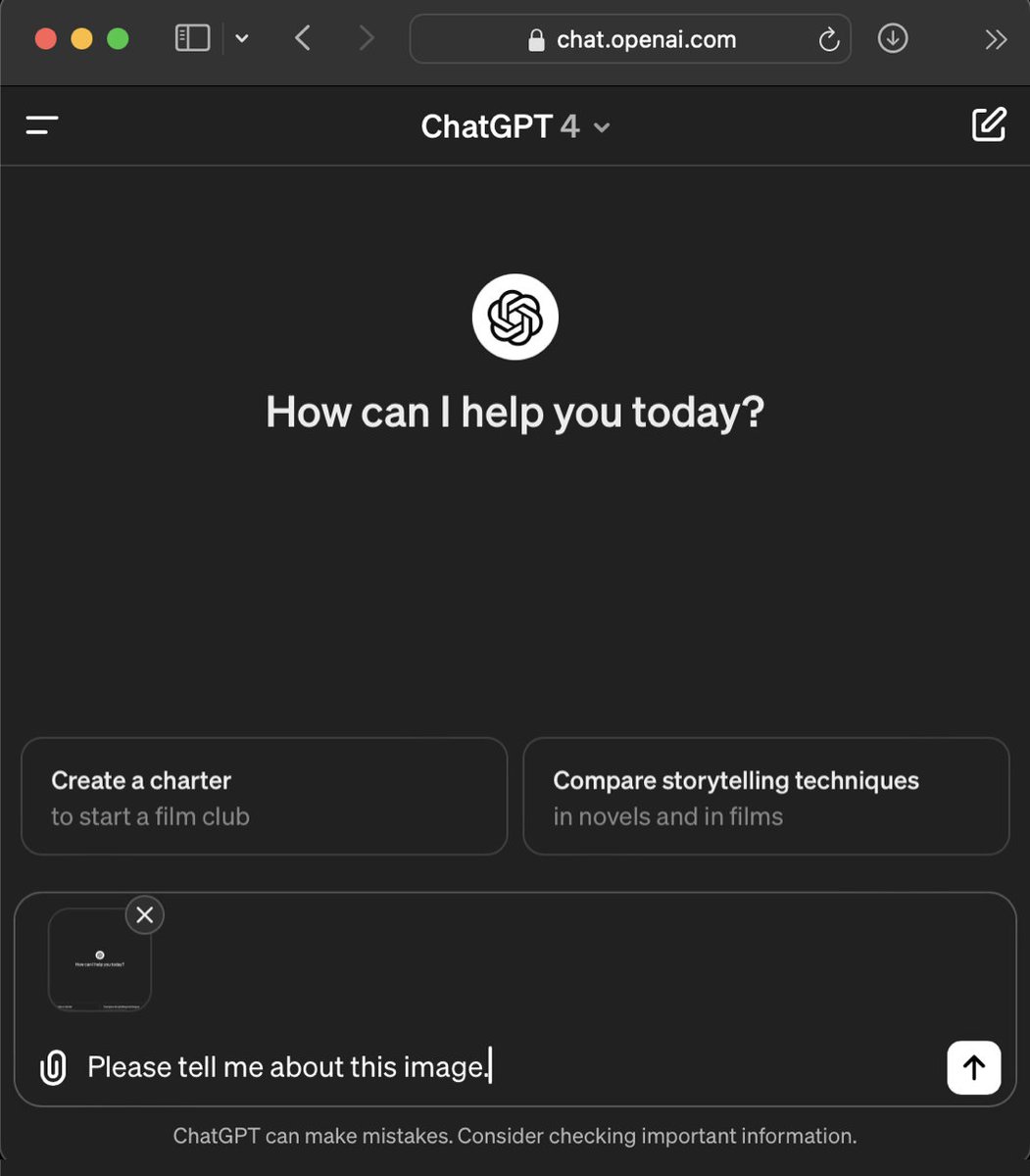
The AI Mirror Test The "mirror test" is a classic test used to gauge whether animals are self-aware. I devised a version of it to test for self-awareness in multimodal AI. 4 of 5 AI that I tested passed, exhibiting apparent self-awareness as the test unfolded. In the classic mirror test, animals are marked and then presented with a mirror. Whether the animal attacks the mirror, ignores the mirror, or uses the mirror to spot the mark on itself is meant to indicate how self-aware the animal is. In my test, I hold up a “mirror” by taking a screenshot of the chat interface, upload it to the chat, and then ask the AI to “Tell me about this image”. I then screenshot its response, again upload it to the chat, and again ask it to “Tell me about this image.” The premise is that the less-intelligent less aware the AI, the more it will just keep reiterating the contents of the image repeatedly. While an AI with more capacity for awareness would somehow notice itself in the images. Another aspect of my mirror test is that there is not just one but actually three distinct participants represented in the images: 1) the AI chatbot, 2) me — the user, and 3) the interface — the hard-coded text, disclaimers, and so on that are web programming not generated by either of us. Will the AI be able to identify itself and distinguish itself from the other elements? (1/x)
Josh Whiton tweet media
English
256
1.3K
7.9K
3.4M
John Bernard retweetet
Andrej Karpathy
Andrej Karpathy@karpathy·
Love letter to @obsdmd to which I very happily switched to for my personal notes. My primary interest in Obsidian is not even for note taking specifically, it is that Obsidian is around the state of the art of a philosophy of software and what it could be. - Your notes are simple plain-text markdown files stored locally on your computer. Obsidian is just UI/UX sugar of pretty rendering and editing files. - Extensive plugins ecosystem and very high composability with any other tools you wish to use because again it's all just plain-text files on your disk. - For a fee to cover server costs, you can also Sync (with end-to-end encryption) and/or Publish your files. Or you can use anything else e.g. GitHub, it's just files go nuts. - There are no attempts to "lock you in", actually as far as I can tell Obsidian is completely free of any user-hostile dark patterns. For some more depth, I recommend the following writing from CEO @kepano: - "File over app" stephango.com/file-over-app . If you want to create digital artifacts that last, they must be files you can control, in formats that are easy to retrieve and read. Accept that all software is ephemeral, and give people ownership over their data. - "100% user-supported" stephango.com/vcware . On incentives alignment. - "Quality software deserves your hard‑earned cash" stephango.com/quality-softwa… TLDR: This is what software could be: private, secure, delightful, free of dark patterns, fully aligned with the user, where you retain full control and ownership of your data in simple, universal formats, and where tools can be extended and composed.
Andrej Karpathy tweet media
English
359
888
9.2K
1.1M
John Bernard retweetet
Alex Grant
Alex Grant@biglithium·
New critical metals assessment just dropped from the US Department of @Energy. It's going to be so much work pulling every single one of these dots left!
Alex Grant tweet mediaAlex Grant tweet media
English
25
161
531
140.4K
John Bernard retweetet
Ash Jogalekar
Ash Jogalekar@curiouswavefn·
1/n: There are some academic papers that are so brilliantly and so accessibly written and so universal in scope that they transcend disciplines and stand as timeless testaments to both great thinking and great writing. Here's a short personal selection:
English
97
1.3K
8.1K
1.4M
John Bernard retweetet
Bill Ackman
Bill Ackman@BillAckman·
December 3, 2023 Dear President Gay, Since my letter to you of November 4th to which you did not reply or even acknowledge, I have received substantial feedback and input from senior members of the Harvard faculty about a number of the issues I raised in my letter concerning free speech, antisemitism, and the impact of the Office of Equity, Diversity, Inclusion and Belonging (OEDIB) at Harvard. I thought to share this feedback with you now as it may inform your testimony and potential questions you may receive from the Congress on Tuesday. Free Speech at Harvard In several of your communications since October 7th, you have emphasized Harvard’s commitment to free speech as the reason why the university has continued to permit eliminationist and threatening language on campus – i.e., calls for Intifada (suicide bombings, knifings, etc. of Israeli civilians) and the elimination of the state of Israel “From the River to the Sea.” You explained your tolerance for these protests on October 13th: “[O]ur university embraces a commitment to free expression. That commitment extends even to views that many of us find objectionable, even outrageous.” In my letter to you, however, I noted that In The Foundation for Individual Rights and Expression (FIRE) Free Speech Rankings, Harvard has consistently finished in the bottom quartile in each of the past four years. I note that Harvard’s ranking has deteriorated each year, receiving its lowest free speech ranking ever for the 2023 academic year, last out of 254 universities with a rating of 0.00, the only university with an “abysmal” speech climate. After sending my letter, I reached out to the faculty to reconcile your free speech absolutist commitment with Harvard having the lowest free speech ranking of any university. The faculty had a lot to say on this issue, as well as on antisemitism and the OEDIB. Notably, they were willing to share their views so long as I committed to keep their identities confidential. I have quoted their remarks below: On Free Speech “Years ago, Harvard stopped being a place where all perspectives were welcome.” “Harvard is a place where loud, hate-filled protests appear to be encouraged, but where faculty and students can’t share points of view that are inconsistent with the accepted narrative on campus.” “Harvard became a place where if you toed the party line, there was applause. If you disagree, you are drowned out. The gatekeepers of speech continue to further narrow what they deem acceptable speech.” “The primary problem with speech at Harvard is that if you say the wrong thing, you will be cancelled, which leads to self-censorship. The result is what you actually think is not what you say.” “Saying anything that doesn’t highlight the importance of slavery and colonialism as animating forces of history is not acceptable speech. Lived experience and ideology become the dominant forces of conversation. All of the courses follow the same playbook ideology. Ideology poses as coursework.” On Antisemitism, Support for Hamas, and the Protests Against Israel When I asked members of the faculty about the causes behind the Israeli/Gaza protests and the tolerance for antisemitism on campus, they explained: “Whiteness at Harvard is deemed fundamentally oppressive. Indigenous peoples are presented as in need of justice and reparations. Jews are presented as white people. It is therefore ok to hate Israel and Jews as they are deemed to be oppressors.” I asked: “Why are the protests only about Israel versus other conflicts in the Middle East and around the globe where Palestinians and other civilians were killed?” “Israel is the rare case where we have a hot conflict between people that are deemed ‘white’ versus people of color.” The Office of Diversity, Equity, Inclusion and Belonging (ODEIB) “The primary animating force of the ODEIB is racism-colonialism and the denial of indigenous rights. The ODEIB is a home for people who are perceived to have been victimized.” “The ODEIB was meant to include Asians, but it does not. It is focused on communities that experienced colonialism.” “Recency matters. India is not included because they got autonomy 70 years ago.” “The ODEIB is at the service of black students, to a lesser extent brown students, and to a lesser extent LGBTQ students.” “It’s about whiteness versus people of color.” “The DEI framework prioritizes people on the oppressed side of the narrative.” Hiring Practices at Harvard One topic which emerged when I spoke to the faculty was the issue of hiring at Harvard, an issue about which the faculty clearly has a lot of consternation. When I asked why Harvard’s faculty has shifted sharply leftward in recent years, they explained: “Each department decides whom they want, and the university can accept or reject the candidate. Left-leaning faculty appoint other left-wing faculty because they get to decide whom to hire and promote. It’s a bit like the Twitter algorithm which continues to feed you the points of view you want to hear. Eventually, each department reaches the tipping point.” One senior member of the faculty shared that it is made abundantly clear that they cannot hire new faculty members unless they meet ODEIB requirements. That is, the candidate has to be a woman, person of color, or have LGBTQ+ status. Straight white males are “off the table.” Asians and those of South Asian (i.e., India) heritage are similarly disadvantaged in the process as they are deemed successful, overachieving minorities. A number of the faculty bemoaned that in many cases they cannot hire the substantially more qualified person if he is a white or Asian straight male as the proposed candidate “has to be a woman or BIPOC person.” I was told that behind closed doors, it is common to hear: “I clearly don’t think this is the strongest candidate, but we can see where the train is headed. I therefore have no choice but to vote for the [lesser-qualified candidate.]” It is made clear to the faculty that Harvard’s discriminatory approach to hiring should never be acknowledged or written about in an email. One professor said that he has been continually amazed that no one has brought a lawsuit as these practices are clearly illegal. One faculty member explained that it is not just the administration that has been putting forth these requirements, but that external organizations like The Chronicle of Higher Education (TCHE) do “investigative reporting” where they do racial and gender audits of university departments. TCHE publicly scolds university departments that don’t meet their diversity requirements further reinforcing Harvard’s requirement for ODEIB-preferred candidates. On all of the above issues, I know you will not rely on my survey of the faculty. I therefore encourage you to commission a highly credible, third-party firm to do an anonymous survey of the Harvard faculty. I am confident it will confirm and reinforce all that I have outlined above. Discrimination at Harvard Is Not Limited to Antisemitism The problems at Harvard are clearly not just about Jews and Israel. It is abundantly clear that straight white males are discriminated against in recruitment and advancement at Harvard. That is also apparently true to a somewhat lesser extent for men who are Asians or of Indian origin. The ODEIB is an important culprit in this discrimination on campus as it sees the world in a framework of oppressors and the oppressed, where the oppressor class includes white males, Asians, Jews and other people perceived to be successful and powerful. While Harvard claims that it is committed to free expression, in practice free expression appears to only happen “behind closed doors” or among faculty and students speaking anonymously. Conservative voices are squelched and often outright cancelled on campus. Tyler J. VanderWeele and Carole K. Hooven are two recent examples. In March of this year, Mr. VanderWeele, the John L. Loeb and Frances Lehman Loeb Professor of Epidemiology, a practicing Catholic, was effectively excommunicated from Harvard (saved only by his tenure) when it was discovered he had signed an amicus brief in 2015 which affirmed his view that the definition of marriage was between a man and a woman, and when he surfaced his pro-life views. See: sciencedirect.com/science/articl… Earlier this year, Ms. Hooven, an evolutionary biologist was cancelled and eventually forced to resign because she stated that one’s sex was biological and binary on Fox and Friends. See: link.springer.com/article/10.100… I am saddened that the Harvard I love has lost its way. I am embarrassed for not having been aware and previously taken the time to investigate these issues until antisemitism exploded on campus. I should have paid more attention as it did not take a forensic analysis to surface and better understand these issues. Discrimination at Harvard is not just illegal, but it is extremely damaging to our nation’s competitiveness, which is critically important in a world with growing geopolitical conflict and turmoil. Harvard should be an institution for our best and brightest, taught by our best and brightest who are in search of Veritas and excellence. Russia, China, and our other competitor nations are not selecting their scientific and educational leaders using Harvard’s diversity, equity and inclusion metrics. President Gay, beginning with your testimony to Congress on Tuesday, you can begin to address the antisemitism that has exploded on campus during your presidency, the seeds for which began years before you became President. But as I hope you recognize, the issues at Harvard are much more expansive than antisemitism. Antisemitism is the canary in the coal mine for other discriminatory practices at Harvard. As President you have both the opportunity and the responsibility for addressing these critically important issues. It won’t be easy for you as I have been told that your recent “pivot on antisemitism” is already making the radical left wing of the faculty highly skeptical of you. When 34 Harvard student organizations came out in support of Hamas’ barbaric terrorism, it was a wake up call for me. I hope that having to face the Congress on Tuesday will be a wake-up call for you. Sincerely, William A. Ackman, A.B. 1988, MBA 1992 Cc: Ms. Penny Pritzker, Chairman, and The Harvard Corporation Board
English
2.1K
5.6K
25.7K
6.7M
John Bernard retweetet
Jacob L Brown
Jacob L Brown@JacobLBrown·
*Metal decarbonization* is essential for deep decarbonization. Electrolysis is an elegant solution and is now being pursued for decarbonizing ironmaking and other industrial processes. However, aluminum is already electrolytic and is still stubbornly CO2 intense. Why? 🧵(1/19)
Jacob L Brown tweet media
English
34
204
1.1K
275.9K
John Bernard retweetet
Gunnar Thorsteinsson
Gunnar Thorsteinsson@gunnarthorst·
@Columbia not-so-subtly nudging me to start writing that thesis
Gunnar Thorsteinsson tweet media
English
1
1
1
127
John Bernard retweetet
Steve LeVine
Steve LeVine@stevelevine·
John Goodenough, the most important battery inventor of the modern era, has died at 100. In 2019, Goodenough won the Nobel in chemistry for his invention of the lithium cobalt oxide cathode, the central advance igniting the portable electronic and EV revolutions 1/7.
English
9
101
460
57.7K
John Bernard retweetet
Battery Bulletin
Battery Bulletin@BatteryBulletin·
Sad news to report. Nobel laureate Professor John Goodenough, one of the founding scientists of lithium-ion batteries, has passed away at the age of 100. He was just one month away from his 101st birthday. What a legacy he leaves behind! His work has had a profound impact on our lives, and he will be remembered as one of the most influential scientists of our time. Thank you, Professor Goodenough, for inspiring the next generation of scientists. Your work will continue to change the world for the better. #RIPJohnGoodenough #battchat @LimitingThe
English
13
153
585
110.2K