
Jonas K. Lindeløv

2.8K posts

Jonas K. Lindeløv banner
Jonas K. Lindeløv

Jonas K. Lindeløv

@jonaslindeloev

Using statistics and programming to turn data into (maximum) utility. Former neuroscientist. Preaches Bayesianism, utilitarianism, and effective altruism.

Denmark Beigetreten Aralık 2013
312 Folgt3.4K Follower
Angehefteter Tweet
Jonas K. Lindeløv
Jonas K. Lindeløv@jonaslindeloev·
I've made this cheat sheet and I think it's important. Most stats 101 tests are simple linear models - including "non-parametric" tests. It's so simple we should only teach regression. Avoid confusing students with a zoo of named tests. lindeloev.github.io/tests-as-linea… 1/n
English
79
2.5K
8K
0
Jonas K. Lindeløv retweetet
Lars Løkke Rasmussen
Lars Løkke Rasmussen@larsloekke·
Dear American friends. We agree that status quo in the Artcic is not an option. So let’s talk about how we can fix it - together. Lars Løkke Rasmussen Danish Foreign Minister
English
2.1K
3.7K
18K
2.4M
Jonas K. Lindeløv
Jonas K. Lindeløv@jonaslindeloev·
@Nate__Haines Yes, I think your title is fine. I'm surprised they managed to hijack the general term "Bayesian Optimization" for such a specific algorithm. Though I've used it for several manufacturing optimization problems and it works great!
English
0
0
1
56
Nathaniel Haines
Nathaniel Haines@Nate__Haines·
@jonaslindeloev Good point! I used "Bayesian *design* optimization" purposefully, but can see how people could get confused. That said, the procedure is very Bayesian, so I think it makes sense to have that in the name 🤔
English
1
0
2
87
Nathaniel Haines
Nathaniel Haines@Nate__Haines·
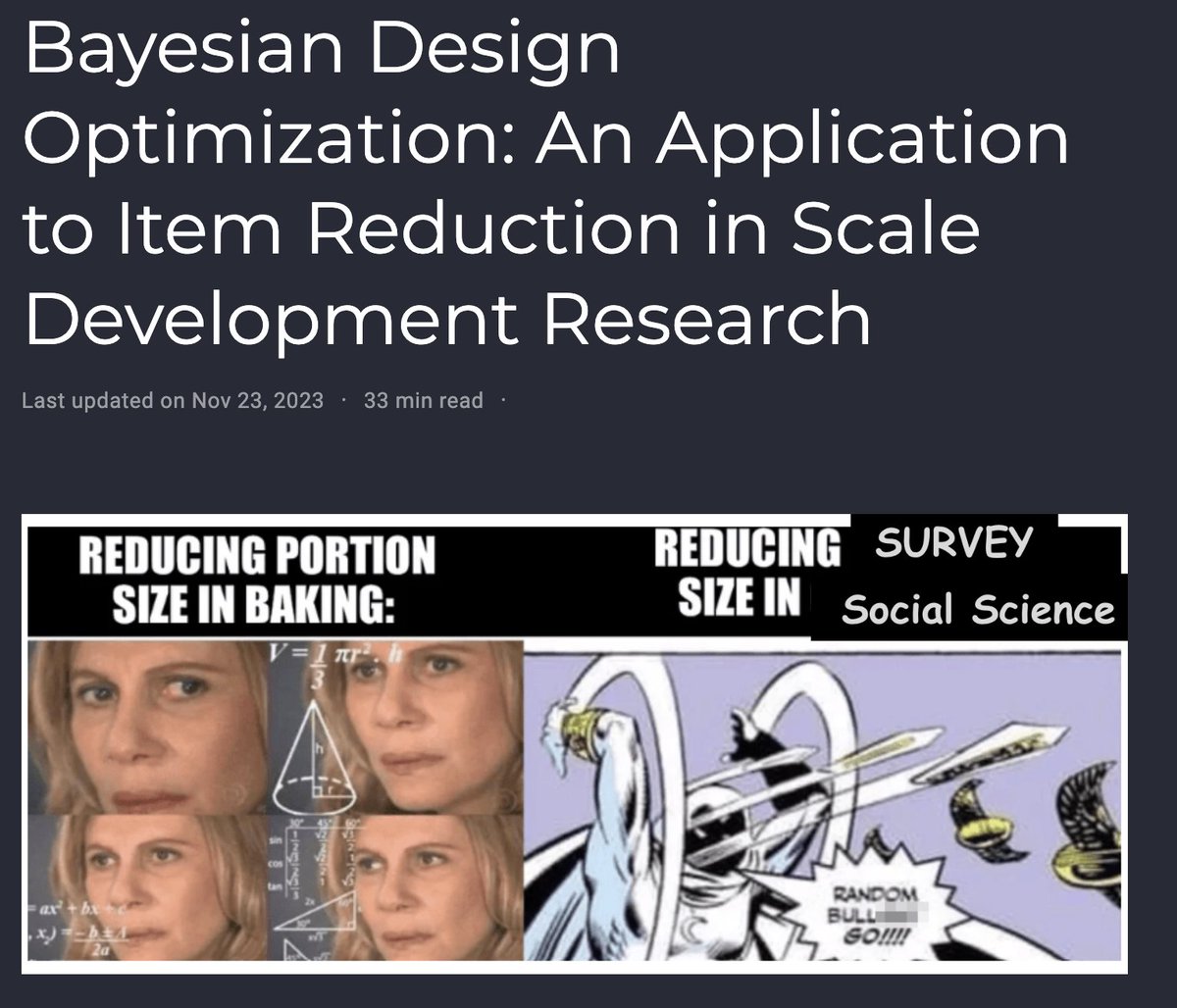
1/N Some New Years reading to share! In this post, we dive into Cronbach's alpha, Fisher info, KL divergence, and Bayes factors as measures of item informativeness. We then use these metrics to reduce a large 100 item pool down to just 15 items while maximizing information 🤖
Nathaniel Haines tweet media
Nathaniel Haines@Nate__Haines

WOAH! This works super well. The reduced set of 30 items (from a full 224 item set) shows correlations of r >= .88 with the full set across all 11 factors in the model 🤓🤖. Some examples below. I am actually very surprised! Now, to make sure I didn't make any mistakes.. 🤔

English
5
10
37
31.9K
Jonas K. Lindeløv
Jonas K. Lindeløv@jonaslindeloev·
@Nate__Haines Well done! Terminology note: "Bayesian Optimization" denotes a particular black-box algorithm for finding the combo of parameter values that maximizes a utility function. It's used a lot in Design Of Experiments (DOE). "Bayesian Design Optimization" sound like that but isn't.
English
1
0
2
141
Jonas K. Lindeløv retweetet
v
v@iavins·
Collection of insane and fun facts about SQLite. Let's go! SQLite is the most deployed and most used database. There are over one trillion (1000000000000 or a million million) SQLite databases in active use. It is maintained by three people. They don't allow outside contributions.
English
127
1.3K
11.1K
2.2M
Jonas K. Lindeløv
Jonas K. Lindeløv@jonaslindeloev·
@mattansb BTW, we primarily relied on Bayesian inference, but we had added p-values after rejection from another journal for the use of "unconventional statistics".
English
0
0
1
51
Jonas K. Lindeløv
Jonas K. Lindeløv@jonaslindeloev·
@mattansb Rejection with reference to one reviewer whose main criticism was, "to my knowledge, an effect size less than 1 SD cannot be significant". I replied with two lines of R code demonstrating d=0.01 can be significant. But no reply. This was a very high-impact journal.
English
1
0
4
98
Mattan S. Ben-Shachar
Mattan S. Ben-Shachar@mattansb·
Hey #statsTwitter, what's that worst statistics-related comment/request you got from a reviewer or editor? Did you comply - did you do what they asked? If not, how did you push back?
English
9
2
17
17.9K
Jonas K. Lindeløv
Jonas K. Lindeløv@jonaslindeloev·
@SolomonKurz Left. At the right, it would be next to impossible to see extreme "low" lines.
English
0
0
1
226
Solomon Kurz
Solomon Kurz@SolomonKurz·
2 ways of showing Bayesian uncertainty. Left is the posterior distribution with the mean line in bold, and the thinner lines 100 random HMC draws. The right is the same, but with semitransparent fill for each of the 100 draws. Thoughts? [#sec-Beta-binomial" target="_blank" rel="nofollow noopener">solomon.quarto.pub/sr2rstan/12.ht…] #RStats #rstan
Solomon Kurz tweet media
English
19
6
74
11.1K
Microsoft Loop
Microsoft Loop@MicrosoftLoop·
Introducing Loop 2.0! We got a fresh new look 🔥🔥🔥 Beyond the new #MicrosoftLoop UI, we've made it easier to get to your meeting notes, favorites, recent, and more. #NewInLoop Check it out: msft.it/6018laHsr Here's what we've been brewing 👇
Microsoft Loop tweet media
English
18
50
228
24.2K
Jonas K. Lindeløv
Jonas K. Lindeløv@jonaslindeloev·
@AJThurston @AllenDowney Always a great point to make! I like to say that we should teach *statistical modeling*. Then testing becomes the easy part. For the {infer} package, that would be spending 75+% of the time on the specify() step.
English
0
0
4
156
Jonas K. Lindeløv retweetet
Giv Effektivt
Giv Effektivt@giveffektivt·
Gør mere godt for pengene ved at give effektivt. Se vores nye explainer-video og del!
Dansk
0
3
2
396
Satisfactory
Satisfactory@SatisfactoryAF·
what date do you think 1.0 is releasing? if you guess correctly, you will officially be allowed to brag about it on the internet for getting it right.
English
724
46
1.8K
96.7K
Dr. Amanda Kay Montoya
Dr. Amanda Kay Montoya@AmandaKMontoya·
@SJKim_Psych @jonaslindeloev Jolynn Pek taught a power analysis class when I was in grad school hybridpower was a product of that class, and I think we either learned about Samantha’s method or I learned about it later. But that class got me really interested in power analysis.
English
1
0
0
53
Jonas K. Lindeløv
Jonas K. Lindeløv@jonaslindeloev·
There are no R packages to calculate sample size (/power) given uncertain population parmeters. I.e., like specifying distributions over mu and sigma in a t-test rather than point estimates. Must. Resist.
English
4
2
33
9.4K
Jonas K. Lindeløv
Jonas K. Lindeløv@jonaslindeloev·
@fusaroli @lakens For now, just think t-test level complexity: mu and sigma. Then we can expand from there 😁 The thing I don't like about sensitivity is that it's just eye-balling/intuition-building. Exactly one *decision* has to be made in the end. One sample size; Run or don't run.
English
1
0
1
219
Riccardo Fusaroli
Riccardo Fusaroli@fusaroli·
@jonaslindeloev @lakens Also do you really know eg the sd of random effects by participant or by stimulus? I do not and it has a huge impact on power. One could do a sensitivity analysis, but adding uncertainty does give more conservative estimates for sensitivity as well, so…
English
1
0
1
229
Jonas K. Lindeløv
Jonas K. Lindeløv@jonaslindeloev·
@MetinBulus I have not; thank you! This seems to align with the approach I had in mind. Do you have an evaluation of the merits of this approach? The package/github repo seems to have gone quite unnoticed.
English
0
0
1
554
Jonas K. Lindeløv
Jonas K. Lindeløv@jonaslindeloev·
@lakens Please say more :-) I'm often involved deciding whether to do a study or not, i.e., whether the required sample size surpasses the budget. Smallest eff of interest is absolute (non-standardized); We have imprecise info about true effect, impact of design differences, etc.
English
1
0
1
591
Daniël Lakens
Daniël Lakens@lakens·
@jonaslindeloev One good reason for this is you should not do a power analysis if you are too uncertain about SD, and the effect size should be based on the smallest effect size of interest. So, in best practices there should be no need for such an R package.
English
2
0
6
1K