Thomas Kang

4.3K posts

Thomas Kang banner
Thomas Kang

Thomas Kang

@kangthomas

economic history, education and development | professor @fceufrgs

Porto Alegre, Brasil Beigetreten Nisan 2010
1.5K Folgt2.9K Follower
Angehefteter Tweet
Thomas Kang
Thomas Kang@kangthomas·
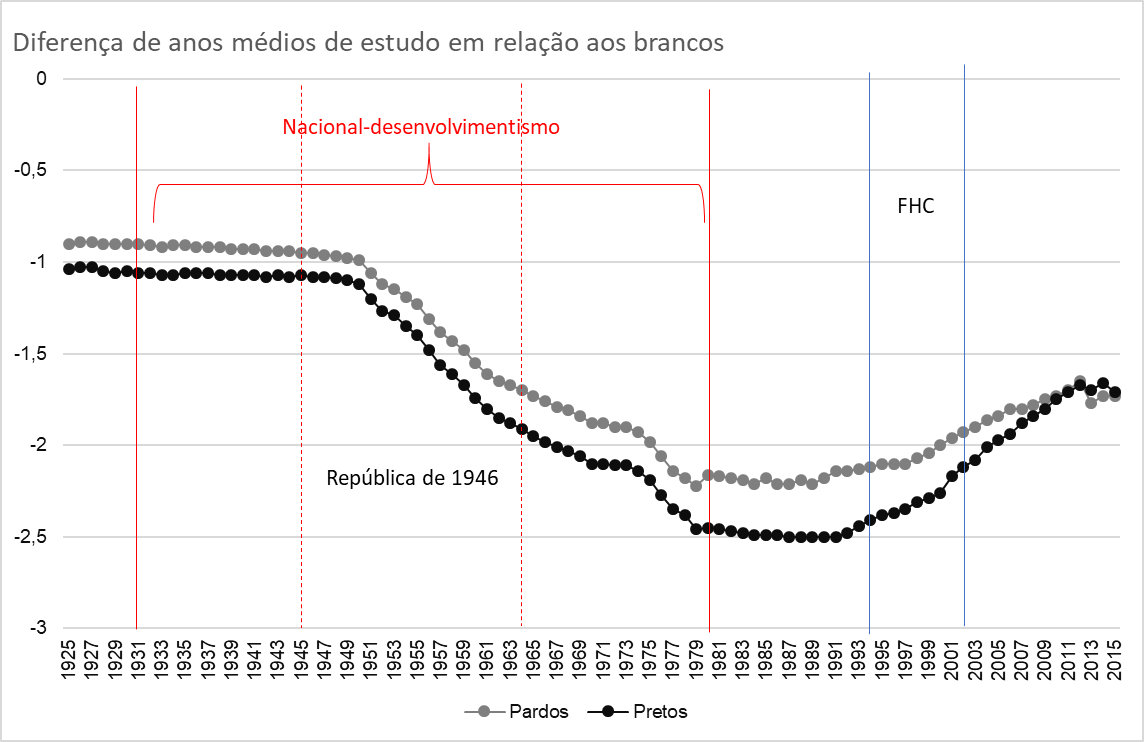
Eu meio que abandonei o X - estou mais no bsky. Mas aproveito para divulgar novo paper com Julia Walter sobre anos de escolaridade no Brasil, 1925-2015. O ponto é: Barro e Lee estão errados para o Brasil (como o @lucasmation já tinha apontado), então refizemos tudo +
Economic History of Developing Regions@HistoryRegions

🚨New article available online! "A new dataset of average years of schooling in Brazil, 1925–2015" by Júlia R. Walter & @kangthomas tandfonline.com/doi/abs/10.108…

Português

1
2
12
1.8K
Thomas Kang
Thomas Kang@kangthomas·
@jcaetanoleite Pois é, postei sem pensar muito. O ponto é o quanto a mudança de politica afetou o sujeito entrante (15 anos) pra mudar o ângulo. Tô com muito sono pra pensar agora kk.
Português
1
0
1
60
Thomas Kang
Thomas Kang@kangthomas·
@jcaetanoleite Opa, fez isso com os nossos dados? Talvez teria que pensar em uma defasagem, já que é estoque, ainda que não mude teu argumento. Como tinha muito mais entrante no estoque do que gente saindo, os últimos devem ter peso pequeno.
Português
1
0
1
111
Dandi no Consignado
Dandi no Consignado@jcaetanoleite·
Ainda não entendeu o que aconteceu? Deixa eu te ajudar um pouquinho mais...
Dandi no Consignado tweet media
Português
3
2
33
1.7K
Dandi no Consignado
Dandi no Consignado@jcaetanoleite·
Galera, alguém teria uma boa ementa, ou slides, de aulas de Formação Econômica do Brasil/ História Econômica do Brasil antes da independência que tenham papers mais contemporâneos?
Português
6
0
48
4.9K
Thomas Kang
Thomas Kang@kangthomas·
@claudferraz Meu ponto é que era pior antes de municipalizar, mesmo sendo ruim agora.
Português
1
0
0
59
Claudio Ferraz
Claudio Ferraz@claudferraz·
Brazil is an outlier in terms of State Capacity to collect taxes. The big question is why that same State Capacity does not translate into public goods and service delivery and my guess is that is has to do with the decentralization of policies via-a-vis centralization of tax
The Economist@TheEconomist

The world’s most complicated tax system is holding back Brazil’s growth. The government collects more tax revenue than most of its peers. But the system is a mess economist.com/the-americas/2…

English
17
45
616
45.1K
Thomas Kang retweetet
Jesús Fernández-Villaverde
Jesús Fernández-Villaverde@JesusFerna7026·
Over the weekend, I wrapped up a new version of my paper “The Neoclassical Growth of China” with Lee Ohanian and Wen Yao: sas.upenn.edu/~jesusfv/Neocl… The main change from previous versions is that we thoroughly redid the analysis using PWT 11.0. This was important because it allowed us to extend the sample to 2023. The additional years are quite informative, although to our pleasant surprise, in full agreement with what the model in the previous version of the paper had predicted using data up to 2019. I include my favorite figure from the paper in this post, which compares China with other East Asian economies at similar income per capita levels. To do so, we identify the year in which each of China, Korea, and Taiwan reached Japan’s 1950 per capita income level; the earliest year available for Japan in PWT 11.0. Japan's income per capita in 1950 was $3,138 (2021 PPP dollars), matching China’s in 1995, Korea’s in 1972, and Taiwan’s in 1961. Also, this initial per capita income of $3,138 is close to the middle-income threshold ($3,000) used by many international institutions and statistical agencies. We then trace the evolution of GDP and investment for each economy from that point onward. What do we see? First, China’s growth since 1995 has been remarkably similar to that of other East Asian economies when they were at the same level of GDP per capita, even though the distance to the technological frontier (proxied by the U.S.) was larger for China than for other East Asian economies because China took off later. Second, the growth pattern of all East Asian countries is amazingly similar. Third, in this pattern, there is a clear slowdown in growth once a country gets to around two-thirds of U.S. income per capita. While China might depart from the growth pattern of other East Asian countries in the future, there is absolutely nothing in the growth data to suggest this has happened so far. We tried all the variations of the same figure one could imagine. Some are in the paper, some got “cut” from the draft. But the main point is sharp: China is different because of its population size, not because of its growth pattern. Personally, I also think this graph shows that the burden of proof lies with those who argue that China’s future growth will differ from that of other East Asian economies. With a total fertility rate of 0.93, my bet is that China’s growth future will not be that different from Japan’s present.
Jesús Fernández-Villaverde tweet media
English
34
103
480
79.4K
carolina fernandes
carolina fernandes@carolaf810·
@kangthomas Estava lendo sobre a transição demográfica chinesa e o gráfico me chamou a atenção. A Europa iniciou a transição demográfica bem antes mas a velocidade que ela está acontecendo na Ásia é surpreendente.
Português
2
0
1
69
Thomas Kang retweetet
Thales ZP
Thales ZP@thaleszp·
Texto sobre nosso projeto com o Modern Endangered Archives Program/UCLA. Ajudem na divulgação, precisamos ter uma base Parker-Gallman para o Brasil! @TP37121645/csb_ffICp_atHJXLeocUqe2qbwgFc8Zm6iPte6OvUPftNqbXXh0aYVuYyIB5Zz3JbfX_5soRi633JRi2_qQXju-29Q" target="_blank" rel="nofollow noopener">digital.estadao.com.br/@TP37121645/cs…
Português
2
12
33
3K
Thomas Kang
Thomas Kang@kangthomas·
@straightedge I may have been too assertive. I use latex presentations myself sometimes, but not the standard beamer design. Congratulations to your slides by the way (and the paper is great too!)
English
1
0
1
48
Nathan Lane
Nathan Lane@straightedge·
@kangthomas I totally get markup languages.. but beamer can really push us into some poor communication practices
English
1
0
1
137
Thomas Kang retweetet
Renato Perim Colistete
Renato Perim Colistete@RPColistete·
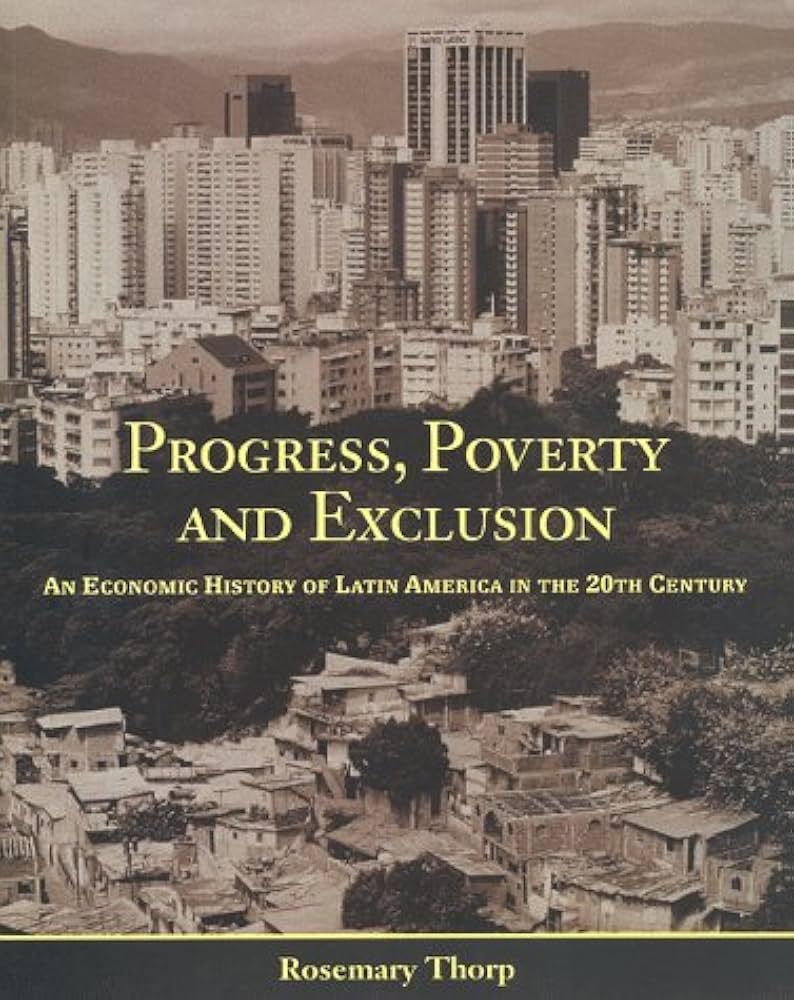
Tristeza com a notícia do falecimento de Rosemary Thorp. Pessoa íntegra, generosa, apaixonada pelo que fazia e que tive o privilégio de tê-la como orientadora. RIP, Rosemary, não te esqueceremos.
Renato Perim Colistete tweet mediaRenato Perim Colistete tweet media
Português
1
3
18
723
Thomas Kang retweetet
Rick Hornbeck
Rick Hornbeck@Rick__Hornbeck·
Hi all, please spread the word and we hope everyone can make good use of this new data drop: CMFdata.org The full surviving establishment-level Census of Manufactures manuscripts from 1850, 1860, 1870, and 1880!
English
5
123
346
61K
Thomas Kang retweetet
Renato Perim Colistete
Renato Perim Colistete@RPColistete·
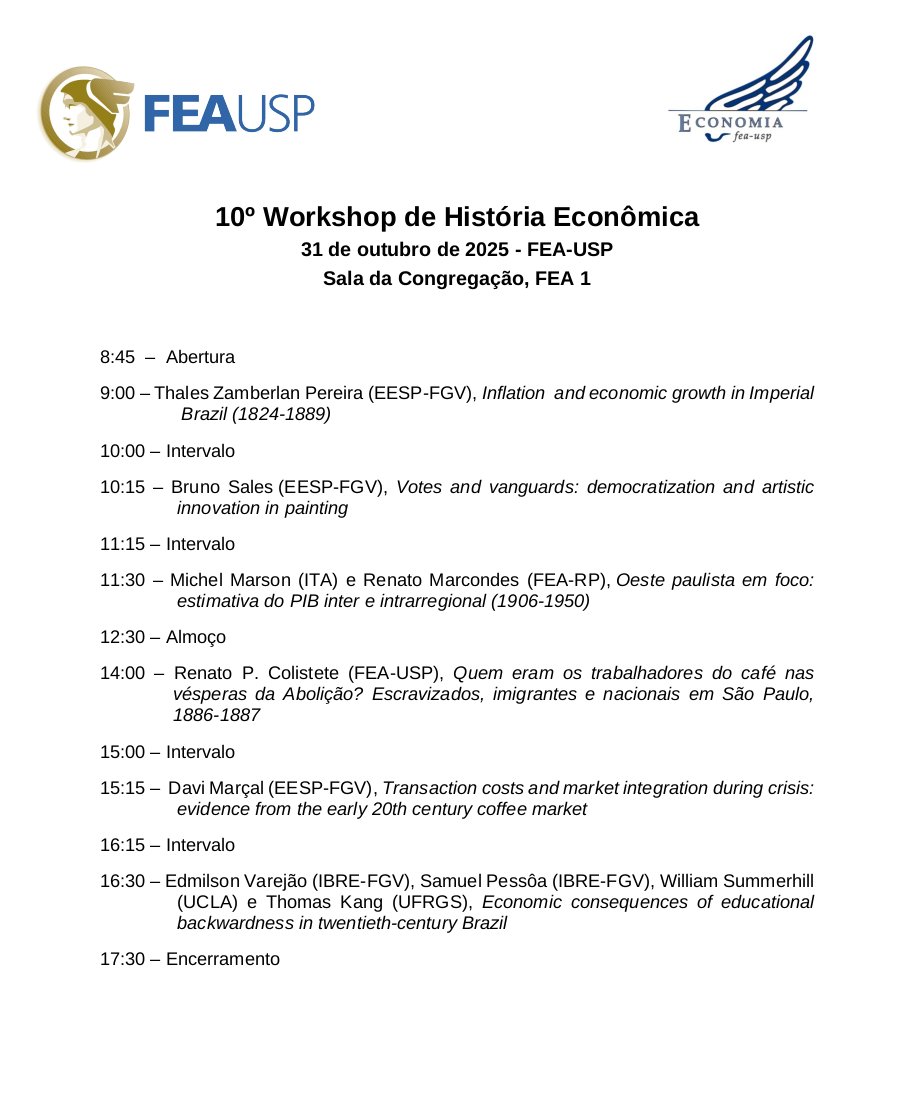
Na próxima sexta-feira, dia 31/10, teremos o Workshop de História Econômica da FEA-USP, evento já na sua 10ª edição destinado à apresentação e discussão intensiva de pesquisas em andamento ou recém-concluídas. Todas as pessoas interessadas são bem-vindas. A programação:
Renato Perim Colistete tweet media
Português
3
15
112
12K
Thomas Kang
Thomas Kang@kangthomas·
Para quem tiver interesse, o Journal of Economic History fez uma página com todos os artigos do Joel Mokyr publicados lá (como já haviam feito quando a Claudia Goldin venceu o Nobel): cambridge.org/core/journals/…
Português
0
1
7
343
Thomas Kang retweetet
PesquisaFapesp
PesquisaFapesp@PesquisaFapesp·
Vencedores do Nobel de Economia investigaram a importância da inovação. Joel Mokyr, Philippe Aghion e Peter Howitt buscaram entender o papel da tecnologia no desenvolvimento econômico. bit.ly/4nTRGAG #nobelprize #prêmionobel2025 #nobeleconomia
Português
0
2
14
2K
Thomas Kang
Thomas Kang@kangthomas·
@BeatrizGietner Não por isso, é só pela anedota: a primeira tese dele não foi aprovada pela banca no MIT. A ideia não é desmotivar com isso. A Economia hoje é bem mais interdisciplinar do que era...
Português
0
0
1
39