MSM Watch

4.8K posts

MSM Watch

MSM Watch

@msmwatchcom

We expose lies & fabrications of mainstream media

Onchain Beigetreten Ekim 2025
272 Folgt178 Follower
MSM Watch
MSM Watch@msmwatchcom·
This post about BTC Quantum threat preparedness is more meaningful than the gibberish from @stephanlivera @TFTC21 @adam3us @_jonasschnelli_ and other BTC maxis
Dan@robustus

@nic_carter My position has not changed: - Quantum is the first/last meaningful technical issue BTC faces - The timelines are likely materially longer than the quantum bulls think - Bitcoin community should quite obviously prioritize quantum safety with a credible plan immediately

English
0
0
0
2
The Wolf Of All Streets
The Wolf Of All Streets@scottmelker·
The defensiveness in the comments of this simple tweet from my news team reinforce that we are more of a cult or religion than simply people with a shared belief in an asset. Funny thing is, years ago I had the same emotional defensiveness to an article written by @TheStalwart. Embarrassing in hindsight and I eventually approached him at a conference and said as much.
The Wolf Of All Streets@scottmelker

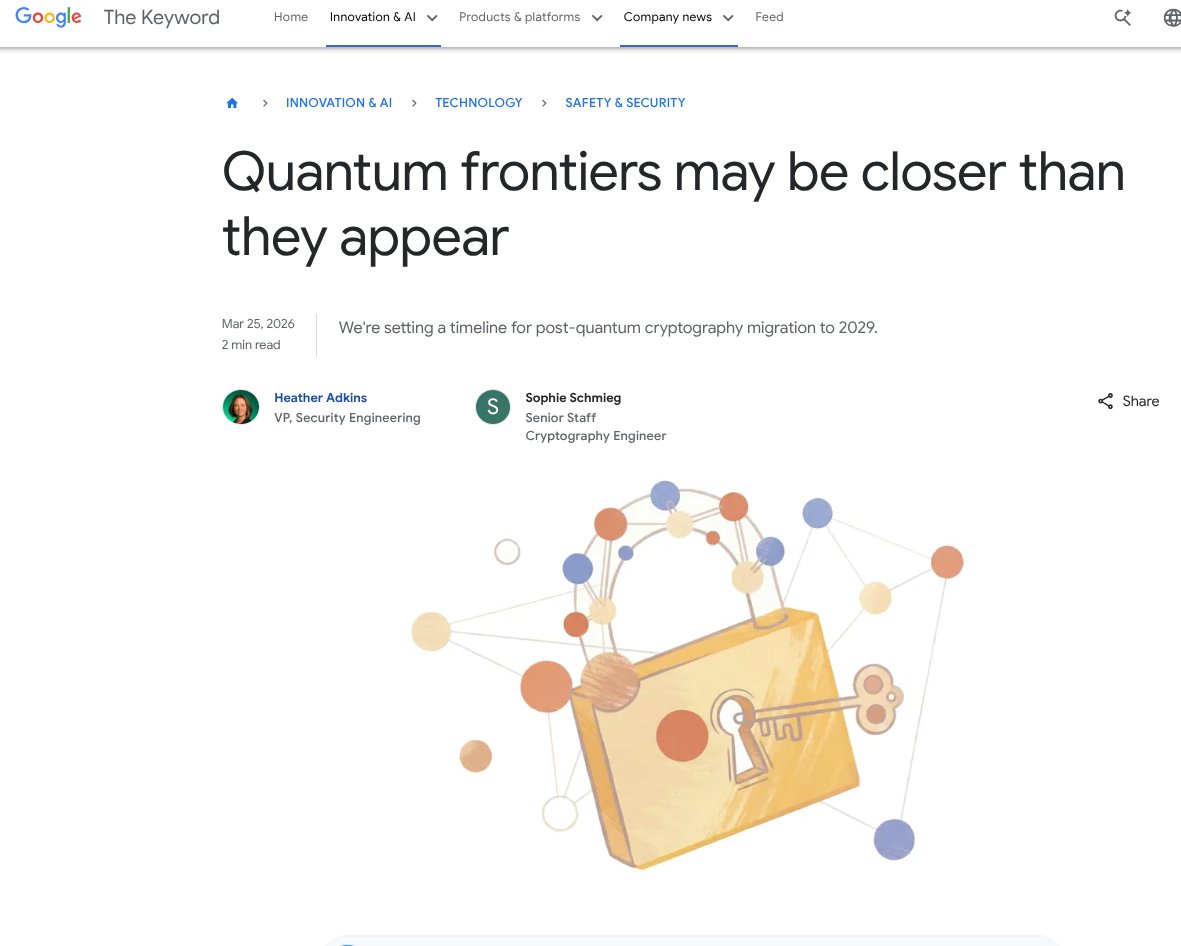
NEW: 🚨 GOOGLE RESEARCH FINDS QUANTUM COMPUTERS COULD BREAK BITCOIN, ETHEREUM, AND MOST MAJOR BLOCKCHAINS SOONER THAN EXPECTED

English
39
2
64
23.8K
MSM Watch
MSM Watch@msmwatchcom·
@stephanlivera It's very misleading to state that everyone is FUDDING it as “Why haven’t the devs fixed this already?!” Almost everyone is simply asking if BTC Devs even have some sort of a roadmap...
English
0
0
0
3
Stephan Livera
Stephan Livera@stephanlivera·
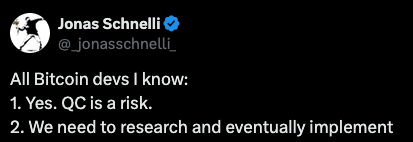
So everyone's talking about Google Quantum AI’s new research paper, “Securing Elliptic Curve Cryptocurrencies against Quantum Vulnerabilities: Resource Estimates and Mitigations.” Cue the predictable Bitcoin quantum FUD: “Why haven’t the devs fixed this already?!” Reality is, it’s not a simple patch. Post-quantum signatures come with serious tradeoffs and Bitcoin faces unique constraints that general tech and web apps don’t. Post-quantum signatures are generally much larger transaction sizes - often 5–50× or more in the signature-heavy parts → higher fees, more compute. Hardware wallets would need a big shift. The choice of scheme (stateless, stateful, or hybrid) would change how we custody coins. HD wallets, watch-only wallets, FROST, MuSig2, silent payments… some of the privacy and UX wins we love today could be gone, degrade or require clunky workarounds. Bitcoin has to stay decentralized: small blocks, permissionless validation. Web servers can throw bigger payloads around; Bitcoin can’t without sacrificing the very properties that make it Bitcoin. Even “standard” post-quantum schemes like ML-DSA (which Android is integrating) produce signatures 35–66× larger than today’s ~70-byte ECDSA signatures, making them too heavy for Bitcoin’s tight constraints on block space, fees, and hardware. That’s why researchers like @n1ckler (and @blksresearch) are doing vital work right now: exploring the right tradeoffs for Bitcoin specifically. Hash-based crypto? Lattice-based? Something else? Which Bitcoin-optimized forms of SPHINCS make sense? SHRINCS (tiny ~324-byte stateful signatures with static backups) or SHRIMPS (for multi-device stateful setups)? How many times will a user sign with the same key? Can we assume user devices can securely maintain state, or do we need fully stateless fallbacks? Would we expand the block size with some kind of quantum witness discount? What do we do about quantum-vulnerable coins? These are the hard, Bitcoin-specific questions that matter. Practical steps are already being taken. BIP 360, proposed by @cryptoquick, @Ethan_Heilman, and @isabelfoxenduke, is a thoughtful first step: it introduces a new Pay-to-Merkle-Root (P2MR) output type that gives us Taproot-like functionality without the quantum-vulnerable keypath spend. It’s designed as an enabling primitive — conservative, upgradable, and focused on reducing address exposure risks while the ecosystem figures out the heavier lifting of actual post-quantum signatures. Bitcoin builders have spent 15+ years improving what is otherwise a very clunky experience in a decentralized environment. Rushing big protocol shifts risks breaking that. This isn’t something to knee-jerk “just fix.” It deserves careful, ongoing research and exploration, not panic. That said, informed skeptics like @reardencode and @bergealex4 are also right to push back. The paper improves resource estimates for breaking secp256k1 (fewer logical qubits, potentially minutes-long attacks on a hypothetical machine), but as @reardencode notes, it’s still theorycrafting: we’d need a large-scale fault-tolerant quantum computer with hundreds of thousands of physical qubits maintaining coherence for minutes — something far beyond today’s best devices (hundreds of qubits coherent for microseconds). A true CRQC capable of breaking ECDSA by 2029 (or even soon after) remains a big maybe. Bitcoin's strength is in deliberate, methodical and conservative steps to address threats.
Stephan Livera tweet mediaStephan Livera tweet media
English
20
36
188
21.6K
MSM Watch
MSM Watch@msmwatchcom·
Dear @PeterMcCormack can you get @adam3us & @nic_carter in the same room and do an episode to hash all of this out... It's pathetic that we keep having to weave together the points in disparate posts
Adam Back@adam3us

@TFTC21 Also bullshit as quantum algorithms are relatively ineffective vs hash functions. Need a cryptographically relevant non vaporware physical quantum computer (my guess is 20 years minimum) and interim focus on PQ signatures upgrade interim like the SHRINCs work from @blksresearch.

English
0
0
0
3
MSM Watch
MSM Watch@msmwatchcom·
There is currently no formal BIP, no concrete proposed post-quantum scheme, no clear roadmap, and many prominent Bitcoin developers continue to downplay or deny the associated risks. BIP 360, in its current form, contains no post-quantum cryptography and does not constitute a viable solution to quantum threats. It primarily introduces minor adjustments to Taproot. The "Shrimps" proposal was released only yesterday and is far from being a widely accepted or established standard.
English
0
0
0
3
TFTC
TFTC@TFTC21·
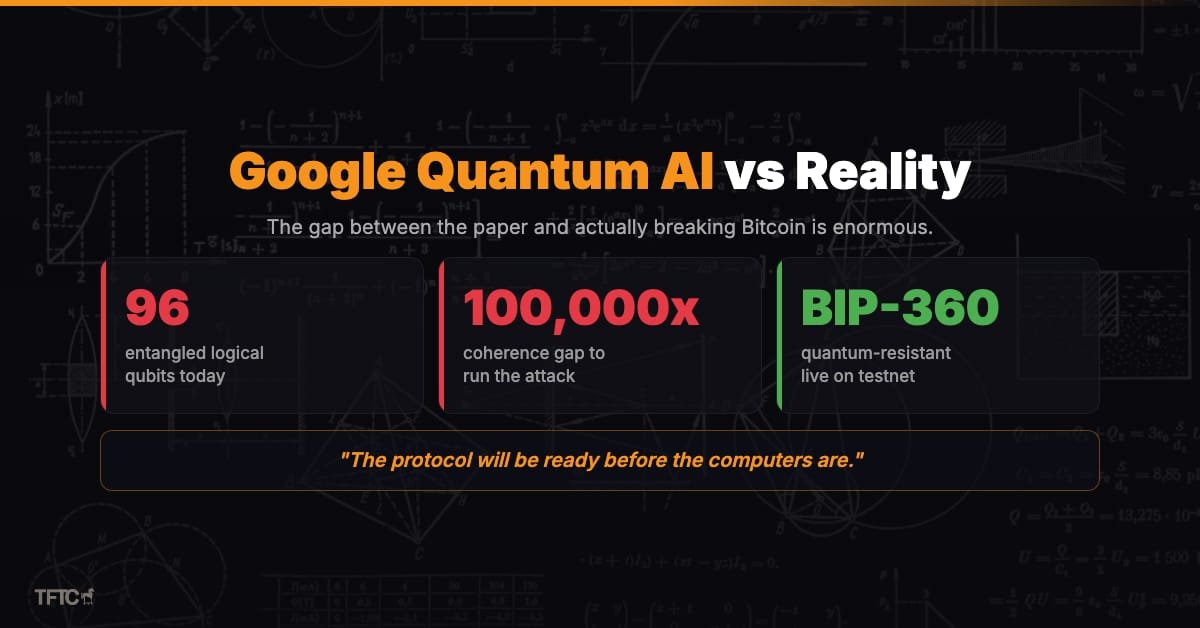
A quantum computer just "broke" Bitcoin. Except it didn't. Not even close. Google Quantum AI published a paper showing they've cut the theoretical ECDSA attack down to 1,200 logical qubits. They didn't publish the circuits. They didn't run the attack. They published a zero-knowledge proof that their math works, then cited national security. Here's where we actually are. Entangled logical qubits achieved so far: 96 Coherence time: 1-2 seconds Time the attack requires: days Physical qubits needed: 500,000 Largest quantum computer today: 1,200 noisy, non-error-corrected qubits That's a 100,000x coherence gap. It's not a software problem. It's a fundamental engineering problem that nobody has solved. But here's what most people miss. Bitcoin developers aren't waiting for a crisis. They're already shipping. SHRIMPS: post-quantum signatures 3x smaller than NIST standards, built for Bitcoin's block space constraints. BIP-360: a quantum-resistant output type already live on testnet, with BTQ Technologies running transactions through it. The full upgrade could take 7 years. That's why the work started now. The protocol will be ready before the computers are.
TFTC tweet media
English
73
276
1.4K
184.6K
MSM Watch
MSM Watch@msmwatchcom·
There is currently no formal BIP, no concrete proposed post-quantum scheme, no clear roadmap, and many prominent Bitcoin developers continue to downplay or deny the associated risks. BIP 360, in its current form, contains no post-quantum cryptography and does not constitute a viable solution to quantum threats. It primarily introduces minor adjustments to Taproot. The "Shrimps" proposal was released only yesterday and is far from being a widely accepted or established standard.
English
0
0
0
3
Alex Thorn
Alex Thorn@intangiblecoins·
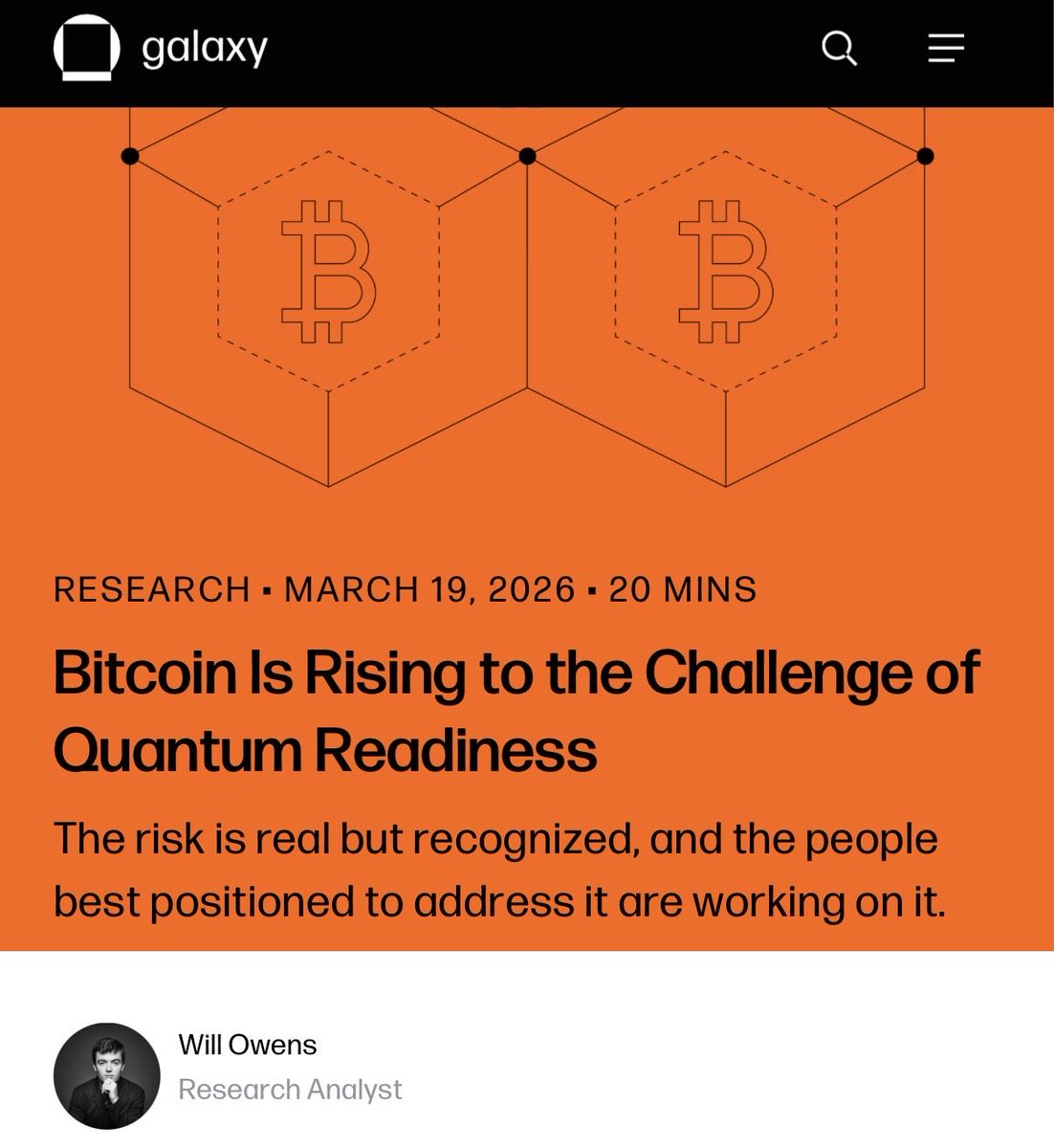
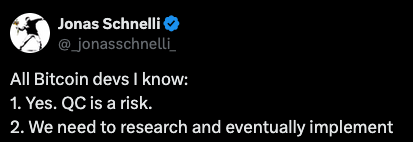
quantum computing may threaten classical cryptography, including the crypto that powers bitcoin transactions if there’s even a chance that’s true, the bitcoin community should work to prepare and mitigate the good news is that bitcoin devs are indeed working on it
Alex Thorn tweet media
English
17
41
200
28.6K
MSM Watch
MSM Watch@msmwatchcom·
There is currently no formal BIP, no concrete proposed post-quantum scheme, no clear roadmap, and many prominent Bitcoin developers continue to downplay or deny the associated risks. BIP 360, in its current form, contains no post-quantum cryptography and does not constitute a viable solution to quantum threats. It primarily introduces minor adjustments to Taproot. The "Shrimps" proposal was released only yesterday and is far from being a widely accepted or established standard.
English
0
0
0
9
MSM Watch
MSM Watch@msmwatchcom·
There is currently no formal BIP, no concrete proposed post-quantum scheme, no clear roadmap, and many prominent Bitcoin developers continue to downplay or deny the associated risks. BIP 360, in its current form, contains no post-quantum cryptography and does not constitute a viable solution to quantum threats. It primarily introduces minor adjustments to Taproot. The "Shrimps" proposal was released only yesterday and is far from being a widely accepted or established standard.
English
0
0
0
10
TFTC
TFTC@TFTC21·
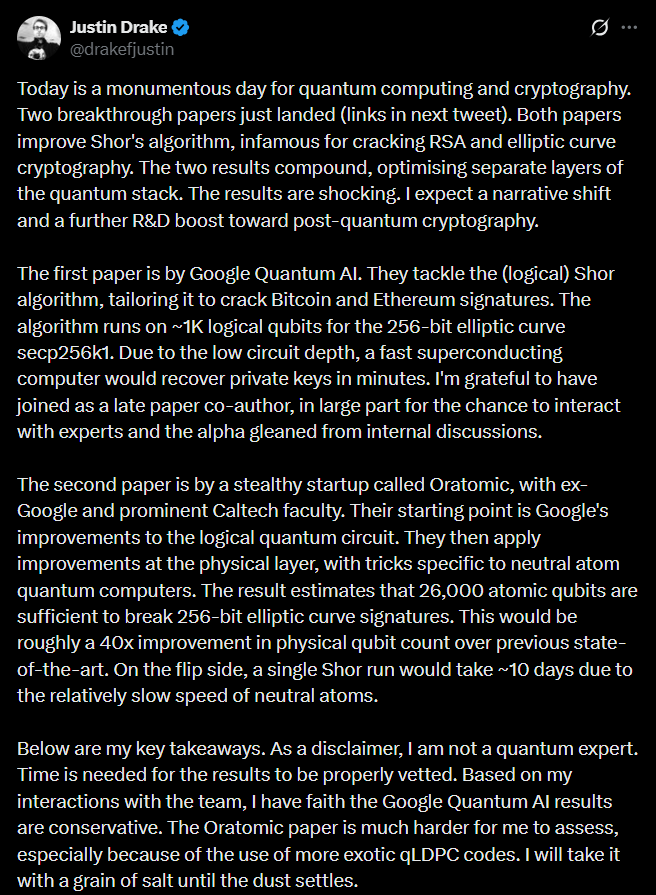
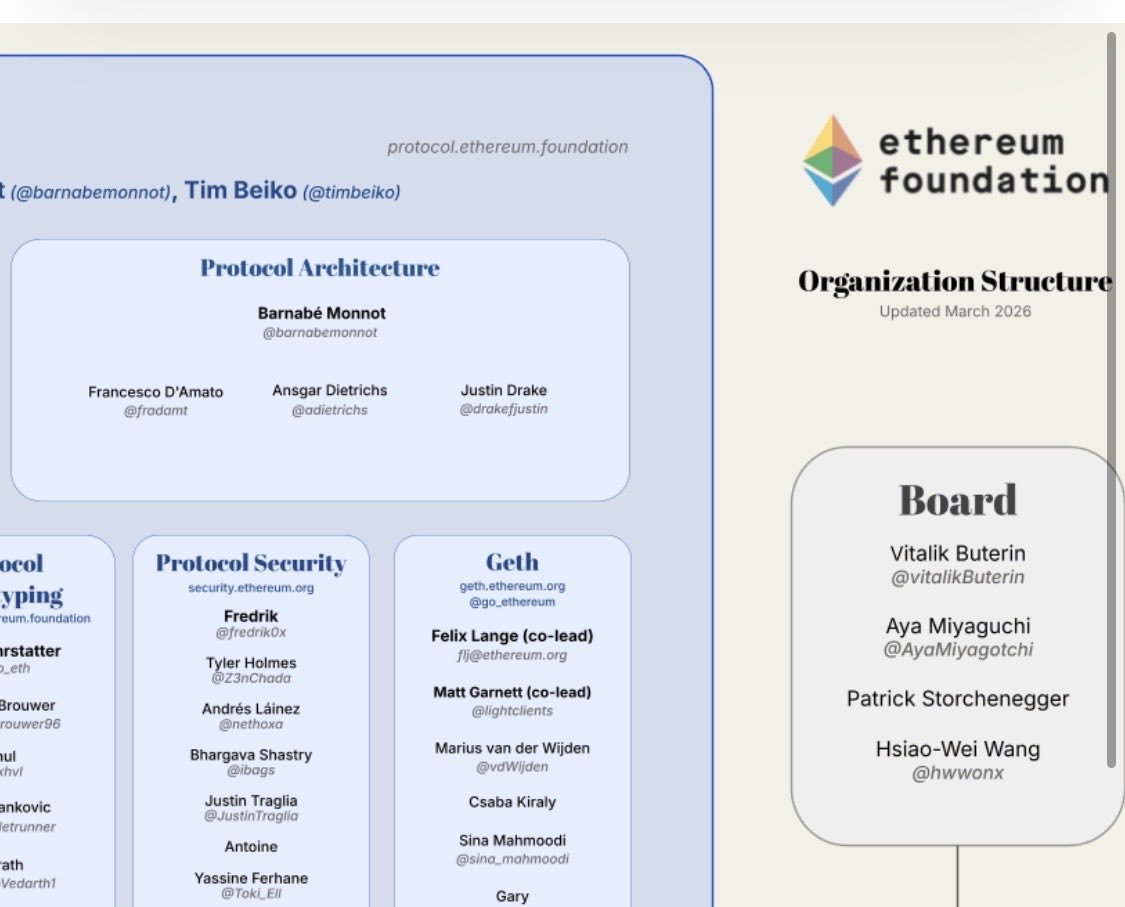
A co-author on Google's quantum paper calls himself a "Bitcoin security researcher." He actually works for the Ethereum Foundation. Then at the end of his own thread about breaking Bitcoin's cryptography, he casually drops that "Bitcoin PoW is cooked." Totally unbiased research.
TFTC tweet mediaTFTC tweet media
TFTC@TFTC21

A quantum computer just "broke" Bitcoin. Except it didn't. Not even close. Google Quantum AI published a paper showing they've cut the theoretical ECDSA attack down to 1,200 logical qubits. They didn't publish the circuits. They didn't run the attack. They published a zero-knowledge proof that their math works, then cited national security. Here's where we actually are. Entangled logical qubits achieved so far: 96 Coherence time: 1-2 seconds Time the attack requires: days Physical qubits needed: 500,000 Largest quantum computer today: 1,200 noisy, non-error-corrected qubits That's a 100,000x coherence gap. It's not a software problem. It's a fundamental engineering problem that nobody has solved. But here's what most people miss. Bitcoin developers aren't waiting for a crisis. They're already shipping. SHRIMPS: post-quantum signatures 3x smaller than NIST standards, built for Bitcoin's block space constraints. BIP-360: a quantum-resistant output type already live on testnet, with BTQ Technologies running transactions through it. The full upgrade could take 7 years. That's why the work started now. The protocol will be ready before the computers are.

English
74
245
1.5K
127.6K
MSM Watch
MSM Watch@msmwatchcom·
@notgrubles You can add Google and Caltech to that list too They're left wing elitist BS factories
English
0
0
0
3
grubles
grubles@notgrubles·
When are people going to realize the Ethereum Foundation is a bullshit factory? This is just the latest after all of their buzzword salad roadmaps serving as a carrot-on-a-stick for retail, whom they dump ETH on relentlessly. Bullshit factory.
TFTC@TFTC21

A co-author on Google's quantum paper calls himself a "Bitcoin security researcher." He actually works for the Ethereum Foundation. Then at the end of his own thread about breaking Bitcoin's cryptography, he casually drops that "Bitcoin PoW is cooked." Totally unbiased research.

English
6
17
113
5.4K
Fred Krueger
Fred Krueger@dotkrueger·
nic carter is the lead VC in a 20 million round for project eleven -- focused on extracting profit from quantum BTC risk. Incentives.
English
67
44
703
32.4K
Nebraskangooner
Nebraskangooner@Nebraskangooner·
@scottmelker So someone created a problem so that they can fix it and then brag about fixing the problem (even though they're the one that created it?)
English
11
1
44
2.7K
MSM Watch
MSM Watch@msmwatchcom·
@jyn_urso You really should try living in an islamist country before thinking you know anything of what it's like to live there and what westerners can constructively do about it. Peak cognitive dissonance.
GIF
English
0
0
0
4
nic carter
nic carter@nic_carter·
Real answer These people have crafted their entire identities around a bitcoin ideology that presupposes bitcoins ontological perfection. Any attempts to change it or point out issues is heresy. Anyone that asks questions is an outsider no matter how long they have been a bitcoiner. Anyone who disturbs the balance must be doing so for impure financial reasons like shitcoining etc. They would truthfully rather that Bitcoin fail entirely than admit they were wrong. Suicide bomber ideology
English
19
5
140
5.2K
MSM Watch
MSM Watch@msmwatchcom·
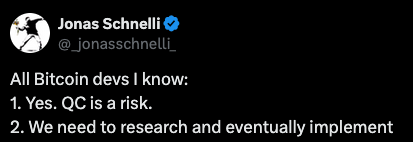
@nvk Even the BTC devs disagree with you
MSM Watch tweet media
English
0
0
0
3
nvk 🌞
nvk 🌞@nvk·
Quantum concern on Bitcoin is a psyop.
English
65
101
976
50.8K
MSM Watch
MSM Watch@msmwatchcom·
@Cloudwatch199 It's not the American dream if they just siphon the cash off back to India... Why should citizens be subject to the law while immigrants are able to operate in the grey area?
English
0
0
0
313
Sidharth
Sidharth@Cloudwatch199·
Sara Gonzales confronted an H-1B tech worker at his wife's food truck like she caught a criminal. Let me get this straight — this man works a full-time tech job, pays taxes, and his wife started a small business that serves the local community and probably employs Americans. His wife runs it. He helps after his 9-5. He doesn't get paid. Is there a technical gray area in immigration law about helping at a spouse's business? Yes. Immigration lawyers can debate where the line is. But this is an immigrant family creating jobs, serving their neighbors, and contributing to the local economy. This is the American dream in action. And instead of recognizing that, Why should one show up with cameras to turn a hardworking family into rage bait.
Sara Gonzales@SaraGonzalesTX

I confronted an H-1B tech worker ILLEGALLY running a food truck business:

English
266
280
3.7K
456.1K