Nāvalaṃ

491 posts

Nāvalaṃ banner
Nāvalaṃ

Nāvalaṃ

@naavalam

...lingering memories of a lost civilization

Beigetreten Kasım 2024
159 Folgt255 Follower
Nāvalaṃ
Nāvalaṃ@naavalam·
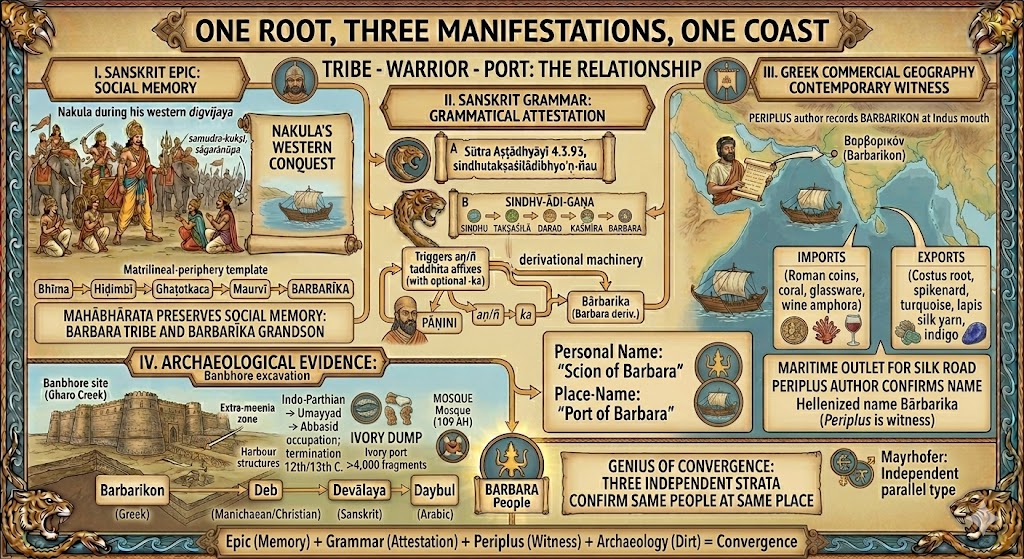
One root, three manifestations, one coast: What is the actual relationship between the tribe, the warrior, and the port? ➖ Mahābhārata locates a Barbara tribe on the sea-coast (samudra-kukṣi, sāgarānūpa) at the western frontier of Bhāratavarṣa, subjugated by Nakula in the western digvijaya, alongside the Pahlavas. ➖ Pāṇini's Gaṇapāṭha, datable to 4-6 millennium BCE, four to six centuries before the Greek Periplus, lists Barbara as a janapada in the Sindhv-ādi-gaṇa, grammatically clustered with Sindhu, Takṣaśilā, Darad, and Kaśmīra. Sūtra 4.3.93 prescribes the aṇ/ñ taddhita affixes (with optional -ka) to derive forms of provenance from these janapadas: Sindhu → Saindhava; Barbara → Bārbarika. The same Sanskritic derivational machinery generates both: ➖ the personal name Bārbarika = "scion of the Barbara people," the grandson worshipped from Khāṭū Śyām in Rajasthan to Yalambar in Kathmandu, embedded in the epic's matrilineal-periphery template (Hiḍimbī → Ghaṭotkaca → Maurvī → Barbarīka), structurally identical to Ulūpī–Irāvāṉ and Citrāṅgadā–Babhruvāhana. ➖ the place-name Bārbarika = "port of the Barbara people," which the Greek merchant of the Periplus c. 60 CE transcribes as Βαρβαρικόν, easily Hellenized because Greek barbarikós "foreign" happened to be a phonetic and semantic match. He did not need to invent a "foreigners' market" name; the local Sanskrit-Prakrit form Bārbarika was already in use, generated by Pāṇini's rule from a janapada that the Mahābhārata had already placed on that coast. The convergence is not just an accident, The bald, three-arrowed warrior beheaded by Kṛṣṇa before Kurukṣetra, the lapis-lazuli emporion described by an Egyptian Greek under Gondophares, and the archaeological mound on the Gharo Creek where an Italian-Pakistani team is still digging in 2026, all three bear the name of a people whom Pāṇini already knew, two and a half thousand years ago, as the Barbara of the sea-coast at the mouth of the Sindhu. The genius of the convergence, three independent textual strata, Sanskrit epic (~3rd c. BCE), Sanskrit grammar (~5th–4th c. BCE), and Greek commercial geography (~60 CE) preserve, in three different registers (mythological, grammatical, mercantile), the same people at the same place. The epic provides the social memory, Pāṇini provides the grammatical attestation, the Periplus provides the contemporary witness, and Banbhore provides the dirt. Mayrhofer was right that Greek bárbaros and Sanskrit barbara are independent expressive lallworts, neither borrowed from the other. Same memory, refracted through three lenses, of the people the Indus produced.
Nāvalaṃ tweet media
Română
0
2
2
97
Nāvalaṃ
Nāvalaṃ@naavalam·
The philological smoking gun, Pāṇini himself. The Gaṇapāṭha (गणपाठ) is one of the five auxiliary texts that together make up the complete Pāṇinian grammatical apparatus. Sūtra Aṣṭādhyāyī 4.3.93, sindhutakṣaśilādibhyo'ṇ-ñau triggers the Sindhv-ādi-gaṇa, which enumerates the NW frontier janapadas: sindhu, varṇu, gandhāra, madhumat, kamboja, sālva, takṣaśilā, uraśā, darad, barbara, gabdika, kaśmīra, sālvaka, kuntiparta, daridraka… Pāṇini lists Barbara as a janapada on the same footing as Sindhu, Kaśmīra, Takṣaśilā, and Gandhāra. Patañjali confirms the gaṇa as authoritative by ~150 BCE. By the mid-1st millennium BCE, four to six centuries before the Greek Periplus, Barbara was attested as a Sanskrit janapada in Pāṇini's grammatical apparatus. When the Periplus writes Βαρβαρικόν in 60 CE, he is not inventing a Greek slur. He is transliterating a local Bārbarika, exactly the form Pāṇini's aṇ/ñ + ka affixation generates from Barbara. The Pakistani-French-Italian Mission has now established stratigraphic continuity: Barbarikon → Deb (Mani, 3rd c.) → Devālaya → Daybul — one site, four linguistic regimes.
Nāvalaṃ tweet media
Suomi
1
1
3
70
Nāvalaṃ
Nāvalaṃ@naavalam·
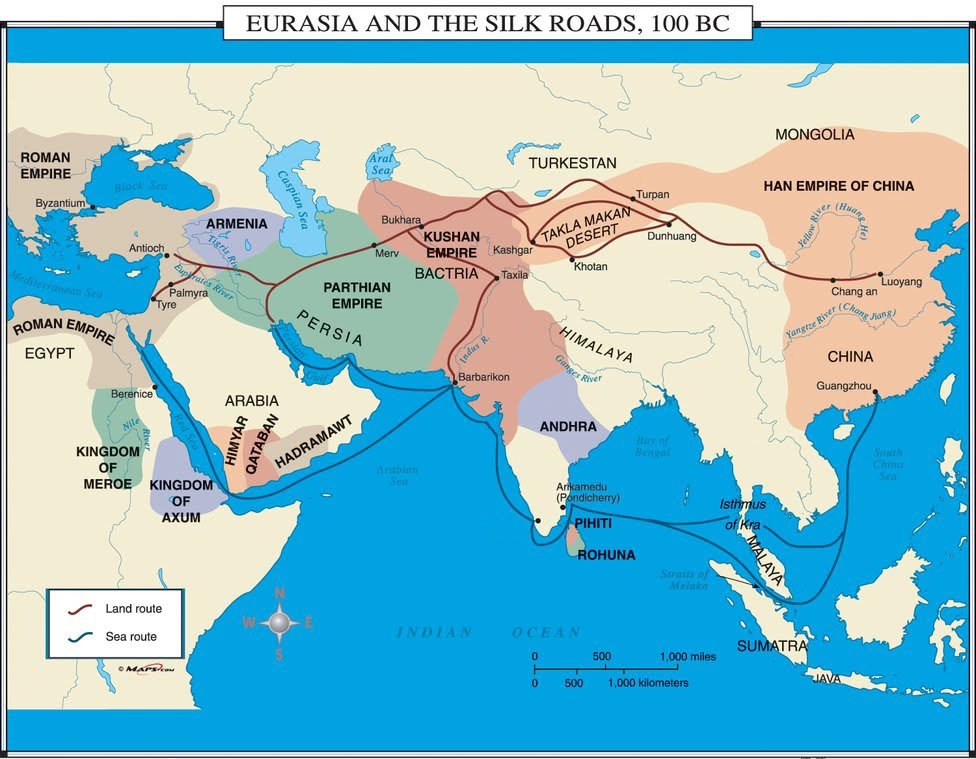
🧵 Barbara–Barbarīka–Barbarikon Complex: Three Words Across 1,000 Years Map A Greek merchant in 60 CE sails into the Indus delta and writes down the name of the port: Βαρβαρικόν (Barbarikon) For two centuries, scholars dismissed it as Greek slang for an emporium, meaning "The foreigners' market." A Hellenistic genericism, nothing Indian about it. They were wrong. This is the story of how three names, Barbara-Barbarīka-Barbarikon, across the Sanskrit epic, Pāṇinian grammar, and Greek commercial geography, all point to one people at one place: the sāgara-kukṣi, the belly of the sea, at the mouth of the Sindhu.
Nāvalaṃ tweet mediaNāvalaṃ tweet media
Nāvalaṃ@naavalam

🧵Pāṇḍyas of ancient Tamiḻakam self-presented themselves as descendants of the Kuru-Pāṇḍavas in their 8th-century copper plates. So when did that claim start, and why? A dynasty famous in the 3rd century BCE waits a full millennium, until 769 CE, to put a Pāṇḍava-descent claim in writing. But the Tamil tradition got there first. Caṅkam poetry calls the Pāṇḍyas Kavuriyar (கவுரியர்), the Tamil for Sanskrit Kauravya, meaning "descendant of Kuru". The formal Sanskrit claim comes with the Velvikkuṭi copper plates of Jaṭila Parāntaka (c. 769–770 CE). And here the praśasti makes a fascinating move that I think is widely underappreciated. It does not claim descent from a specific Pāṇḍava or from the Pūru–Bharata–Kuru–Pāṇḍu trunk or claim descent from Yadu, Turvasu, Druhyu, or Anu. It claims descent from Purūravas Aila, the apical Candravaṃśa king before all branching. The praśasti also names a primordial king, Pāṇḍya, who ruled the coastal region in the previous kalpa and was reborn as Budha, Purūravas's father. The dynasty's identity is made coterminous with the very origin of the Candravaṃśa.

1
3
4
603
Nāvalaṃ
Nāvalaṃ@naavalam·
Put all together, Tamil Kavuriyar (Caṅkam) --> Sanskrit Purūravas descent (Velvikkuṭi 769 CE) --> four-position adjacency (Cinnamaṉūr 900 CE). The Pāṇḍyas don't borrow downward from a northern model. They construct a senior southern parallel to it.
English
0
0
2
72
Nāvalaṃ
Nāvalaṃ@naavalam·
The Velvikkuṭi text skips ten generations and lands directly at historical Māravarman. No Pāṇḍava ancestor. No Pūru, no Bharata, no Kuru, no Pāṇḍu. The senior trunk and nothing else. A century and a half later, the Larger Cinnamaṉūr Plates of Maravarman Rājasiṃha II take this further by stating that the Pāṇḍya ancestors are simultaneously allies of Pāṇḍavas, leading elephants on the Pāṇḍava side at Kurukṣetra, relieving Arjuna of Vasu's curse, conquering Arjuna in single combat, and sponsoring the Tamil Mahābhārata. Mahābhārata itself supplies remarkable textual hooks. Karṇa Parva introduces the Pāṇḍya king Malayadhvaja with sandalwood-and-aguru standard, titled Malayeśvara, "Lord of Malaya." Sañjaya says Malayadhvaja regarded himself as equal to Karṇa, Bhīṣma, Vāsudeva, and Arjuna. His death is framed as Bali's defeat by Viṣṇu, placing him in the Somavaṃśa, asura-king-that -high-ritual-stature register the Velvikkuṭi plates would later inherit. Even more striking, Ādi Parva has Arjuna travel south along the seacoast (samudratīreṇa) from Mahendra to Maṇalūra, where King Citravāhana's daughter, Citrāṅgadā, is formally declared putrikā, the technical Dharmaśāstric term for a matrilineal heir.
Română
1
0
1
97
Nāvalaṃ
Nāvalaṃ@naavalam·
🧵Pāṇḍyas of ancient Tamiḻakam self-presented themselves as descendants of the Kuru-Pāṇḍavas in their 8th-century copper plates. So when did that claim start, and why? A dynasty famous in the 3rd century BCE waits a full millennium, until 769 CE, to put a Pāṇḍava-descent claim in writing. But the Tamil tradition got there first. Caṅkam poetry calls the Pāṇḍyas Kavuriyar (கவுரியர்), the Tamil for Sanskrit Kauravya, meaning "descendant of Kuru". The formal Sanskrit claim comes with the Velvikkuṭi copper plates of Jaṭila Parāntaka (c. 769–770 CE). And here the praśasti makes a fascinating move that I think is widely underappreciated. It does not claim descent from a specific Pāṇḍava or from the Pūru–Bharata–Kuru–Pāṇḍu trunk or claim descent from Yadu, Turvasu, Druhyu, or Anu. It claims descent from Purūravas Aila, the apical Candravaṃśa king before all branching. The praśasti also names a primordial king, Pāṇḍya, who ruled the coastal region in the previous kalpa and was reborn as Budha, Purūravas's father. The dynasty's identity is made coterminous with the very origin of the Candravaṃśa.
Nāvalaṃ@naavalam

x.com/i/article/2058…

English
2
2
3
1K
Nāvalaṃ retweetet
Nāvalaṃ retweetet
நா. கணேசன் (Dr. N. Ganesan)
Correct. H. Tieken never countered the epigraphic evidence. For example, Iravatham Mahadevan's Tamil Brahmi inscriptions (Harvard Oriental Series). Tieken said Sangam texts were created at Pandyan court in 8th century or so. All scholars of Iravatham Mahadevan's era had to date the dates only by paleography and writing style. After this phase, archaeologist K. Rajan's team started using C14 dating. 100s of samples of Tamil Brahmi inscriptions have been tested. And, Tamil Brahmi inscriptions go at least as old as 6th century BCE. Earlier scholars such as Zvelebil, Ramanujan, Hart, ... have had to say that Sangam literature started in 3rd century BCE because emperor Ashoka invented Brahmi script only than. But in numerous sites, Brahmi script has been shown to be earlier than Mauryan Brahmi script at least by 2 centuries. So, the Sangam texts go earlier than Asoka chakravarti. Now, at a village in Rajasthan, Brahmi script is found in 7th or even 8th century BCE. These findings have a lot of bearing on when Tamil literature gets started to be written. will tell more, N. Ganesan @marthandavelan @naavalam @sansbarrier @Anand_Venkatram @Banukumar_R
English
1
4
9
281
vakibs
vakibs@vakibs·
@naavalam @marthandavelan @naa_ganesan When today many Tamils do have Sanskrit names, why not use the extra letters to write them unambiguously? They can be borrowed from Grantha script, isn’t it? If the word is fully nativized (Tadbhava word with major phonetic changes), then I can understand using fewer letters.
English
1
0
0
66
Nāvalaṃ
Nāvalaṃ@naavalam·
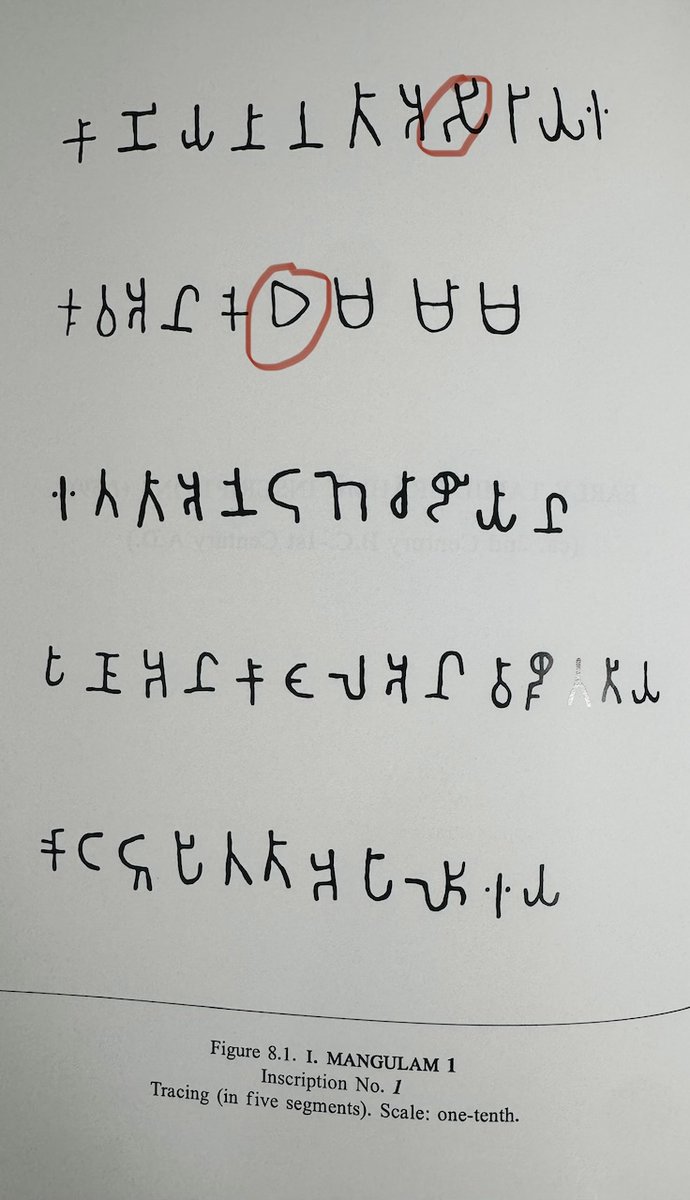
You're right that early Tamil Brahmi scribes had access to the full Aśokan Brahmi inventory; the additional letters used for Prakrit were within their scope. Where Tamil Brahmi differs is in whether those letters were required in the regular Old Tamil orthography, and the evidence shows that scribes in the Tamil land intentionally dropped them. The evidence for intentionality is that the same scribes used the Aśokan letters when the material required it. When writing Prakrit names and loanwords, they used the northern dh- and sa-; for instance, the word dhammam in one of the earliest Mangulam inscriptions is written with the northern dh- letter (visible in the image). The scribes knew these letters, kept them on hand, and used them when writing non-Tamil names. They simply chose not to use them for Tamil. The northern Aśokan Brahmi carried a full Indo-Aryan stop inventory of twenty-five letters arranged in five rows, voiceless unaspirated, voiceless aspirated, voiced unaspirated, voiced aspirated, and nasal, designed to write Prakrit, which has all of those distinctions phonemically. Tamil Brahmi retained only the voiceless-unaspirated column and the nasals: க (k), ச (c), ட (ṭ), த (t), ப (p), and their corresponding nasals ங, ஞ, ண, ந, ம. The four other columns voiced unaspirated (g, j, ḍ, d, b), voiceless aspirated (kh, ch, ṭh, th, ph), and voiced aspirated (gh, jh, ḍh, dh, bh) were dropped from the inventory, because Tamil distinguished none of them. The grammatical reason is straightforward. Old Tamil phonology has no phonemic voicing distinction for stops; voicing is purely allophonic, determined by position. There is probably also a political dimension. When Sanskrit became the dominant court language under the Pallavas, Grantha evolved precisely to handle the non-native sounds that Sanskrit required. When a need arises, the script accommodates it, which is exactly why Kannada and Malayalam include those additional letters today. Old Tamil, two thousand years ago, had no such need, and the scribes simply dropped from the inventory what their language did not require, a minimalism that reflects a deliberate choice, not a gap in knowledge.
Nāvalaṃ tweet mediaNāvalaṃ tweet media
English
1
0
1
56
vakibs
vakibs@vakibs·
The claim was by your friend, and as follows "Afaik even early tamil brahmi inscriptions containing sanskrit/ prakrit loans are written by adhereing to tamil conventions of borrowing" I think that is unlikely. My counterclaim is that the Tamil Brahmi script had the scope for these extra letters, which were later explicitly abandoned. The Grantha script didn't appear out of nowhere.
English
1
0
0
47
Nāvalaṃ retweetet
Ministry of Information and Broadcasting
N. Swaminathan, eminent artist and head of the Thevara Padasalai of Dharumapuram Aadheenam, will be honoured with the Padma Shri for his exceptional contribution to Tamil Pann Isai, traditional Thirumurai hymns, and the preservation of ancient musical discourses. Celebrated as a supreme artist and 'A' grade All India Radio performer with an artistic journey spanning over 55 years, he has dedicated his life to carrying Tamil devotional music to global audiences across continents and releasing over 100 albums. He is deeply revered for his commitment to oral traditions, training generation after generation of students in the fine art of Thirumurai Isai at the grassroots level. #PeoplesPadma #PadmaAwards2026 @HMOIndia @PadmaAwards @MinOfCultureGoI @pibchennai @airchennai
English
17
398
1.3K
46.5K
Nāvalaṃ
Nāvalaṃ@naavalam·
Tamil Brahmi, descended from Brahmi, is another heated debate and could take a longer thread to understand the nuances. The way I would see it is that Tamil adapted a script that suited its grammar while denouncing some of those letters in question, ख, ग, घ, etc., while innovating letters for the ones lacking in Prakrit: ழ (ḻa), ள (ḷa), ற (ṟa), and ன (ṉa). Simply, Tamil adhered to its grammar when borrowing a script to write, and it stuck.
English
2
0
1
133
vakibs
vakibs@vakibs·
@naavalam @marthandavelan @naa_ganesan Well, the claim is not about Tamil. But about the transcription of Sanskrit/Prakrit words into old Tamil Brahmi inscriptions. Considering that Tamil Brahmi descended from Brahmi, it will be weird to not use the full script for characters like ख ग घ etc.
English
1
0
0
133
Nāvalaṃ
Nāvalaṃ@naavalam·
Twitter is a fun place for the language warriors; every day, someone is debating how many letters a language has and flexing about it. Yet another discussion on the 200+ alphabets in Tamil.
Nāvalaṃ@naavalam

From an orthographic perspective, Tamil didn't use the graphemes for ga, ba, da, etc., the voiced counterparts of unvoiced ka, pa, ta, etc., from the very early stages of Tamil Brahmi onward, due to the grammatical tradition. Wrote something similar in this context. x.com/naavalam/statu…

English
1
0
3
372
Nāvalaṃ
Nāvalaṃ@naavalam·
At the end of the day, how many letters an Indic language uses is irrelevant, imo. Some languages have a lax grammatical tradition, or are more up to date with how languages evolve. Tamil is more conservative and strictly aligned with a 2000-year-old grammatical tradition. But every language has to evolve, and the force of nature will dictate how they adapt new letters, how new letters must be represented, etc. More on the grammatical tradition, x.com/naavalam/statu…
English
1
0
2
60