NoiseToAlpha

987 posts

NoiseToAlpha banner
NoiseToAlpha

NoiseToAlpha

@noisetoalpha

Tracking the narratives, signals and risk shifts that move markets before consensus catches up.

Beigetreten Temmuz 2023
24 Folgt918 Follower
Angehefteter Tweet
NoiseToAlpha
NoiseToAlpha@noisetoalpha·
Markets move on narratives before fundamentals fully catch up. At NoiseToAlpha, we track: • narrative shifts • sentiment inflections • risk-aware market signals Follow for cleaner market context, sharper research, and less noise.
English
2
1
2
674
NoiseToAlpha
NoiseToAlpha@noisetoalpha·
Samsung is reportedly preparing to exit China’s home appliance and TV sales market this year. Not production. Sales. The key detail: Samsung may keep Chinese factories for refrigerators, washing machines and air conditioners, but use them mainly as export supply hubs. This says a lot about where China’s consumer electronics market is heading. Chinese brands are increasingly good enough, vertically integrated, and gaining share both domestically and globally. For Samsung, the China market appears to be shifting from growth opportunity to margin pressure. The broader read-through: China is becoming harder for foreign consumer hardware brands. But China remains too important to leave as a manufacturing base. That is the new operating model: Sell less in China. Produce selectively in China. Compete with China everywhere else.
NoiseToAlpha tweet media
English
0
0
0
9
NoiseToAlpha
NoiseToAlpha@noisetoalpha·
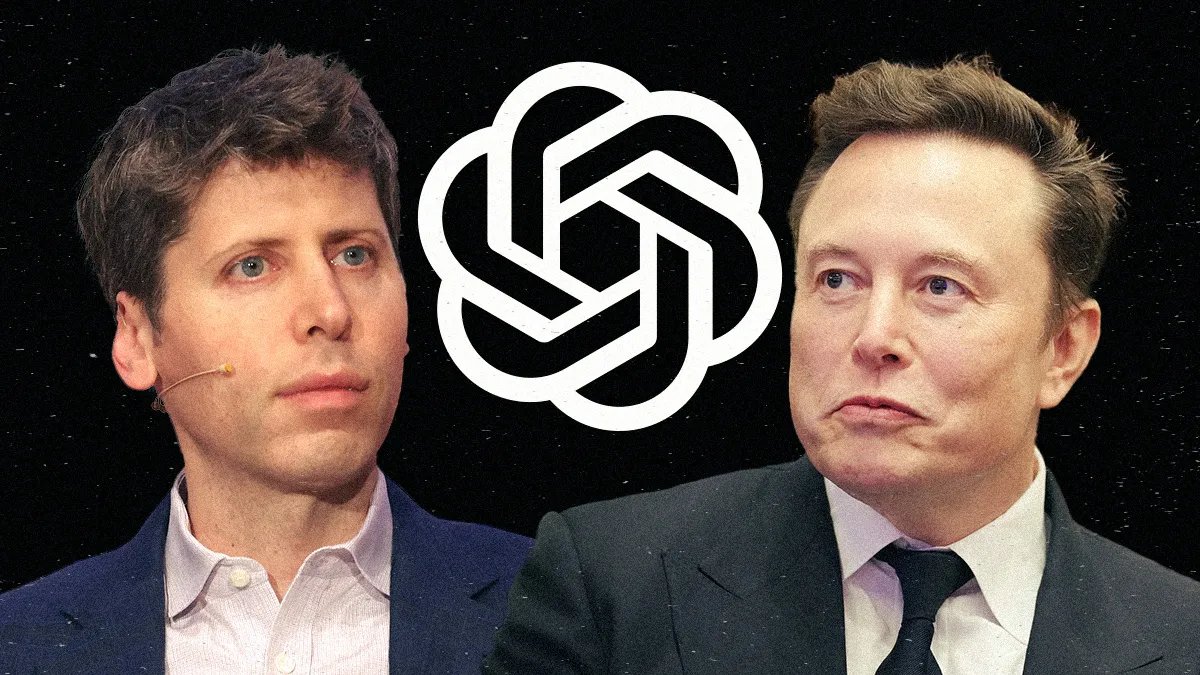
The OpenAI trial could become one of the most important AI events of the year. Musk is reportedly seeking $ 150B in damages from OpenAI and $MSFT, arguing OpenAI abandoned its original nonprofit mission. OpenAI says Musk wanted control and is now trying to support xAI. With a potential OpenAI IPO, Microsoft’s stake, rising compute costs and AI competition intensifying, this is no longer just a founder dispute. It is a control battle over the future AI stack.
NoiseToAlpha tweet media
English
0
0
0
83
NoiseToAlpha
NoiseToAlpha@noisetoalpha·
OpenAI may be moving deeper into consumer hardware. Reports suggest the company is working with $QCOM and MediaTek on smartphone processors, with the bigger goal potentially being AI-agent-native devices. This matters for $AAPL. If OpenAI can bundle subscriptions, hardware and developer ecosystems into one AI-native platform, the smartphone value chain starts shifting from “device-first” to “agent-first.” Apple’s moat has always been hardware + OS + ecosystem. OpenAI may be trying to build the AI-era version of that stack.
NoiseToAlpha tweet mediaNoiseToAlpha tweet media
English
0
0
0
180
NoiseToAlpha
NoiseToAlpha@noisetoalpha·
Adidas just got a marketing moment money can’t easily buy. Kenya’s Sabastian Sawe won the London Marathon in Adidas shoes, becoming the first man to run an official marathon under 2 hours. $ADSGN shares moved higher after the news. In sportswear, product innovation is one side of the story. Cultural proof is the other.
NoiseToAlpha tweet mediaNoiseToAlpha tweet media
English
0
0
0
35
NoiseToAlpha
NoiseToAlpha@noisetoalpha·
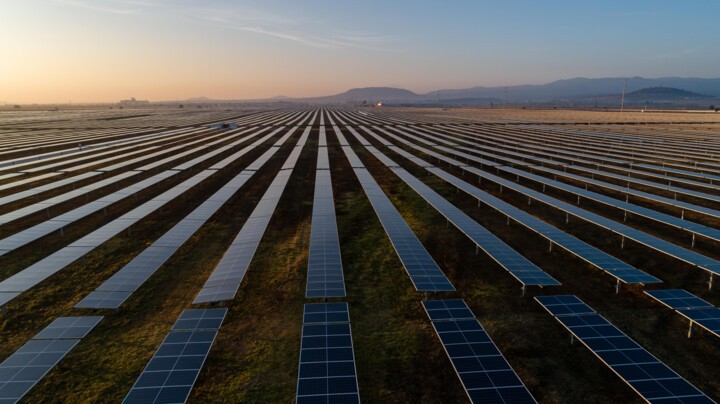
$META is buying optionality for the AI infrastructure race. Up to 1 GW of space-based solar power from Overview Energy, with commercial delivery targeted for 2030 and an orbital demo planned for 2028. The signal is clear: AI data centers are turning energy into a strategic asset. Next bottleneck may be reliable power at scale. The AI capex cycle is moving from chips → data centers → energy infrastructure.
NoiseToAlpha tweet mediaNoiseToAlpha tweet media
English
0
0
0
63
NoiseToAlpha
NoiseToAlpha@noisetoalpha·
This is bigger than one $META deal. AI assets are becoming strategic infrastructure. Models, chips, data, talent and distribution are now being treated like national security assets. The next AI cycle will not only be decided by product quality. It will also be shaped by regulation, export controls and geopolitical alignment.
English
4
0
2
211
Shay Boloor
Shay Boloor@StockSavvyShay·
China has blocked $META $2B acquisition of AI startup Manus. Regulators reportedly ordered the deal unwound after backlash over AI technology flowing to the U.S.
Shay Boloor tweet media
English
44
41
281
42.4K
NoiseToAlpha
NoiseToAlpha@noisetoalpha·
This is the part the market may still be underpricing: AI infrastructure is moving from pure GPU scale-out to full system orchestration. Agentic AI needs more CPUs, more networking, more memory, and more efficient data movement. That makes $AMD data center CPU upside much bigger than GPU story.
English
0
0
0
422
Oguz Erkan
Oguz Erkan@oguzerkan·
$AMD is nearing its $NVDA moment.. Digitimes saw data center AI chip shipments at 53 million units in 2030. They estimated that 10% of this would be data center CPUs, 13% would be networking processors. This comes up to roughly 8:1 GPU-to-CPU ratio. If this balance shifts to 2:1 due to agentic AI, we'll need to ship 15 million more CPUs in 2030. At an average price of $10,000, we are looking at an additional $150 billion in CPU revenue in 2030. Assuming 75%-25% mix of x86 and $ARM, and 40% revenue share for $AMD in the x86 segment, $AMD will generate $45 billion in revenue from data center CPUs in 2030. For reference, its full-year revenue last year was just $35 billion. Couldn't be more bullish on $AMD.
Oguz Erkan tweet media
English
18
23
194
14.1K
NoiseToAlpha
NoiseToAlpha@noisetoalpha·
China has reportedly blocked $META $ 2B acquisition of AI startup Manus and ordered the deal to be unwound. Capital, models, talent and data are now being treated like national security layers. The AI race is also about who controls the ecosystem.
NoiseToAlpha tweet media
English
1
0
1
93
NoiseToAlpha
NoiseToAlpha@noisetoalpha·
@DollarCostAvg The real $MU thesis is simple: AI is becoming memory-bound. More GPUs require more HBM, more DRAM, more bandwidth and more storage. Compute gets the headlines. Memory decides utilization.
English
0
0
0
210
investing
investing@DollarCostAvg·
Memory is in high demand, and without it, AI compute will stall. This can’t happen because capital expenditures are high, and hyperscalers must keep growing. $MU is next to rip big. Put $MU on your watchlist. Their peg ratio is 0.2, the lowest in tech, and they have the most memory, which is currently in highest demand. Don’t be surprised if $MU reaches the 600s in a few weeks. $MU will follow $SNDK My $MU target for EOY is $1000 + similar to $SNDK
English
8
1
97
5.8K
NoiseToAlpha
NoiseToAlpha@noisetoalpha·
DeepSeek just reignited the AI price war. The company cut input cache hit pricing across its API suite to 1/10 of previous levels and kept V4-Pro at a 75% discount until May 5. This matters because the next AI adoption wave will not be driven only by better models. It will be driven by cheaper inference. Lower costs expand developer usage, enterprise pilots, and agent workloads. But they also pressure rivals to cut prices. AI demand is accelerating. AI monetization may get more competitive.
NoiseToAlpha tweet media
English
0
0
0
61
NoiseToAlpha
NoiseToAlpha@noisetoalpha·
This is bigger than a one-day $TSM move. When a dominant index weight gets a higher single-stock cap, the regulatory change can mechanically unlock more domestic fund demand. AI demand is the fundamental driver. But flow rules decide how much capital can actually chase the leader. Bullish for Taiwan tech liquidity.
English
0
0
1
239
Trade Whisperer
Trade Whisperer@TradexWhisperer·
$TSM $ASX Forgot to post this on Friday. There is a regulatory tailwind for Taiwanese stocks. Old rule: Funds and actively managed Taiwan-focused ETFs were capped at 10% of net asset value in any single stock. New rule: Domestic equity funds and Taiwan-only ETFs can now allocate up to 25% in any single company that has a >10% weighting on the Taiwan Stock Exchange (clearly aimed at TSMC, which dominates the index).
Trade Whisperer tweet media
English
3
17
92
17K
NoiseToAlpha
NoiseToAlpha@noisetoalpha·
China’s AI chip trade is heating up. Chinese semiconductor stocks rallied again as investors priced in stronger domestic AI infrastructure demand after DeepSeek’s latest open-source model preview. Key moves: SMIC +9% NAURA +10% HuaHong +7% Yangtze Optical Fibre +5.5% Market is buying the local supply chain behind them: • AI servers • chip packaging • foundry capacity • optical networking • advanced manufacturing equipment This is the bigger story: China’s AI cycle is becoming inseparable from semiconductor self-sufficiency. US restrictions may slow access to leading-edge foreign tech, but they are also accelerating domestic substitution. For investors, the China AI trade is shifting from software headlines to hardware capacity.
NoiseToAlpha tweet media
English
0
0
0
22
NoiseToAlpha
NoiseToAlpha@noisetoalpha·
This is the part of the AI supply chain many still underweight. If $GOOGL is really moving TPU packaging toward Intel’s EMIB, then $INTC is becomes an advanced packaging optionality story too. AI infra is shifting from “who sells the GPU?” to: Who packages the chip? Who owns the interconnect? Who can scale custom silicon? For Intel, foundry credibility may come one customer win at a time.
English
4
0
2
486
NoiseToAlpha
NoiseToAlpha@noisetoalpha·
$NVDA $AMD $ARM $INTC $TXN $SOXX US chip stocks are breaking out again. The Philadelphia Semiconductor Index hit an all-time high, rose 3.2%, and is now up more than 47% this year. The interesting part: this rally is no longer just about $NVDA. $INTC surged more than 22% after strong revenue guidance showed rising demand for CPUs in AI workloads. $AMD and $ARM also rallied double digits. The AI trade is broadening from GPUs into the full compute stack: GPUs train the models. CPUs orchestrate inference. Memory feeds the bandwidth. Foundries and equipment scale the supply. Markets are starting to price AI infrastructure as an ecosystem, not a single-stock story.
NoiseToAlpha tweet media
English
0
0
0
105
NoiseToAlpha
NoiseToAlpha@noisetoalpha·
DeepSeek just launched a new AI model adapted for Huawei chips. This signals China’s AI stack is moving from “running on Nvidia when allowed” to “optimizing directly for domestic silicon.” DeepSeek V4 was built with close Huawei collaboration and is positioned for AI agent workloads, where compute efficiency and long-context processing matter. The bigger market takeaway: U.S. export controls may not simply slow China down. They may accelerate the creation of a parallel AI ecosystem built around Huawei Ascend, SMIC, domestic foundries and local software stacks. For $NVDA, the risk is not losing one shipment cycle. The risk is losing developer gravity in China over time.
NoiseToAlpha tweet media
English
0
0
0
44
NoiseToAlpha
NoiseToAlpha@noisetoalpha·
$ARM is business model leverage. As AI infrastructure fragments across $NVDA Grace, $AMZN Graviton, $AAPL silicon, $QCOM edge chips and hyperscaler custom CPUs, Arm can benefit without needing to own every end market directly. In the agentic AI era, CPU demand rises. But the bigger question is: who licenses the architecture behind the next wave of compute?
English
2
0
3
616
Shay Boloor
Shay Boloor@StockSavvyShay·
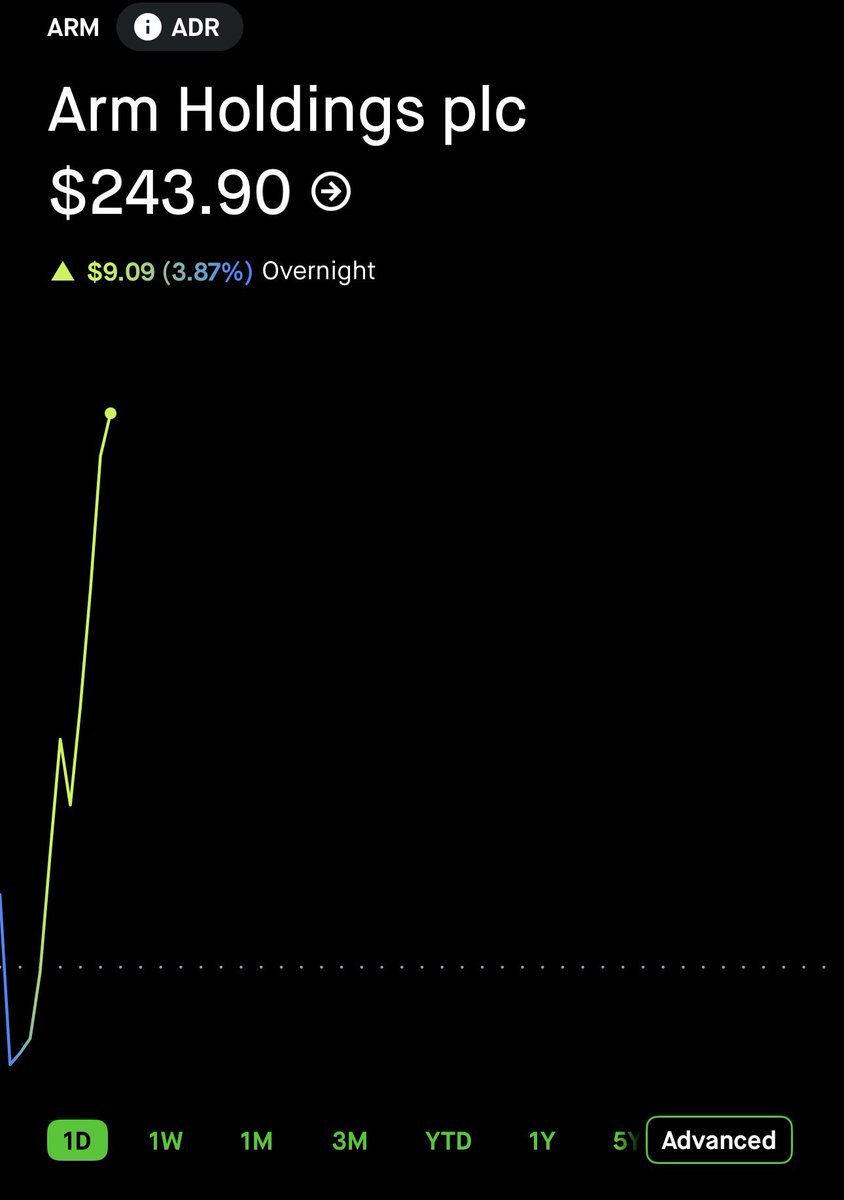
$ARM is up ~4% overnight to a new all-time high. I own a position in the family portfolio because I think the market is still underpricing the CPU bottleneck as AI shifts toward agents executing real tasks. Arm gives me exposure to the efficient CPU architecture already inside $NVDA Grace, $AMZN Graviton, $AAPL M-series, $QCOM data center chips & now its own AGI CPU with $META as launch customer.
Shay Boloor tweet media
Shay Boloor@StockSavvyShay

PETER LYNCH’S FAVORITE METRIC IS THE PEG RATIO PEG < 1 usually means mispriced growth PEG > 2 starts to push into the danger zone Semiconductor multi-year PEG ratios: • $INTC ~3.2x • $AMAT ~2.5x • $KLAC ~2.5x • $ARM ~2.2x • $ALAB ~2.1x • $ANET ~2.0x • $LRCX ~2.0x • $AAOI ~1.6x • $ASML ~1.6x • $COHR ~1.4x • $CRDO ~1.1x • $NVDA ~0.9x • $TSM ~0.9x • $AVGO ~0.9x • $AMD ~0.8x • $SNDK ~0.7x • $ON ~0.7x • $MRVL ~0.6x • $LITE ~0.6x • $MU ~0.2x

English
29
60
580
119.2K
NoiseToAlpha
NoiseToAlpha@noisetoalpha·
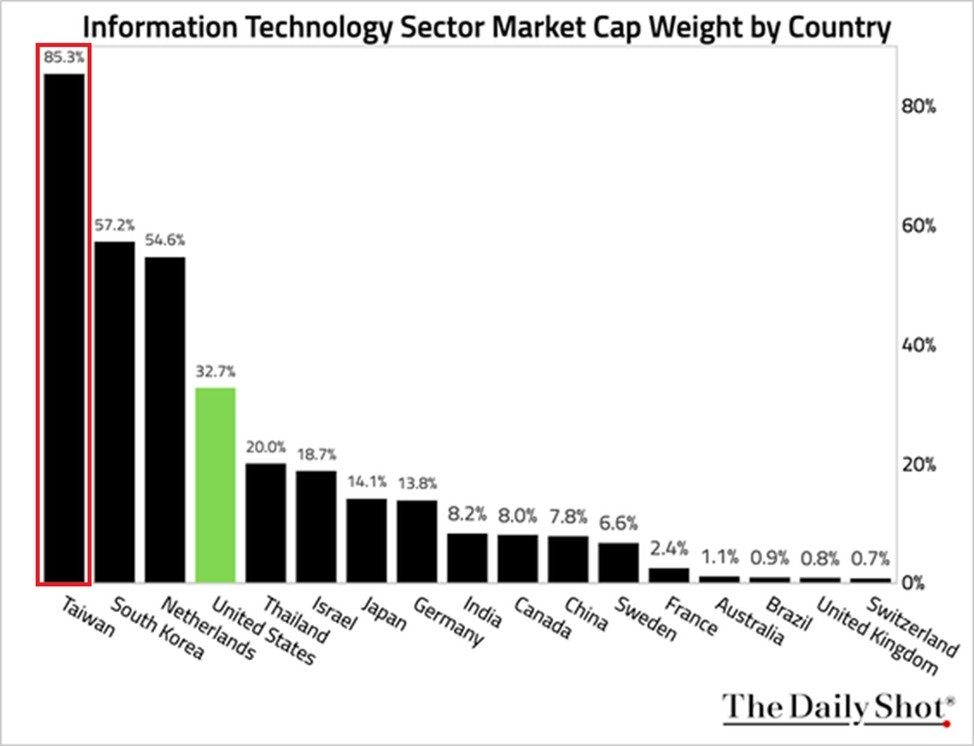
AI trade is becoming less about “US tech vs rest of world” and more about which countries control the bottlenecks. Taiwan = foundry concentration Korea = memory concentration Netherlands = lithography concentration US = platforms + cloud + AI demand Tech dominance is global now, but the real edge sits where supply is hardest to replicate. AI is turning entire national equity markets into semiconductor supply-chain proxies.
English
0
0
5
292
The Kobeissi Letter
The Kobeissi Letter@KobeissiLetter·
Tech dominance is now a global trend: The information technology sector now reflects 85% of Taiwan's stock market cap, the most among major world markets. This is followed by South Korea and the Netherlands, at 57.2% and 54.6%, respectively. The US is ranked 4th, with IT making up 32.7% of the S&P 500's total market value. Including communication services, technology stocks reflect a near-record 45% of the US stock market, still below the top 3 countries. Meanwhile, the weight of global tech stocks as a % of the total global market ex-US stands at ~11.0%, the highest since 2021 but below the 14% peak during the 2000 Dot-Com Bubble. Global equity markets have rarely been this concentrated in a single sector.
The Kobeissi Letter tweet media
English
65
159
1K
137.6K
NoiseToAlpha
NoiseToAlpha@noisetoalpha·
$ULCC $SAVE $JBLU $DAL $AAL Budget airlines are asking Washington for a lifeline. Frontier, Avelo and other U.S. low-cost carriers are reportedly seeking a $2.5B relief package from the Trump administration in exchange for warrants that could convert into equity stakes. Why now? Jet fuel. The request is based on expected fuel costs running above $4/gallon for the rest of the year, after the U.S.-Israel/Iran conflict disrupted oil supply and pushed upstream prices higher. Budget airlines are especially exposed because the model depends on razor-thin margins, high utilization and low fares. If fuel stays elevated, the pressure moves quickly from income statements to balance sheets. This is another example of how the oil shock is spreading into the real economy.
NoiseToAlpha tweet media
English
0
0
0
66
NoiseToAlpha
NoiseToAlpha@noisetoalpha·
Real debate is not whether $NVDA is “cheap” or “expensive” on today’s multiple. It’s whether earnings power is still being revised fast enough to absorb the market cap. Sales growth + forward guidance upgrades matter more than static valuation screenshots. But the key risk is also clear: at this scale, the bar keeps moving higher every quarter.
English
0
0
0
106
Thomas James Investing
Thomas James Investing@Thomas_james_1·
VERY IMPORTANT UPDATE FOR $NVDA People in my comments still calling $NVDA overvalued is WILD. We have the exact same setup as we had last year playing out at the moment, ahead of schedule as well. In the last 9 months, $NVDA increased sales from $46.7 billion to $68.1 billion, a 50% increase while the stock stayed flat. $NVDA have also increased forward guidance for Q1 and Q2, so the stock needs to catch up. Nvidia WILL hit $250-$300 this year, and bears will be, once again, left behind. Don’t miss out.
Thomas James Investing tweet media
Thomas James Investing@Thomas_james_1

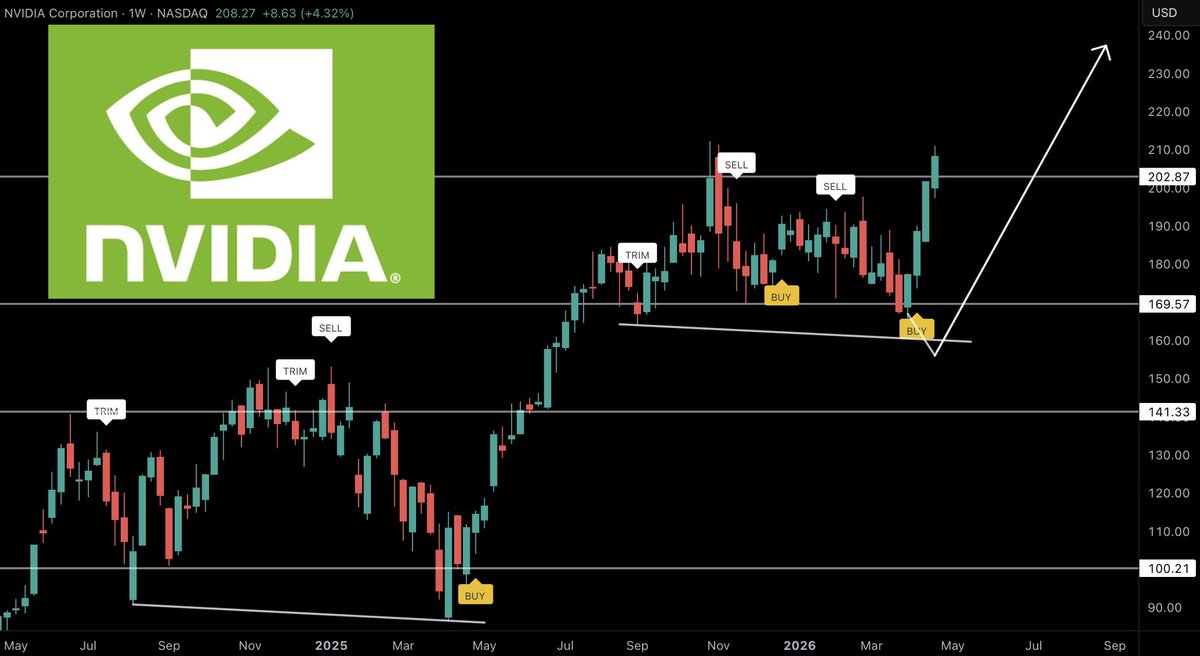
The ONLY Chart you need for $NVDA Last week we saw a very nice follow through week, pushing back to that $200 resistance level. It wouldn’t surprise me to see some consolidation at this resistance level. Similar to what we saw back in April/May of 2025, before breaking out to new highs $240+ Lots of Bears calling for $140 and below over the last few weeks, all of which are now very quiet! What’s your $NVDA prediction for this year?

English
13
26
207
23.4K
NoiseToAlpha
NoiseToAlpha@noisetoalpha·
$OGN $SUN Sun Pharma is acquiring Organon for $14/share in cash, valuing the deal at ~$11.75B enterprise value. Organon brings: • $6.2B annual revenue • $1.9B adjusted EBITDA • 70+ products across 140 countries • Strong women’s health + general medicines portfolio The combined company would generate ~$12.4B in revenue and operate across 150 countries. Strategic read: Sun Pharma is using balance sheet strength to scale globally, while Organon gets an exit after carrying $8.6B of debt. Big pharma consolidation continues.
NoiseToAlpha tweet media
English
0
0
1
128