

@AgnesCallamard @andrewfeinstein Epstein was an early investor in Palantir. So it is not exclusively a CIA cutout as it also has links via Epstein to Mossad. novaramedia.com/2026/02/05/jef…
English
Migrating to @phatcontroller.bsky.social
39.7K posts
@phat_controller
See you at @phatcontroller.bsky.social Co-Founder @ADRNorg Book series editor: Digital Africa Free typo with every Tweet

When Eisenhower was asked why the United States did not allow the 1956 Vietnamese reunification elections agreed upon at Geneva, he answered with unusual honesty. He said that if elections were held, Hồ Chí Minh would win with approximately 80 percent of the vote. So they cancelled the elections. Think about that every time an American politician talks about "spreading democracy." They cancelled the democratic election because the "wrong" person would win. They then spent the next two decades killing people to prevent the government that would have been democratically elected from taking power. And they called the other side anti-democratic. This is not ancient history. This is the logic that still governs every "democracy promotion" operation today. Democracy is acceptable when it produces the "right" results. When it does not, you cancel the election, back a coup, fund the opposition, impose sanctions, and call the government that the people actually chose a "dictatorship." Vietnam exposed this logic completely. Not with arguments. With history. With the receipts.



🚨: Millionaire paid US$10,000to hunt buffalo in South Africa and ended up brutally killed by the animal itself.
Unfortunately, this is the default African technocratic position, particularly among those who went to university in the 1970s, 1980s, and 1990s. Many of them studied in the West. The niche, elite, reformist intellectual position of that era was to be anti-West, and they seem to have kept it. They came home and taught the same thing. That is why anti-imperialism, which in African economic discourse is functionally anti-Western, has such deep roots. It is also grievance-led, to the extent that it has not yet recognised that the imperialist extracting value from Africa right now is China. David lists "responsiveness, value for money, customer service" as the reason Chinese contractors dominate. The framing is emotionally satisfying. It is structurally incomplete. Chinese dominance in African infrastructure is vendor financing. Chinese policy banks fund the project. Chinese contractors build it. Chinese equipment fills it. Chinese supply chains service it. Africa owns the road. The industrial learning curve stays in Guangzhou. The "value for money" is a tied procurement model where the money circulates back to Chinese firms before the ribbon is cut. The "conditionality" that African elites resent, competitive tendering, transparency, enforceable standards, is precisely what lowers the cost of capital. African Eurobonds yield 9.1 per cent. Latin America pays 6.5 per cent. Asia pays 5.3 per cent for comparable ratings [Feb 2026]. That premium reflects governance risk, not Western interference. Chinese financing avoids the lecture but delivers inflated prices through tied procurement, not improved creditworthiness. The deeper question: what happens after the road is built? China's household consumption sits at 39.9 per cent of GDP. Its goods trade surplus exceeded USD1.19 trillion in 2025. 89 per cent of Africa's exports to China are extractives. 94 per cent of China's exports to Africa are manufactured goods. Africa exchanges rocks for finished products. If Africa wants to move beyond extraction, to process its own cobalt, refine its own copper, it needs markets that can purchase what it makes. Those are absorber economies: the US at 68 per cent household consumption, the EU at 52 per cent. China cannot absorb African manufactures because its own industrial capacity already exceeds domestic demand. Selling value-added goods to a competitor whose policy is designed to dominate those same markets is a dead end. Chinese contractors are not treating Africa as valued customers. They are treating Africa as a valued input. One builds capacity. The other feeds an export machine that sells finished goods back to the continent it extracted from. The question is not who builds the road cheaply. It is whether the road leads to industrial capacity, or to a port where unprocessed minerals leave and finished goods arrive. I wrote about this in "The Forced Choice." canarycompass.com/p/the-forced-c…


My fellow Africans, look at the world: Iran has oil & and refineries. Russia has oil and refineries. Saudi Arabia, Qatar, and Kuwait have oil and refineries. They export refined oil products. Now look at Africa: Nigeria, Angola, Congo, and Sudan have oil but few to no refineries. We export crude… and import finished fuel. Really? Others refine and supply their regions. Africa only exports and not even to its neighbors. Africa needs to fix this now.
The US ambassador in Beirut today stated that the US government asked the Israelis to “spare Christian villages” in South Lebanon.

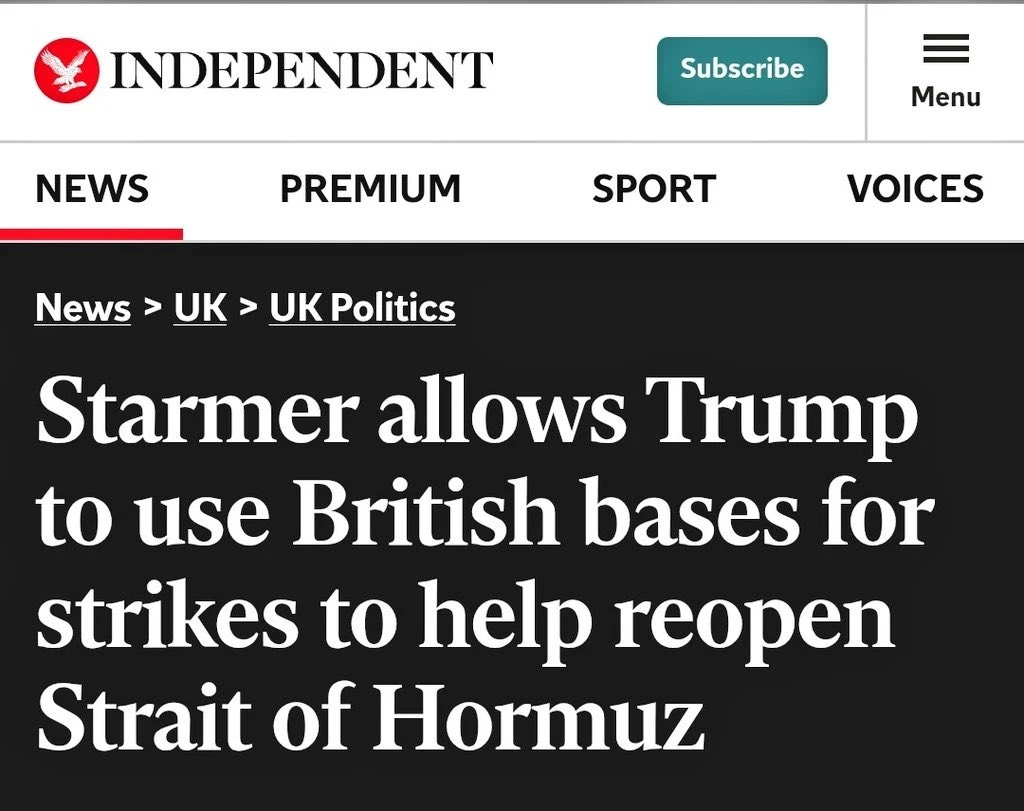

UK agrees to let US use British bases to strike Iranian sites targeting Strait of Hormuz Follow live: bbc.in/3PB0sHr
Pete Hegseth accuses Iran of investing in missiles and weapons instead of people, during a speech in which he's asking for $200 billion for weapons, instead of people.
The Tories gave 23 contracts to Palantir Labour gave the 24th contract to Palantir to implement its software in Coventry City Council. Coventry City Council signed a £500,000 contract with Palantir to use AI for transcribing and summarising notes in child services, the first known deal between a UK local authority and the company. The Coventry contract is small potatoes compared to what Labour has done at the national level. Palantir hired four ex-MoD officials in 2025 alone, and held official meetings with the Prime Minister, six cabinet ministers, and senior officials from the Cabinet Office, the Treasury, and the Home Office. Questions have been raised in Parliament about whether Peter Mandelson, who was a controlling shareholder in Global Counsel, which had Palantir as a client, played any role in the December 2025 £240 million MoD contract. The 10 new contracts are all extensions to the previous ones.
Face recognition is "a dangerous, error-prone, discriminatory technology,” EFF’s Adam Schwartz told @GVWire, and it's “especially inappropriate as a means to screen members of the public seeking to participate in democratic self-government.” gvwire.com/2026/03/17/fir…