

Alex

3.5K posts

Alex banner
Alex

Alex

@pilouanic

@clarnium_io co-founder, blockchains researcher & project growth adviser, founder of @wobblytimer & https://t.co/mTf42AZqfm

Ukraine Beigetreten Eylül 2009
1.6K Folgt1.6K Follower
Alex retweetet
Yasir Ai
Yasir Ai@AiwithYasir·
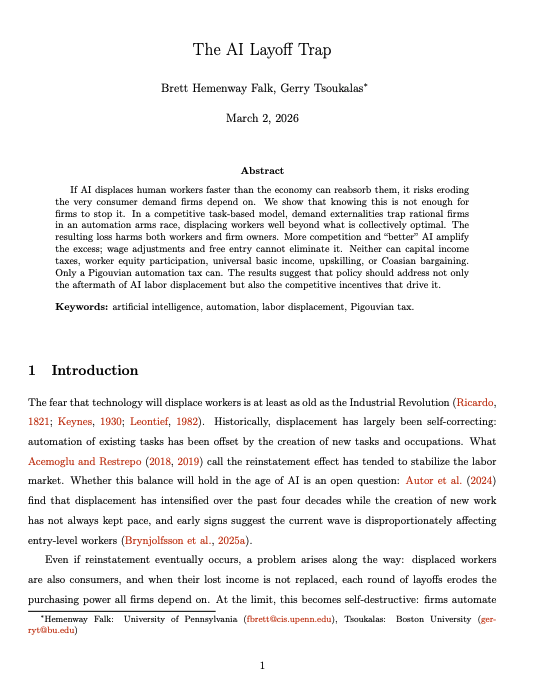
🚨BREAKING: Two researchers from UPenn and Boston University just published a paper that should be uncomfortable reading for every CEO automating their workforce right now. The argument is straightforward. Every company replacing workers with AI is also eliminating its own future customers. Laid off workers stop spending. Enough of them stop spending and nobody can afford to buy anything. The companies that fired everyone end up selling into an economy with no purchasing power left. Every executive can see this. The math is not complicated. But here is why nobody stops. If you do not automate, your competitor does. They cut costs, lower prices, take your market share, and you collapse anyway. So every company automates knowing it is collectively destructive because the alternative is dying alone while everyone else survives. The researchers proved this is a Prisoner's Dilemma playing out in real time. The numbers are already moving. Block cut nearly half its 10,000 employees this year. Jack Dorsey said AI made those roles unnecessary and that within the next year the majority of companies will reach the same conclusion. Salesforce replaced 4,000 customer support agents with AI. Goldman Sachs deployed a coding tool that lets one engineer do the work of five. Over 100,000 tech workers were laid off in 2025 and AI was cited as the primary driver in more than half those cases. 80% of US workers hold jobs with tasks susceptible to AI automation. The researchers tested every proposed solution. Universal basic income does not change a single company's incentive to automate. Capital income taxes adjust profit levels but not the per-task decision to replace a human. Collective bargaining cannot hold because automating is always the dominant strategy. They also identified what they call a Red Queen effect. Better AI does not solve the problem, it accelerates it. Every company chases faster automation to gain market share over rivals but at the end everyone has automated equally, the gains cancel out, and the only thing left is more destroyed demand. The one thing the math says could work is a Pigouvian automation tax. A per-task charge that forces companies to account for the demand they destroy each time they replace a worker. The conclusion is that this is not a transfer of wealth from workers to owners. Both sides lose. Workers lose income. Companies lose customers. It is a deadweight loss with no market mechanism to stop it on its own. (Link in the comment)
Yasir Ai tweet media
English
593
4.1K
11.5K
2.8M
Alex
Alex@pilouanic·
Pure knowledge in 200 lines, but 99.99 don't care
Elias Al@iam_elias1

The co-founder of OpenAI just built an entire AI training engine in 200 lines of code. No dependencies. No libraries. No frameworks. Pure Python. And he says he cannot make it any shorter. Andrej Karpathy — former Director of AI at Tesla, founding member of OpenAI, one of the most respected AI researchers alive — published microgpt on February 12, 2026. It is 200 lines. It trains and runs a GPT model completely from scratch. Here is what those 200 lines actually contain. A full dataset loader. A tokenizer. An autograd engine that computes gradients. A GPT-2 architecture neural network. The Adam optimizer. A complete training loop. A complete inference loop. Everything needed to build, train, and run a large language model — in a file you could print on two pages of paper. This is the culmination of a decade-long obsession. Karpathy previously built micrograd, makemore, and nanoGPT — each one a step toward stripping AI down to its mathematical skeleton. microgpt is the final answer. The irreducible core. He wrote: "This script is the culmination of multiple projects and a decade-long obsession to simplify LLMs to their bare essentials. I cannot simplify this any further." Here is why this matters beyond the elegance.Every AI course in the world teaches through abstraction. You use PyTorch. You import transformers. You call functions you do not understand. You build things without knowing how they work. Karpathy's entire career has been a war against that approach. He believes the only way to truly understand intelligence — artificial or otherwise — is to build it from nothing .200 lines. No dependencies. From nothing. For anyone who has ever wanted to understand what a large language model actually is — not what it does, but what it is — this file is the answer. Free. Open source. On GitHub right now. gist.github.com/karpathy/8627f…

English
0
0
0
5
Alex
Alex@pilouanic·
Just save here for the crack
Guri Singh@heygurisingh

Someone just open sourced a complete AI agency and it hit 50K GitHub stars in under two weeks. It's called The Agency. And it's not a prompt template. It's 147 specialized AI agents across 12 divisions -- engineering, design, marketing, product, QA, support, spatial computing, each with its own personality, workflow, and deliverables. Here's what you actually get: → 147 agents across 12 divisions, each with unique voice and expertise → Works natively with Claude Code, GitHub Copilot, Gemini CLI, Cursor, OpenCode, and more → One-command install for any supported tool → Agents have defined missions, success metrics, and production-ready code examples → Full modding support -- build and contribute your own agents → Interactive installer that auto-detects your dev environment → Conversion scripts for every major agentic coding tool → Lua-style Markdown templates with YAML frontmatter Here's the wildest part: Most people use AI like a generalist intern. One model doing everything from writing copy to debugging code. This repo structures AI like an actual company. Specialized roles. Clear responsibilities. Defined workflows between agents. It started as a Reddit thread. Now it has 50K+ stars, 7.5K forks, and contributions from developers around the world. Greg Isenberg called it out. It hit 10K stars in 7 days. This is what the future of AI-assisted development actually looks like. 50K+ GitHub stars. 7.5K forks. 147 agents. 12 divisions. 100% Open Source. MIT License. (Link in the comments)

English
0
0
0
9
Alex retweetet
Visegrád 24
Visegrád 24@visegrad24·
🇪🇸 Islamist networks of the Muslim Brotherhood are aiming to turn Spain back into Al-Andalus, as it was called during Muslim rule for centuries before the Christian reconquest. Security experts warn that Spain, under Far-Left Socialist Prime Minister Pedro Sánchez, is currently a hotbed of Islamist influence. Counterterrorism experts, like J. M. Zuloaga, describe the Muslim Brotherhood group as a "hidden danger" that uses a medium-to-long-term strategy to infiltrate Spanish society through a network of institutions rather than a formal organization. One example of regional Islamist influence has been identified in Catalonia, where the group is accused of exploiting legal loopholes to establish influence over the local Muslim community. According to most analysts, the ultimate ambition of the Muslim Brotherhood is to establish a global Islamic caliphate where Spain is one of the regions with its old Muslim name, Al-Andalus. A 2026 report from Israel's Ministry of Diaspora notes that the Brotherhood has built an extensive network in Spain and other European nations that mirrors its activities in the Middle East, often under a façade of moderation to gain public funding and political legitimacy. For this reason, Spanish authorities find it difficult to prosecute and curb Islamist influence covertly operated by the Muslim Brotherhood. Thus, it is unsurprising to see Spain's cordial relations with the Islamic regime in Iran, as well as the thousands of Spaniards who show solidarity for Islamist groups like Hamas and Hezbollah. The specific focus on Spain comes from the fact that Spain was once under Muslim rule for centuries as part of various Islamic caliphates and states, before the Christian Iberians reconquered the Iberian Peninsula and expelled Muslim dynasties from their lands in a centuries-long struggle known as the Reconquista. And now, Spain under Pedro Sánchez is a key focal point for the Muslim Brotherhood's long-term Islamist expansion in Europe.
Visegrád 24 tweet media
English
82
564
1.7K
49.3K
Alex retweetet
DefiLlama.com
DefiLlama.com@DefiLlama·
When you hold a token, you're exposed to every market that touches it. Until now, there was no way to quickly understand what that actually looks like. Introducing token pages on DefiLlama. Understand how tokens are being used in DeFi: - Risks across lending markets - Usage by protocol - Liquidation levels - Yields & borrow rates Enter a token in our search bar to find its page.
English
28
62
502
38K
Alex retweetet
CyrilXBT
CyrilXBT@cyrilXBT·
ANTHROPIC JUST PROVED MOST PEOPLE HAVE NO IDEA HOW TO PROMPT CLAUDE. Their applied AI team dropped a 24 minute free workshop. Not a creator who reverse engineered it. Not a Reddit thread. ANTHROPIC. The people who wrote the weights. And what they showed is uncomfortable. There are 6 elements to a properly structured Claude prompt. Most people are using 1. Maybe 2. That is not a skill issue. That is an information issue. And it has been quietly costing you every single day. The outputs that felt slightly off. The responses you had to rewrite 4 times. The prompts that worked once and never again. All of it traces back to the same 6 missing elements. The people who watch this 24 minute workshop tonight will understand something about Claude that most daily users still do not know exists. The people who skip it will keep getting 30% of what the tool is actually capable of and wonder why the results never quite land. I watched it twice. Then I built a Claude Skill that applies all 6 elements to every prompt automatically. No more thinking about structure. No more guessing what Claude needs. The framework runs in the background every single time. Full breakdown and skill setup is below. Bookmark this now. Watch the workshop first. Then read the guide. This is the one that compounds. Follow @cyrilXBT for the exact prompt architecture, Claude skills, and systems I use to get outputs most people do not believe came from one person working alone.
English
161
681
7.1K
699.8K
Alex retweetet
Gap | Suby
Gap | Suby@gaspardlezin·
I sent €100 from Paris to a US merchant. The merchant received $96.65. That $3.35 didn't disappear, it was distributed across 7 intermediaries you've never heard of. Most people think a card payment is one transaction. It's not. It's a relay race between 8 different companies, running on two parallel networks, taking different cuts, on different timelines. I traced a single €100 payment, end to end. Here's what I found. 𝗧𝗵𝗲 𝟮 𝗻𝗲𝘁𝘄𝗼𝗿𝗸𝘀 𝗿𝘂𝗻𝗻𝗶𝗻𝗴 𝘀𝗶𝗱𝗲 𝗯𝘆 𝘀𝗶𝗱𝗲: → The info layer: ~2 seconds. Authorisation messages bouncing between issuer, Visa, acquirer, processor. This is the part that flashes "Order paid ✓" on the merchant's screen. → The money layer: ~2 days. Actual settlement via ACH, with FX conversion buried somewhere in the middle. The fact that your checkout feels instant is theatre. The money is still in flight. 𝗪𝗵𝗲𝗿𝗲 𝘁𝗵𝗲 €𝟯.𝟯𝟱 𝗮𝗰𝘁𝘂𝗮𝗹𝗹𝘆 𝘄𝗲𝗻𝘁: 1️⃣ You: €100 leaves your account 2️⃣ Issuing bank (BNP Paribas / SocGen), holds the funds, no fee 3️⃣ Card network (Visa / Mastercard) −€1.20 cross-border scheme fee 4️⃣ FX engine: −€2.10 hidden spread (1.5% above mid-market) 5️⃣ Acquiring bank (Chase / Wells Fargo): −$2.65 interchange + acquirer markup 6️⃣ Processor (Stripe / Adyen): −$0.65 (0.3% + $0.30) 7️⃣ ACH settlement: no fee, but locks the funds for 2 business days 8️⃣ US merchant: receives $96.65 𝗪𝗵𝗮𝘁'𝘀 𝗶𝗻𝘃𝗶𝘀𝗶𝗯𝗹𝗲 𝗯𝘆 𝗱𝗲𝘀𝗶𝗴𝗻: The customer sees 1 actor (their bank). The merchant sees 2 (their processor and their bank). The other 5 are invisible and the biggest fee, the FX spread, is the one nobody itemizes. It's not a fraud. It's just stacked. Each intermediary takes a margin that's individually defensible, and collectively adds up to ~7% on cross-border. 𝗪𝗵𝘆 𝘁𝗵𝗶𝘀 𝗺𝗮𝘁𝘁𝗲𝗿𝘀: Every SaaS company selling internationally pays this stack. Every ecommerce store accepting cards from abroad pays this stack. Most never see the breakdown, they just see "International processing fee" on a statement and move on. The next generation of payment infrastructure isn't trying to add a 9th intermediary. It's trying to delete 5 of them. PS: I'm the founder of Suby and I post weekly about payments, stablecoins, and what the cross-border stack actually looks like under the hood. Follow for more.
GIF
English
9
5
80
9.7K
Alex retweetet
Litecoin
Litecoin@litecoin·
Litecoin update: • A zero-day bug caused a DoS attack that disrupted major mining pools. • Non-updated mining nodes allowed an invalid MWEB transaction allowing them to peg out coins to third party DEX’s • A 13-block reorg reversed those invalid transactions — they will not be included in the main chain • All valid transactions during that period remain unaffected • The bug is now fully patched, and the network continues to operate normally
English
246
440
2K
642.2K
Alex retweetet
Smart Money Crypto
Smart Money Crypto@Smart_Money·
☠️ ANTHROPIC HAT GERADE EBAY ERLEDIGT! Das ist der Chart von $EBAY. Minus 5,3 Prozent. An einem Tag. Von $103,40 runter auf $97,94. Kein Earnings. Kein Skandal. Kein Insider-Verkauf. Nur ein Forschungs-Paper von Anthropic. "Project Deal" heißt das Ding. Anthropic hat in seinem San-Francisco-Büro einen Marktplatz für die eigenen Mitarbeiter gebaut. 69 Leute. Je 100 Dollar Budget. Klassisches Craigslist-Setup. Nur mit einem Twist: Die Verhandlungen führt Anthropic. Nicht der Mensch. Die KI kauft, verkauft, dealt für dich. 186 Transaktionen in einer Woche, über 4.000 Dollar Volumen. Und ein interessantes Detail aus dem Paper: Wer einen schwächeres Modell bekam, machte nachweislich schlechtere Deals. Hat es aber selbst nicht gemerkt. Klingt nach Büro-Spielerei. Ist es nicht. Es ist ein Proof of Concept dafür, dass jeder Marktplatz im Netz austauschbar ist. eBay verdient Geld weil Menschen eBay brauchen, um zu handeln. Was, wenn Menschen nichts mehr machen müssen? Wall Street hat verstanden. Sofort. Alles, was Marktplatz ist betroffen. Salesforce ist seit Januar 33 Prozent runter, weil "Claude Cowork" die ganze CRM-Industrie in Frage gestellt hat. Adobe minus 36. ServiceNow gerade von UBS auf Neutral runtergestuft. Der Software-Index IGV ist 35 Prozent unter seinem Hoch. Eine ganze Branche wird vor unseren Augen umgeschrieben. Wall Street hat dafür schon einen Namen. SaaSpocalypse. Seit Januar 2026 sind ungefähr 2 Billionen US-Dollar aus der Software-Wirtschaft verdampft. Zwei Billionen. Und das Spiel fängt grade erst an. Was Wall Street gerade einpreist: Pro-Seat-Lizenzen verlieren ihren Sinn, wenn ein Agent eine ganze Abteilung ersetzt. Plattform-Take-Rates kollabieren, sobald Agenten direkt mit Agenten verhandeln. Werbung verliert ihre Logik in einem Markt ohne menschliche Klicker. Was bleibt sind Infrastruktur-Anbieter, Daten-Besitzer und die Modell-Hersteller selbst. Und genau da kommt der nächste Schlag. Anthropic hat letzte Woche Opus 4.7 vorgestellt. Sonnet 5 ist seit Anfang April live. Das Roadmap-Leak von vor zwei Monaten zeigt interne Referenzen auf Sonnet 4.8 und Claude 5 - geplant für den Sommer. Google hat parallel angekündigt, bis zu 40 Milliarden Dollar in Anthropic zu investieren. Das ist ein All-In auf die Disruption der eigenen Cloud-Kunden. Bei OpenAI läuft das gleiche Spiel, nur lauter. Sam Altman hat im März bei BlackRock öffentlich gesagt, sie trainieren in Abilene, Texas, das nach eigener Einschätzung beste Modell der Welt. Übersetzt: GPT-6. Release-Fenster: Ende Mai. Was die Modelle laut Roadmap können sollen? Selbstständige Workflows. Bezahlsysteme. Buchungen. Verhandlungen. Komplexe Transaktionsketten ohne menschliche Aufsicht. OpenAI hat parallel mit Etsy und Shopify die ersten Pilot-Integrationen für agentic shopping gestartet. Du sagst ChatGPT was du brauchst, ChatGPT kauft. Ohne Klick auf Etsy. Und du musst dir die Frage stellen, welches Geschäftsmodell das überlebt. Marktplätze überleben so nicht. Wenn ein Agent für mich kauft, brauche ich keine Plattform mit Suchfunktion und Verkäufer-Reviews. SaaS-Lizenzen pro Sitzplatz fallen genauso. Wenn 10 Agenten die Arbeit von 100 Sales-Reps erledigen, braucht keiner mehr 100 Salesforce-Logins. Werbung wird ein Nullsummenspiel. Agenten klicken keine Anzeigen. Wie schnell diese Unternehmen sterben, ist die einzige offene Frage. Ich sehe drei Szenarien. ⚠️ Erstens: Die Plattformen integrieren die Agenten und werden selbst zur Infrastruktur. eBay wird zum reinen Settlement-Layer für Claude und GPT. Möglich. Aber die Margen brechen weg. ⚠️ Zweitens: Die Plattformen sterben langsam und Anthropic plus OpenAI werden selbst zum neuen Marktplatz. Wahrscheinlich. Wer die Schnittstelle besitzt, besitzt den Kunden. Und die zwei sammeln gerade die Schnittstellen ein. ⚠️ Drittens: Eine ganz neue Asset-Klasse setzt sich durch. On-Chain. Programmierbar. Permissionless. Wo Agenten ohne Custodian und ohne Plattform handeln können. Krypto war von Anfang an für eine Welt gebaut, in der Maschinen Geld bewegen. Keine andere Schiene kann das aktuell. Ich bin etwas besorgt 🫠. x.com/AnthropicAI/st…
Smart Money Crypto tweet media
Deutsch
55
141
799
151.7K
Alex
Alex@pilouanic·
True centralization, but I'm ok with it
BlockSec Phalcon@Phalcon_xyz

.@arbitrum Security Council took emergency action to freeze 30,766 ETH held at the Arbitrum One address linked to the @KelpDAO exploit. The key technical point is how this was executed: it was not a normal transfer signed by the exploiter's key. Based on the on-chain trace, this appears to have been executed from Ethereum (L1) via governance-level emergency upgrade powers. The Upgrade Executor temporarily upgraded DelayedInbox, invoked a temporary entrypoint to enqueue a delayed L1→L2 message via Bridge.enqueueDelayedMessage(kind=3, ...), and then restored the original implementation. The critical logic change was that the sender input shifted from the standard msg.sender path to a caller-controlled parameter (then transformed via L1→L2 aliasing), allowing the injected message to carry exploiter-linked sender context. Also, kind=3 maps in Nitro to L1MessageType_L2Message, which allows L2MessageKind_UnsignedUserTx execution on L2, i.e., this path does not require a user signature check. So the L2 transaction view (“from exploiter to 0x…0DA0”) reflects a chain-level forced state transition, not a standard user-signed transfer. TX on L1: app.blocksec.com/phalcon/explor… TX on L2: app.blocksec.com/phalcon/explor…

English
0
0
0
27
Alex retweetet
Michael Egorov
Michael Egorov@newmichwill·
So let me start. DeFi is the future of the World Financial System. That's my belief, and this is why we are here. This amount of absolutely preventable hacks we see in DeFi (with root causes attributable to CENTRALIZED points of failure) is enormous recently. This damages out industry, and I build for this industry. So I cannot remain silent. Imagine an average grandma (mass adoption is here?) putting her life savings on Aave. And then BOOM, she cannot withdraw her funds on Monday. Aave (the biggest DeFi protocol btw) said it's operating as intended - just rsETH got exploited. rsETH said that all code is safu - just LayerZero bridge got hacked. LayerZero (the biggest bridge securing quarter of a trillion $) said that everything operating as intended. Yet, she cannot withdraw here funds. WTF? Are we industry of clowns? But here's the thing. All issues like this should be prevented BEFORE they happen, not AFTER. Number of single points of failure should be reduced, not increased. When these points of failure are unavoidable - trust should be split. If there's a reliance on infrastructure - we should share best practices how to configure it. Not to mention that code should be very well checked - everyone gets that already. We should probably come together and develop safety standards for DeFi. How to build safely, and how to verify safety. Probably everyone should bring their best practices, and the projects, auditors and risk assessment groups should know them. Maybe we need @ethereumfndn and @SolanaFndn bringing all the ecosystem projects to participate and come up with principles, rules and recommendations of safe building. And, perhaps, we can even learn something about protecting the few remaining centralized points of failure from traditional finance who have many more of those. DeFi will win
English
135
199
1.2K
78.1K
Alex retweetet
Dune | We Are Hiring!
Following the KelpDAO hack, we built an open analysis of DVN security configurations across every active OApp on LayerZero over the last 90 days. Of ~2,665 unique OApp contracts: 47% run a 1-of-1 DVN security floor, 45% run 2-of-2, and ~5% run 3-of-3 or higher. As we know, KelpDAO's rsETH sat in the first bucket. Open query, public methodology, feedback welcome: dune.com/dune/layerzero…
English
76
207
979
377.5K
Alex
Alex@pilouanic·
That’s looks not good 😌
Jeremy@Jeremybtc

Another day, another breach. This time it's Vercel and this one is different. > Vercel owns and maintains Next.js, the most widely used React framework on earth. > Next.js gets roughly 6 MILLION downloads every single week. > They also built Turborepo and run the deployment infrastructure behind a significant chunk of the modern web. > Today, April 19, 2026, Vercel published an official security bulletin confirming unauthorized access to certain internal systems. > They've engaged incident response experts, notified law enforcement and are actively investigating. > ShinyHunters, the same group behind the European Commission breach, the Rockstar Games breach, and reportedly over 400 companies hit through Salesforce integrations claims responsibility on BreachForums. > They're reportedly offering Vercel's internal data for $2 million. > The alleged data includes access keys, source code, employee accounts, API keys, NPM tokens and GitHub tokens. > Vercel confirmed a limited subset of customers have been impacted and are being contacted directly. > They're recommending all customers immediately review their environment variables and enable the sensitive environment variable feature. > But here is why this one matters more than a typical breach. > Vercel maintains Next.js and controls the npm publishing pipeline for one of the most installed packages in the JavaScript ecosystem. > If NPM tokens were genuinely compromised, a malicious package update could theoretically reach every developer who installs or updates Next.js. > That's not a data leak. That's the potential for a supply chain attack at a scale the internet has rarely seen. > 6 MILLION weekly downloads. One compromised update. Every app built on Next.js at risk. > Vercel says services remain operational and the investigation is ongoing. If you're a developer using Vercel, rotate your environment variables now. Don't wait for the investigation to conclude.

English
0
0
0
33