Angehefteter Tweet
✨
22.6K posts

✨ retweetet
✨ retweetet
✨ retweetet
✨ retweetet

Today is day 990 of Israel’s genocide of the Palestinians.
Gaza Notifications@gazanotice
“Oh God, it’s my brother” 🚨HEARTBREAKING: A Palestinian girl cried out in anguish as she desperately pleaded for help the moment her brother was injured before her eyes in an Israeli airstrike on Al-Mawasi area in Khan Younis southern the Gaza Strip.
English
✨ retweetet
✨ retweetet

No one ever truly recovers from this. Not an adult, and certainly not a child.
Ramy Abdu| رامي عبده@RamAbdu
“They killed my mother — and before that, my brother. I urge everyone: do not go to the American aid distribution points soaked in blood. This bag only contains 2 empty flour sacks — nothing else — & yet they shot & killed my mother as she tried to get us something to eat today.”
English
✨ retweetet
✨ retweetet
✨ retweetet
✨ retweetet

🚨Gaza this morning, moments ago
Israel is still committing genocide in Gaza‼️

English
✨ retweetet
✨ retweetet
✨ retweetet
✨ retweetet
✨ retweetet

There are wounds that belong to the body. There are wounds that belong to war.
And there are wounds so deep that neither flesh nor medicine can fully explain them.
One afternoon, a mother entered the clinic carrying her child in her arms.
She did not look different from any other mother. She held him with the same careful tenderness, the same instinctive protection with which women have carried their children through every century of human suffering.
I asked what had brought her to us. “Diarrhea,” she answered.
It was an ordinary complaint in an extraordinary place.
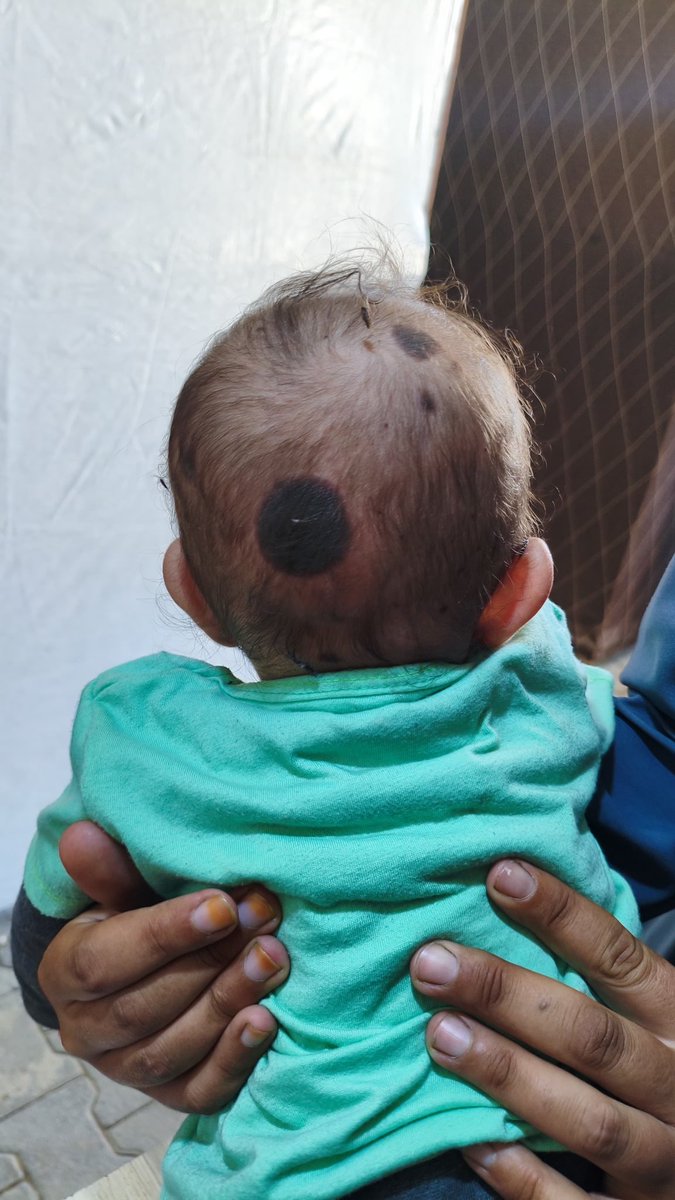
But as I leaned closer, I noticed dark patches scattered across the child’s face. I pointed toward them.
Before I could speak, the mother interrupted softly. “That is not the worst of it.”
Then she turned him over.
What I saw upon his back seemed less like a disease than a sentence.
A vast dark lesion spread across his small body as though some invisible hand had written its sorrow upon his skin. The same marks had already reached one of his hands. Quietly, patiently, they continued their advance.
“What is it?” I asked.
The mother shook her head. “We do not know.”
Had she visited a specialist? Once.
She had been given a cream and sent away with the terrible gift of uncertainty.
Then I asked the question that revealed the true illness.
Why had she never sought another opinion?
The answer did not come immediately. Some silences require courage.
When she finally spoke, it was not medicine that stood accused.
It was humanity.
Her husband refused to take the child outside. He was ashamed. Ashamed of his own son. Ashamed of the gaze of strangers. Ashamed of questions. Ashamed of whispers.
He blamed his wife for the child’s condition, as though suffering were inherited from guilt and disease were evidence of a crime.
Sometimes he would not even leave the house himself, fearing that others might see the child and, through the child, judge him.
At that moment the lesion upon the boy’s skin became the smallest tragedy in the room.
For there is something more terrible than a disease. It is abandonment.
There is something more painful than physical suffering. It is teaching a child that he must hide.
The world has always possessed a cruel habit. It sees what is unusual before it sees what is human.
It notices the scar before the smile, the deformity before the soul, the wound before the child.
And little by little, those who are stared at begin to disappear, not from life, but from sight.
They are kept indoors. Kept silent.
As I looked at the boy, I found myself wondering how many battles he had already inherited.
A battle against disease. A battle against war. A battle against poverty.
And now, a battle against shame.
He had chosen none of them. No child chooses the burdens laid upon his shoulders.
Yet there he sat, carrying them all.
Small enough to fit in his mother’s arms. Heavy enough to carry the failures of an entire society.
Perhaps the saddest part was not what covered his body.
Perhaps the saddest part was the possibility that his family had suffered alone for so long that they had begun to mistake despair for destiny.
War does more than destroy buildings and hospitals. It destroys the systems that guide people toward hope.
It leaves families alone with terrifying questions and no one to answer them. Alone with shame where there should be support. Alone with fear where there should be treatment.
And after enough years of carrying that burden alone, people begin to believe that nothing will ever change.
That there will never be a diagnosis. Never be a treatment.
Never be a future different from the one they see today.
#WoundedGaza


English
✨ retweetet
✨ retweetet
✨ retweetet
✨ retweetet

Six-year-old child Yamen Baroud is in critical condition after being diagnosed with multiple cancerous masses in his abdomen, the largest measuring 16 cm, causing severe swelling and a rapid deterioration in his health. His family is urgently appealing to humanitarian and medical organizations to help facilitate his transfer for treatment outside the Gaza Strip before it is too late.
English
✨ retweetet