Sachin Chaurasiya

1.6K posts

Sachin Chaurasiya banner
Sachin Chaurasiya

Sachin Chaurasiya

@sachindotcom

Founding Engineer @isotopes_ai • Building Aidnn, an AI agent for business analytics • ex-HackerRank • Open Source • Technical Writer

India Beigetreten Ocak 2019
535 Folgt207 Follower
Sachin Chaurasiya retweetet
Arun C Murthy
Arun C Murthy@acmurthy·
AI can produce an answer in seconds, but if your data is scattered across systems and the output hasn't been reconciled or verified, you're still spending all your cycles on verifying (data, context, accuracy etc.) before you can act. That gap, between a fast answer and a decision-ready one, is where most "chat with your data" tools break down. 📅 Join me and the @isotopes_ai team for our webinar on Thursday, 4/23 | 9:30am PDT to learn: → Why the warehouse-as-single-source-of-truth model breaks down in practice → How aidnn assembles, reconciles, and verifies data across disconnected systems → Real customer examples of true self-service analytics If your team is still spending weeks on reconciliation work that should take minutes, this one's for you.
Arun C Murthy tweet media
English
0
5
6
174
Sachin Chaurasiya
Sachin Chaurasiya@sachindotcom·
The real bottleneck isn't getting answers faster. It's that the data needed to answer them is fragmented across systems, and it needs to be reconciled and assembled before it can be analyzed. Then the answers need to be accurate to make better decisions. 📅 Join the @isotopes_ai webinar on Thursday, 4/23 | 9:30pm PST to learn: → Why the warehouse-as-single-source-of-truth model breaks down in practice → How aidnn assembles, reconciles, and verifies data across disconnected systems → Real customer examples of true self-service analytics If your team is still spending weeks on reconciliation work that should take minutes, this one's for you. 🔗 Register here: isotopes.ai/webinar/verifi…
English
0
0
1
5
Sachin Chaurasiya
Sachin Chaurasiya@sachindotcom·
Whatever comes to your mind, you can build it now. That's the promise of the AI era. But here's what nobody talks about just because you can build it doesn't mean you should. I've watched features get built beautifully and then thrown away. Not because the engineering was bad. But because nobody stopped to ask if the problem still mattered. And this will only get worse. Execution is cheap now. But your time? Your energy? Your focus? Those are still expensive. The real differentiator isn't speed. It's not even judgment. It's caring. Judgment is the what. Caring is the why. You don't ask "why does this matter" unless you actually care about the answer. I picked this up at HackerRank. They had this core value that stuck with me for years "We truly, madly, deeply care. Just when we think we have cared enough, we care some more." Whether it's a feature, a copy on the website, an email, or the margins on a presentation. Everything counts. Everything adds up. That changed how I approach building. I don't just ask "can I build this?" I ask "does this solve a real problem for a real person?" I ask "am I willing to own this after it ships?" The engineers who thrive won't just be fast. They won't just have good judgment. They'll be the ones who care deeply about what they build. Without care, judgment is just opinion. With care, it becomes conviction. Before you open that new branch ask "do I care enough about this to build it right?" That question will save you more time than any AI tool ever will.
English
0
0
0
5
Sachin Chaurasiya retweetet
Arun C Murthy
Arun C Murthy@acmurthy·
The real bottleneck isn't getting answers faster. It's that the data needed to answer them is fragmented across systems, and it needs to be reconciled and assembled before it can be analyzed. Then the answers need to be accurate to make better decisions. In the upcoming @isotopes_ai webinar, we'll walk through why fragmented enterprise data breaks traditional analytics, why chat-with-data tools paper over the problem instead of solving it, and how a verification-first, multi-agent approach with aidnn delivers answers you can actually act on. Join us April 23rd @ 9:30am PST to learn how you can make better business decisions with verified answers before your competition. Register today to join me: isotopes.ai/webinar/verifi…
Arun C Murthy tweet media
English
0
5
6
163
Sachin Chaurasiya
Sachin Chaurasiya@sachindotcom·
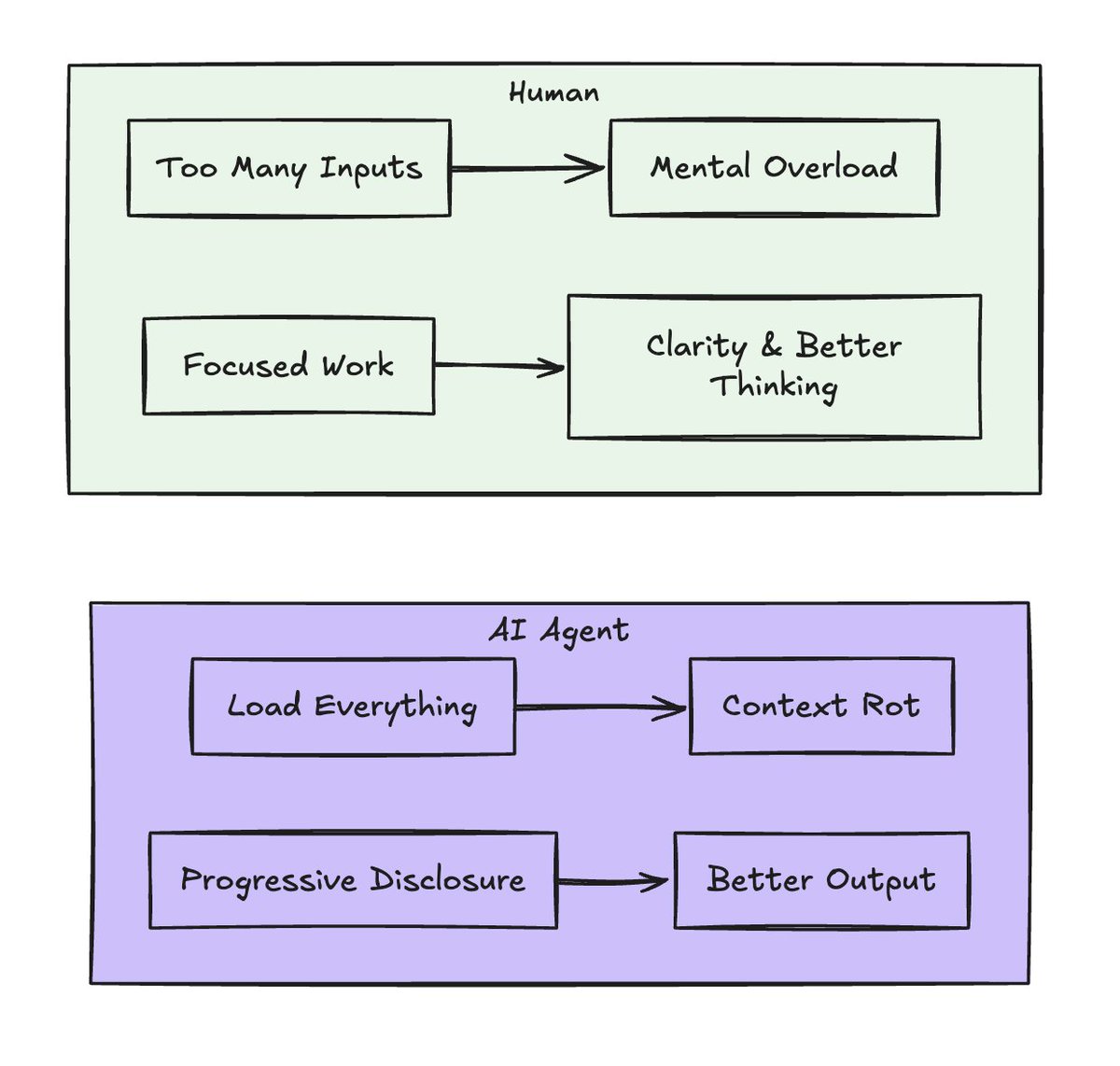
Your brain has a context window. And it's smaller than you think. In AI agents, there's a pattern called progressive disclosure. The idea: don't load everything into the agent's context at once. Start with what's essential. Load more only when the task demands it. Because when you dump everything upfront, all the tools, all the docs, all the instructions, the agent doesn't get smarter. It gets worse. It loses focus. Makes bad connections. Misses the thing that actually matters. This is called context rot. Now think about how you work. You sit down to write code. But you've got 12 tabs open, 3 Slack threads unread, a meeting in 20 minutes, and yesterday's bug still somewhere in the back of your mind. You're not more prepared. You're overloaded. That's context rot, the human version. The fix is the same for both: - Start with the minimum you need to make progress - Go deeper only when the task demands it - Don't hold what you don't need right now Agents have context windows. Humans have working memory. Both have limits. Both degrade when you ignore those limits. The best agents are designed to load only what's relevant. The best engineers work the same way. Not by knowing everything. By knowing what to load and when. We built progressive disclosure for AI. Turns out we needed it for ourselves all along.
Sachin Chaurasiya tweet media
English
0
0
1
14
Sachin Chaurasiya
Sachin Chaurasiya@sachindotcom·
@trq212 Having tools is great, but what to do with them needs clarity, and if you have clarity with context, then you can get the job done.
English
0
0
0
18
Thariq
Thariq@trq212·
I think "prompting" will keep being an incredibly high-leverage skill, like writing or public speaking. It is the skill of talking to agents, mediated by the harness. My main goal is to grow the bandwidth between humans and agents, to help us understand each other better.
English
332
154
2.8K
174.2K
Sachin Chaurasiya retweetet
Andrej Karpathy
Andrej Karpathy@karpathy·
Wow, this tweet went very viral! I wanted share a possibly slightly improved version of the tweet in an "idea file". The idea of the idea file is that in this era of LLM agents, there is less of a point/need of sharing the specific code/app, you just share the idea, then the other person's agent customizes & builds it for your specific needs. So here's the idea in a gist format: gist.github.com/karpathy/442a6… You can give this to your agent and it can build you your own LLM wiki and guide you on how to use it etc. It's intentionally kept a little bit abstract/vague because there are so many directions to take this in. And ofc, people can adjust the idea or contribute their own in the Discussion which is cool.
Andrej Karpathy@karpathy

LLM Knowledge Bases Something I'm finding very useful recently: using LLMs to build personal knowledge bases for various topics of research interest. In this way, a large fraction of my recent token throughput is going less into manipulating code, and more into manipulating knowledge (stored as markdown and images). The latest LLMs are quite good at it. So: Data ingest: I index source documents (articles, papers, repos, datasets, images, etc.) into a raw/ directory, then I use an LLM to incrementally "compile" a wiki, which is just a collection of .md files in a directory structure. The wiki includes summaries of all the data in raw/, backlinks, and then it categorizes data into concepts, writes articles for them, and links them all. To convert web articles into .md files I like to use the Obsidian Web Clipper extension, and then I also use a hotkey to download all the related images to local so that my LLM can easily reference them. IDE: I use Obsidian as the IDE "frontend" where I can view the raw data, the the compiled wiki, and the derived visualizations. Important to note that the LLM writes and maintains all of the data of the wiki, I rarely touch it directly. I've played with a few Obsidian plugins to render and view data in other ways (e.g. Marp for slides). Q&A: Where things get interesting is that once your wiki is big enough (e.g. mine on some recent research is ~100 articles and ~400K words), you can ask your LLM agent all kinds of complex questions against the wiki, and it will go off, research the answers, etc. I thought I had to reach for fancy RAG, but the LLM has been pretty good about auto-maintaining index files and brief summaries of all the documents and it reads all the important related data fairly easily at this ~small scale. Output: Instead of getting answers in text/terminal, I like to have it render markdown files for me, or slide shows (Marp format), or matplotlib images, all of which I then view again in Obsidian. You can imagine many other visual output formats depending on the query. Often, I end up "filing" the outputs back into the wiki to enhance it for further queries. So my own explorations and queries always "add up" in the knowledge base. Linting: I've run some LLM "health checks" over the wiki to e.g. find inconsistent data, impute missing data (with web searchers), find interesting connections for new article candidates, etc., to incrementally clean up the wiki and enhance its overall data integrity. The LLMs are quite good at suggesting further questions to ask and look into. Extra tools: I find myself developing additional tools to process the data, e.g. I vibe coded a small and naive search engine over the wiki, which I both use directly (in a web ui), but more often I want to hand it off to an LLM via CLI as a tool for larger queries. Further explorations: As the repo grows, the natural desire is to also think about synthetic data generation + finetuning to have your LLM "know" the data in its weights instead of just context windows. TLDR: raw data from a given number of sources is collected, then compiled by an LLM into a .md wiki, then operated on by various CLIs by the LLM to do Q&A and to incrementally enhance the wiki, and all of it viewable in Obsidian. You rarely ever write or edit the wiki manually, it's the domain of the LLM. I think there is room here for an incredible new product instead of a hacky collection of scripts.

English
1.1K
2.8K
26.3K
6.8M
Sachin Chaurasiya retweetet
Anthropic
Anthropic@AnthropicAI·
Introducing Project Glasswing: an urgent initiative to help secure the world’s most critical software. It’s powered by our newest frontier model, Claude Mythos Preview, which can find software vulnerabilities better than all but the most skilled humans. anthropic.com/glasswing
English
2K
6.7K
44K
30.9M
Sachin Chaurasiya retweetet
Anthropic
Anthropic@AnthropicAI·
New Anthropic research: Emotion concepts and their function in a large language model. All LLMs sometimes act like they have emotions. But why? We found internal representations of emotion concepts that can drive Claude’s behavior, sometimes in surprising ways.
English
1K
2.7K
17.7K
3.8M
Sachin Chaurasiya
Sachin Chaurasiya@sachindotcom·
I kept losing my best ideas to context switches. A bug thought while reviewing code. A "we should fix that" during a meeting. A feature idea at 11pm. By morning, all gone. So I built dump — a CLI where I just type what's on my mind and move on. No formatting. No waiting. Captured in milliseconds. When I'm ready, I type /insights. It looks at everything together and tells me what actually matters. The thing that surprised me: connections I'd never make on my own. Like "fix logging first — it unblocks the checkout bug." Two separate thoughts, days apart. One insight. Try it: npm i -g dump-ai dump.sachinchaurasiya.dev #DeveloperTools #AI #CLI #Productivity
English
0
0
1
20
Sachin Chaurasiya
Sachin Chaurasiya@sachindotcom·
Nobody tells you this when you start out, but being senior has very little to do with how much you know. The senior engineers I've worked with aren't the ones with the most tools in their belt. They're the ones who stay useful when nothing is clear. Give them a vague problem and they'll come back with a plan the team can actually execute. Not because they've seen it before. Because they know how to break things down and make a call. They don't think in tickets. They think in outcomes. "Did I finish my part" matters less to them than "does this work end-to-end." And they'd rather build something boring and maintainable than something clever and fragile. With AI handling more of the execution side, this is becoming the real dividing line. Code is easy to produce. Clarity on what to build and what to leave out is not. The pattern keeps showing up.
English
0
0
0
15
Sachin Chaurasiya
Sachin Chaurasiya@sachindotcom·
Today Anthropic's Claude Code source code went public. Not through a breach. Not through a sophisticated attack. Through a .map file left in the npm package. 512,000+ lines. 1,900 files. Full system prompts. Unreleased feature flags. Internal model codenames. All sitting in plain sight on the npm registry. As someone who builds and ships production software, this hit different. Because the failure isn't exotic. It's painfully familiar. Every team has that moment where someone asks: "Are we sure we're not shipping debug artifacts?" And the answer is usually "the pipeline handles it." Until it doesn't. What makes this worse: - source maps were turned on for debugging but never turned off for publish - npm publishes everything unless you explicitly exclude it - a whitelist approach in package.json would have prevented this - npm pack --dry-run takes seconds and shows exactly what ships None of this is hard. All of it gets skipped when speed is the priority. And this wasn't even the first time. A similar source map exposure was quietly patched in early 2025. Same company. Same mistake. Bigger spotlight. The broader pattern worth thinking about: As AI tools become part of critical developer workflows, the bar for supply chain hygiene goes up, not down. Your pipeline is part of your security posture. Your build config is part of your attack surface. Your publish step is a security checkpoint, not a formality. If it can happen to Anthropic, it can happen to any of us. The difference is whether we check before someone else does. github.com/instructkr/cla…
English
0
0
0
33
Sachin Chaurasiya
Sachin Chaurasiya@sachindotcom·
I think we misunderstand what experience looks like in engineering. It’s not just knowing more. It’s being able to say this won’t work much earlier. I’ve noticed this with more experienced engineers. They don’t explore every option. They don’t go down every path. They just stop certain ideas very quickly. Earlier I thought they were faster thinkers. Now it feels more like: they’ve already seen these things fail. So instead of figuring everything out, they’re mostly avoiding known mistakes. That’s a different kind of skill. And it becomes more obvious now with AI. Generating solutions is trivial. You can get 10 approaches in seconds. But that doesn’t help much if you don’t know: which ones are actually worth pursuing. Feels like the real skill is shifting. Less about finding answers. More about rejecting bad ones early. Still working on that…
English
0
0
2
14
Sachin Chaurasiya
Sachin Chaurasiya@sachindotcom·
Most of us still use AI in the same pattern: Ask a question → get an answer. But that’s not really how research works. Real research is messy. You start with a question. You search. You read a few sources. You notice gaps. That leads to better questions. And the loop continues. What caught my attention recently is the idea of modeling this research loop explicitly. Instead of one prompt → one answer, the system runs a process: generate questions → search → read → summarize → ask follow-ups → repeat. That shift feels important. It moves AI from being an answer engine to something closer to a process engine. And once AI can run structured processes like research, investigation, or analysis, the interface stops being just a chatbot and starts looking more like a system that thinks alongside you. Still early days, but this direction feels much closer to how real thinking actually happens. If you’re curious, this write-up explores the idea through a system called AutoResearcher: manthanguptaa.in/posts/autorese… Curious how others are thinking about this, are agents better thought of as answer engines, or process engines?
English
0
0
1
14
Sachin Chaurasiya retweetet
Arun C Murthy
Arun C Murthy@acmurthy·
Most AI products give you a chatbot. You ask, it answers. But that doesn’t work for serious analytical work. Your team doesn't watch every step. They start an analysis, go to meetings, come back the next day. Colleagues need to understand what happened. Sometimes you need to rewind and try a different path. A chatbot can't do any of that. So we threw out the chatbot model and rebuilt around one idea: the event stream. Every action aidnn takes is emitted as a structured, ordered event. That single decision unlocks everything: → Teammates jump in, ask questions anchored to specific moments, and keep going → Close your laptop, come back tomorrow — zero lost progress → Branch from any checkpoint and compare results → See assumptions and reasoning before execution, not after The result feels less like querying a black box and more like working with a teammate who documents their work and can be reviewed for methods, not just results. Full breakdown on the @isotopes_ai blog: blog.isotopes.ai/building-a-col…
English
1
6
6
1.7K
Sachin Chaurasiya
Sachin Chaurasiya@sachindotcom·
If you’re building AI agents and not thinking about security, you’re already late. I’m not talking about chatbots. I mean real agents that: - call internal APIs - mutate databases - trigger workflows - act on behalf of users That shift from "talking" to "acting" changes everything. If a chatbot hallucinates, it’s awkward. If an agent hallucinates, it can delete data. Most agent failures aren’t "AI gone rogue." They’re boring. - Prompt injection - Indirect injection through RAG - Letting the LLM decide permissions - Tool calls without validation - Multi-agent cascades The common root? Over-trusting the model. The rule I now follow: Never trust LLM output without validation. Not for permissions. Not for tool calls. Not for access control. LLMs generate text. Text is not authority. Security isn’t: - longer system prompts - "please behave" guardrails - hope-based engineering Security is: - deterministic checks - least privilege - constrained agency - observability - adversarial testing I design agents like this now: - Assume failure. - Assume manipulation. - Design for abuse. Agents are like junior engineers with root access. Very capable. Very dangerous if unchecked. If you’re building agents today, what’s the one security lesson you learned the hard way? #AIAgents #AISecurity #AIEngineering #LLMSecurity #SystemDesign
Sachin Chaurasiya tweet media
English
2
0
1
45
Sachin Chaurasiya
Sachin Chaurasiya@sachindotcom·
ML Engineering ≠ AI Engineering I've noticed a lot of confusion around these two roles lately. Let me break it down: ML Engineering = Training models from scratch AI Engineering = Building reliable systems around existing foundation models Here's the thing: You don't need to train GPT-5. You need to build production systems that use it effectively. What AI Engineers actually do: - Understand model limitations and cost structures - Write prompts as if they're application logic - Implement RAG (Retrieval-Augmented Generation) - Design agent workflows and tool integrations - Add guardrails and output validation - Build evaluation datasets - Monitor latency, token usage, and costs The reality? Most AI systems aren't simple "prompt → answer" flows. They're compound architectures: Retriever → Model → Tool Layer → Validation → Logging → Storage This means AI Engineering looks more like: - Backend engineering - System design - Site reliability work ...and less like research ML. The foundation model is just one piece of the puzzle. The real value comes from judgment, integration, and evaluation. AI Engineering isn't about making models smarter. It's about making systems dependable. It's a systems problem, not a math problem.
Sachin Chaurasiya tweet media
English
0
0
1
34
Sachin Chaurasiya retweetet
HackerRank
HackerRank@hackerrank·
updated.
HackerRank tweet media
English
5
8
117
4.7K