Samuli Ripatti

1.7K posts

Samuli Ripatti banner
Samuli Ripatti

Samuli Ripatti

@samrip

Samuli Ripatti is director of @fimm_uh, director of @coecdg and professor of biometry at @helsinkiuni.

Helsinki Beigetreten Ağustos 2009
765 Folgt1.4K Follower
Samuli Ripatti retweetet
Simon Pfisterer
Simon Pfisterer@SimonPfisterer·
Out now! We established a platform for functional characterization of gene variants, providing insight for 315 LDLR variants. Functional data improves cardiovascular risk assessment, going beyond "pathogenic" and "benign" groups. Important for #FH sciencedirect.com/science/articl…
English
2
3
11
545
Samuli Ripatti retweetet
FIMM HelsinkiUni
FIMM HelsinkiUni@FIMM_UH·
A FinnGen-based study led by FIMM Group Leader Elisabeth Widén has identified a gene defect in the TBPL2 gene that affects the maturation of oocytes, leading to infertility in women who have inherited the non-functional form of the gene from both parents. helsinki.fi/en/news/genes/…
English
0
2
3
623
Nina Mars
Nina Mars@ninajmars·
@JuhaniKnuuti @petterij Tulkintasi ei ole tasapäisestä vertailusta. PRS:n efekti on per SD mutta sukuriskissä oli on pienemmästä joukosta mikä heijastuu tässä suurempana efektinä. Sekin vain hieman, ja vain sepelvaltimotaudissa. Eikä tuo poista sitä että PRS:llä on merkitystä myös jos on sukuriskiä.
Nina Mars tweet media
Suomi
1
0
0
85
Juhani Knuuti
Juhani Knuuti@JuhaniKnuuti·
Koska geenien vaikutus väestön elintapasairauksissa on jopa puolet, kannattaisiko geeniriskiä määrittää potilailta? Valitettavasti näyttää siltä, että geneettisen riskin määrityksestä ei ole olennaista hyötyä. Miksi? Vastaus löytyy pääkirjoituksestamme: duodecimlehti.fi/duo18511/
Suomi
4
5
46
4.3K
Samuli Ripatti
Samuli Ripatti@samrip·
@ninajmars @JuhaniKnuuti @petterij Joo, tämä asetelman keskeinen erilaisuus olisi ollut tyylikästä mainita tuossa pääkirjoituksessa. Nyt siitä jää lukijalle pikkuisen harhaanjohtava kuva.
Suomi
1
0
3
88
Nina Mars
Nina Mars@ninajmars·
@JuhaniKnuuti @petterij Olen lukenut tämän. Tärkeä ero: Asetelmanne on oireiset, eikä PRS yleensä toimi ellei sitä ole kehitetty vastaavassa asetelmassa. Vaikka olisittekin käyttäneet parempia (nuo käyttämänne 2018-20 kehitetyt ovat jo varsin vanhoja), eivät ne todennäköisesti olisi toimineet.
Suomi
1
0
1
72
Samuli Ripatti retweetet
FIMM HelsinkiUni
FIMM HelsinkiUni@FIMM_UH·
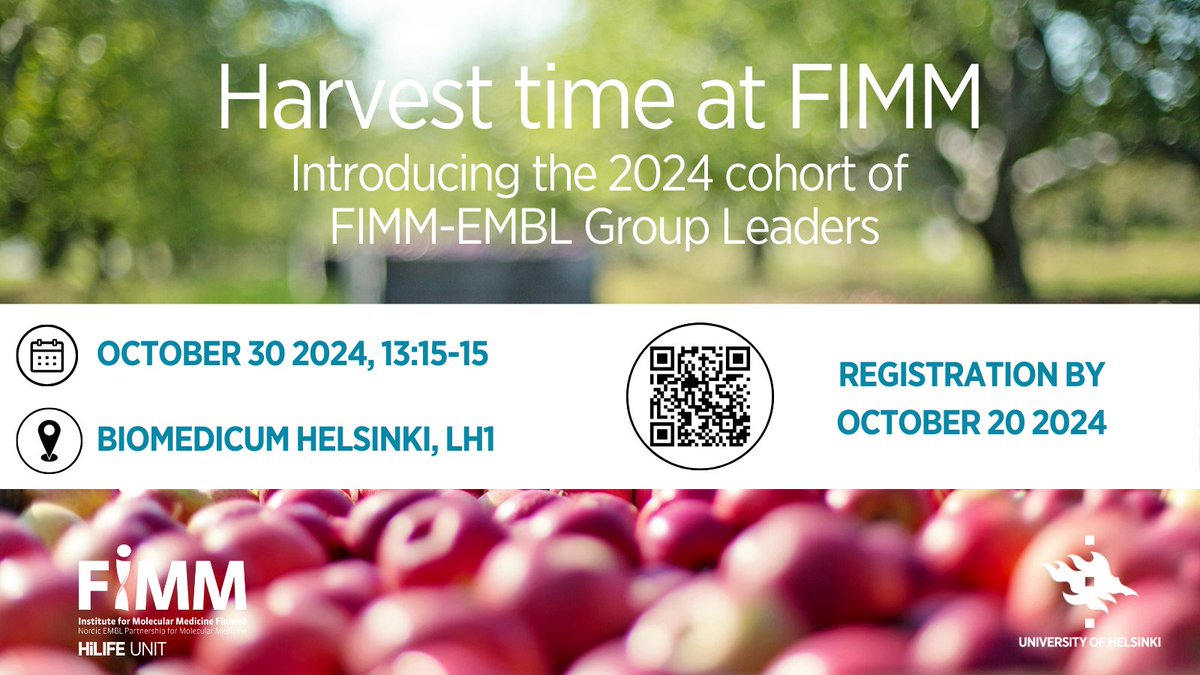
Warm welcome to the Harvest time at FIMM seminar! FIMM Director @samrip and new FIMM-EMBL Group Leaders will present their plans for the near future. 📅Wednesday Oct 30 at 13:15-15:00 🏢Biomedicum Helsinki, Lecture Hall 1 More information and registration: lyyti.fi/reg/FIMM_harve…
FIMM HelsinkiUni tweet media
English
0
5
6
1.1K
Samuli Ripatti retweetet
Mait Metspalu
Mait Metspalu@maitbb·
We are hiring! Looking for two postdocs. Topics: a) ancestry informed polygenic scores for mixed ancestry individuals and b) integrating polygenic risk models with clinically actionable rare variants for comprehensive disease risk assessment. genomics.ut.ee/en/content/job…
English
0
22
29
5.2K
Samuli Ripatti retweetet
FIMM HelsinkiUni
FIMM HelsinkiUni@FIMM_UH·
Over 40 members of the FIMM community are currently enjoying the company of our @NordicEMBL colleagues, inspiring science, and the wonderful hospitality of our sister institute @NCMMnews in Oslo. #NEPM24
FIMM HelsinkiUni tweet mediaFIMM HelsinkiUni tweet mediaFIMM HelsinkiUni tweet mediaFIMM HelsinkiUni tweet media
English
0
2
18
641
Samuli Ripatti retweetet
FIMM HelsinkiUni
FIMM HelsinkiUni@FIMM_UH·
Welcome to the "Harvest time at FIMM" seminar on Oct 30! The event includes a talk by FIMM Director Samuli Ripatti, followed by presentations from the new FIMM-EMBL Group Leaders: Nina Mars, Arafath (Rafa) Najumudeen & Simone Rubinacci. Register by Oct 20: lyyti.fi/reg/FIMM_harve…
FIMM HelsinkiUni tweet media
English
0
5
12
904
Samuli Ripatti retweetet
FIMM HelsinkiUni
FIMM HelsinkiUni@FIMM_UH·
Professor Olli Kallioniemi has been awarded a 2.5 M€ Brain Gain grant for research into artificial intelligence in medicine. The grant will allow Kallioniemi to return to Finland and establish a group @FIMM_UH @HiLIFE_helsinki gradually, during 2024-25. helsinki.fi/en/news/life-s…
English
1
4
36
1.5K
Samuli Ripatti retweetet
Andrea ganna
Andrea ganna@andganna·
Our flaghsip @intervene_eu paper is now published! I think this is an important piece of work to elevate the stature of polygenic score to that of other well-studied risk factors We provide country-specific cumulative incidence estimates for 18 diseases by PGS levels.
English
1
11
52
9.8K
Samuli Ripatti retweetet
FIMM HelsinkiUni
FIMM HelsinkiUni@FIMM_UH·
Exciting start to our scientific retreat "Fit for FIMM - the 2024 Mix" in Korpilampi! During the first session, five of our FIMM-EMBL Group Leaders captivated the audience by presenting their impressive work. Warm thanks to our sponsors for supporting the event!
FIMM HelsinkiUni tweet mediaFIMM HelsinkiUni tweet mediaFIMM HelsinkiUni tweet media
English
0
3
14
798
Samuli Ripatti retweetet
FIMM HelsinkiUni
FIMM HelsinkiUni@FIMM_UH·
Hurry and apply now — the first NORPOD postdoc call is closing soon, so don't miss this exciting opportunity! The core concept of the NODPOD programme is that all postdocs are supervised by two Group Leaders from the @NordicEMBL partnership, each from a different institute.
FIMM HelsinkiUni tweet media
FIMM HelsinkiUni@FIMM_UH

The brand new NordForsk-funded @NordicEMBL postdoc programme #NORPOD now welcomes applications for seven exciting collaborative postdoc positions! FIMM is involved in four of these projects - for further details and links please see the thread. projects.au.dk/nordic-embl-pa…

English
0
5
6
3.3K
Samuli Ripatti retweetet
Antti Latvala
Antti Latvala@AnttiLatvala·
Kesällä vietetään suomalaisten kaksoskohorttitutkimusten 50-vuotisjuhlia @helsinkiuni @FIMM_UH 🍾
Antti Latvala tweet media
Suomi
1
2
15
1.6K
Samuli Ripatti retweetet
Veera Rajagopal 
Veera Rajagopal @doctorveera·
Today, RGC has published an important paper in @Nature today, describing an analysis of close to a million human exomes (n=983,578) as a single variant call set (!). This is the largest and most diverse rare variant database created so far. This impressive feat is accomplished by a large @RegeneronDNA team led by my wonderful colleague @suganthibala. @SunKat_y et al. Nature 2024 nature.com/articles/s4158… What kind of insights can we learn from sequencing ~980k exomes? Below is a summary of the major findings from the paper. ​ Background of RGC Regeneron Genetics Center (RGC) was established in 2014 just on time when major pharma companies started entering into the human genomics playfield. Last year, RGC celebrated its 10th year anniversary. I've written about the origin story of RGC before (x.com/doctorveera/st…). ​ The business model of RGC is simple and efficient. It collaborates with academic institutions across the world and provide sequencing as free service in exchange for access to genotypic and phenotypic data. ​ The first successful collaboration was made with Geisinger Health system (GHS) to sequence 100,000 individuals, which was soon followed by an avalanche of large collaborations. Some of our largest collaborators include UK Biobank (N=500k), GHS (N=175k) and Mexico City Prospective Study (N=150k). Today, RGC has more than 300 collaborations around the world. Just a few months ago, it surpassed the milestone of 2 million exomes. What is described in the current paper is only a fraction of that sample. ​ Diversity of samples The 980k exome dataset come from a diverse set of samples. 23% (n=190k) of the participants are of non-European ancestries, the largest proportion to date for any similar datasets created so far. This includes both outbred populations and special populations enriched with communities with long-standing cultural history consanguineous and endogamous unions. ​ When it comes to human genetics, diversity is the key to making discoveries. Almost everyone agrees, and the field is embracing it now. But RGC is way ahead of the game. Just a few months ago, RGC partnered with other companies and laid the first foundational stone of what will become in a few years from now the world's largest genomics resource comprising half a million African Americans and Africans (x.com/doctorveera/st…). ​ Variant survey Human genome is ~3 billion base pairs long. ~1% of which (~30 million base pairs), containing exons, is targeted by exome sequencing. By sequencing 980k exomes, the authors have captured ~16.5 million unique variants. That is, on average, one per every two base pairs across the exome. ​ The main goal of concentrating on exomes is to capture deleterious spelling errors in the genome, resulting in either loss or substantial decrease or, sometimes, increase in gene function. The authors have identified - ~1.1 million predicted loss of function variants (pLOFs), ~50% of which are singletons (that is, seen in just one individual) - ~10 million missense variants, 40% of which are singletons. ​ As expected, African ancestry groups had more variants (18% more) than any other ancestry group. ​ Footprints of selection pLOFs in the human genomes are like bullet holes in aircraft returning from war. The genes untouched or rarely hit by the pLOFs are the most critical genes, without which life is probably impossible. ​ Studying ~980k exomes, the authors have identified ~4000 genes that are depleted of pLOFs, suggesting they are indispensable. For more than 20% of these genes, we are learning their critical requirement for normal life for the first time. Previous datasets were not able to quantify their mutation constraints because of the shorter length. Most of these genes were not linked to a human disease yet. The current list will inspire many Mendelian discoveries in the near future. ​ Regional selection We have 10 times more missense variants than pLOFs, which means we can zoom into within genes and study which parts of a gene are indispensable and which parts aren't. ​ Not all parts of a protein are critical, but some parts are. For example, DNA binding regions of transcription factor protein, catalytic sites of an enzyme protein, transmembrane domains that forms the pore of channel proteins etc. With a knowledge of ~10 million missense variants from 980,000 humans, such critical regions are now starting to light up, illuminating the most crucial regions of proteins. For example, here is a trace of missense tolerance across different domains of cancer gene KRAS. Human genetics shows that the first 80 amino acids as the most critical region of KRAS, falling under the top 1 percentile of regional missense constrain metric. ​ Human knockouts The function of a gene in an organism is understood, typically, by studying the phenotypic consequences of deleting the gene. We cannot do such experiments in humans. But fortunately, Nature has already done this mutagenesis experiments for us. By studying naturally occurring human knockouts, we can assess the consequences of completely inhibiting a gene. This is crucial data for drug developers, as it informs about safety of drugs that act by inhibiting a gene or its product. ​ Studying the pLOFs across 980k humans, the authors have found 4.686 genes with at least one human knockout, suggesting that a life without these genes is likely possible. In line with that, the authors find that these genes are the ones that were mutationally least constrained (that is, they are enriched for pLOFs). For >1700 genes, we are learning for the first time humans completely lacking these genes do exist in this world. This is an incredible resource for drug development. Clinical genetics insights One of the most important use case of reference variant databases is to help clinical geneticists to identify disease causing variants in the patients. Historically, variant databases have been biased towards European populations. As a result, clinical geneticists struggle when they study exomes of non-European ancestry patients and often label the suspected variants as variants of unknown significance (VUS), because of a lack of proper reference database. ​ Cross-referencing the clinvar database with RGC dataset, the authors find European ancestry groups had more variants labelled "pathogenic" in Clinvar than African ancestry groups. Conversely, African ancestry groups had more VUS than European ancestry groups. This is not because Africans are protected from pathogenic variants, but simply reflect current databases are ignorant to clinically important variants in non-European ancestry individuals. With growing diverse databases such as the current one from RGC, the situation will soon change. ​ Conclusion RGC has created one of the largest reference database for studying human exomes. The implications of this resource are many, spanning all areas of human biology from basic science to drug discovery. ​ Congrats to all my colleagues (@SunKat_y et al.) on this incredible accomplishment. And thanks to all RGC collaborators and research participants without whom such a dataset wouldn't exist.
Veera Rajagopal  tweet mediaVeera Rajagopal  tweet mediaVeera Rajagopal  tweet mediaVeera Rajagopal  tweet media
English
13
212
706
124.6K
Samuli Ripatti retweetet
M P Reeve
M P Reeve@mpreeve·
Do oral and non-oral lichen planus share the same genetics? Yes (20) and no (7)! Our new paper @AJHGNews using @FinnGen_FI reveals genetic heterogeneity between the two, with differential risk for autoimmune diseases and oral cancer cell.com/ajhg/fulltext/…. 1/7
English
1
7
27
6.8K