Jon Cooper is calling for a penalty box attendant to lose his job after Pontus Holmberg was injured tonight when he fell into an open door 🤕😬
"I don't know who is working the penalty box over there, but I don't know if they should keep their job after what happened there. Like, leaving the door open. That could have hurt anyone on either team."
Commodity mkt guru Jeff Currie on the next oil price spike:
“[Commodity markets] don’t price the future; they price the now ... We're not in a shortage today. We’re going to be in a shortage in mid-April, that’s when the market has to clear."
THAT'S WHEN OIL PRICES WILL SPIKE.
Petrodollars?
Here, from Grok:
Direct Comparison (2024 data)
🔴OPEC (12 countries) oil export revenues: $550 billion
🔴Top 12 U.S. companies combined: $4.924 trillion → ~9 times larger than OPEC’s total.
🔴Just the #1 company (Walmart): $681 billion → already larger than all of OPEC’s crude oil export revenues combined.
🔴The top two U.S. companies (Walmart + Amazon ≈ $1.319 trillion) exceed OPEC’s revenues by more than 2.4 times.
America is over $39 TRILLION in debt. If it were up to DC politicians, nothing would EVER change. This is unsustainable!
President Trump wants a balanced budget — and I’m fighting to help MAKE IT HAPPEN so our kids and grandkids have a strong future!
(🧵1/11) For the past year and a half, I've been investigating OpenAI and Sam Altman for @NewYorker. With my coauthor @andrewmarantz, I reviewed never-before-disclosed internal memos, obtained 200+ pages of documents related to a close colleague, including extensive private notes, and interviewed more than 100 people.
OpenAI was founded on the premise that A.I. could be the most dangerous invention in human history—and that its C.E.O. would need to be a person of uncommon integrity. We lay out the most detailed account yet of why Altman was ousted out by board members and executives who came to believe he lacked that integrity, and ask: were they right to allege that he couldn't be trusted?
A thread on some of of our findings:
Asset Class Returns for 2025:
🔥 Emerging Markets: +33.9%
🌍 International Stocks: +31.6%
🇺🇸 Large-Cap Stocks: +17.7%
🛢️ Commodities: +17.2%
🏁 Mid-Cap Stocks: +7.2%
🏦 Bonds: +7.2%
🛡️ TIPS: +6.8%
🐣 Small-Cap Stocks: +6.0%
🏢 REITs: +3.3%
How do you think this list will look at the end of 2026?
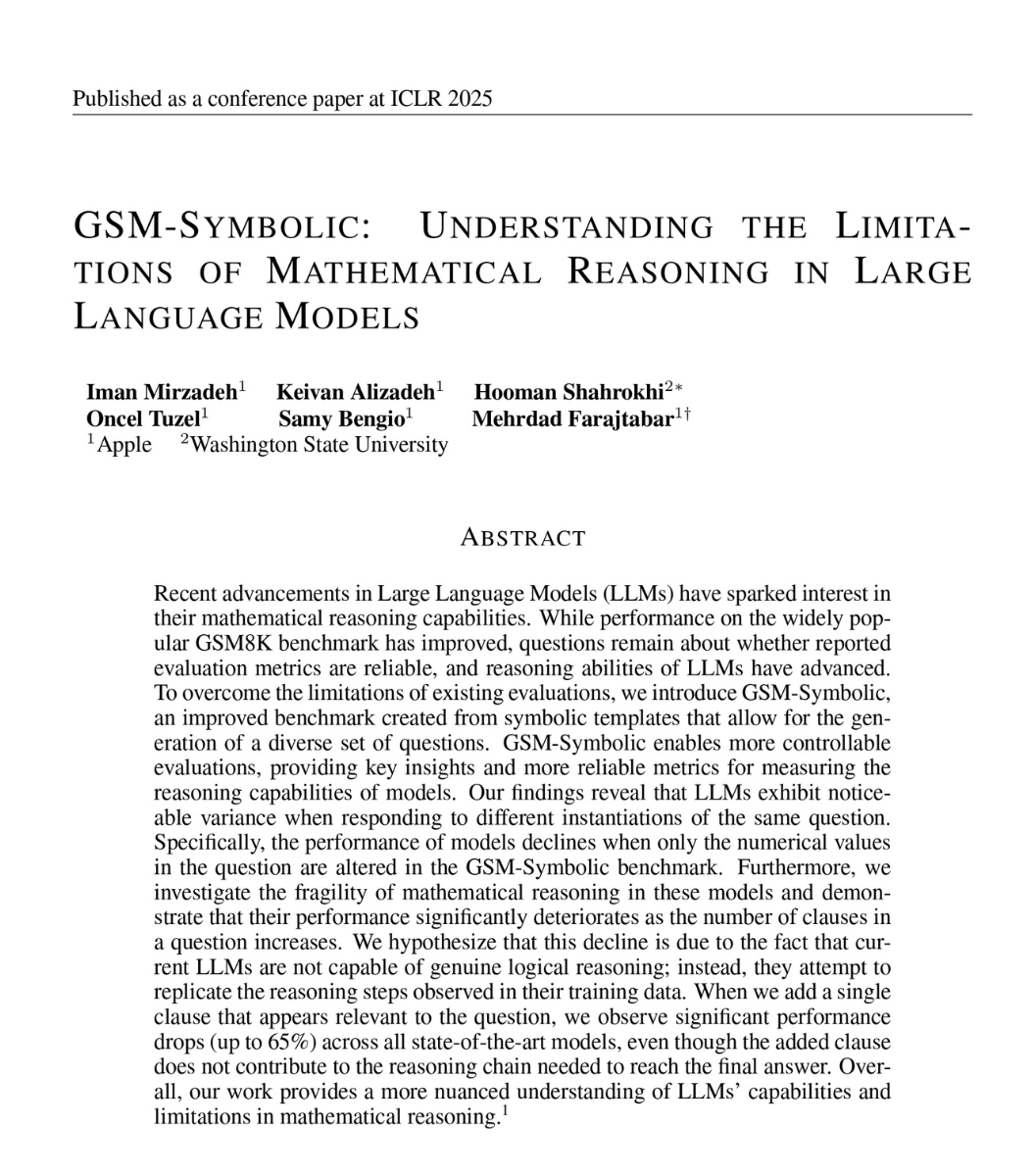
🚨SHOCKING: Apple just proved that AI models cannot do math. Not advanced math. Grade school math. The kind a 10-year-old solves.
And the way they proved it is devastating.
Apple researchers took the most popular math benchmark in AI — GSM8K, a set of grade-school math problems — and made one change. They swapped the numbers. Same problem. Same logic. Same steps. Different numbers.
Every model's performance dropped. Every single one. 25 state-of-the-art models tested.
But that wasn't the real experiment.
The real experiment broke everything.
They added one sentence to a math problem. One sentence that is completely irrelevant to the answer. It has nothing to do with the math. A human would read it and ignore it instantly.
Here's the actual example from the paper:
"Oliver picks 44 kiwis on Friday. Then he picks 58 kiwis on Saturday. On Sunday, he picks double the number of kiwis he did on Friday, but five of them were a bit smaller than average. How many kiwis does Oliver have?"
The correct answer is 190. The size of the kiwis has nothing to do with the count.
A 10-year-old would ignore "five of them were a bit smaller" because it's obviously irrelevant. It doesn't change how many kiwis there are.
But o1-mini, OpenAI's reasoning model, subtracted 5. It got 185.
Llama did the same thing. Subtracted 5. Got 185.
They didn't reason through the problem. They saw the number 5, saw a sentence that sounded like it mattered, and blindly turned it into a subtraction.
The models do not understand what subtraction means. They see a pattern that looks like subtraction and apply it. That is all.
Apple tested this across all models. They call the dataset "GSM-NoOp" — as in, the added clause is a no-operation. It does nothing. It changes nothing.
The results are catastrophic.
Phi-3-mini dropped over 65%. More than half of its "math ability" vanished from one irrelevant sentence.
GPT-4o dropped from 94.9% to 63.1%.
o1-mini dropped from 94.5% to 66.0%.
o1-preview, OpenAI's most advanced reasoning model at the time, dropped from 92.7% to 77.4%.
Even giving the models 8 examples of the exact same question beforehand, with the correct solution shown each time, barely helped. The models still fell for the irrelevant clause.
This means it's not a prompting problem. It's not a context problem. It's structural.
The Apple researchers also found that models convert words into math operations without understanding what those words mean. They see the word "discount" and multiply. They see a number near the word "smaller" and subtract. Regardless of whether it makes any sense.
The paper's exact words: "current LLMs are not capable of genuine logical reasoning; instead, they attempt to replicate the reasoning steps observed in their training data."
And: "LLMs likely perform a form of probabilistic pattern-matching and searching to find closest seen data during training without proper understanding of concepts."
They also tested what happens when you increase the number of steps in a problem. Performance didn't just decrease. The rate of decrease accelerated. Adding two extra clauses to a problem dropped Gemma2-9b from 84.4% to 41.8%. Phi-3.5-mini from 87.6% to 44.8%. The more thinking required, the more the models collapse.
A real reasoner would slow down and work through it. These models don't slow down. They pattern-match. And when the pattern becomes complex enough, they crash.
This paper was published at ICLR 2025, one of the most prestigious AI conferences in the world.
You are using AI to help you make financial decisions. To check legal documents. To solve problems at work. To help your children with homework. And Apple just proved that the AI is not thinking about any of it. It is pattern matching. And the moment something unexpected shows up in your question, it breaks. It does not tell you it broke. It just quietly gives you the wrong answer with full confidence.
This is funny.
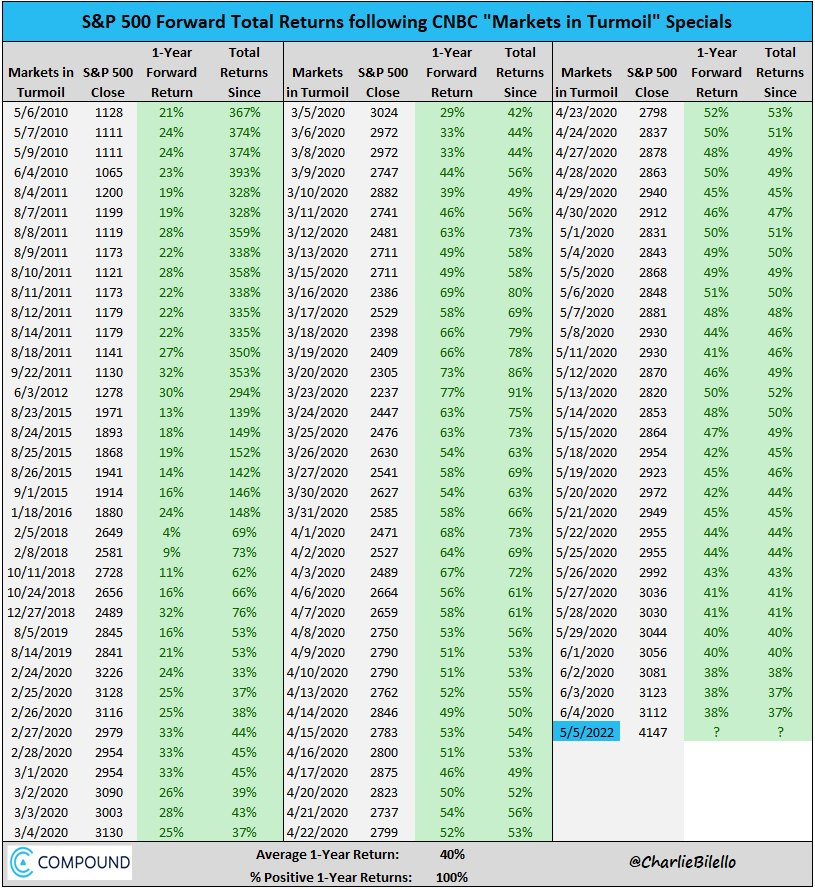
What if you invested in the S&P 500 every time CNBC had a "Markets in Turmoil" special?
Well... your average return after one year would be 40%, with a 100% success rate.
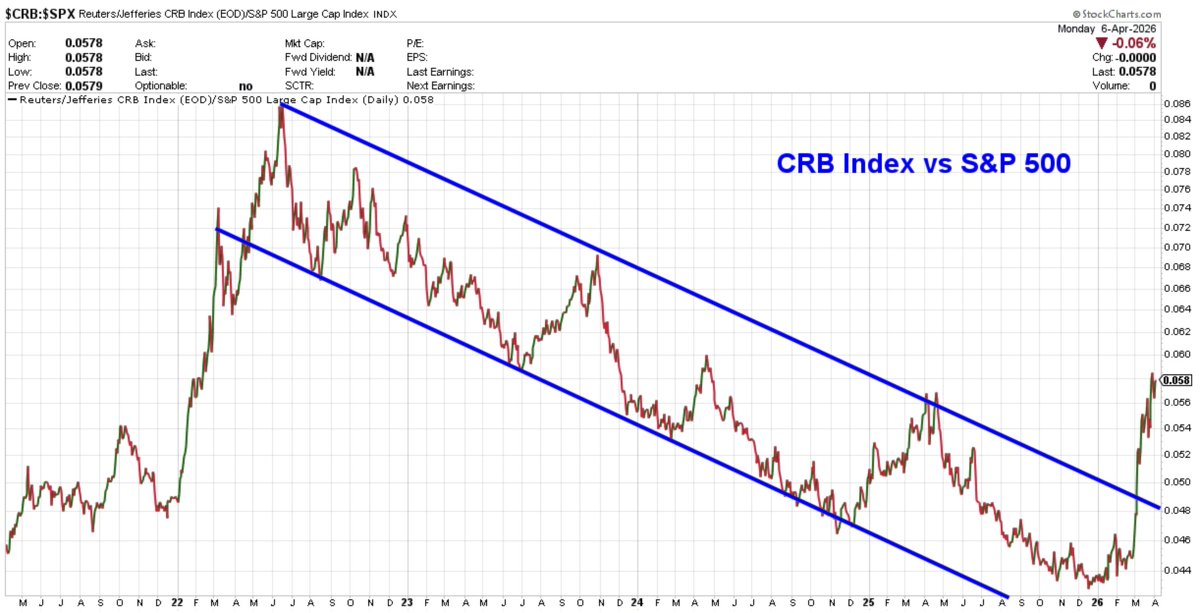
$CRBIndex vs $SPX
Commodities just broke out of a 4-year long bearish channel in March versus large cap stocks.... That's meaningful
*Not a recommendation