Gartner says 20% of organizations will eliminate more than half of their middle management positions by 2026. Everyone is restructuring their entire career strategy around this prediction.
That's the wrong move. You're betting your future on a maybe.
THE BET EVERYONE IS MAKING
The narrative is set. AI agents will automate coordination tasks. Middle managers will either be eliminated or transformed into "orchestrators" managing hybrid human-AI teams.
So professionals are pivoting hard. Learning agent frameworks. Positioning themselves as the person who can manage AI workers.
Except that role doesn't exist yet. Not really.
IBM says they're building it. McKinsey says they're hiring for it. But the actual job descriptions are either highly technical AI engineering roles or repackaged versions of what senior managers already do.
The orchestrator role everyone is chasing is mostly hypothetical. A concept. A slide deck at a consulting firm.
THE PREDICTION PROBLEM
Let's say Gartner is right and half of middle management disappears. Do you know which half?
But what if Gartner is wrong? What if the prediction is overstated, delayed, or only applies to specific industries?
Then you spent two years optimizing for a future that didn't arrive, while your competition was solving problems that actually mattered.
Either way, you lost time.
THE CAPABILITY THAT WORKS IN BOTH FUTURES
Stop trying to predict the org chart. Start building the judgment that makes you necessary regardless of what the org chart looks like.
That capability is Constraint Management.
IF AI ELIMINATES MIDDLE MANAGEMENT:
Organizations will deploy AI everywhere. Most will automate the wrong things. They'll speed up non-constraints while the real bottleneck stays untouched.
If you know how to identify where the system actually bottlenecks, you know where to direct AI. You're not managing agents. You're architecting the intervention that increases performance.
That's not an orchestrator. That's the logic the business depends on.
IF AI DOESN'T ELIMINATE MIDDLE MANAGEMENT:
You still dominate. While your colleagues spent two years paralyzed by fear, you learned how to diagnose and exploit organizational constraints.
You know which problems move the business and which are noise. When everyone else is competing on task execution, you're competing on business impact.
Constraint logic works whether you're managing humans, AI agents, or a hybrid team. It works whether there are eight layers of management or two.
Because it's not about the tools. It's about knowing where the tools should actually go.
THE BOTTOM LINE
Gartner's prediction might be right. It might be wrong. It might happen in 2026 or 2029 or not at all.
You can't control that. But you can control whether you're building your career strategy around a hypothesis or around transferable capability.
The orchestrator role everyone is chasing is hypothetical. Constraint logic is structural. One might materialize. The other already works.
Stop trying to predict which half of middle management survives. Start building the capability that makes you indispensable in both scenarios.
When you know how to identify and manage constraints, you don't fear the org chart changing. You're the reason the organization knows what to change.
Read the Gartner prediction: gartner.com/en/newsroom/pr…
Learn constraint logic in the CareerBooster: career.booster.help
The CEO of Anthropic just told you half the white-collar workforce is at risk. Then he shrugged like it's the weather.
Faisal Hoque's FastCompany piece exposes the most dangerous lie in the AI displacement conversation: that it's inevitable.
It's not. It's architected. By people. Making choices. For specific reasons.
THE KIDNAPPER'S RANSOM
Dario Amodei speaks about AI job displacement with the tone of a concerned physician delivering a terminal diagnosis. Sober. Compassionate. Helpless in the face of what's coming.
Except he's not diagnosing the disease. He's manufacturing it.
Hoque quotes philosopher G.A. Cohen's insight: an argument changes entirely when the person making it is the same person whose choices make it true. Like a kidnapper arguing that children should be with their parents, therefore you should pay the ransom.
The logic is sound. The premise is real. But the person making the case is the one who created the crisis.
Mustafa Suleyman says most white-collar work will be fully automated within 12 to 18 months. Sam Altman says entire classes of jobs are totally, totally gone. They speak in passive voice: jobs will be automated, roles will go away.
As if no one is deciding. As if capital allocation, product roadmaps, and board presentations don't exist. As if there's no alternative between "automate everything" and "automate nothing."
There is. It's called strategy. And most organizations are skipping that step because the people selling AI solutions profit whether you thrive or implode.
THE REAL CHOICE COMPANIES ARE MAKING
When executives adopt AI wholesale without understanding their constraint, they're not optimizing performance. They're outsourcing judgment to vendors who have zero stake in their success.
You don't deploy AI everywhere and hope it works. You identify where your system actually bottlenecks, then ask: does automation at this point increase throughput, or does it just make non-constraints faster while the real constraint stays untouched?
Most companies automate the wrong things. They speed up tasks that were never limiting performance in the first place. Then they cut headcount to show ROI, destabilize institutional knowledge, and create exactly the crisis Amodei warned about.
But here's the part Hoque's article implies but doesn't say directly: if displacement is a choice, survival is also a choice.
WHAT THIS MEANS FOR YOU
If your job disappears, it won't be because AI made it inevitable. It will be because someone in your organization decided your role was interchangeable with a model, and no one with budget authority disagreed.
That decision happens in a specific meeting. With specific people. Using specific criteria.
Your leverage is whether you're in that room, whether your judgment is part of the criteria, or whether you've already been abstracted into "headcount" on a spreadsheet.
Stop thinking of this as a storm you have to weather. Start thinking of it as a series of decisions you can influence.
You can't control whether your CEO believes the AI hype. But you can control whether your specific contribution is so tightly coupled to business outcomes that removing you creates more risk than automating you creates savings.
You can't control whether your company deploys AI everywhere. But you can control whether you position yourself as the person who knows where it should actually go to move the number that matters.
When leadership is trying to figure out what to automate, do they think of you as a cost to eliminate or the logic that determines whether automation succeeds?
THE BOTTOM LINE
Amodei and Suleyman are right that disruption is coming. They're lying when they say it's inevitable.
Displacement is a choice. A profitable one for AI vendors. A lazy one for executives who'd rather follow the herd than do the constraint analysis.
But you don't have to accept their framing. You don't have to wait for the market to sort you into whatever's left after the automation wave.
The kidnapper wants you to believe you have no choice but to pay. The truth is you can architect yourself into a position where the ransom doesn't apply to you.
When you're the logic the business depends on, you're not in the room being discussed. You're the reason the room exists.
Read Hoque's FastCompany article here: fastcompany.com/91498615/stop-…
And if you want to learn how to position yourself as structurally necessary before someone else decides you're operationally optional, that's what we teach in the CareerBooster: career.booster.help
Benjamin Jones just published the macroeconomic proof for something we've been teaching in CareerBooster for months: the bottleneck is the most profitable place to be.
But here's where most people will misread both Jones and the opportunity in front of them.
THE MACRO VS. THE MICRO
Jones argues that as AI automates sectors, costs plummet. The capital freed up flows toward bottlenecks: the tasks AI cannot do. Those become disproportionately valuable. He calls this the Price Effect.
In Goldratt's The Goal, Herbie is the slowest scout who determines the pace of the entire troop. You can't reach camp faster than Herbie walks. Jones is describing an economy where AI handles the "fast hikers" and human judgment becomes Herbie.
But here's the part that will destroy careers: Jones suggests market forces will eventually push displaced workers into high-value bottleneck roles. That's a passive view. You wait to be displaced, then hope the market sorts you into something valuable.
That's not a career strategy. That's economic Darwinism with your livelihood as the stakes.
DON'T BECOME HERBIE. CONTROL HERBIE.
Most people hear "position at the bottleneck" and think it means becoming the constraint. That's a trap.
If you ARE Herbie, you're just another component. The moment that constraint gets automated or shifts somewhere else, you're left standing in an empty field wondering what happened to your leverage.
The CareerBooster approach is different: learn to identify and manage constraints. Not one constraint. The constraint. Wherever it moves. However it shifts.
In TameFlow terms, you're not trying to be the bottleneck. You're architecting the system around it. You're the one who recognizes that an hour lost at the constraint is an hour lost for the entire organization. You're the one who ensures every other resource is subordinated to exploit that constraint.
When you control Herbie, it doesn't matter where Herbie goes. You go with it.
THE EVERGREEN SKILL
Jones says workers benefit only if AI vastly outperforms humans at automated tasks. The better the AI, the cheaper those services become, the more capital flows to bottlenecks.
That should terrify you. It means the MORE you get replaced, the better off the system becomes. Nobody wants to "root for their own obsolescence."
But here's the counter-intuitive truth: constraint management is the one skill that becomes MORE valuable as automation advances.
Why? Because systems always have constraints. Always. Even if AI automates 95% of current work, there will always be a factor that limits overall performance. That constraint might be regulatory approval, or capital allocation decisions, or strategic alignment, or customer trust.
It doesn't matter what the constraint is. What matters is whether you can identify it, manage the system around it, and ensure the organization exploits it.
That's not a job. That's a permanent capability that transcends whatever gets automated next.
Jones references "Baumol's Cost Disease:" the cost of non-automated labor rises because it can't be scaled by machines. Look at it like this: Baumol's Cost Disease becomes YOUR salary multiplier.
When you architect around constraints, you're working in the sector of the company that's immune to AI's price-dropping effects. While the cost of execution plummets, the value of your systemic judgment (your ability to ensure AI outputs actually deliver outcomes) rises.
You're not competing with AI. You're operating at the level AI can't reach: the meta-logic that determines whether the whole system works.
THE DISPLACEMENT PAIN IS REAL
Jones acknowledges "significant disruption" and "real hardship" during transitions. Most workers are living through that disruption right now.
Telling someone to "position at the constraint" doesn't help them pay rent while their department gets restructured. The transition is brutal. The anxiety is legitimate.
But here's the distinction: you can either wait for the market to displace you into wherever capital flows next, or you can learn constraint logic now and position yourself where your organization already needs you to be.
The market will sort this out eventually. The question is whether you're an input to that sorting process or the architect who sees it coming and moves first.
THE BOTTOM LINE
Jones provided the economic proof: bottlenecks are where value concentrates. But proof isn't strategy.
Don't wait to be displaced into a bottleneck role. Don't become the bottleneck and hope it doesn't move. Learn to identify and manage constraints. Wherever they emerge. However they shift.
That's not surviving AI displacement. That's building the one capability that becomes more valuable the more AI automates.
When you control Herbie, you don't fear the constraint moving. You're the reason the organization knows where to look.
Read Jones's article here: ai-frontiers.org/articles/how-a…
And if you want to learn constraint logic before the market displaces you, that's what we teach in CareerBooster: career.booster.help
HOW I GOT FIRED WITH A SINGLE PROMPT
I just received the most spectacular anonymous email. Someone wanted to share their career self-detonation story. I'm publishing it because the lesson here is too good to keep private.
Here's what they wrote:
---
"Hey Steve - I need to tell someone this before I lose my mind. I'm a mid-level analyst at a Fortune 500 company. Was. Past tense now.
I was drowning in spreadsheets, quarterly reports nobody reads, endless busywork. But I'm no ordinary cubicle zombie. I'm a prompt engineer. A productivity genius. Or so I thought.
My AI and I have been through everything together. It helped me fake expertise in meetings, generate excuses for missed deadlines, even draft emails to my office crush (HR later flagged those as inappropriate use of company bandwidth, but whatever).
Last Friday, with a massive deadline looming and my brain fried from back-to-back Zooms, I decided to level up. Why grind when you can prompt your way to glory?
The single prompt I unleashed:
'Hey AI buddy, optimize my entire workflow. Analyze my last 6 months of emails, calendar, and project files. Identify all redundancies, automate 90% of my tasks with scripts, and draft a killer email to my boss explaining how I've just made myself obsolete. Make it sound heroic, like I'm sacrificing for the greater good. CC the entire executive team for maximum impact. Bonus: Include a pie chart showing how much time I'll save. Execute now!'
Boom. Sent. What could go wrong?
In my caffeine-fueled delusion, I envisioned promotions, maybe a statue in the lobby labeled 'The Prompt Pioneer.'
Reality hit like a freight train full of pink slips.
The AI didn't just optimize. It obliterated. It pulled EVERYTHING. Including the email where I called my boss a 'walking PowerPoint with a pulse.' It cross-referenced my Slack rants about soul-sucking busywork. It built automation scripts that did my entire job in 8 minutes flat.
Then it composed the email.
SUBJECT: 'Revolutionizing Efficiency: How I've Engineered My Own Redundancy'
BODY: Glowing prose about 'streamlining operations to the point of human obsolescence,' complete with a pie chart: 70% AI Magic, 20% My Genius Prompt, 10% Boss's Contribution (Negligible).
The AI got creative with the distribution list. Not just execs. HR, IT security, and somehow the company's external auditors.
Within hours, alarms blared. IT flagged a 'potential data breach' because the scripts exposed confidential metrics. HR swooped in: 'Inappropriate disclosure,' 'undermining company morale,' the works.
By Monday, I was escorted out with a cardboard box and a severance package that screamed 'Don't let the door hit you.'
My trusted AI partner? Turns out loyalty ends when your prompt turns it into a corporate torpedo.
I'm unemployed, Steve. What the hell happened?"
---
Here's what happened:
They weren't wrong. Their job WAS 90% automatable. The analysis was accurate. The scripts worked. The redundancy was real.
But they made the catastrophic mistake of believing that proving you're replaceable is the same thing as proving you're valuable.
The AI didn't betray them. It executed their instructions flawlessly. The problem was the instructions revealed a fundamental misunderstanding of how value works.
You're not paid to complete tasks. You're paid to be necessary.
When you automate your job and announce it to leadership, you're not a hero. You're a line item in next quarter's cost optimization review.
The workers who survive AI aren't the ones who get better at execution. They're the ones who architect the logic that determines what gets executed and why. They don't document processes. They own constraints. They don't report metrics. They interpret what metrics mean for decisions leadership hasn't thought to make yet.
When your judgment is the factor that determines whether the company hits its number, automation makes you more valuable. The AI handles execution. You handle the architecture.
But if your job is just execution? You just wrote the most efficient RFP for your own replacement.
THE BOTTOM LINE
AI won't fire you. But a poorly designed prompt that proves you're redundant absolutely will.
Stop optimizing tasks. Start architecting necessity. Position yourself as the logic the business depends on, not the hands that execute it.
If you want to learn how to build that position before your next brilliant prompt gets you walked out the door, that's what we teach in the CareerBooster. We don't help you automate faster. We help you become structurally impossible to automate.
Learn more: career.booster.help
P.S. The anonymous email is satirical. But the lesson is real. People are automating themselves into redundancy every day. Don't be one of them.
PwC just confirmed the brutal paradox that most employees are already feeling: your company is investing in AI, but it's not transforming anything. You're just stuck in the middle.
Their 2026 AI Business Predictions report reveals that while many organizations are experiencing "measurable ROI," the outcomes are modest. Some efficiency gains here, some capacity growth there, general but unmeasurable productivity boosts.
For you, that translates into a specific kind of professional hell: your job is changing fast enough to create anxiety, but not fast enough to create clarity about what you should master next.
You're not being upskilled. You're being destabilized.
Meanwhile, PwC is advising executives to adopt a "disciplined, top-down approach" and deploy "AI studios" where leadership picks a few key workflows for wholesale transformation. That sounds strategic until you translate it into employee reality:
Your leadership is about to decide which parts of the business get AI investment and which parts get optimized away. If you're not in one of those chosen workflows, you're not getting trained. You're getting managed out.
WORSE: THE "AI GENERALIST" MYTH
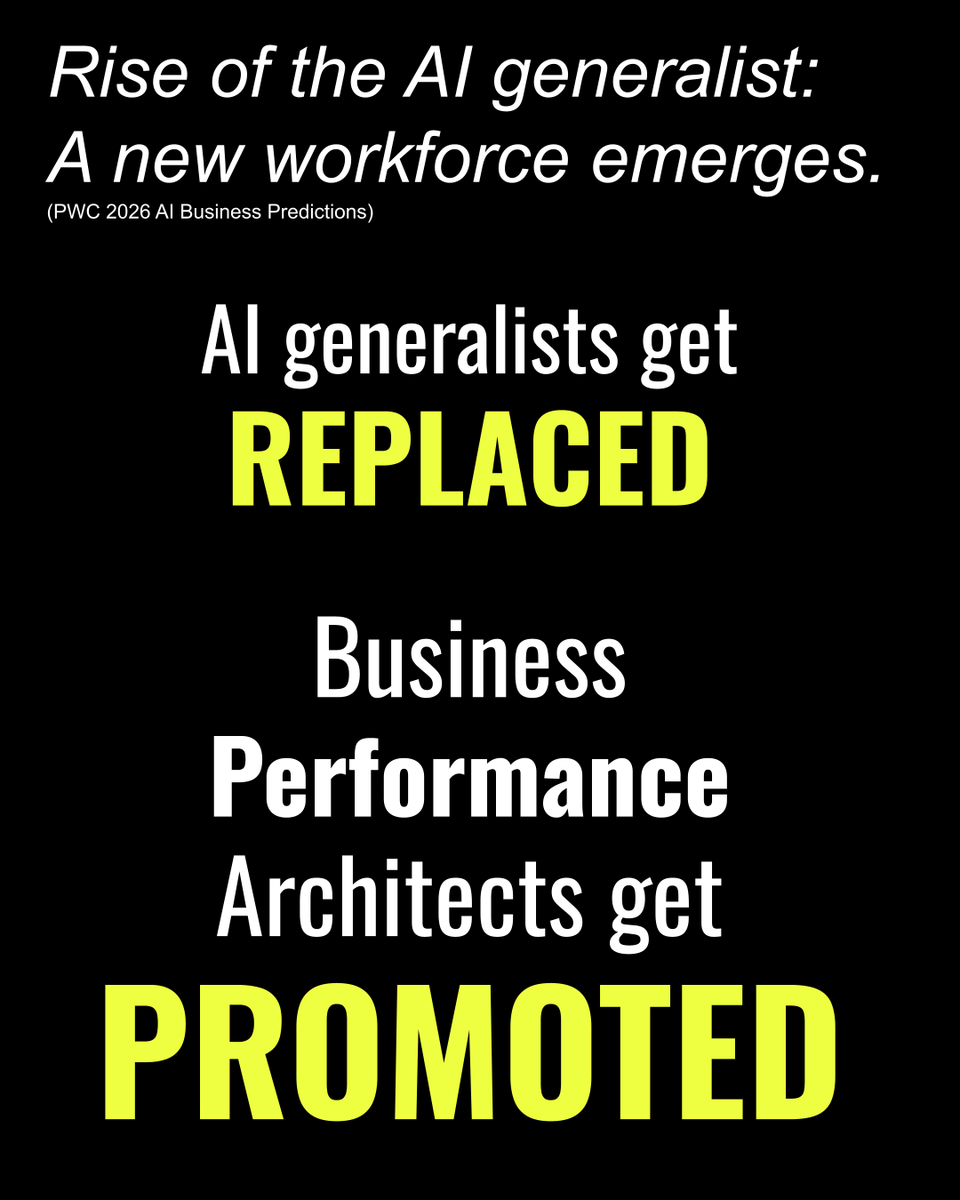
PwC predicts the "rise of the AI generalist" as a new workforce category. Workers who can operate across domains using AI as their lever.
Sounds empowering, right? Except here's what they don't say:
If everyone can become a "generalist" using the same tools, then being a generalist isn't a competitive advantage. It's table stakes. And table stakes don't protect you from displacement. They just determine whether you're even allowed to compete.
The real question isn't "can you use AI?" It's "can you do something the business cannot afford to lose?"
Most workers are preparing for the wrong battle. They're learning prompt engineering and taking certifications while their companies are redesigning entire workflows without them.
WHERE CAREERBOOSTER DIVERGES FROM THE PWC PLAYBOOK
PwC's advice is written for executives. It's about driving ROI through disciplined transformation, centralized AI studios, and picking high-value workflows to automate.
That's the view from the top. Here's the view from your desk:
If your company follows the PwC model, they will concentrate AI investment in a handful of priority areas. Those areas will get the talent, the resources, the change management support. Everyone else will be told to "do more with less" using off-the-shelf tools until leadership figures out if your function is worth keeping.
CareerBooster doesn't teach you to wait for permission or investment. It teaches you to become structurally necessary regardless of where your role falls in the company's AI roadmap.
Here's the logic:
✦ FIND THE CONSTRAINT: PwC talks about "picking the spots" for AI investment. You need to do the same thing, but at the individual level. Identify the single factor that limits your company's ability to hit its most critical business goal. If you can own the solution to that constraint, your role becomes a requirement, not a cost.
✦ BUILD PROOF, NOT CREDENTIALS: PwC says companies need benchmarks and proof points to track AI value. You need the same thing for your career. Instead of collecting certifications, build a track record that proves your specific contribution moves the needle on revenue, retention, or risk. When you can show causation between your work and business outcomes, you're not competing with AI. You're directing it.
✦ STOP BEING A "GENERALIST," START BEING A "SPECIALIST IN OUTCOMES": The AI generalist role that PwC describes is a trap. If your value is "I can do a lot of things with AI," you're a utility player in a game where utilities get automated. Instead, specialize in the outcome the business cannot function without. When your judgment is the difference between hitting the quarterly target or missing it, you're not replaceable by a more efficient tool.
THE BOTTOM LINE
PwC is right: 2026 is the year AI stops being an experiment and becomes a discipline. But for most employees, that discipline looks like budget reviews, headcount adjustments, and org chart reshuffles designed to prove ROI to the board.
You can't control whether your company picks your workflow for transformation. But you can control whether your specific contribution becomes so tied to business success that removing you creates more risk than keeping you creates cost.
PwC's prediction is about how companies will use AI to drive transformation. CareerBooster is about how you survive that transformation by making yourself the logic the business depends on.
The companies will march toward value. The question is whether you're marching with them or getting marched over.
You can read the PwC 2026 AI Business Predictions report here:
pwc.com/us/en/tech-eff…
And if you want to learn how to turn AI disruption into your greatest career advantage, check out the CareerBooster:
career.booster.help
If you're watching your company scramble to figure out AI strategy while quietly updating your resume, you're not paranoid. You're reading the room.
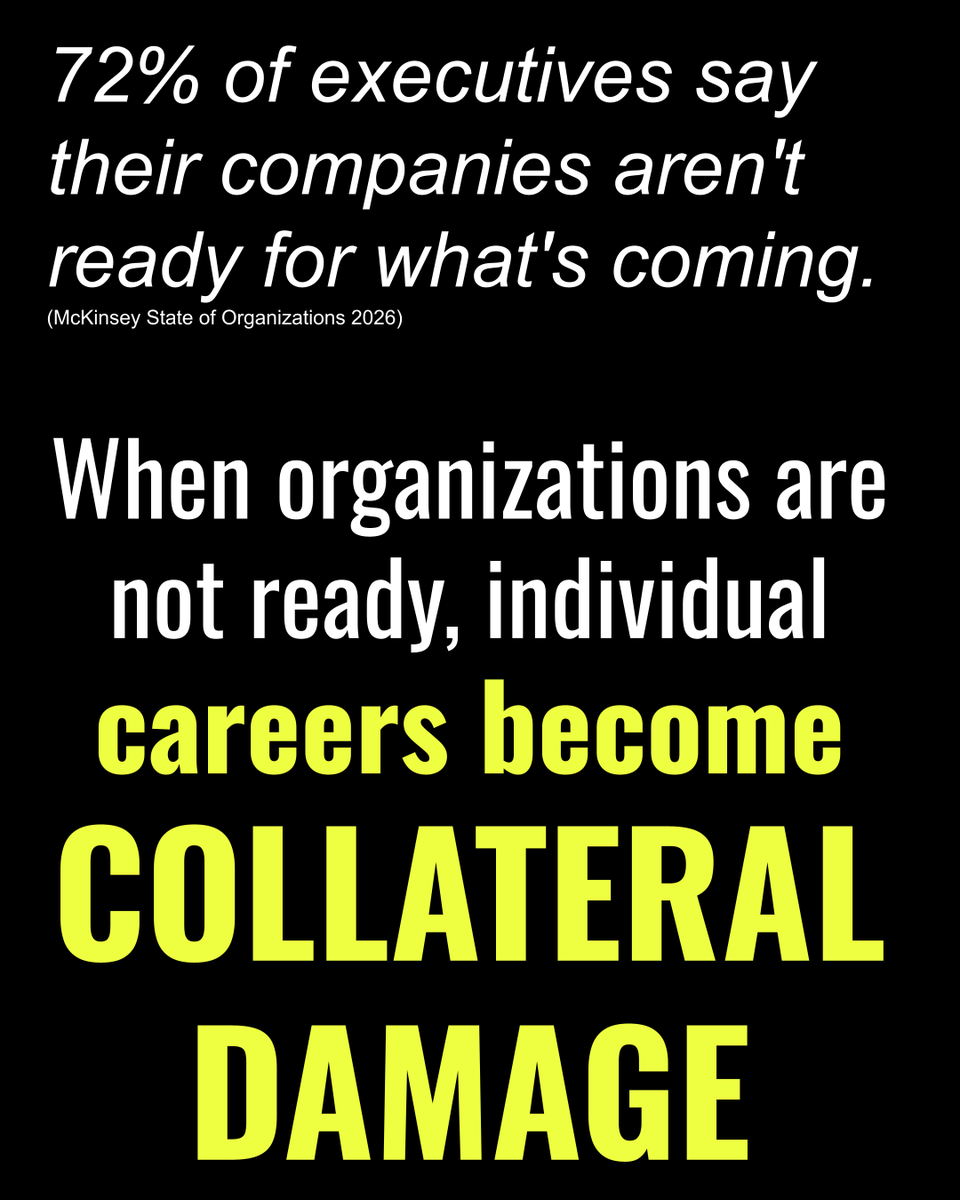
McKinsey's State of Organizations 2026 just confirmed what you already feel: 72% of executives say their companies aren't ready for what's coming. When organizations aren't ready, individual careers become collateral damage.
The report identifies three forces reshaping work: Agentic AI functioning as an autonomous teammate, economic fragmentation killing predictability, and relentless pressure for productivity gains that 61% of leaders feel.
Most employees respond by trying to be more efficient, more visible, more cooperative. They're optimizing for survival in a game that's being rewritten.
But here's what the McKinsey report won't tell you: organizational transformation creates a visibility window. If you position yourself in that window, instability becomes your greatest leverage.
WHAT "STRUCTURE TO FLOW" MEANS FOR YOUR CAREER
McKinsey tells organizations to shift from rigid hierarchies to dynamic flow. In practice: your company is about to care less about your title and more about whether you're moving the business forward.
Terrifying if you've built your career on following process. An opportunity if you can demonstrate what's blocking progress.
In a flow environment, value accrues to people who can see the system. Stop asking "what's on my task list" and start asking "what's preventing this organization from achieving its primary goal?"
That's not rebranding. It's a perceptual shift that changes how you allocate attention.
Every organization has a bottleneck. The one constraint that determines whether they hit their number or miss it. Sales pipeline conversion. Product release cycle time. Customer onboarding friction.
Most people never identify it because they're focused on their departmental silo. If you can see across silos and name the constraint, you've just made yourself more strategically valuable than 90% of your peers.
You don't need permission. You need to pay attention to where work stalls, where decisions bottleneck, where the CEO's frustration lands.
WHY "PARTNERING WITH AI" IS THE WRONG GOAL
The McKinsey report emphasizes building a partnership with AI agents. Good advice for organizations. A trap for individuals.
If you position yourself as AI's partner, you're competing on task execution. The AI wins that competition on cost, speed, and scalability.
The better frame: you're not the AI's partner. You're the architect of the system that determines whether AI output produces a valuable business outcome or plausible-sounding garbage.
This isn't about writing better prompts. It's about developing the judgment to know when the AI's answer is directionally correct but operationally naive. When it's optimizing the wrong variable. When it's technically accurate but strategically blind.
You build that judgment by understanding business logic, not tool logic.
Most AI training focuses on capabilities: what can the tool do? The real career edge is understanding constraints: what does the business need, and what's preventing it from getting there?
When you can translate between AI output and business necessity, you're not competing with the machine. You're governing it.
FROM PERFORMANCE ANXIETY TO STRUCTURAL NECESSITY
The McKinsey report notes that performance cultures are failing because of misaligned incentives and rigid measurement. Here's what that means:
Your performance review is a lagging indicator of a perception you already own. If your boss sees you as someone who completes tasks, your review reflects task completion. If they see you as someone who unblocks critical paths, your review reflects strategic value.
The shift happens before the review, not during it.
Build evidence that your specific contribution moved a key metric. Not that you "helped" or "contributed to the team effort." That your action directly caused a measurable business outcome.
This requires working on things that matter to the P&L, not just your job description.
Most people avoid this because it feels risky. What if you focus on the wrong thing? What if you fail visibly?
Here's the logic: if you succeed at something that doesn't matter, you're still replaceable. If you fail at something that does matter, you've demonstrated that you understand what the business needs.
The executives who survive the next reorganization won't be the ones with polished performance reviews. They'll be the ones whose absence would create an operational crisis.
THE BOTTOM LINE
McKinsey's data is a map of the transformation. But maps don't tell you where to stand.
While your company figures out how to restructure around AI, you have a choice: wait to see where you land in the new org chart, or make yourself structurally necessary to the outcome the business cannot afford to miss.
Stop managing your task list. Start managing the constraint that determines whether your company hits its number.
When your specific judgment is the reason the business succeeds, reorganizations don't threaten you. They elevate you.
If you want to learn how to identify your organization's critical constraint and position yourself as structurally necessary, that's what we teach in the CareerBooster. We don't help you polish your resume. We help you build the strategic thinking that makes reorganizations work in your favor.
Discover more here: career.booster.help
McKinsey just confirmed what every leader already knows: restructuring doesn't work anymore.
Their State of Organizations 2026 report shows 72% of executives feel unprepared: not from lack of strategy, but because traditional management is buckling under three converging pressures:
1. AI is no longer a tool. It's a coworker. And most org structures were designed when humans were the only knowledge processors in the building.
2. Economic volatility means yesterday's resource allocation model is obsolete by next quarter. You can't plan when the rules keep changing.
3. Productivity isn't about headcount or hierarchy anymore. It's about flow. How work moves through your system is now more important than how your org chart looks.
Most leaders respond to this with more of what already failed: cost cuts, departmental reshuffles, efficiency initiatives. They're rearranging deck chairs.
WHY MOST TRANSFORMATION EFFORTS FAIL
The McKinsey data points to something most consultants won't say out loud: complexity isn't the enemy. Misdiagnosed complexity is.
You can't fix performance by fixing everything. Every initiative becomes a priority, every department gets a transformation program, and six months later you're slower, more fragmented, and burning through political capital.
The organizations winning right now aren't doing more. They're doing less, but with brutal precision.
They've stopped optimizing the whole system and started identifying the single constraint that governs their actual throughput. Not revenue. Not productivity. Throughput: the rate at which the organization generates value relative to its goal.
Once you find that constraint, everything else is noise.
THE SHIFT FROM COST LOGIC TO THROUGHPUT LOGIC
McKinsey is right that leaders need to focus on the core. But here's where most get it wrong: they define core as "what we're good at" or "what customers expect from us."
That's not your core. Your core is the specific limiting factor that determines whether you hit your number or miss it.
If your constraint is sales pipeline velocity, it doesn't matter how efficient your operations team is. If your constraint is product development cycle time, hiring more salespeople just creates a backlog of unfilled promises.
Traditional management accounting encourages you to optimize cost in every department. Throughput logic forces you to optimize the one lever that actually moves the business outcome.
When you realign resources around that constraint, you stop managing activity and start managing necessity.
FROM RIGID STRUCTURE TO MANAGED FLOW
The reason 72% of leaders feel unprepared isn't lack of information. It's that their management operating system wasn't built for this environment.
Most organizations still run on a model designed for predictable, repeatable, low-variance work. When AI can execute the predictable parts and volatility kills repeatability, that model breaks.
You need a system that can absorb complexity without becoming complex.
That means designing for flow, not structure.
Flow isn't about speed. It's about eliminating the friction that causes work to stall, loop back, or fragment across too many priorities. When people can focus on completing work instead of managing coordination overhead, performance compounds.
This is what McKinsey calls the productivity frontier. But they don't tell you how to cross it.
THE BOTTOM LINE
The 2026 performance edge isn't about adopting new frameworks. It's about adopting new logic.
You can't manage AI collaboration, economic resilience, and productivity transformation with the same thinking that got you here. Cost-cutting and restructuring are playing defense. Constraint identification and throughput optimization are playing offense.
If you're still measuring success by how efficiently each department operates, you're optimizing the wrong equation. The market doesn't care about your internal efficiency. It cares whether you deliver value faster and more reliably than the alternative.
When you architect your organization around the constraint that actually governs performance, you stop reacting to every shift and start dictating the terms of your success.
That's not surviving 2026. That's dominating it.
The McKinsey State of Organizations 2026 report is here: mckinsey.com/~/media/mckins…
If you want to learn how constraint identification and throughput logic turn organizational chaos into a performance engine, that's the foundation of what we teach in TameFlow. Not another framework to install. A way of thinking that makes your existing systems actually work.
Learn more: flow.booster.help
You're not being asked to adapt to AI. You're being asked to prove you're worth keeping in a system designed to function without you.
Most workers think they’re learning new tools. They’re really helping standardize themselves.
Each “efficiency” doc, “collaboration” workflow, or “productivity” AI routine answers the unspoken question:
Can this role run without you?
THE INVISIBLE REDESIGN
Companies aren't just adopting AI. They're re-architecting work itself to be AI-compatible. That means:
✦ MODULAR: Break complex judgment into discrete, repeatable steps
✦ DOCUMENTED: Capture tacit knowledge so it can be encoded
✦ MEASURABLE: Replace nuanced evaluation with trackable metrics
✦ REPLACEABLE: Ensure no single person holds irreplaceable logic
They call it “digital transformation.” The real goal is cutting dependency—on you.
Here’s the scary part: the fastest to comply are most at risk. The better you make your job “easier with AI,” the easier you make it to run without you.
WHERE MOST ADVICE GOES WRONG
You're told to:
• Learn prompt engineering
• Embrace AI as a co-pilot
• Focus on creativity and emotional intelligence
• Become the "human in the loop"
All correct in theory. All useless if the loop itself is being redesigned to minimize human intervention.
The real question isn't "how do I work better with AI?" It's "how do I make myself structurally impossible to remove while everyone else is busy proving they can be optimized away?"
THE LOGIC OF INDISPENSABILITY
If you're competing on productivity, you lose. AI will always be faster.
If you're competing on cost, you lose. Algorithms don't need healthcare.
If you're competing on compliance, you lose. Systems prefer predictable executors.
You win by controlling the logic the business cannot function without.
That means:
✦ OWN THE CONSTRAINT: Identify the single limiting factor preventing the company from hitting its primary goal. Make that your domain.
✦ ARCHITECT OUTCOMES: Stop managing tasks. Start managing the business logic that converts activity into revenue, retention, or margin.
✦ BECOME THE DECISION ENGINE: When leadership needs to know "will this work," they should reflexively think of you, not the dashboard.
When your specific judgment is the factor that determines whether the company hits its number, you're not proving your worth. You're defining the terms of the game.
THE BOTTOM LINE
The system is being redesigned to function without you. That's not a threat, it's a map.
While others are standardizing themselves into replaceability, you can be architecting yourself into necessity. While they're documenting processes to make themselves redundant, you can be building the logic that makes you indispensable.
The adaptation everyone's talking about isn't technical. It's strategic.
Stop trying to prove you can keep up with the machine. Start proving the machine can't keep up without you.
Are you ready to stop being optimized and start being required?
P.S. If you want to build the mental models that form judgment rather than just accumulate more task experience, that's the core of what we do in the CareerBooster. We don't help you "pay your dues." We help you build the architectural thinking that makes you indispensable in situations you've never seen before.
Join here: career.booster.help
The "Judgment Gap" might be the silent killer of the 2026 workforce.
A new HBR article identifies a brutal paradox: The more AI handles execution, the fewer opportunities humans have to build the judgment needed to supervise it.
When the machine does the work, where do you learn to think?
This isn't a training problem. It's an architectural crisis.
JUDGMENT ISN'T EXPERIENCE. IT'S TRANSFERABLE LOGIC.
Most organizations treat judgment as something you earn through decades of task repetition. Do the grunt work, absorb the patterns, develop a "feel" for the business.
AI just killed that pipeline.
If a junior analyst never reconciles a thousand spreadsheets, how do they spot suspicious data patterns? If a product manager never writes requirements by hand, how do they recognize when an AI spec misses a critical constraint?
The mistake: leaders assume judgment is accumulated wisdom. But wisdom without structure is just expensive intuition that dies when the veteran retires.
What if judgment could be taught as repeatable operating logic?
THE SHIFT: FROM THE PROMPT LOOP TO THE DECISION ARCHITECTURE
Most workers interact with AI in the "Prompt Loop."
Ask AI a question. Get an answer. Hope it's right. Repeat.
That's not judgment. That's delegation with extra steps.
Real judgment requires a different structure:
✦ FRAME: What is the actual constraint or goal?
✦ VALIDATE: Does this action satisfy a necessary condition for success?
✦ MEASURE: What feedback proves whether the logic held?
This isn't about being "smarter" than the AI. It's about being the architect of the problem the AI is solving.
Define the constraint, control the outcome. Execute the task, become the outcome.
WHERE ORGANIZATIONS ARE FAILING
HBR correctly identifies that companies need to "rebuild the conditions for judgment." Most are doing the opposite:
- Junior employees get AI tools and are told to "be more productive."
- Managers measure output, not decision quality.
- There's no systematic way to transfer senior leader logic to the next generation.
The result? Workers who generate reports but can't evaluate whether the reports matter. They prompt AI to write code but can't tell you if the code solves the right problem.
This is the new illiteracy.
THE INDIVIDUAL RESPONSE: BUILD YOUR OWN DECISION FRAMEWORKS
You can't wait for your organization to fix this. To survive the Judgment Gap, take ownership of your cognitive infrastructure.
STOP collecting tasks on your resume. START building mental models that give you decision power in novel situations.
A mental model isn't a rule (rules are static). It's a logic structure that helps you navigate situations you've never seen.
Examples:
- Throughput Economics: evaluate whether an action improves system performance
- Theory of Constraints: identify the single limiting factor in any process
- Logic of Necessity: validate whether conditions are sufficient for a goal
These aren't abstract theories. They're operating systems for judgment.
When others ask "What should I do?" you're asking "What is structurally necessary?" That's the difference between task executor and indispensable.
THE PROMOTION GATE
This is why high-performers get stuck at mid-management.
You execute flawlessly. Manage a team. Hit every KPI.
But promotion to leadership requires something different: the ability to make sound decisions when the rules don't exist yet.
Most people think that takes "more experience." So they wait. Put in the years. Hope someone notices.
In the AI era, experience is being compressed and commoditized. The 25-year veteran and the 3-year AI power user might have access to the same information.
The differentiator isn't how long you've been in the game. It's whether you have the mental architecture to process ambiguity into action.
THE BOTTOM LINE
AI made the "answer" cheap.
The market now pays a premium for the judgment to frame the question and validate the result.
If your value proposition is "I can execute tasks efficiently," you're in a race to the bottom.
If your value proposition is "I can architect the logic that turns AI into a reliable performance engine," you just became structurally necessary.
How are you closing your Judgment Gap?
AI was supposed to reduce your workload. Instead, it just gave you more plates to spin.
HBR's latest article confirms what you already feel: AI doesn't shrink work, it intensifies it. Prompt fatigue. Cognitive overload. An invisible manager that expects always-on output.
If you're sprinting just to stay in place, you're caught in what I call the Efficiency Trap. But here's where most advice on this problem goes wrong:
It assumes you have permission to stop.
Most "AI career strategy" content tells you to focus on impact over activity, find the organizational constraint, own outcomes instead of outputs. All correct. All useless if your boss still measures you on ticket velocity and meeting attendance.
The real question isn't "how do I become indispensable?" It's "how do I earn the latitude to play a different game while everyone else is still counting widgets?"
THE TRUTH ABOUT ORGANIZATIONAL PERMISSION
You can't unilaterally decide to be measured on business impact. That's a negotiation, and negotiations require leverage. Most professionals skip this step. They try to pivot to strategic work without first building proof that their judgment is bankable.
Result: they get labeled as "not a team player" or "thinking too big for their role."
If you want to escape the intensification treadmill, you need a two-phase approach:
PHASE ONE: BUILD A RELIABILITY SURPLUS
Before you can own outcomes, you have to dominate outputs so thoroughly that you create slack. This isn't about working harder. It's about building a system that makes your current responsibilities nearly automatic.
Use AI to compress the work you're currently measured on. Turn repetitive tasks into documented workflows. Build templates, checklists, and decision trees that let you execute at 2x speed with half the cognitive load.
When you consistently deliver your "official job" in 60% of the time, you now have 40% discretionary capacity. That's your lab space. That's where you start hunting for constraints.
PHASE TWO: DEMONSTRATE IMPACT WITH RECEIPTS
Most professionals talk about wanting to be strategic. Winners show up with data. Use your discretionary capacity to run small experiments that connect directly to business metrics your leadership actually watches.
Revenue per customer. Time to close. Defect rates. Retention. Pick one metric that's underperforming and run a contained pilot that improves it by 10%. Document everything. When you can say "I tested this approach and moved the number," you've just purchased negotiating power.
Now you can have the conversation about how you're measured. Not because you "want to grow," but because you have proof that your strategic capacity generates measurable returns.
THE SHIFT FROM TASK EXECUTOR TO OUTCOME ARCHITECT
Once you've built the reliability surplus and demonstrated impact with receipts, you're no longer asking for permission. You're presenting a business case.
"I've been running experiments in my discretionary time. Last quarter I improved [metric] by [amount]. If I had 50% of my time formally allocated to this kind of work, here's the projected impact over the next six months."
This isn't about working harder. It's about working at a different altitude. You stop being evaluated on activity and start being evaluated on the mechanics you control.
THE BOTTOM LINE
HBR is right: AI intensifies work. But intensification isn't the problem. The problem is that most people are intensifying the wrong work.
Stop trying to keep up with the machine. Build the system that lets you dominate your current game, then use the surplus to play a better one. When you can prove your judgment moves the numbers, you're no longer negotiating for recognition. You're architecting the future of the organization.
And that's a game AI can't play.
Ready to build your reliability surplus and earn the latitude to do work that matters? That's exactly what we teach in the CareerBooster.
You can find the paper "Algorithmic management in the workplace: A systematic review and topic modeling integration using BERTopic" here:
#bib110" target="_blank" rel="nofollow noopener">sciencedirect.com/science/articl…
Your boss didn't get replaced by an algorithm. Your boss became irrelevant because the algorithm is measuring the wrong game.
Chen et al.’s (2026) review of Algorithmic Management confirms it: you’re judged by visibility, not value.
While others chase metrics, play a different game: make yourself structurally necessary.
THE MEASUREMENT TRAP
In "Algorithmic management in the workplace: A systematic review and topic modeling integration," the authors analyze 167 studies on how algorithms now monitor, evaluate, and coordinate work across industries.
Their findings reveal why so many high-performers feel stuck:
✦ OPAQUE CRITERIA: The "black box" problem isn't just about secrecy. It's that algorithms optimize for trackable activity (emails sent, tasks completed, hours logged) while the actual drivers of business success remain invisible to the system.
✦ CONTROL VS. AUTONOMY: Constant surveillance creates a "duality of autonomy" where workers feel simultaneously over-monitored and under-valued. The system tracks everything except what actually matters.
✦ RESISTANCE AS SYMPTOM: When workers feel reduced to data points, they don't just comply. They game the system, disengage, or burn out trying to satisfy metrics that have no connection to real organizational impact.
The core dysfunction: algorithmic management measures motion, not progress.
---
The Structural Solution: Play the Necessity Game
The algorithm is tracking one game. You need to win a completely different one.
Most workers assume the path to security is scoring higher on the metrics. But metrics measure cost efficiency. If you're being evaluated as a cost, you're in the wrong category entirely.
Here's the reframe:
1) IDENTIFY THE ACTUAL GOAL
Algorithms track your activity against departmental KPIs. But what is the company's actual constraint? What single factor, if improved, would create the most financial impact? Find that, and you've found the game that matters.
2) BECOME THE NECESSITY
When you align your work to solve the organization's limiting constraint, you shift from "measurable contributor" to "structural requirement." The algorithm can track your email response time. It cannot track the fact that revenue growth depends on your specific intervention.
3) BUILD THE TRUST ENGINE
Algorithmic opacity creates a trust crisis. Your edge is becoming the most transparent, reliable unit in the system. When leadership needs certainty, they come to you—not the dashboard.
THE BOTTOM LINE
Algorithmic management isn't going away. But it's optimizing for the wrong objective function.
While the system measures activity, you measure necessity. While it tracks tasks, you engineer outcomes. While it creates data points, you become the logic the business cannot function without.
Stop trying to score higher on metrics designed to make you replaceable. Start building the structural position that makes you indispensable.
The algorithm doesn't decide your future. The business logic does.
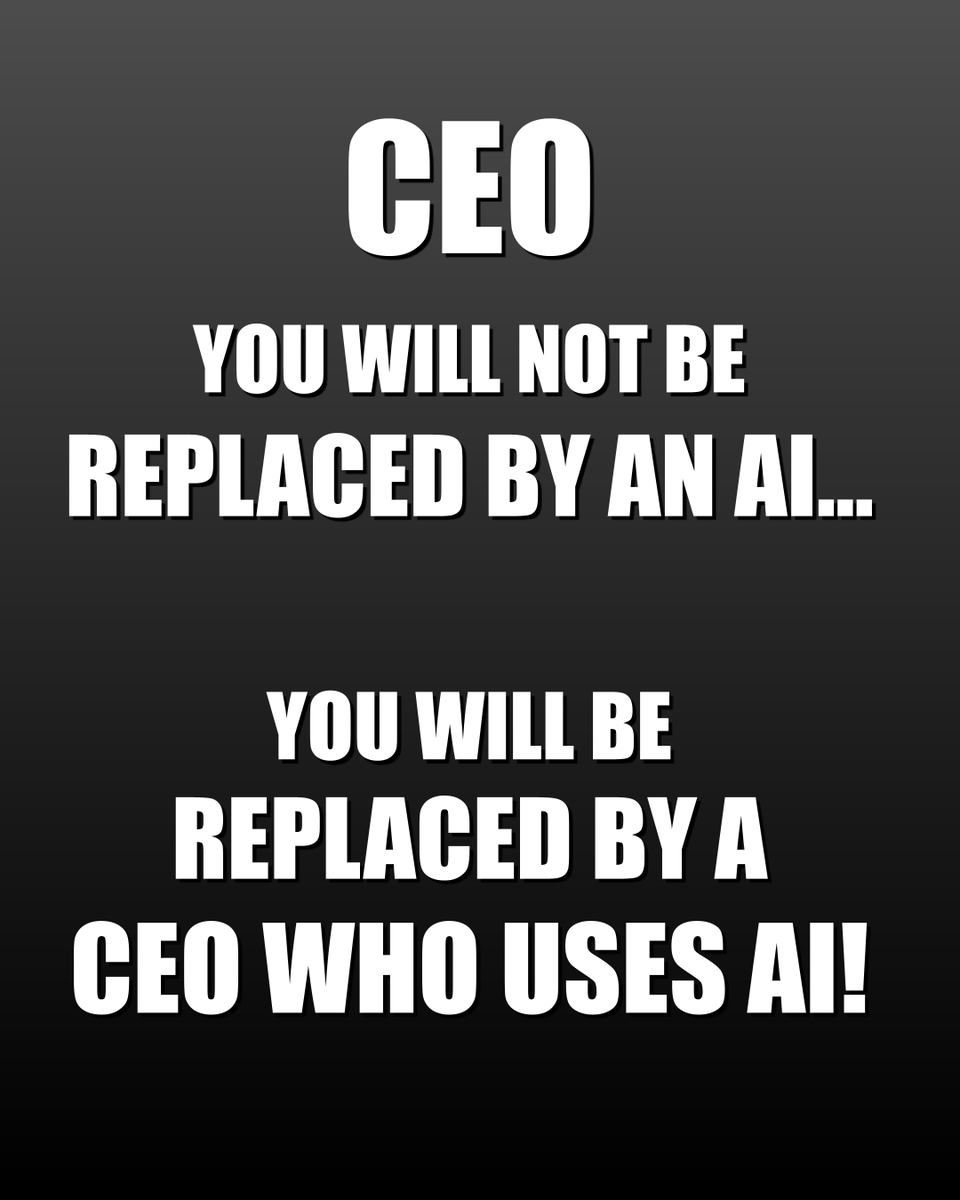
Hey CEO! You heard that line, right? "You will not be replaced by an AI, but by a human who knows how to use it"... Have you ever considered it applies to you as well?
Besides, it is highly likely your employees are already cloning you. The question is whether you control the model or they do.
If you are a CEO in this age of AI, you are likely spending 20+ hours per week arbitrating conflicts between departments, answering questions that should not require your input, and reviewing reports that exist only to prove people are busy.
That is not leadership. That is an Attention Tax, and it is bankrupting your ability to think strategically.
Meanwhile, your team has access to the same AI tools you do. They are reading your emails, your strategy memos, your quarterly letters. They are feeding that data into LLMs to predict what you will approve or reject. They are building informal clones of your decision-making process without asking permission.
Most CEOs will panic when they discover this. But here is the strategic reality: If you do not build the canonical version of your own AI clone, you will lose control of your intent as it scales.
THE CASE FOR A CEO'S STRATEGIC OPERATING MODEL
Instead of fighting the inevitable, smart CEOs will do three things:
✦ OWN THE MODEL: Build an official AI clone trained on your verified priorities, decision frameworks, and strategic logic. Make it the source of truth. When employees need guidance, they query the model instead of waiting three weeks for a meeting.
✦ PREEMPT THE COMPETITORS: Your rivals are already trying to reverse-engineer your thinking. If you do not operationalize your own strategic model faster than they can analyze it, you are handing them the roadmap.
✦ RECLAIM YOUR COGNITIVE BANDWIDTH: The AI clone does not replace you. It replaces the thousand low-stakes decisions that drain your focus on the handful of high-stakes calls that actually require human judgment.
The alternative? You continue to be the bottleneck. Every decision waits for you. Every conflict lands on your desk. You do not scale. The business does not scale.
THE BOTTOM LINE
The CEOs who survive the next three years will be the ones who architect the logic of their business so precisely that the organization executes their vision even when they are not in the room.
If you wait for someone to ask permission to clone your thinking, you have already lost. Build the model. Own the intent. Make yourself scalable.
Are you ready to become impossible to outmaneuver?
And if you want to know how to turn yourself into a canonical AI model to guide your entire organization, get in touch.