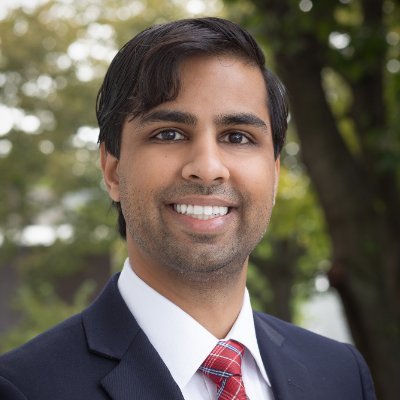
Jonathan Ullman

1K posts

Jonathan Ullman banner
Jonathan Ullman

Jonathan Ullman

@thejonullman

Associate Professor of Computer Science @KhouryCollege @Northeastern. Probably an imposter.

Newton, Massachusetts Beigetreten Temmuz 2020
277 Folgt3K Follower
Jonathan Ullman
Jonathan Ullman@thejonullman·
@gautamcgoel I dont feel strongly for or against, but balancing supply and demand for reviews isnt enough: * Submitting a paper doesnt make you qualified to review papers * Incentivizing reviewing is easy, incentivizing high quality reviewing is hard
English
1
0
0
85
Gautam Goel
Gautam Goel@gautamcgoel·
I have long favored a credit system, where you receive one credit per review, and must pay a fractional credit (divide by num coauthors) to submit. It is the only system which guarantees supply/demand equilibrium.
Vaishnavh Nagarajan@_vaishnavh

Curious why conferences don't have a system where the authors of every paper together guarantee to provide N reviews (and they can distribute the load amongst themselves). This way wouldn't we tax authors in proportion to the number of papers they burden the system with?

English
2
1
11
1.6K
Jonathan Ullman
Jonathan Ullman@thejonullman·
@vitalyFM I'm so glad I've cultivated an image where people can't quite tell if you're joking.
English
0
0
5
195
Jonathan Ullman
Jonathan Ullman@thejonullman·
@vitalyFM Can you really become a Canadian without the Barenaked Ladies?
English
0
0
1
52
Jonathan Ullman
Jonathan Ullman@thejonullman·
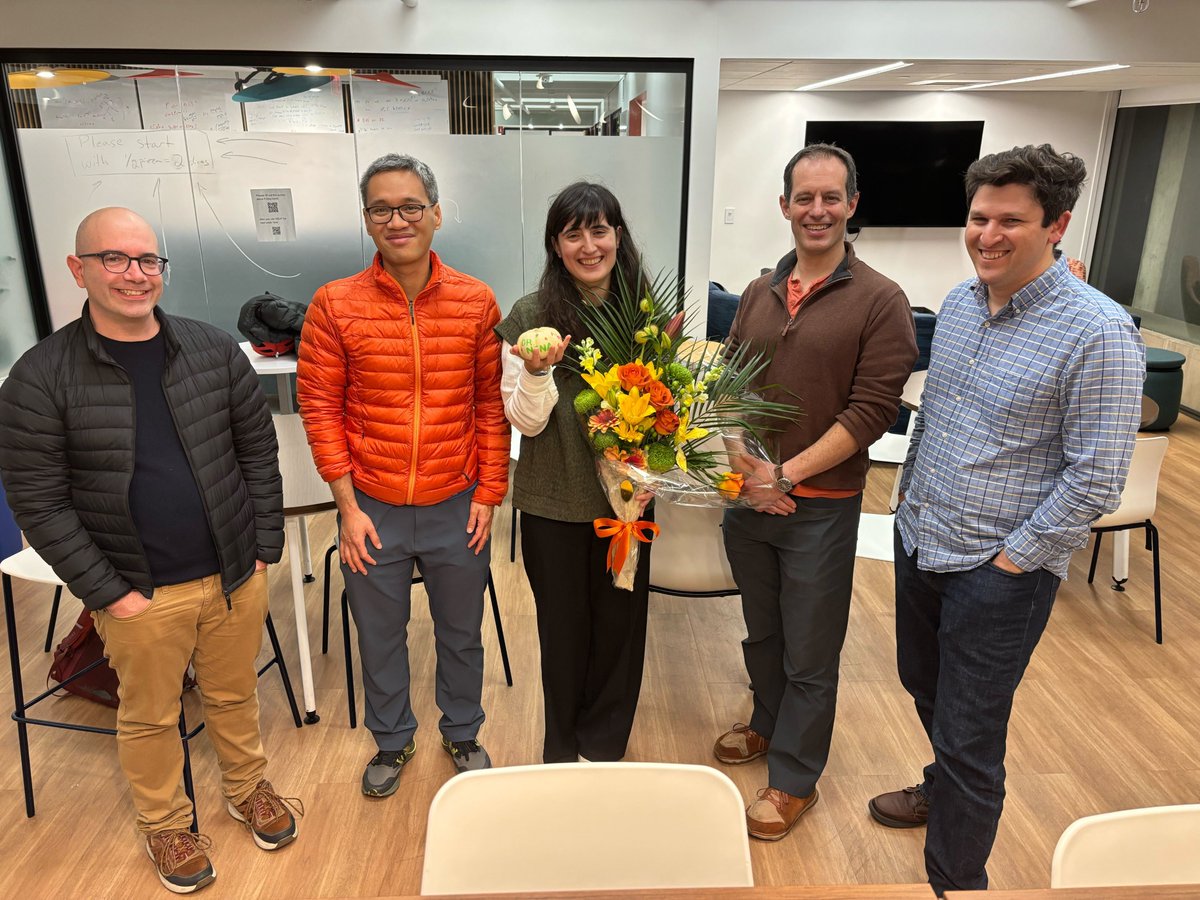
Huge congratulations to my student Konstantina Bairaktari for defending her thesis on Monday!🍾🥳🎊 I'm kinda jealous that Konstantina is headed to Aarhus to do a postdoc with the amazing @kasperglarsen. I can't wait to see what she does next!
Jonathan Ullman tweet media
English
1
1
21
1.6K
Jonathan Ullman retweetet
Gautam Kamath
Gautam Kamath@thegautamkamath·
Announcing (w Adam Smith and @thejonullman) the 2025 edition of the Foundations of Responsible Computing Job Market Profiles! Check out 40 job market candidates (for postdoc, industry, and faculty positions) in mathematical research in computation and society writ large! 1/3
Gautam Kamath tweet media
English
2
15
76
33.4K
Jonathan Ullman
Jonathan Ullman@thejonullman·
📢Adam Smith, @thegautamkamath, and I are putting together a list of job market candidates in Foundations of Responsible Computing! Last year's list was a great success so we're keeping it going! If you want to be included, or nominate someone, see link in the replies!
English
1
9
35
15.3K
Jonathan Ullman
Jonathan Ullman@thejonullman·
@minilek Hey Ya! is closer to the bottom 500 songs of all time than the top 500.
English
1
0
0
468
Jelani Nelson
Jelani Nelson@minilek·
No. Not even close.
Jelani Nelson tweet media
English
2
0
5
3.3K
Jonathan Ullman retweetet
Mahdi Haghifam
Mahdi Haghifam@HaghifamMahdi·
Very happy to share our paper with Adam Smith and Jon Ullman (@thejonullman) on the “sample complexity” of membership inference (MIA). We ask: Is the number of data typically used in practice enough to build strongest possible MIAs? 🧵 link: arxiv.org/abs/2508.19458
Mahdi Haghifam tweet media
English
9
12
92
9.7K
Jonathan Ullman
Jonathan Ullman@thejonullman·
I really relate to the part about thinking your results were barely worthy of an email to the authors. I have a two papers from my PhD days where I told my advisor "I have a small observation but I'm not sure what to do with it" and he informed me that it was already a paper.
Eli Ben-Sasson | Starknet.io@EliBenSasson

How did I end up a Mathematician? (long story) As a child, my dad said to me "our family isn't good in math" and I, preferring soccer and dating to anything involving brain work, accepted this as truth. As an undergrad I studied Biology and CS, to go into Neuroscience (I ended up marrying the daughter of one of my esteemed professors. But that's a different story). I realized I really liked the math courses, and hated anything applied - be it programming or biology labs. In fact, every semester opening I went to the Dean of undergrad at the time (Prof. @noamnisan, now an advisor to StarkWare) to negotiate replacing programming courses with more math (which is why I don't know programming till this day; even though Intro to C++ was the first course I taught as an Assistant Professor. But that, too, is a different story.) Then, as a graduate student, I wanted to go into Machine Learning, but the coveted Professor (Tali Tishby, RIP), had already a gazzilion students. I was sitting in a course on Computational Complexity taught by a Postdoc, when he was replaced for one lecture by one Avi Wigderson. I knew nothing about him at the time (his picture did appear on posters, as he just received the Nevanlinna Prize, but as a dumb young graduate student I didn't know what that means). Avi spoke about how some folks are now trying to formally prove that it's impossible to settle the P vs. NP conjecture. And I was mesmerized by this. So I told him: I want to study this as my MSc. project. A period of courting started. Avi wasn't sure I'm a good fit for him (my math grades were ok, but I never was the straight-A student type). So, he dropped a book about Proof Complexity on me, saying: Read and summarize it to me. I read that book like 3 times cover to cover and didn't understand a word beyond the intro chapter (today I know that's more likely the fault of the author, not my own stupidity. But that's another story). A few weeks later, still not understanding a word on the subject matter, Avi asked to explain a recent paper on "degree and size of Polynomial Calculus proofs". We sat in his home, I explained. At some point he asked: "Why can't this be applied to the Resolution proof system?" (Resolution is The most important and basic propositional calculus proof system). I squinted, thought a bit, and said "Oh, but it can, here's how", and applied the same proof method to Resolution. Avi got very excited. I said "let's send an email to the authors of the previous paper", thinking that if I understand this stuff, it can't really be more than email-worthy. Avi insisted we write it up as a paper. Every few days I tried to convince him to drop it and just send an email, but he was adamant, and I listened. Good thing I did. It ended up as my most cited and impotant paper prior to the STARK/SNARK ones. After that paper, a few others came along. With each one, I was sure it's only an email-worthy observation, not Deep Math. I saw all these other papers, that were so hard to understand, and by comparison my own stuff was so clear and simple. It took me many years to realize that this is how math progresses. You spend a lot of time internalizing some theoretical concepts, and then one day you "see it". And then it seems to you all clear and simple. But its clear and simple only to you. To others, its complicated. Today, when I have to go and look back at some of my earlier papers, I find myself squinting, scratching my head, and saying "damn, that's some serious stuff, how did they come up with this?" :-) After those initial math breakthroughs, Avi offered I do not do just an MSc but actually a PhD, which is how I ended up a theoretical computer scientist (which is a kind of mathematician). THE END.

English
0
0
14
1.6K
Jonathan Ullman retweetet
Eli Ben-Sasson | Starknet.io
Eli Ben-Sasson | Starknet.io@EliBenSasson·
How did I end up a Mathematician? (long story) As a child, my dad said to me "our family isn't good in math" and I, preferring soccer and dating to anything involving brain work, accepted this as truth. As an undergrad I studied Biology and CS, to go into Neuroscience (I ended up marrying the daughter of one of my esteemed professors. But that's a different story). I realized I really liked the math courses, and hated anything applied - be it programming or biology labs. In fact, every semester opening I went to the Dean of undergrad at the time (Prof. @noamnisan, now an advisor to StarkWare) to negotiate replacing programming courses with more math (which is why I don't know programming till this day; even though Intro to C++ was the first course I taught as an Assistant Professor. But that, too, is a different story.) Then, as a graduate student, I wanted to go into Machine Learning, but the coveted Professor (Tali Tishby, RIP), had already a gazzilion students. I was sitting in a course on Computational Complexity taught by a Postdoc, when he was replaced for one lecture by one Avi Wigderson. I knew nothing about him at the time (his picture did appear on posters, as he just received the Nevanlinna Prize, but as a dumb young graduate student I didn't know what that means). Avi spoke about how some folks are now trying to formally prove that it's impossible to settle the P vs. NP conjecture. And I was mesmerized by this. So I told him: I want to study this as my MSc. project. A period of courting started. Avi wasn't sure I'm a good fit for him (my math grades were ok, but I never was the straight-A student type). So, he dropped a book about Proof Complexity on me, saying: Read and summarize it to me. I read that book like 3 times cover to cover and didn't understand a word beyond the intro chapter (today I know that's more likely the fault of the author, not my own stupidity. But that's another story). A few weeks later, still not understanding a word on the subject matter, Avi asked to explain a recent paper on "degree and size of Polynomial Calculus proofs". We sat in his home, I explained. At some point he asked: "Why can't this be applied to the Resolution proof system?" (Resolution is The most important and basic propositional calculus proof system). I squinted, thought a bit, and said "Oh, but it can, here's how", and applied the same proof method to Resolution. Avi got very excited. I said "let's send an email to the authors of the previous paper", thinking that if I understand this stuff, it can't really be more than email-worthy. Avi insisted we write it up as a paper. Every few days I tried to convince him to drop it and just send an email, but he was adamant, and I listened. Good thing I did. It ended up as my most cited and impotant paper prior to the STARK/SNARK ones. After that paper, a few others came along. With each one, I was sure it's only an email-worthy observation, not Deep Math. I saw all these other papers, that were so hard to understand, and by comparison my own stuff was so clear and simple. It took me many years to realize that this is how math progresses. You spend a lot of time internalizing some theoretical concepts, and then one day you "see it". And then it seems to you all clear and simple. But its clear and simple only to you. To others, its complicated. Today, when I have to go and look back at some of my earlier papers, I find myself squinting, scratching my head, and saying "damn, that's some serious stuff, how did they come up with this?" :-) After those initial math breakthroughs, Avi offered I do not do just an MSc but actually a PhD, which is how I ended up a theoretical computer scientist (which is a kind of mathematician). THE END.

English
29
47
322
24.6K
Jonathan Ullman
Jonathan Ullman@thejonullman·
@minilek @KhouryCollege There are just *so many* classes to teach. But sometimes basically the only thing available for TT faculty to teach are PhD seminars. (I'm not saying that isn't a perk in some ways.)
English
0
0
2
352
Jonathan Ullman
Jonathan Ullman@thejonullman·
I think this goes the other way too. Part of the social contract R1 universities have is that the majority of our world-class teachers should do research and do research well. My own university/department @KhouryCollege has really badly let down the side in this regard.
Jelani Nelson@minilek

A reminder that part of the social contract R1 universities have with the public is that not only should we produce fantastic research output, but our world-class faculty should teach and teach well.

English
2
0
8
4.3K
Jonathan Ullman
Jonathan Ullman@thejonullman·
@minilek @KhouryCollege They are inexact but not exagerated. It is driven by our global campus network (one of the worst ideas in acdemia) which is basically just us operating a bunch of non-R1 colleges and calling it one university. TT faculty do still teach.
English
1
0
1
305
Jelani Nelson
Jelani Nelson@minilek·
@thejonullman @KhouryCollege With that amount of teaching capacity, are your TT faculty still teaching anymore? (Are those numbers exaggerated? 200 is a lot …)
English
1
0
0
302
Jonathan Ullman
Jonathan Ullman@thejonullman·
@minilek @KhouryCollege Like whether you agree with me or not about the merits, it's a pretty literal violates my proposition that most of the people doing teaching at an R1 should also be doing world-class research.
English
1
0
0
387
Jonathan Ullman
Jonathan Ullman@thejonullman·
@minilek @KhouryCollege Nothing "happened." But my dept has something like 200 lecturers and 80 tenure track faculty. I just dont think thats good.
English
1
0
1
417