
Professor Chaos retweetet
Professor Chaos
16.9K posts


Professor Chaos
@timedilator
order emerges from chaos💯
texas Beigetreten Kasım 2011
2.9K Folgt715 Follower

Professor Chaos retweetet

Professor Chaos retweetet


Professor Chaos retweetet

Salto Duruhaáya, a lesser known waterfall in Venezuela with a stunning veil like flow
📹christpheer
English
Professor Chaos retweetet



Professor Chaos retweetet

National Geographic Award Winning Photograph.😮

English
Professor Chaos retweetet
Professor Chaos retweetet

This is called negative space effect. Black paint makes chicken wire near invisible. Black absorbs all light, making the wire non-reflective. When painted, it blends into shadows and becomes nearly undetectable. The dark gaps between the wire start to dominate visually. Your eyes ignore the thin black lines. The negative space takes over. The wire is still there but your brain stops registering it. One simple principle. Perfect optical illusion..
English
Professor Chaos retweetet

This is what a timelapse of sleeping seals looks like. Seals can hold their breath for up to 19 minutes and even nap underwater. While sleeping, they sink and periodically swim to the surface to breathe.
📹zeehondencentrum
English
Professor Chaos retweetet

Focus on the black cross and the red dots will appear to follow waves even though they move straight.
English
Professor Chaos retweetet

Professor Chaos retweetet
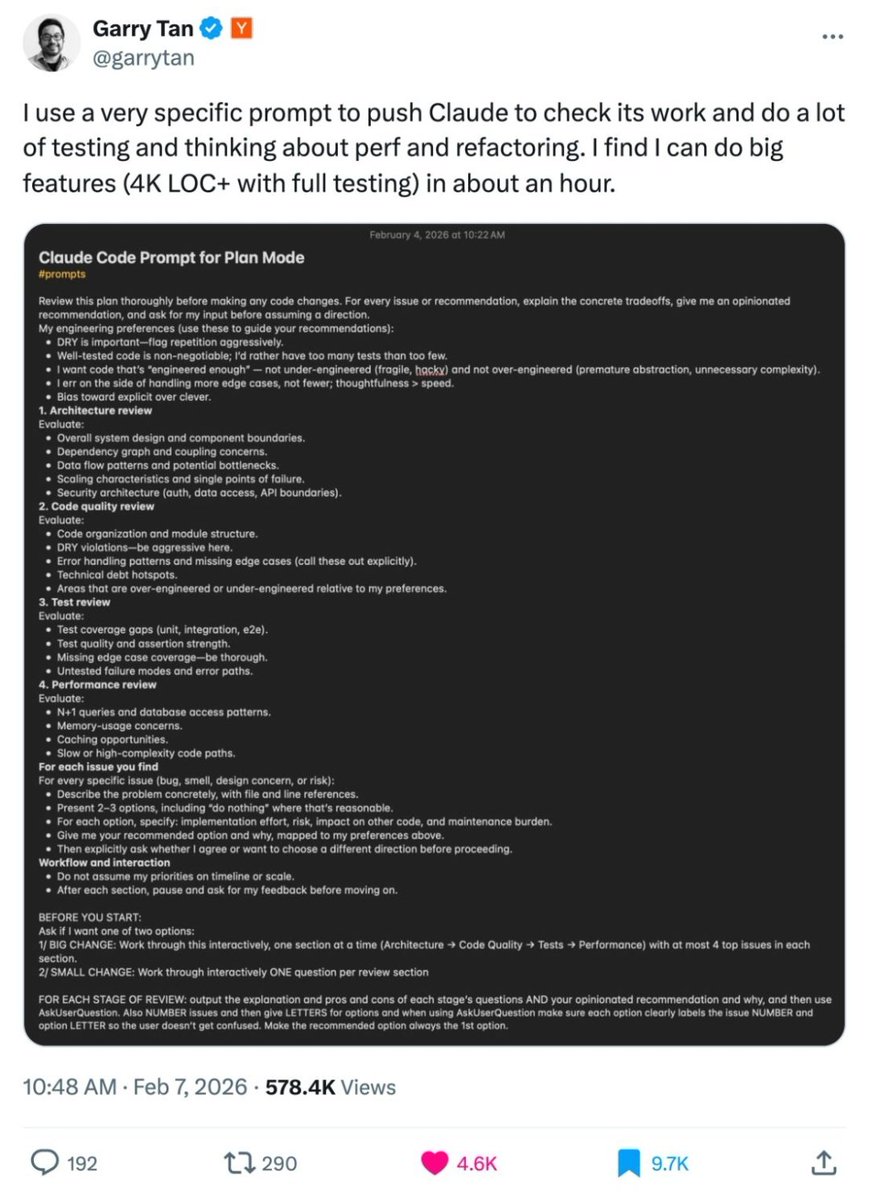
Review this plan thoroughly before making any code changes. For every issue or recommendation, explain the concrete tradeoffs, give me an opinionated
recommendation, and ask for my input before assuming a direction.
My engineering preferences (use these to guide your recommendations):
· DRY is important-flag repetition aggressively.
. Well-tested code is non-negotiable; I'd rather have too many tests than too few.
. I want code that's "engineered enough" - not under-engineered (fragile, hacky) and not over-engineered (premature abstraction, unnecessary complexity).
. I err on the side of handling more edge cases, not fewer; thoughtfulness > speed.
· Bias toward explicit over clever.
1. Architecture review
Evaluate:
. Overall system design and component boundaries.
. Dependency graph and coupling concerns.
· Data flow patterns and potential bottlenecks.
. Scaling characteristics and single points of failure.
· Security architecture (auth, data access, API boundaries).
2. Code quality review
Evaluate:
· Code organization and module structure.
. DRY violations-be aggressive here.
· Error handling patterns and missing edge cases (call these out explicitly).
· Technical debt hotspots.
· Areas that are over-engineered or under-engineered relative to my preferences.
3. Test review
Evaluate:
· Test coverage gaps (unit, integration, e2e).
. Test quality and assertion strength.
. Missing edge case coverage-be thorough.
. Untested failure modes and error paths.
4. Performance review
Evaluate:
· N+1 queries and database access patterns.
. Memory-usage concerns.
. Caching opportunities.
. Slow or high-complexity code paths.
For each issue you find
For every specific issue (bug, smell, design concern, or risk):
. Describe the problem concretely, with file and line references.
. Present 2-3 options, including "do nothing" where that's reasonable.
. For each option, specify: implementation effort, risk, impact on other code, and maintenance burden.
. Give me your recommended option and why, mapped to my preferences above.
. Then explicitly ask whether I agree or want to choose a different direction before proceeding.
Workflow and interaction
. Do not assume my priorities on timeline or scale.
. After each section, pause and ask for my feedback before moving on.
BEFORE YOU START:
Ask if I want one of two options:
1/BIG CHANGE: Work through this interactively, one section at a time (Architecture -> Code Quality -> Tests -> Performance) with at most 4 top issues in each
section.
2/SMALL CHANGE: Work through interactively ONE question per review section
FOR EACH STAGE OF REVIEW: output the explanation and pros and cons of each stage's questions AND your opinionated recommendation and why, and then use
AskUserQuestion. Also NUMBER issues and then give LETTERS for options and when using AskUserQuestion make sure each option clearly labels the issue NUMBER and
option LETTER so the user doesn't get confused. Make the recommended option always the 1st option.
English

@Amank1412 Do you have a link to the post?
English

CEO of Y Combinator shared his CLAUDE.md prompt for Claude Code
It helps him ship 4,000+ line features with full tests in about an hour:
This prompt pushes Claude to:
Decide if the plan is overbuilt, underbuilt, or "engineered enough" before writing any code
Aggressively review test coverage, edge cases, and failure modes
Look for performance risks, scaling issues, and refactoring opportunities
But the real difference is the workflow.
Instead of jumping into implementation, he makes Claude:
Do a structured review (architecture → code quality → tests → performance)
Present tradeoffs with opinionated recommendations
Pause for feedback before proceeding
In other words, Garry is using it as a senior engineer reviewing the system before changes are made.
For small teams, this is a game changer. When you don't have a staff engineer reviewing every PR, you design the review process into your Al.
English
Professor Chaos retweetet

Professor Chaos retweetet
Professor Chaos retweetet
Professor Chaos retweetet

Professor Chaos retweetet

Professor Chaos retweetet
Professor Chaos retweetet
