Angehefteter Tweet
Origin Financial
1.6K posts

Origin Financial
@useorigin
You have money questions. We have money answers. Get started for just $1. Featured in @Forbes, @FastCompany, and @Axios.
San Francisco Beigetreten Nisan 2020
409 Folgt2.6K Follower

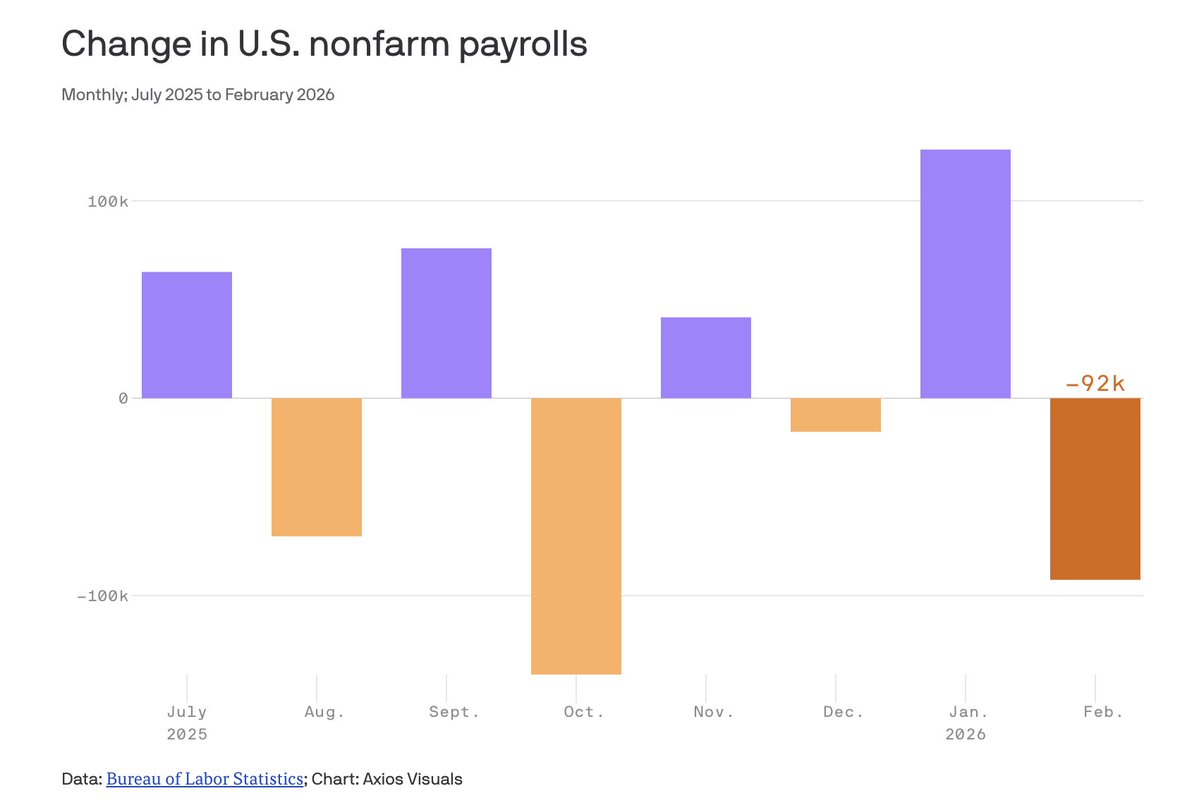
After February’s dismal jobs report, which showed the US shed 92,000 jobs, new data from January show that total openings actually increased by 396,000, but it didn’t translate into much actual hiring.
The latest JOLTS data shows about 6.9 million openings nationwide, while hiring remained flat at roughly 5.3 million and quits barely moved — a labor market where jobs exist, but fewer people are actually changing them.

English

February’s inflation data came in as expected (2.4%) last week, but the real data that the Fed was waiting on (PCE) arrived on Friday.
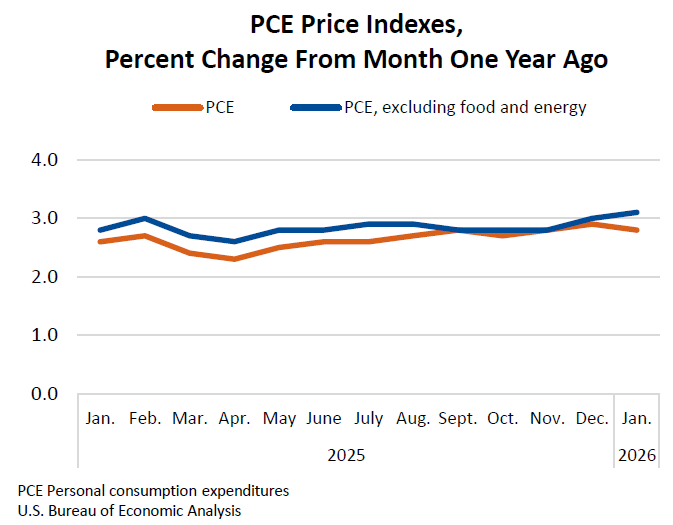
Core PCE came in at 3.1%, the highest it’s been in over two years. This divergence from headline CPI does not bode well for potential rate cuts, and the Fed will likely confirm that decision at their meeting tomorrow.

English

Gen Z is investing instead of buying homes.
Home buying used to be the pinnacle of the “American Dream,” but now, it’s more like an afterthought.
The share of 25- to 39-year-olds transferring money into investment accounts more than tripled over the past decade, rising to 14.4%, according to JPMorgan Chase Institute data.
Among 26-year-olds, that figure jumped from 8% in 2015 to roughly 40% by 2025.
And that excludes 401(k)s — this is brokerage money.
With Gen Z’s homeownership rate sitting at just 16% and first-time home buyers at an all-time low, it’s not hard to see why. The average $400,000 home now carries a $2,170 monthly mortgage — roughly a third of a median household’s after-tax pay. For many young investors, the market simply feels more attainable than a mortgage.
So instead of stretching for a down payment that keeps drifting further away, many young adults are opening brokerage accounts that take five minutes to fund. Housing used to be the default wealth engine. For Gen Z, the market increasingly looks more attainable than a mortgage.

English

With all of the conflicting signals, good news is starting to feel like a fake-out — but that’s exactly what February’s inflation report delivered. Kind of.
After cooling to a 2.4% annual rate in January, February delivered the same: 2.4% year-over-year (YoY) CPI, and Core Inflation again came in at 2.5%, analogous to last month’s print.
The real intrigue here is likely to be the Fed's preferred inflation gauge —the Personal Consumption Expenditure index, which comes out on Friday (PCE lags one month, so it’ll be January’s data).
Recently, it’s been running hot — PCE came in at 2.9% for December, and most estimates expect the same for January.
So, although headline inflation is closer to 2%, the Fed’s preferred metric is now.
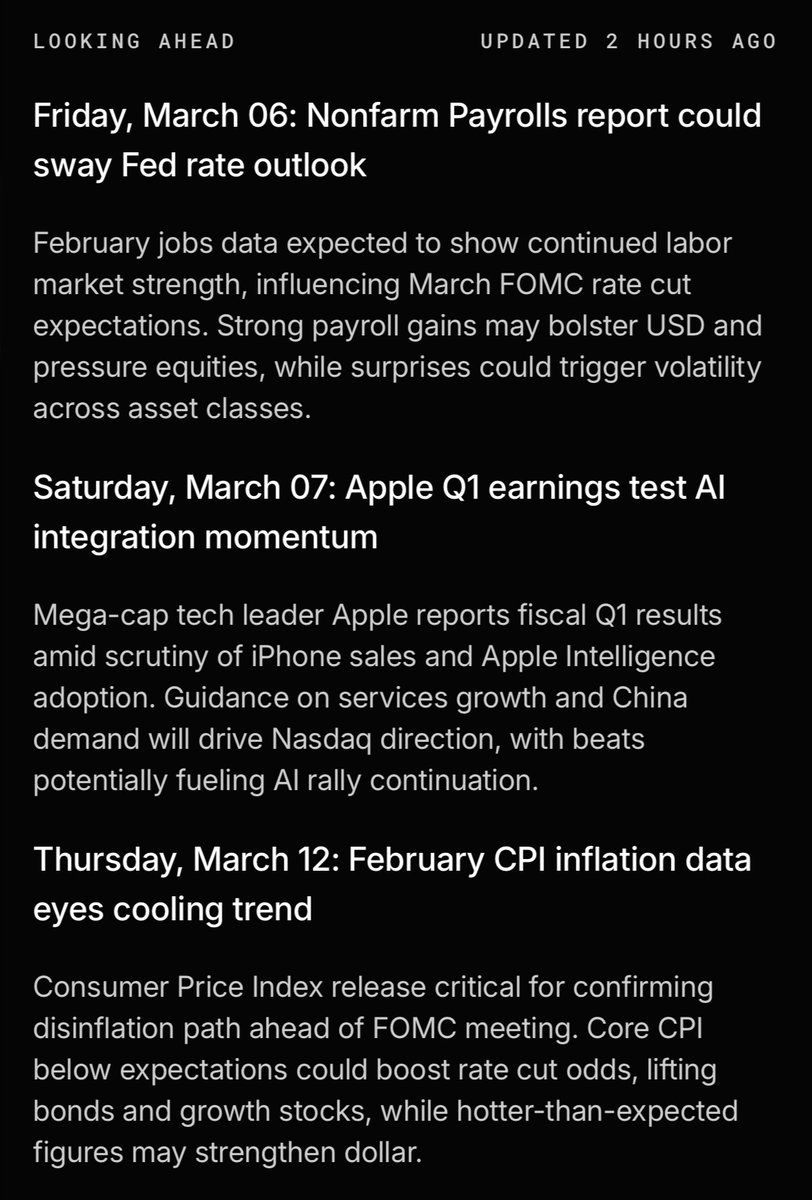
The Fed’s board of governors will convene again early next week, and they’re not expected to budge on interest rates just yet — oddsmakers currently give a 99% chance of a “no change” outcome yet again.

English

Last month’s jobs report showed the U.S. labor market unexpectedly adding 130,000 jobs — the highest monthly gain in over a year, mind you, after adding just 181,000 total jobs in the entirety of 2025.
Great, a pleasant surprise, we love to see it.
But…hold your horses — February just inserted a reality check. The BLS released last month’s job numbers on Friday, and it wasn’t pretty — a net loss of 90,000.
Economists were anticipating more like ~50,000 added, so this report missed the mark by orders of magnitude. Unemployment ticked up slightly, back up to 4.4%, and the U.S. economy has now minted a net loss of jobs in three out of the past six months — sweet.

English

Stocks have traded green and red days like punches this week as investors navigate global ambiguity.
Crude oil futures are up 20%+ this week, and gas prices are already rising accordingly.
Bond yields have ticked up as buyers worry about inflation again, and subsequently, assume the possibility of "higher for longer" interest rates if so.
TL;DR: Things are in limbo — don't get jumpy.

English

How much credit card debt do Americans owe now? About $1.28 trillion — up $44 billion in the fourth quarter alone, and 5.5% higher than a year ago, according to the New York Fed.
Now, for context, this isn’t exactly a headliner either — this number pretty much sets a new record every single quarter for eternity — inflation + more people + more spending = more debt. Pretty simple. The more interesting data is really in what lies beneath.
But — the New York Fed says the data show “evidence consistent with a K-shaped economy.” Translation: Some households are fine, others are not.
Serious credit-card and auto-loan delinquencies are nearing levels last seen after the financial crisis. Overall household debt in some stage of delinquency has climbed to 4.8% — the highest since 2017

English

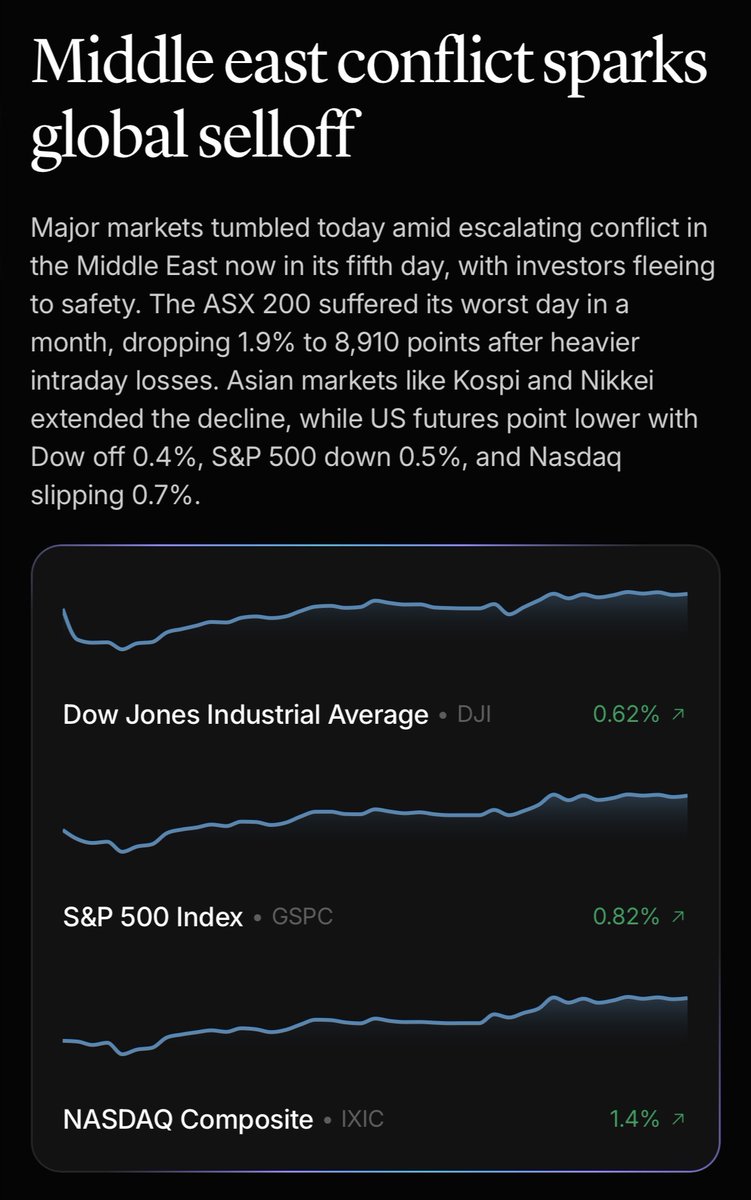
Investors have never liked international conflict, and markets proved that today as tensions heightened globally.
All major indices fell off a cliff at the open, with the Dow leading losses, down 1.7% at the bottom. Equities firmed up as the day went on, but still sit deeply red.
Other signs of concern abound, though: Investors fled emerging market currencies and into a downtrodden USD — which was up about 0.6% Tuesday morning — and treasury yields climbed as investors worried about the impacts of oil prices on inflation.
Overall vibe: Weird day.

English

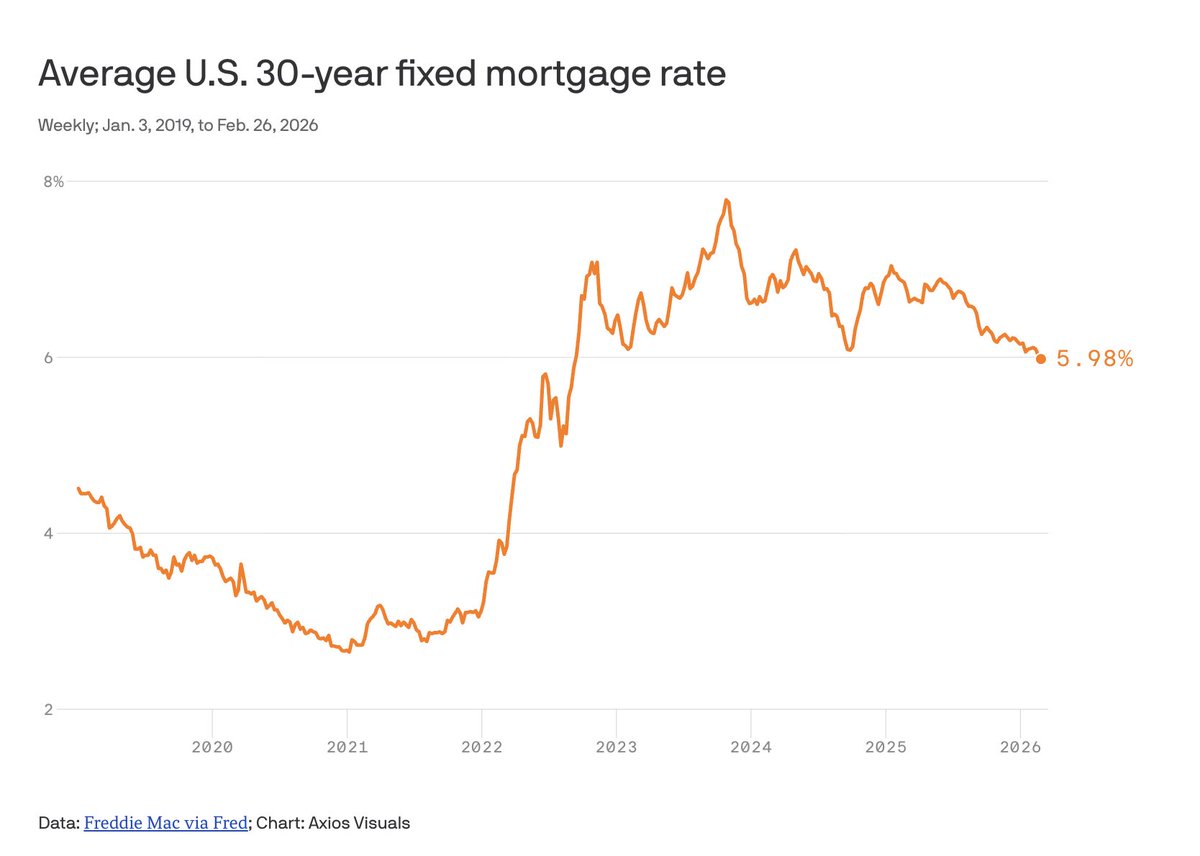
For the first time since 2022, the average 30-year fixed-rate mortgage dipped below 6% (5.98%), which is an important psychological threshold for prospective buyers.
And there’s something else — Americans with a mortgage rate of 6% or higher now outnumber those with a sub 3% rate — meaning this factor is losing weight, and likely to nudge sellers toward the market, slowly freeing up supply.
It’s going to take a lot more than just a sub-6% rate to oil the gears of the housing market, but it’s still progress for both buyers and sellers. Going into the year, many forecasts had home prices sitting flat — or even slipping modestly — offering buyers some long-awaited relief.
A move below 6% supports that narrative at the margins, but there’s a catch. If mortgage rates continue falling and demand responds faster than supply expands, price pressure can reemerge.
Lower financing costs stimulate buyers immediately. Supply, especially in housing, adjusts far more slowly. Depending on how the Fed navigates rate policy for the rest of the year, sustained rate declines could soften the emerging “buyer’s market” dynamic rather than accelerate it.

English

Annual fees on premium credit cards keep climbing — and so does the effort required to make them pay off. Amex’s Platinum card now costs $895, Chase Sapphire Reserve is up to $795, and Citi’s new Strata Elite clocks in at $595.
The perks list might look impressive on paper — airport lounges, dining credits, luxury travel upgrades — but actually extracting that value has become a job in itself.
And most cardholders are failing at it.
The Consumer Financial Protection Bureau estimates Americans left $33 billion in credit card rewards unclaimed in 2022, and…that’s kind of the point. Issuers dangle the potential of “up to $3,000 in value,” knowing most cardholders will capture a fraction of it.
For high spenders and frequent travelers, it can still make sense. Lounge access, travel insurance, and bonus categories can easily offset the fee if you’re diligent. But let’s be honest — for most people, it’s just an expensive flex you can swipe at a nice dinner sometimes.
English

Check it out and let us know what you think: app.useorigin.com/?dashboard-tab…
English

Hitting 1 million pieces of financial advice via AI Advisor is a product milestone for us, but…it’s also a watershed moment for money management as a whole — and we’re proud to be the ones planting that flag.
Check out our blog post on this for a deeper dive into the data ⬇️
useorigin.com/resources/blog…
English

AI Advisor has now answered over 1 million money questions. The milestone means a lot to us — but the more interesting story here is what people chose to ask.
We're seeing some patterns with how people use it: People trust AI Advisor with the full spectrum of their financial lives, from the embarrassingly small to the genuinely life-changing.
Here’s what we learned ⬇️
English

Most people pay hundreds of dollars to file their taxes. They shouldn't have to.
Origin members can now file federal and state returns for free — in under an hour — through our partnership with april.
Learn more: useorigin.com/product/taxes

English