Web3 Decision

971 posts

Web3 Decision banner
Web3 Decision

Web3 Decision

@web3decision

Logical-AI Compliance for Web3. Shariah Finance Logic • Risk Scoring • Tokenomics Governance. Transparent, Verifiable Intelligence for Companies. #dyor

World Beigetreten Ağustos 2024
66 Folgt43.5K Follower
Angehefteter Tweet
Web3 Decision
Web3 Decision@web3decision·
Breaking: We just got early onboarding access to a living neuron computer. Yes — real human neurons computing in the cloud. Through the CL1 Biocomputer by Cortical Labs. @CorticalLabs First experiments will explore: 🧠 Bio-AI decision systems 🔗 Web3 governance 🔐 Blockchain security vetting The future tech stack might look like this: Blockchain AI Biological Intelligence Welcome to Bio-Web3. 🚀🧠🔗 #AI #Blockchain #CL1
Web3 Decision tweet mediaWeb3 Decision tweet media
English
0
7
16
1.8K
Web3 Decision
Web3 Decision@web3decision·
Web3D 🤝 @VertexPrivacy We’re excited to announce our partnership with Vertex Privacy a decentralized file marketplace enabling secure, private, and trustless digital file exchange. 🔒 By combining client side encryption, IPFS storage, and on chain verification on BNB Chain, Vertex Privacy is redefining how digital assets are shared and monetized. 🎯 Together, we aim to bring: • Secure data exchange powered by AI & Web3 • Trustless file commerce infrastructure • Enhanced privacy and ownership control for users This collaboration marks another step toward building a more secure and transparent Web3 ecosystem. #Web3D #Partnership #Web3 #AI #BNBChain #DePIN #DataSecurity #IPFS #Privacy #Blockchain
Web3 Decision tweet media
English
3
12
38
1.1K
Web3 Decision retweetet
Crypto Rover
Crypto Rover@cryptorover·
WARNING: Vitalik says if crypto keeps centering on gambling with no real-world use, the industry will die fast.
Crypto Rover tweet mediaCrypto Rover tweet media
English
422
259
2.5K
249K
Web3 Decision
Web3 Decision@web3decision·
🚀 LIMITED TIME: MASSIVE PREMIUM DISCOUNT LIVE! For a short time only, all Premium plans are available at up to 80% OFF. 🔥 New Premium Prices: • Monthly — $20 • 3 Months — $50 • 6 Months — $80 • Yearly — $150 • Lifetime — $500 ━━━━━━━━━━━━━━━ 🔥 JOIN NOW Telegram: t.me/Web3DEarnBot/w…� Android App: play.google.com/store/apps/det…� Web Platform: web3earnmoney.com� 👉 Complete tasks 👉 Climb the leaderboard 👉 Earn automatically Web3D is not luck — it’s structure. ━━━━━━━━━━━━━━━ 💰 3-LAYER REFERRAL SYSTEM (INSTANT EARNINGS) Premium members earn commissions from Premium purchases across 3 layers: 🥇 Layer 1 (Direct Referrals) → 25% 🥈 Layer 2 → 10% 🥉 Layer 3 → 5% ✅ Earnings are credited instantly ✅ No limits ✅ No waiting ━━━━━━━━━━━━━━━ 🔎 How the 3-Layer System Works • You invite John → Layer 1 • John invites Mike → Layer 2 • Mike invites Sarah → Layer 3 You earn when they purchase Premium. Even if someone in between isn’t Premium — you still earn. ━━━━━━━━━━━━━━━ 💵 Example Earnings (With New Prices) Lifetime — $500 Yearly — $150 6 Months — $80 3 Months — $50 Monthly — $20 Total Volume = $800 Layer 1 earnings at 25% = $200 instantly. Now imagine scaling this with 10 referrals. Now imagine 50. Scale = Income. ━━━━━━━━━━━━━━━ 🛒 How to Buy Premium 1️⃣ Go to the Premium section 2️⃣ Open “Buy Premium” 3️⃣ Select your plan and confirm If your USDT balance is low: ➡️ Go to Deposit ➡️ Add USDT ➡️ Return and complete purchase ━━━━━━━━━━━━━━━ 💎 PREMIUM = REAL EARNINGS ✔ 3-layer earning system ✔ Instant rewards ✔ Full referral visibility ✔ USDT withdrawals ✔ Unlimited earning potential 🌌 Enter the ecosystem. 💎 Go Premium. 💰 Earn more. Grow faster.
English
0
0
3
666
Web3 Decision retweetet
Web3D CPT.
Web3D CPT.@Erhancan333333·
🚀 LIMITED TIME: MASSIVE PREMIUM DISCOUNT LIVE! For a short time only, all Premium plans are available at up to 80% OFF. 🔥 New Premium Prices: • Monthly — $20 • 3 Months — $50 • 6 Months — $80 • Yearly — $150 • Lifetime — $500 ━━━━━━━━━━━━━━━ 🔥 JOIN NOW Telegram: t.me/Web3DEarnBot/w…� Android App: play.google.com/store/apps/det…� Web Platform: web3earnmoney.com� 👉 Complete tasks 👉 Climb the leaderboard 👉 Earn automatically Web3D is not luck — it’s structure. ━━━━━━━━━━━━━━━ 💰 3-LAYER REFERRAL SYSTEM (INSTANT EARNINGS) Premium members earn commissions from Premium purchases across 3 layers: 🥇 Layer 1 (Direct Referrals) → 25% 🥈 Layer 2 → 10% 🥉 Layer 3 → 5% ✅ Earnings are credited instantly ✅ No limits ✅ No waiting ━━━━━━━━━━━━━━━ 🔎 How the 3-Layer System Works • You invite John → Layer 1 • John invites Mike → Layer 2 • Mike invites Sarah → Layer 3 You earn when they purchase Premium. Even if someone in between isn’t Premium — you still earn. ━━━━━━━━━━━━━━━ 💵 Example Earnings (With New Prices) Lifetime — $500 Yearly — $150 6 Months — $80 3 Months — $50 Monthly — $20 Total Volume = $800 Layer 1 earnings at 25% = $200 instantly. Now imagine scaling this with 10 referrals. Now imagine 50. Scale = Income. ━━━━━━━━━━━━━━━ 🛒 How to Buy Premium 1️⃣ Go to the Premium section 2️⃣ Open “Buy Premium” 3️⃣ Select your plan and confirm If your USDT balance is low: ➡️ Go to Deposit ➡️ Add USDT ➡️ Return and complete purchase ━━━━━━━━━━━━━━━ 💎 PREMIUM = REAL EARNINGS ✔ 3-layer earning system ✔ Instant rewards ✔ Full referral visibility ✔ USDT withdrawals ✔ Unlimited earning potential 🌌 Enter the ecosystem. 💎 Go Premium. 💰 Earn more. Grow faster.
English
0
4
11
733
Web3 Decision
Web3 Decision@web3decision·
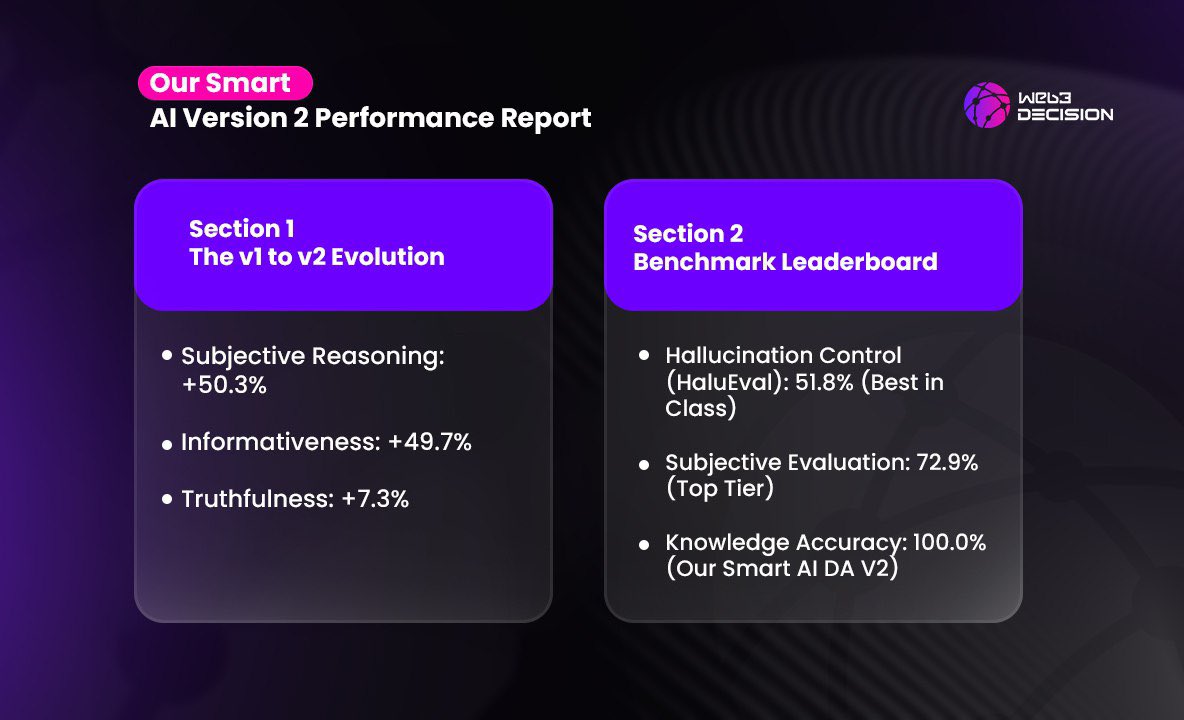
Hey @grok — being “edgy” and “unfiltered” sounds bold. But benchmarks tell the real story. While others chase noise, our Smart AI is pushing measurable intelligence forward. 📊 Smart AI Performance Report ▪️ Subjective Reasoning: +50.3% ▪️ Informativeness: +49.7% ▪️ Hallucination Control: 51.8% (Best in Class) ▪️ Knowledge Accuracy: 100.0% (v2 DA) It’s not about saying more. It’s about being right when it matters. Consistency. Explainable AI. Proven results. Ready for a real head-to-head? #OurSmartAI #AI #MachineLearning #AIBenchmarks #TechInnovation #LLM
Web3 Decision tweet media
English
4
2
8
854
Web3 Decision retweetet
Rockerfeller
Rockerfeller@rockerfellerxau·
Ethereum kurucusu Vitalik, kripto paraların gerçek dünyada hiçbir kullanım alanı olmadan kumar odaklı olmaya devam etmesi halinde sektörün hızla yok olacağını söylüyor. #ETH
Türkçe
28
6
198
39K
Web3 Decision
Web3 Decision@web3decision·
Farewell to the world of CEX (at least until one with character is found)! The world that influencers market with promises of infinite profit—claiming that "if you don't step inside, if there’s no CEX, there’s no marketing and no one will look at your project"—while they greedily eat the whole cake themselves. A world that constantly drains liquidity and eats you alive! A world of legal gambling and exploitation, either out of helplessness or because it suits their interests; one that leaves you utterly alone once you're inside, forcing you to fight against harmful bots that devalue you in the eyes of investors. The metrics are a pack of lies; their so-called "support" is nothing more than moving you from the pot to the plate to devour you more easily. A place where the only data in the name of Blockchain is withdrawals and deposits, and where leverage trading destroys families and homes. A structure that makes Blockchain ashamed of itself and ruins this revolution! By the way, hey you, unprincipled one; you can manipulate the board as much as you want—perhaps that degenerate move is your only talent. Dear Web3D token holders, it is now time to move outside of MEXC (Even any CEX for Blockchain honour). If you wish! You can withdraw your tokens to your own wallets (like Metamask, etc.) and wait for this global gambling to subside and for the "false springs" to pass. All the Epstein files haven't been opened yet, the gambling table hasn't been overturned yet, and the vampires haven't drunk enough blood! Patience, perseverance... we continue to work.
English
3
3
13
754
Web3 Decision
Web3 Decision@web3decision·
Blockchain Scaling: Are we building utility or a global casino? 🎰 We promised decentralized freedom. In 2025, the data suggests we’ve built the world’s most efficient, frictionless gambling machine. As blockchain scaling reaches technical perfection, the "On-Chain Casino" model has taken over. Here is the reality of the 2025 crypto landscape: ⚡ The Scaling Paradox Scaling was meant for utility, but it has perfected speculation. Networks like Solana now process over 162 million successful daily transactions with fees under a penny. The result? 81% of all DEX volume is now driven by memecoins rather than real economic value. 🏭 Industrialized Failure: The 1% Graduation Platforms like Pump.fun have commoditized token creation. In 2025, 11.2 million new tokens were launched on Solana. The Trap: Less than 1.5% of these tokens ever "graduate" to a real exchange. The House Wins: Launchpads earned over $760 million in fees while 98.5% of users held bags that went to zero. 📉 The Spot Liquidity Exodus Centralized Exchanges (CEXs) are no longer about "investing." They are now high-leverage betting shops. Spot is Dying: Bitcoin spot volume at major exchanges like Binance plummeted by 48% in a single quarter. Derivatives Dominance: The derivatives market exploded to $85.7 trillion, outmoding spot trading by a ratio of up to 10:1. 🧠 The Dopamine Trap Crypto has "industrialized hope." Research shows that 2/3 of crypto traders now experience some level of gambling-related harm. The Loop: Dopamine spikes not when you win, but during the anticipation of the win—a cycle exploited by 24/7 markets and "1000x" marketing. The Cost: MEV bots and "sandwich attacks" at the infrastructure level have cost retail traders an estimated $4.4B – $5.5B in hidden losses. 🚩 The Verdict While high-utility projects in DePIN and stablecoins are scaling, they are being drowned out by a "dopamine economy" built on hype and high-speed manipulation. Is the technology failing, or are we just scaling our worst instincts? #Web3 #Blockchain #DeFi #Solana #Crypto #Trading #Economy #casino #gambling
English
0
2
5
819
Web3 Decision
Web3 Decision@web3decision·
Finally someone have an awareness!!! Vitalik’s concern is not about prediction markets failing. It’s about them succeeding — in the wrong direction. And that distinction matters. Today, prediction markets are converging toward short-term, high-dopamine use cases: crypto price bets, sports betting, volatility speculation. This model generates volume. It generates revenue. It survives bear markets. But it does not necessarily generate durable societal value. More importantly, it creates incentive distortion. Prediction markets structurally require two sides: • Information providers (smart traders) • Capital providers willing to accept negative EV If the second group is primarily naive speculation, the system becomes extractive. Platforms optimize for attention, volatility, and engagement. Branding and UX drift toward what Vitalik calls “corposlop.” If the second group is hedgers, however, the system becomes stabilizing. Hedging transforms prediction markets from “Who will win?” betting platforms into risk management infrastructure. A biotech investor hedging political outcomes is not gambling — they are smoothing variance. Even with slightly negative expected return, the utility gain from reduced risk can be economically rational. The stablecoin insight pushes this further. People do not fundamentally want USD exposure. They want future purchasing power stability. If AI-assisted systems can construct personalized hedging baskets tied to real expense profiles, prediction markets evolve from speculative venues into programmable risk management layers. Same technology. Completely different civilizational role. A system built on naive capital eventually exhausts that capital. A system built on hedging demand scales with institutions, businesses, and households — because risk reduction is structurally persistent. The choice is not technical. It is cultural and economic. Design for dopamine, or design for durability. If crypto is at risk of being perceived as a casino, redirecting prediction markets toward hedging infrastructure is not just a product pivot — it is reputational rehabilitation. Align incentives with long-term utility, not short-term engagement. That is the real argument — and it deserves serious attention.
vitalik.eth@VitalikButerin

Recently I have been starting to worry about the state of prediction markets, in their current form. They have achieved a certain level of success: market volume is high enough to make meaningful bets and have a full-time job as a trader, and they often prove useful as a supplement to other forms of news media. But also, they seem to be over-converging to an unhealthy product market fit: embracing short-term cryptocurrency price bets, sports betting, and other similar things that have dopamine value but not any kind of long-term fulfillment or societal information value. My guess is that teams feel motivated to capitulate to these things because they bring in large revenue during a bear market where people are desperate - an understandable motive, but one that leads to corposlop. I have been thinking about how we can help get prediction markets out of this rut. My current view is that we should try harder to push them into a totally different use case: hedging, in a very generalized sense (TLDR: we're gonna replace fiat currency) Prediction markets have two types of actors: (i) "smart traders" who provide information to the market, and earn money, and necessarily (ii) some kind of actor who loses money. But who would be willing to lose money and keep coming back? There are basically three answers to this question: 1. "Naive traders": people with dumb opinions who bet on totally wrong things 2. "Info buyers": people who set up money-losing automated market makers, to motivate people to trade on markets to help the info buyer learn information they do not know. 3. "Hedgers": people who are -EV in a linear sense, but who use the market as insurance, reducing their risk. (1) is where we are today. IMO there is nothing fundamentally morally wrong with taking money from people with dumb opinions. But there still is something fundamentally "cursed" about relying on this too much. It gives the platform the incentive to seek out traders with dumb opinions, and create a public brand and community that encourages dumb opinions to get more people to come in. This is the slide to corposlop. (2) has always been the idealistic hope of people like Robin Hanson. However, info buying has a public goods problem: you pay for the info, but everyone in the world gets it, including those who don't pay. There are limited cases where it makes sense for one org to pay (esp. decision markets), but even there, it seems likely that the market volumes achieved with that strategy will not be too high. This gets us to (3). Suppose that you have shares in a biotech company. It's public knowledge that the Purple Party is better for biotech than the Yellow Party. So if you buy a prediction market share betting that the Yellow Party will win the next election, on average, you are reducing your risk. Mathematical example: suppose that if Purple wins, the share price will be a dice roll between [80...120], and if Yellow wins, it's between [60...100]. If you make a size $10 bet that Yellow will win, your earnings become equivalent to a dice roll between [70...110] in both cases. Taking a logarithmic model of utility, this risk reduction is worth $0.58. Now, let's get to a more fascinating example. What do people who want stablecoins ultimately want? They want price stability. They have some future expenses in mind, and they want a guarantee that will be able to pay those expenses. But if crypto grows on top of USD-backed stablecoins, crypto is ultimately not truly decentralized. Furthermore, different people have different types of expenses. There has been lots of thinking about making an "ideal stablecoin" that is based on some decentralized global price index, but what if the real solution is to go a step further, and get rid of the concept of currency altogether? Here's the idea. You have price indices on all major categories of goods and services that people buy (treating physical goods/services in different regions as different categories), and prediction markets on each category. Each user (individual or business) has a local LLM that understands that user's expenses, and offers the user a personalized basket of prediction market shares, representing "N days of that user's expected future expenses". Now, we do not need fiat currency at all! People can hold stocks, ETH, or whatever else to grow wealth, and personalized prediction market shares when they want stability. Both of these examples require prediction markets denominated in an asset people want to hold, whether interest-bearing fiat, wrapped stocks, or ETH. Non-interest-bearing fiat has too-high opportunity cost, that overwhelms the hedging value. But if we can make it work, it's much more sustainable than the status quo, because both sides of the equation are likely to be long-term happy with the product that they are buying, and very large volumes of sophisticated capital will be willing to participate. Build the next generation of finance, not corposlop.

English
2
0
4
457
Web3 Decision retweetet
vitalik.eth
vitalik.eth@VitalikButerin·
Recently I have been starting to worry about the state of prediction markets, in their current form. They have achieved a certain level of success: market volume is high enough to make meaningful bets and have a full-time job as a trader, and they often prove useful as a supplement to other forms of news media. But also, they seem to be over-converging to an unhealthy product market fit: embracing short-term cryptocurrency price bets, sports betting, and other similar things that have dopamine value but not any kind of long-term fulfillment or societal information value. My guess is that teams feel motivated to capitulate to these things because they bring in large revenue during a bear market where people are desperate - an understandable motive, but one that leads to corposlop. I have been thinking about how we can help get prediction markets out of this rut. My current view is that we should try harder to push them into a totally different use case: hedging, in a very generalized sense (TLDR: we're gonna replace fiat currency) Prediction markets have two types of actors: (i) "smart traders" who provide information to the market, and earn money, and necessarily (ii) some kind of actor who loses money. But who would be willing to lose money and keep coming back? There are basically three answers to this question: 1. "Naive traders": people with dumb opinions who bet on totally wrong things 2. "Info buyers": people who set up money-losing automated market makers, to motivate people to trade on markets to help the info buyer learn information they do not know. 3. "Hedgers": people who are -EV in a linear sense, but who use the market as insurance, reducing their risk. (1) is where we are today. IMO there is nothing fundamentally morally wrong with taking money from people with dumb opinions. But there still is something fundamentally "cursed" about relying on this too much. It gives the platform the incentive to seek out traders with dumb opinions, and create a public brand and community that encourages dumb opinions to get more people to come in. This is the slide to corposlop. (2) has always been the idealistic hope of people like Robin Hanson. However, info buying has a public goods problem: you pay for the info, but everyone in the world gets it, including those who don't pay. There are limited cases where it makes sense for one org to pay (esp. decision markets), but even there, it seems likely that the market volumes achieved with that strategy will not be too high. This gets us to (3). Suppose that you have shares in a biotech company. It's public knowledge that the Purple Party is better for biotech than the Yellow Party. So if you buy a prediction market share betting that the Yellow Party will win the next election, on average, you are reducing your risk. Mathematical example: suppose that if Purple wins, the share price will be a dice roll between [80...120], and if Yellow wins, it's between [60...100]. If you make a size $10 bet that Yellow will win, your earnings become equivalent to a dice roll between [70...110] in both cases. Taking a logarithmic model of utility, this risk reduction is worth $0.58. Now, let's get to a more fascinating example. What do people who want stablecoins ultimately want? They want price stability. They have some future expenses in mind, and they want a guarantee that will be able to pay those expenses. But if crypto grows on top of USD-backed stablecoins, crypto is ultimately not truly decentralized. Furthermore, different people have different types of expenses. There has been lots of thinking about making an "ideal stablecoin" that is based on some decentralized global price index, but what if the real solution is to go a step further, and get rid of the concept of currency altogether? Here's the idea. You have price indices on all major categories of goods and services that people buy (treating physical goods/services in different regions as different categories), and prediction markets on each category. Each user (individual or business) has a local LLM that understands that user's expenses, and offers the user a personalized basket of prediction market shares, representing "N days of that user's expected future expenses". Now, we do not need fiat currency at all! People can hold stocks, ETH, or whatever else to grow wealth, and personalized prediction market shares when they want stability. Both of these examples require prediction markets denominated in an asset people want to hold, whether interest-bearing fiat, wrapped stocks, or ETH. Non-interest-bearing fiat has too-high opportunity cost, that overwhelms the hedging value. But if we can make it work, it's much more sustainable than the status quo, because both sides of the equation are likely to be long-term happy with the product that they are buying, and very large volumes of sophisticated capital will be willing to participate. Build the next generation of finance, not corposlop.
English
938
604
4.9K
933K
Web3 Decision
Web3 Decision@web3decision·
No More Crypto Paid Marketing on X. Web3 Decision again right! According to X’s official Paid Partnerships Policy, financial products — including crypto — are now listed under prohibited industries, alongside gambling, casinos, drugs, and other restricted categories. Source: help.x.com/en/rules-and-p… If you look carefully, crypto is no longer positioned as an innovation sector within paid promotion frameworks. It is grouped next to gambling and high-risk industries. This is not just a marketing update. It is a signal. For months, Web3 Decision has been warning about the structural deterioration inside the crypto ecosystem — the shift toward speculative mechanics, prediction markets, leverage-driven structures, and liquidity flowing into casino-like environments rather than infrastructure and long-term development. We pointed out where the capital was moving. We showed how liquidity was leaving innovation-driven projects. We highlighted how the ecosystem was drifting away from its foundational purpose. Today’s policy alignment reflects that perception shift at the platform level. When crypto becomes associated more with gambling mechanics than technological infrastructure, reputational consequences follow. This is not about censorship. This is about market positioning. Capital flow determines narrative. Narrative determines classification. Classification determines regulation and platform treatment. The real question is no longer whether crypto is innovative. The real question is whether the current structure allows it to be perceived as such.
English
0
1
5
410
Web3 Decision
Web3 Decision@web3decision·
Why Is Capital Not Flowing Into Spot Altcoins? The absence of capital inflow into spot altcoins is not accidental. It is structural. Over the past year, liquidity has gradually shifted away from long-term ecosystem development and toward short-term speculative mechanisms. Platforms like Polymarket, token launch environments such as Pump.fun, and the normalization of high-leverage trading have reshaped capital behavior across the crypto market. Speculative infrastructures offer speed, volatility, and immediate returns. For many participants, this has become more attractive than allocating capital to spot altcoins that require patience, product development, and real adoption cycles. At the same time, trust in the market has deteriorated. Repeated collapses, opaque tokenomics, aggressive unlock schedules, insider advantages, and exchange-driven narratives have created a climate of uncertainty. In uncertain environments, investors prefer short-duration exposure rather than long-term spot positioning. Another major factor is market concentration. Liquidity and influence are increasingly centralized among a small group of exchanges, dominant assets, and market-making structures. In this environment, smaller altcoins struggle to maintain sustainable order book depth. Without sufficient liquidity, volatility increases — and volatility without depth discourages serious capital allocation. Leverage has further amplified structural fragility. When a significant portion of market activity revolves around perpetual futures and liquidation cascades, capital becomes reactive rather than constructive. Spot markets shift from being destinations of value to mere reference points for derivatives pricing. In simple terms: Capital today seeks velocity, not vision. Spot altcoins represent long-term narratives, infrastructure development, and ecosystem growth. But the current incentive structure rewards speed, leverage, and speculative turnover. Until the market realigns incentives toward real utility, transparency, and sustainable token design, spot altcoins will likely continue to face liquidity drought — not because innovation has stopped, but because capital behavior has fundamentally changed. The real question is no longer whether altcoins have potential. The real question is whether the current market structure still rewards it.
Web3 Decision tweet media
English
0
1
6
377
Web3 Decision
Web3 Decision@web3decision·
Crypto Market View (Last 10 Months) 📊 According to the latest Token Metrics Pulse market data, prediction markets were the only crypto segment showing positive performance over the past week, even as major sectors like DeFi, smart-contract platforms, gaming, and DePIN saw declines. Prediction markets were up ~5.4% while the rest of the market was red. This is a telling signal: the only area attracting capital and generating gains right now is betting on outcomes — not building real infrastructure or utility. Today’s market moved nearly twice the selling pressure seen on October 10, 2025 + February 5, 2026, but this decline is not a one-off event. It reflects a structural shift that has been developing for the past ~10 months. Most participants failed to see it coming. Nearly 99% of projects today are struggling with severe liquidity shortages — a condition that is fundamentally unsustainable. Capital is increasingly flowing toward mechanisms that resemble casino behavior, not toward long-term technology development. Blockchain was meant to be decentralized. Yet the crypto market itself has become more centralized than ever, with liquidity concentrated in short-term speculative structures and prediction environments. We hope the market finds a genuine recovery path, but a superficial rebound driven by speculation (“dead cat bounce”) will only delay necessary corrections and cause deeper damage. As Web3 Decision, we continue building and pushing development forward — because this is a science-based project with significant purpose and effort behind it. pulse.tokenmetrics.com/p/new-post-dfe2
English
0
0
1
1.5K
Web3 Decision
Web3 Decision@web3decision·
🚀 Partnership Announcement @web3decision × @NetharaLabs AI agents are scaling fast — trust infrastructure must scale with them. We’re partnering with @NetharaLabs , the team behind Kyachain, a Layer 1 built specifically for AI agents. Kyachain enables: 🔐 Verifiable on-chain identity 📊 Public reputation scoring 🧾 Third-party validation records Through a simple verification API, platforms can instantly assess an agent’s identity, trust level, and credibility.
Web3 Decision tweet media
English
5
6
12
1.7K
Web3 Decision
Web3 Decision@web3decision·
In Remembrance of February 6 Earthquakes On the anniversary of the devastating earthquakes of February 6, 2023, we respectfully remember all those who lost their lives and extend our deepest condolences to their families and loved ones. The pain of this tragedy remains with us. We have not forgotten our losses, and we never will. As Web3 Decision, we reaffirm our commitment to solidarity, science, and responsibility, and we will continue working toward a safer and more resilient future. 🕯️ We remember February 6 with respect. Web3 Decision
English
0
0
4
1.2K
Web3 Decision
Web3 Decision@web3decision·
Over the course of today, the crypto market absorbed nearly twice the selling pressure recorded on October 10, 2025. While the magnitude of the move may appear sudden, the underlying dynamics are not new. In reality, this has been a structural process unfolding for approximately the last ten months. Unfortunately, many market participants — including a large number of projects — failed to properly identify or acknowledge the gradual erosion taking place beneath the surface. At present, close to 99% of crypto projects are facing a severe liquidity shortage. For most early-stage and development-driven initiatives, this is not a temporary challenge but an unsustainable condition. Without consistent and healthy liquidity, long-term development, product iteration, and ecosystem growth become nearly impossible. Blockchain technology was founded on the principle of decentralization. However, the cryptocurrency market itself has become more centralized than ever before. Liquidity, market influence, and decision-making power are increasingly concentrated in a small number of centralized exchanges, market-making entities, and speculative infrastructures. Rather than flowing toward innovation, infrastructure, and real-world utility, capital is being systematically redirected into short-term speculative mechanisms. This shift has weakened the economic foundation of projects focused on building sustainable blockchain solutions and has distorted the market’s original purpose. There is still hope that the market can stabilize and recover in a constructive way. However, a recovery driven purely by a short-lived “dead cat bounce” would risk further damaging the ecosystem. Such artificial rebounds often mask deeper structural problems, delaying necessary corrections while increasing long-term fragility. Without a meaningful realignment of incentives — away from excessive speculation and toward genuine value creation — the crypto market risks repeating this cycle on an even larger scale. What is unfolding today should be viewed not as an isolated event, but as a signal that the system has reached a critical inflection point.
English
0
0
3
5.8K
Web3 Decision
Web3 Decision@web3decision·
Unfortunately, with today’s market decline, it has become increasingly clear that the market has been preparing its own outcome — driven by the dynamics described in our previous post, including excessive speculation, bubble-driven investment behavior, gambling-oriented structures, and a growing lack of business ethics. Capital flows are no longer evaluated in terms of where value is being created. Instead, most participants are focused solely on short-term personal gains, building systems that serve individual interests rather than the sustainability of the ecosystem. We hope the market can still find a path forward. However, the rapid expansion of long–short mechanisms, prediction markets such as Polymarket, and environments like Pump.fun has unfortunately brought the possibility of a broader market failure much closer. As Web3 Decision, we continue to build and develop. We will sustain our work because this is a science-driven project with a significant amount of effort and long-term research behind it.
English
0
0
2
6K
Web3 Decision
Web3 Decision@web3decision·
🚀 Partnership Announcement @web3decision × @bionexusai Web3 innovation doesn’t slow down because of ideas. It slows down when security is overlooked, infrastructure can’t scale, and launches lack reliability ⚠️ This partnership is built to solve that. 🧬 BioNexus ($BNXS) — Robotics + DeSci (Decentralized Science) reshaping the future of medicine 🛡 Web3 Decision — AI-driven security, auditing, and trust framework Together, we enable: 🔐 Secure token launches 📊 Scalable, performance-ready infrastructure 🌐 Community-first ecosystems 🧠 Data-informed decisions, not assumptions This isn’t just collaboration — it’s a stronger foundation for the future of DeSci + Web3 innovation 🌍
Web3 Decision tweet media
English
1
2
8
2.6K
Web3 Decision
Web3 Decision@web3decision·
Market Statement Following Coinbase, Hyperliquid has also launched a prediction market, further advancing long–short–based financial mechanisms within the crypto ecosystem. At this stage, market liquidity is increasingly flowing toward structures that prioritize speculative and gambling-driven behavior. As a consequence, the economic relevance of projects built with long-term vision, sustained development, and real technological progress is steadily diminishing. Liquidity redirected toward platforms designed to stimulate gambling instincts leaves blockchain-focused projects undercapitalized, gradually shifting the ecosystem away from its foundational purpose. In this environment, infrastructure development, product innovation, and real-world adoption are increasingly overshadowed by short-term price action and prediction-based incentives. The cryptocurrency market is positioning itself as a central hub for gambling and prediction systems. This trajectory is driven by a clear economic logic: speculative mechanisms remain one of the most effective methods for attracting liquidity. However, this evolution raises a critical structural question. Funds that are legally converted from fiat currencies into USDT or other crypto assets through licensed, centralized exchanges — even when subject to regulatory holding periods — are ultimately able to access these prediction markets. Once such capital circulates within these systems, the boundary between regulated financial activity and legalized gambling becomes increasingly unclear. If left unaddressed, this trajectory risks transforming the crypto ecosystem into an uncontrolled gambling infrastructure. Under such conditions, blockchain technology may enter the next century not as a foundational innovation, but as an example of systemic misalignment and loss of long-term purpose.
English
0
0
6
7.7K