Suchergebnisse: "#OnThisDay"

20 Ergebnisse


TrillerTV
TrillerTV@Triller_TV·
#OnThisDay in 2021, Arnold Adams returned to the squared circle after losing his world title. He made a profound statement with a dominant stoppage over Bobo O'Bannon 🔙
English
0
0
0
11
theblacksocceracademic
theblacksocceracademic@thesoccerdemic·
#OnThisDay in 8️⃣9️⃣ Dwight Yorke made his international debut🙌🏾 ⚽️Aged 1️⃣7️⃣ he started for Trinidad & Tobago🇹🇹 vs 🇵🇾Paraguay in a 2-2 draw✨️ 🌎Born in Canaan, Tobago🇹🇹 the striker went onto win 7️⃣2️⃣ caps & captained the #SocaWarriors at the 2006 World Cup🔥 #AVFC #MUFC #Rovers
theblacksocceracademic tweet media
English
0
0
0
44
theblacksocceracademic
theblacksocceracademic@thesoccerdemic·
#OnThisDay in 9️⃣4️⃣ Ian Wright scored his 2️⃣nd #PremierLeague hat-trick🙌🏾 ⚽️His goals came for #Arsenal vs #SaintsFC in a 4-0 win at The Dell🔥 🌎He followed Les Ferdinand as the 2️⃣nd footballer to score 'back-to-back' #EPL hat-tricks✨️🇯🇲🏴󠁧󠁢󠁥󠁮󠁧󠁿 🎥 @TheN5News x.com/TheN5News/stat…
theblacksocceracademic tweet media
The N5 History@TheN5News

19 March 1994: Southampton 0-4 Arsenal @IanWright0 scored a stunning hat-trick against Southampton @arsenal


English
0
0
0
45
History-Collectors
History-Collectors@OAPOH_Official·
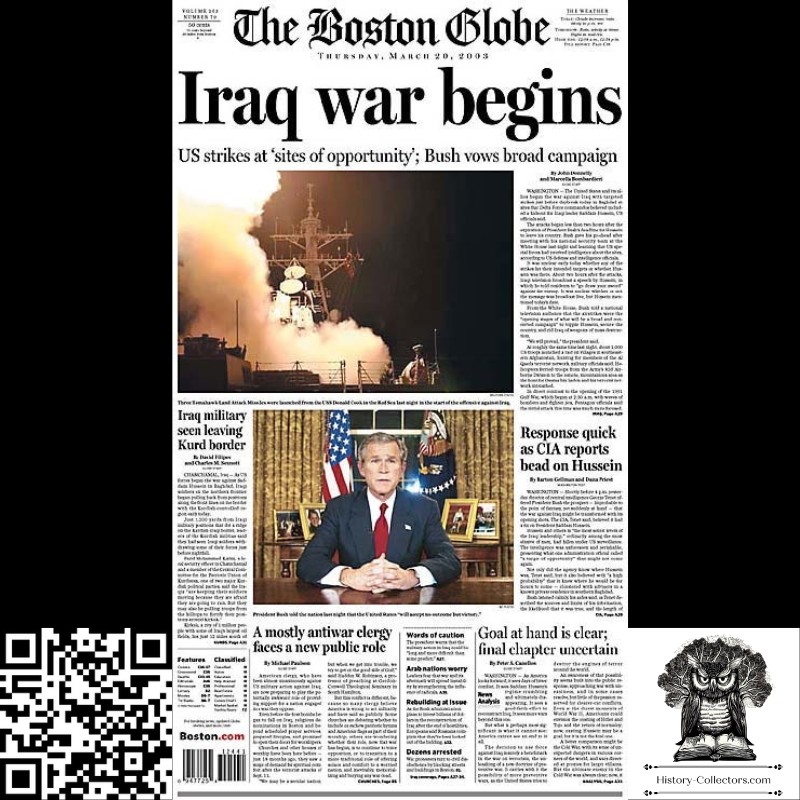
#OnThisDay March 19, 2003: Operation Iraqi Freedom history-collectors.com | Own A Piece Of History ---------------- FREE AUDIO BOOK OFFER: Hero Tales From American History Originally Written In 1895 By Theodore Roosevelt And Henry Cabot Lodge: bit.ly/43grpV2 ---------------- References / More Knowledge: The National Security Strategy of the United States of America (2002): georgewbush-whitehouse.archives.gov/nsc/nss/2002/ United Nations Security Council Resolution 1441: un.org/Depts/unmovic/… Authorization for Use of Military Force Against Iraq Resolution of 2002: congress.gov/107/plaws/publ… The Report of the Commission on the Intelligence Capabilities of the United States Regarding Weapons of Mass Destruction: govinfo.library.unt.edu/wmd/report/ind… U.S. Department of Defense - Shock and Awe: Achieving Rapid Dominance: history.defense.gov/Portals/70/Doc… #IraqWar #AmericanHistory #Geopolitics
English
0
0
0
4
Thomas Sporsheim
Thomas Sporsheim@ThomasSporsheim·
#onthisday in 2014, legends Wazza & Giggsy do the post match interview after the win.
English
0
0
0
15
History-Collectors
History-Collectors@OAPOH_Official·
#OnThisDay March 19, 2003: Operation Iraqi Freedom. The initiation of Operation Iraqi Freedom represents a definitive pivot in twenty-first-century American foreign policy, marking the transition from a containment-based strategy to one of preemptive intervention. This shift was codified by the National Security Strategy of 2002, often termed the Bush Doctrine, which asserted the United States' right to strike first against perceived threats from rogue states and terrorist organizations. The invasion of Iraq was not an isolated military engagement but the culmination of a decade of geopolitical tension, beginning with the aftermath of the 1991 Gulf War and the subsequent imposition of a stringent United Nations sanctions regime and "no-fly" zones. By early 2003, the administrative focus in Washington had shifted toward "regime change" as the only viable solution to the alleged presence of weapons of mass destruction (WMD) and Iraq’s non-compliance with UN Security Council Resolution 1441. The military campaign commenced with a "shock and awe" aerial bombardment designed to paralyze the Iraqi command and control infrastructure. This doctrine, developed by Harlan Ullman and James Wade, emphasized the use of overwhelming force and spectacular displays of power to achieve rapid psychological dominance over the adversary. Historically, the start of the war signaled a departure from the "Powell Doctrine," which required a clear exit strategy and broad international consensus. Instead, the 2003 invasion was executed by a "Coalition of the Willing," primarily led by the United States and the United Kingdom, without a specific second UN resolution authorizing the use of force. This created a significant rift within the North Atlantic Treaty Organization (NATO), as long-standing allies such as France and Germany voiced strenuous opposition, leading to a period of diplomatic friction that reshaped trans-Atlantic relations for years. Domestically, the start of the war saw a significant consolidation of executive power and a shift in the role of the American media. The practice of "embedding" journalists with military units provided an unprecedented, real-time view of the battlefield, yet it also raised academic questions regarding the objectivity of conflict reporting and the psychological framing of the war for the American public. In the legal and constitutional sphere, the invasion was predicated on the Authorization for Use of Military Force Against Iraq Resolution of 2002, which granted the President the authority to use the Armed Forces as he deemed "necessary and appropriate" to defend national security. This expansion of executive war-making power remains a central topic of debate in constitutional law, reflecting the tension between legislative oversight and executive agility in the post-September 11 era. The historical significance of March 19 also lies in the immediate destabilization of the regional balance of power in the Middle East. The removal of the Ba'athist government eliminated a primary counterweight to Iranian influence, a geopolitical consequence that would dictate regional security dynamics for the following two decades. Furthermore, the dissolution of the Iraqi military and the "de-Ba'athification" policy implemented shortly after the invasion’s start contributed to a security vacuum, facilitating the rise of insurgent groups and sectarian conflict. This outcome underscored the historical difficulty of transitioning from conventional military victory to successful nation-building. Ultimately, the start of the Iraq War serves as a case study in the complexities of intelligence-led warfare. The failure to locate stockpiles of WMD post-invasion prompted the most significant restructuring of the American intelligence community since 1947, leading to the creation of the Office of the Director of National Intelligence. As a historical landmark, March 2003 remains a period of intense scrutiny regarding the limits of American hegemony, the ethics of preemptive strike, and the long-term viability of democratic imposition in the 19th-century Westphalian sense of statehood. The conflict transitioned the U.S. military from a force prepared for large-scale state-on-state warfare to one deeply entwined in counter-insurgency and asymmetric operations, a shift that defined American military doctrine for an entire generation of service members. References / More Knowledge: The National Security Strategy of the United States of America (2002): georgewbush-whitehouse.archives.gov/nsc/nss/2002/ United Nations Security Council Resolution 1441: un.org/Depts/unmovic/… Authorization for Use of Military Force Against Iraq Resolution of 2002: congress.gov/107/plaws/publ… The Report of the Commission on the Intelligence Capabilities of the United States Regarding Weapons of Mass Destruction: govinfo.library.unt.edu/wmd/report/ind… U.S. Department of Defense - Shock and Awe: Achieving Rapid Dominance: history.defense.gov/Portals/70/Doc… #IraqWar #AmericanHistory #Geopolitics
History-Collectors tweet media
English
0
0
0
3