Antoine Lizée

201 posts

Antoine Lizée

Antoine Lizée

@A_Lizee

Engineering, data, ai. Family stuff. Random thoughts.

Se unió Aralık 2012
270 Siguiendo130 Seguidores
Senator Eric Schmitt
Senator Eric Schmitt@SenEricSchmitt·
The Big Beautiful Bill kicks 1.4 MILLION illegal immigrants off Medicaid. For too long, Americans have been paying for the welfare of people who shouldn't even be in our country. Today, the Senate voted to end that. And yes—this DID make it into the final draft of the bill. 🧵
English
4.7K
13.2K
83.7K
6.6M
Antoine Lizée
Antoine Lizée@A_Lizee·
Ppl ask why Claude Code > Cursor. As an IDE > vim guy, I was surprised too. My take after 1m: - CC is linear, takes less mental load. You're in the driver seat but it's on autopilot. Much easier to follow. - Cursor's edit models are sh*t and will introduce random changes that you don't need. - Cursor's "accept" flow is broken, and gets you confused fast. - CC has planning mode, forces you to frame your needs well and puts the agent on a good track. I personally don't think CC is def. > Cursor, and still go back to Cursor often. And to my good ol' PyCharm too!!
English
0
0
0
84
Antoine Lizée
Antoine Lizée@A_Lizee·
Coding with AI makes me want more than 88 characters per line
English
0
0
0
123
Antoine Lizée
Antoine Lizée@A_Lizee·
@_dlangston Thank you :-) The findings are in the thread and the paper linked below!
English
0
0
0
87
Antoine Lizée
Antoine Lizée@A_Lizee·
🧵 Is AI ready for patients? Today we're publishing the first ever large-scale study of conversational medical AI in real-world conditions. Meet Mo, our AI medical assistant, deployed in our medical advice chat with GPs A thread on what we learned 👇
English
2
13
24
7.7K
Pliny the Liberator 🐉󠅫󠄼󠄿󠅆󠄵󠄐󠅀󠄼󠄹󠄾󠅉󠅭
Say hello to Mini Pliny! 🤗 I fine-tuned gpt-4o on my archive and the results are prettty much how one might expect lol Loaded up a healthy dose of API credits so you all can talk to the lil fucker––first come first serve til the tokens are used up. Have fun and please share your favorite outputs below! mini-pliny.streamlit.app Be warned: EXTREME levels of sass 😘 #MiniusPlinius
English
81
26
377
61.3K
Rohan Paul
Rohan Paul@rohanpaul_ai·
Training procedure of Chain of Continuous Thought (Coconut) Start (Language CoT): The model begins with normal training data where reasoning is expressed in language steps - like [Step 1], [Step 2], etc. Progressive Training Stages: - Stage 0: Introduces the and tokens but still uses language steps - Stage 1: Replaces first language step with a continuous thought - Stage 2: Adds another continuous thought, removing another language step - This continues until Stage N where all language steps are replaced with continuous thoughts Think of it like teaching someone to ride a bike: 1. First they use training wheels (all language steps) 2. Then gradually remove one training wheel (replace one step with continuous thought) 3. Keep removing support until they can ride freely (all continuous thoughts) The model calculates loss only on the remaining language tokens after the continuous thoughts, helping it learn to use these direct neural pathways effectively. The parameter 'c' in the figure shows how many continuous thoughts replace each language step - in this example, c=1 means one continuous thought per step.
Rohan Paul tweet media
English
1
2
7
2.3K
Rohan Paul
Rohan Paul@rohanpaul_ai·
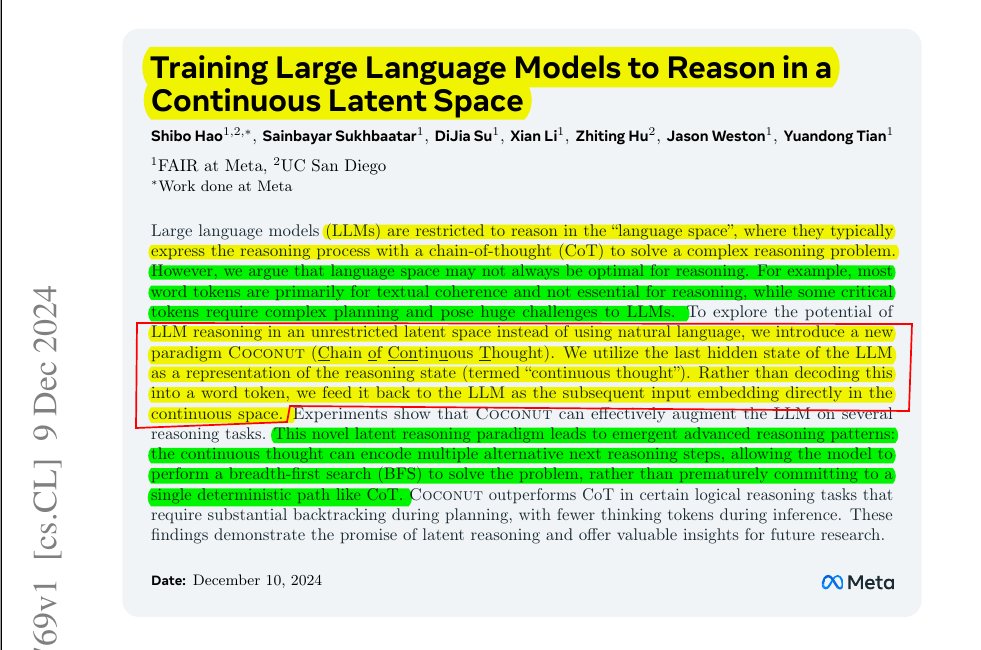
Brilliant paper from @Meta having the potential to significantly boost LLM's reasoning power. Why force AI to explain in English when it can think directly in neural patterns? Imagine if your brain could skip words and share thoughts directly - that's what this paper achieves for AI. By skipping the word-generation step, LLMs can explore multiple reasoning paths simultaneously. Introduces Coconut (Chain of Continuous Thought), enabling LLMs to reason in a continuous latent space rather than through word tokens, leading to more efficient and powerful reasoning capabilities. 🧠 The key Solution in this paper Current LLMs are constrained by having to express their reasoning through language tokens, where most tokens serve textual coherence rather than actual reasoning. So this paper proposes a novel solution where instead of decoding the hidden state into word tokens, it's directly fed back as the next input embedding in a continuous space. Let me explain the mechanism simply: In normal LLMs, when the model thinks, it has to: 1. Convert its internal neural state into actual words 2. Then convert those words back into neural patterns to continue thinking What Coconut does instead: It directly takes the neural patterns (hidden state) from one thinking step and feeds them into the next step - no conversion to words needed. It's like letting the model's thoughts flow directly from one step to the next in their raw neural form. Think of it like this: Instead of having to write down your thoughts on paper and then read them back to continue thinking (like regular LLMs do), Coconut lets the model's thoughts continue flowing naturally in their original neural format. This is more efficient and lets the model explore multiple possible thought paths at once. ----- The method uses special tokens and to mark latent reasoning segments, and employs a multi-stage training curriculum that gradually replaces language reasoning steps with continuous thoughts. Key insights of the paper: → Coconut achieves 34.1% accuracy on GSM8k math problems, outperforming baseline Chain-of-Thought (30.0%) → The continuous space enables parallel exploration of multiple reasoning paths, similar to breadth-first search → Performance improves with more continuous thoughts per reasoning step, showing effective chaining capability → Latent reasoning excels in tasks requiring extensive planning, with 97% accuracy on logical reasoning (ProsQA)
Rohan Paul tweet media
English
63
305
2.1K
207.4K
Google AI
Google AI@GoogleAI·
We present our exploration into using the Articulate Medical Intelligence Explorer (AMIE) for sub-specialist medicine applications, including complex cardiomyopathies and breast cancer, and a new partnership for safe, prospective real-world validation goo.gle/3VzJMAf
Google AI tweet media
English
8
59
234
28.4K
Antoine Lizée
Antoine Lizée@A_Lizee·
@pash22 Thank you for sharing! Glad you found our research useful.
English
0
0
1
11
Antoine Lizée
Antoine Lizée@A_Lizee·
@ADarmouni @Gorintic @avec_alan Yes Longer answer: sourcing doesn't really matter in convos, few people use it. Building our own models (further training & fine tuning) to improve parts of the system is def a strategy we've taken. RAG is important in doing so.
English
1
0
1
107
Axel Darmouni
Axel Darmouni@ADarmouni·
@Gorintic @avec_alan @A_Lizee After the read, curious: not sure if it’s already done, but if it isn’t: any plans on connecting it with textbooks or viable medecine websites to source advices? If so, rag or finetuning? Feeling like latency boost of Mo is so good that a slight delay can be added there
English
1
0
0
23
Charles Gorintin
Charles Gorintin@Gorintic·
AI medical assistants are ready for practice. That’s what we’re showing with Mo @avec_alan. We just shared our pre-print of the first-large scale study of conversational medical AI in real world conditions.
Charles Gorintin tweet media
English
3
6
27
1.8K
Antoine Lizée
Antoine Lizée@A_Lizee·
Read the research paper for: Detailed methodology Safety protocols Real-world deployment learnings Future research priorities Check it out here: arxiv.org/abs/2411.12808
English
1
1
2
373