
Tweet fijado
Fowler ⚙️
1.9K posts

Fowler ⚙️
@DRFFowler
Hold, trade, enjoy & get rekt since 2017. I write about things that make me curious.
Planet Earth Se unió Nisan 2017
907 Siguiendo183 Seguidores
🚨 In just 48 hours, the UAE may have executed one of the most expensive missile defense operations in modern history.
It worked. A reported 96% interception rate.
But beneath that success lies a far more unsettling reality:
They are firing interceptors faster than they can replace them.
And the numbers are sobering.
Over two days, Iran reportedly launched 708 projectiles toward the UAE:
165 ballistic missiles
2 cruise missiles
541 drones
Most were intercepted.
But consider the economics of this defense.
A single THAAD interceptor costs between $12–15 million.
Annual production? Roughly 96 units per year.
By contrast, Iran’s Shahed-136 drone costs around $20,000.
And Iran can reportedly produce up to 400 per day.
Read that again.
The defender may spend $12 million to destroy a $20,000 drone.
That’s a 600:1 cost imbalance tilted in the attacker’s favor.
And estimates suggest Iran may have tens of thousands of such drones stockpiled.
Before mid-2025, the United States had built roughly 534 THAAD interceptors in total. A significant portion were reportedly expended defending Israel during the brief but intense Israel–Iran conflict.
Now, both the UAE and the U.S. could be drawing from the same limited pool while Iran is believed to retain 1,200–1,800 ballistic missiles.
Yes, Lockheed Martin has announced plans to ramp up THAAD production from 96 to 400 per year.
But scaling advanced defense manufacturing isn’t instant.
Full capacity could take years.
And the conflict is unfolding now.
Military analysts often describe a “cheapshot” strategy:
Phase 1: Saturate the sky with low-cost drones. Force defenders to exhaust high-value interceptors on inexpensive targets.
Phase 2: Once stockpiles thin, launch heavier ballistic missiles toward high-value targets such as Abu Dhabi, Al Dhafra Air Base, or Dubai.
Under sustained pressure, advanced interceptor inventories can deplete far faster than production lines can refill them.
That’s the strategic dilemma.
Modern missile defense systems are extraordinarily capable but they are not infinite.
In high-intensity conflict, even the most advanced shield has limits.
And when resupply lags behind expenditure, time becomes the most critical variable of all.
English


@RnaudBertrand Do you know If you are not Chinese resident and you have no connection with the country how can you come for routine check ups?
English
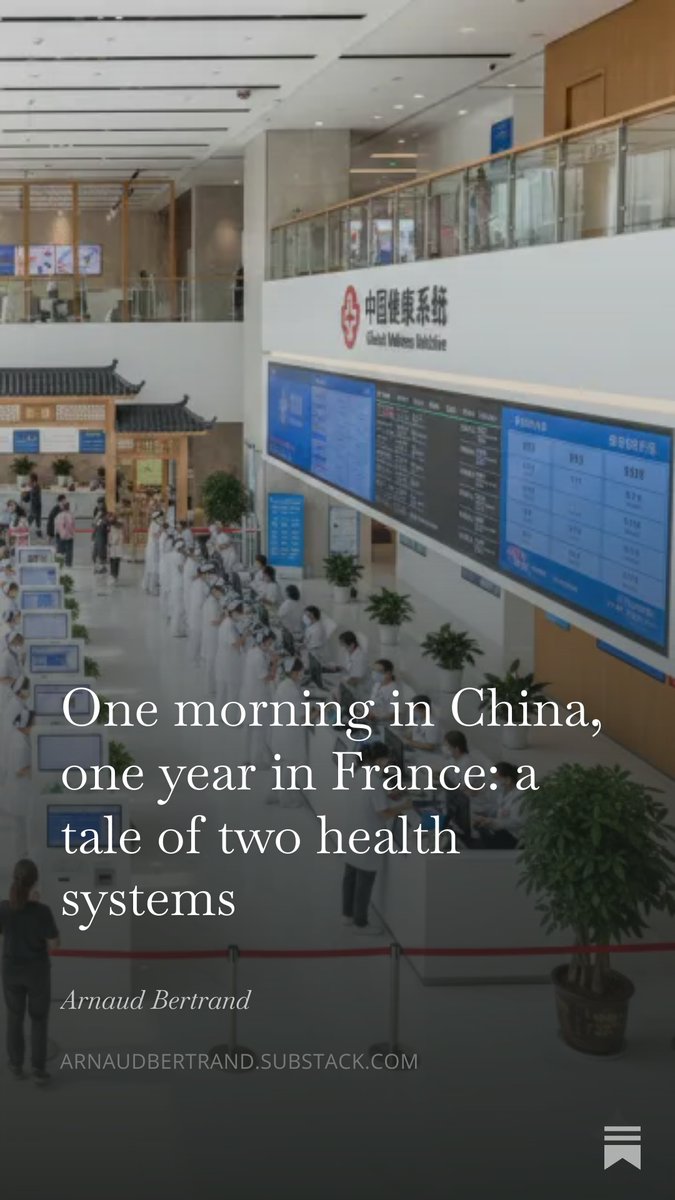
I've been wanting to write this for a while: an article on the key characteristics of the Chinese health system, as a patient.
It's something that I - perhaps unfortunately - have come to have a lot of experience with in my eight years in China.
I've been to the doctor as a patient dozens of times. My wife delivered our first daughter in a Chinese hospital, and had cancer surgery in Shanghai. My younger daughter - who once completely severed her thumb in an unfortunate accident in rural Gansu - had emergency surgery in a small clinic there (her thumb is fine now!). We spent the entire covid episode in China. And, to this day, I still go back to China every year to do my routine health tests or the occasional procedure (like a thyroid biopsy in Harbin last year).
In other words, when it comes to the Chinese health system, I've seen a lot.
What's fascinating about the Chinese health system, and that's true in general about many things in China, is that it never inherited Western dogma about how things were supposed to work, it's completely unconstrained by what everyone else has decided is "normal".
And, as a result, you end up with things that would simply sound impossible to any Western patient: a consultation with the head cardiologist of one of Shanghai's best hospitals for less than $10, blood test results in under 30 minutes, and a system where you can walk in, see three specialists and walk out with a diagnosis and your medicine - all before noon.
As I argue in the article that's all enabled by 3 characteristics that sound super unorthodox:
1) extremely short consultation times, less than 5 minutes
2) no GP gatekeepers (you go straight to see specialists)
3) systematic testing for every patient, even if you just have a cold
Each one sounds wrong. And in fact when I describe them to doctor friends in the West they immediately explain to me why that can't possibly work, and how their own system is far superior.
Except that it does work, I checked the numbers (on top of my personal experience): the Chinese system handles close to 10 billion total outpatient visits a year (nhc.gov.cn/cms-search/dow…), or about 7 visits per person per year on average, and the average wait time is only about 18 minutes (gov.cn/yaowen/shipin/…).
Contrast this with France, my country, where people already go to the doctor A LOT, but still less than in China: only 5.5 visits per person per year (evaluation.securite-sociale.fr/home/maladie/M…). And the French system can't even handle this lower volume: when you can see a specialist straight away in China - you don't even need to make an appointment in advance - you need to wait months to see one in France (50 days on average for a cardiologist, for instance: drees.solidarites-sante.gouv.fr/sites/default/…).
I've personally managed to see 3 specialists AND do all related tests AND get the test results AND get diagnoses AND buy the medicine to cure me - all in the space of a morning at a hospital in Shanghai. That would have undoubtedly taken me a whole year in the French system.
My purpose here is not to argue that the West should replicate the Chinese health system wholesale, but to ask an honest question: what if some of the things we take for granted about healthcare aren't nearly as inevitable as we think? Is it completely unthinkable that we've developed some dogmas that are costing us - in money, in time, and occasionally in lives?
That's the whole point of my article: describing a health system built from first principles by people who never assumed we in the West knew better - up to you to decide if they have a point.
Enjoy the read here: open.substack.com/pub/arnaudbert…
English

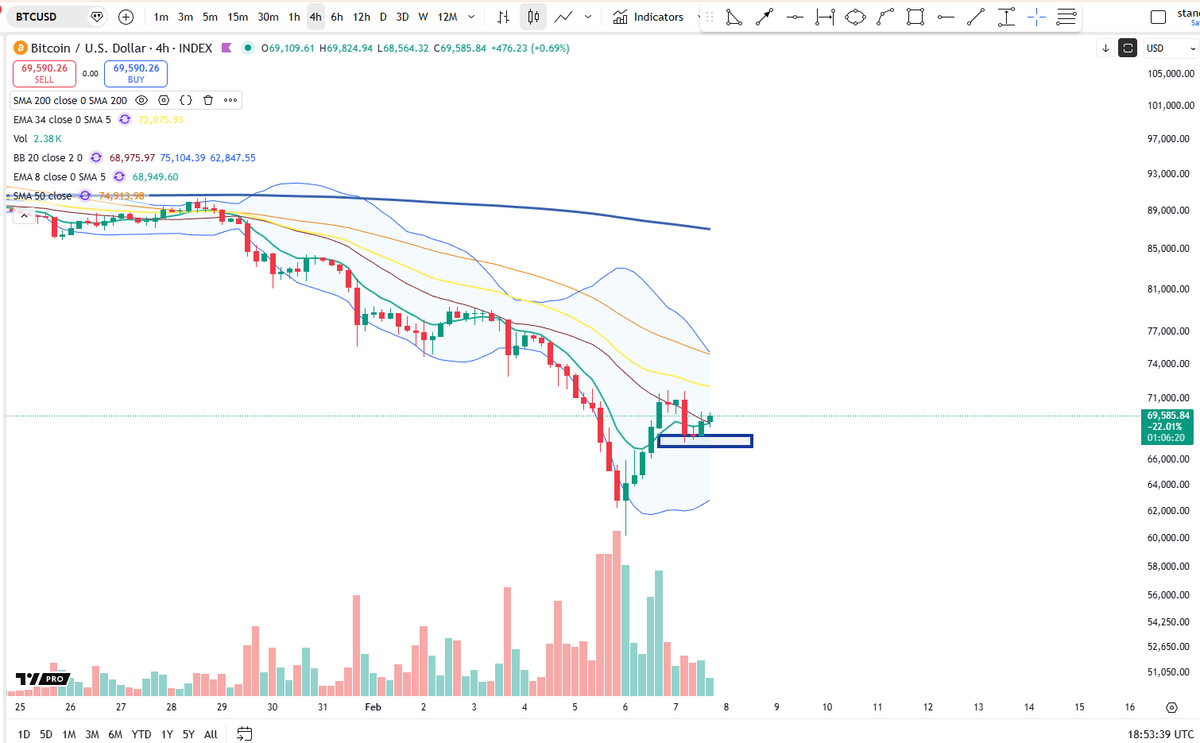
$BTC we now have a 4H higher low to watch as price pushes towards next overhead circa 76k zone
English

The MegaETH pre-deposit bridge is here ⚡️
🔗️ megaeth.pre-deposit.com
✔️ Asset: $USDC
✔️ Cap: $250M
✔️ $mUSD will be distributed on @megaeth mainnet at launch (December).
🔥 This will likely fill fast - be ready, be quick.
$MegaUSD #MegaUSD #MegaETH $MEGA
English

If you went to school before the 2000's, how many kids did you know with gender dysphoria?
English

Access will be limited.
For additional information:
predeposit.megaeth.com
English





@AviFelman Hi Avi. Thank you for sharing your thoughts. Have you bought stocks also for short trade?
English
@vooi_io @cookiedotfun @legiondotcc is it true, that Tokenomics not released yet regardless that the sale is in 32 mins?
English

It’s the VOOI season.
You’re VC now — VOOI has partnered with @cookiedotfun and @legiondotcc to host the $VOOI community token sale.
Direct access to the sale will be available next week, on November 17th — curated by Cookie and powered by Legion infrastructure.
Own a fraction of the Next-Gen Trading SuperApp: legion.cc/app/invest.
Not intended for US/UK persons.

English
@whoami_eth @shikasenbei420 @yugacohler @UpOnlyTV UpOnly, so they rather start from the bottom and go Up
English

@shikasenbei420 @yugacohler @UpOnlyTV The most entertaining outcome would be they drop 1st vid at start of another leg up which actually takes us to banana zone this time with a blow off top & max euphoria. NO ONE would see that coming.
English

Here’s my issue. What were the top signals we were supposed to notice?
English


Imagine you're a 16-year-old Japanese girl, dozing on the train to school, when a Pakistani muslim attacks, drags you off, and rapes you in bushes near the station.
His name: Afzal Muhammad.
What punishment for this savagery?

English


Fowler ⚙️ retuiteado

