
Tweet fijado

Cabo Verde eu te amo e é justamente por isso que precisamos tratar de um determinado assunto...

Alan Passos 🍫@Alan_Passos
Fez história por Cabo Verde e pelo Brasil. O maior de todos. 🇧🇷🇨🇻
Português
¸.·¯⍣✩🇧🇷𓆩ĐȺꞦĪȺ𓆪🇧🇷✩⍣¯·.¸
978 posts

@DariaBookstan
꧁༺ a rapadura é sweet mas num é soft não ༻꧂
Fez história por Cabo Verde e pelo Brasil. O maior de todos. 🇧🇷🇨🇻


A reação do Endrick com o segundo gol da Noruega. Ali ele já soube que não daria mais, pqp...


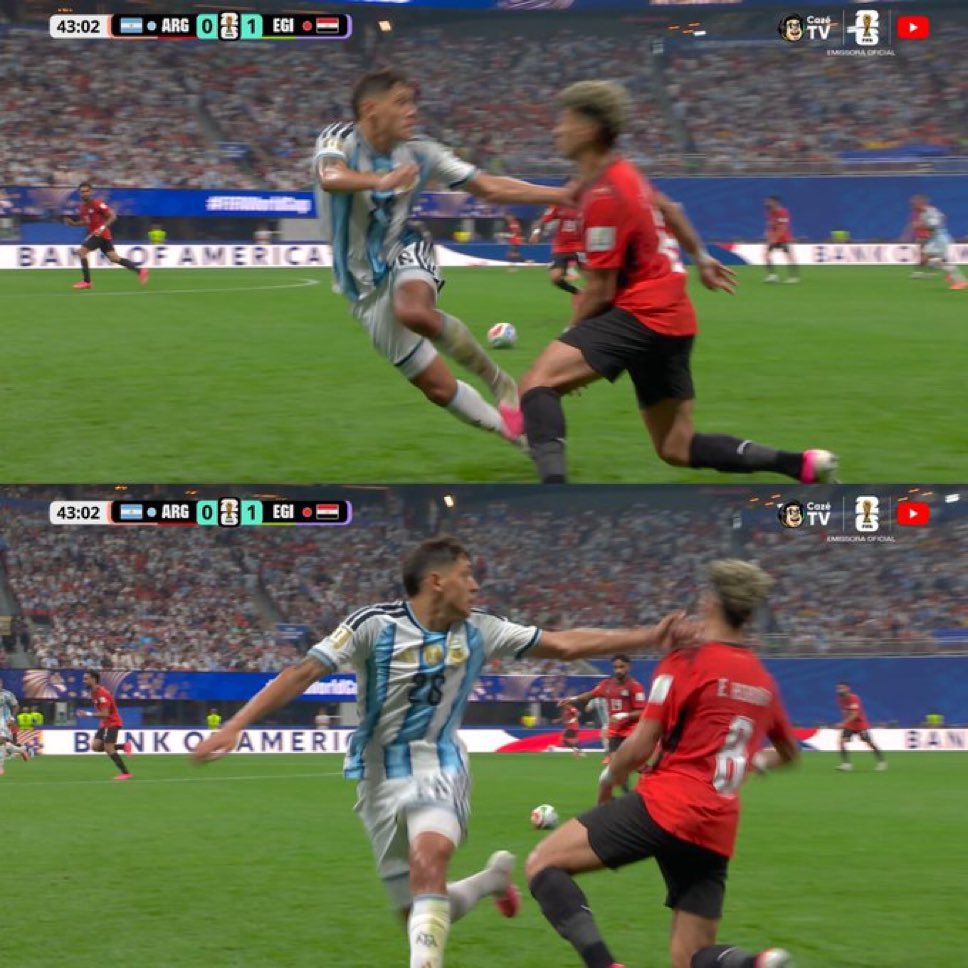
🚨🇪🇬 AGORA! Zico, do Egito, detona arbitragem após eliminação para a Argentina: "Partida direcionada". “O árbitro não foi bom, foi injusto. A injustiça dele foi clara. Nos perseguiu desde o início. Não quer que a gente vença. Uma partida direcionada.” “Queria muito dar alegria aos torcedores, mas peço desculpas. Não deu. Não foi nossa culpa. Esse árbitro… Parece que essa partida foi direcionada. Estávamos vencendo por 2 a 0, e ele vindo para cima da gente. Parabéns à Argentina por mais uma Copa do Mundo, pelo jeito.” 🗞️ @geglobo 📸 Seleção Egípcia | Reprodução/Globo


O Endrick no Lyon é a prova viva de que o deslize de domingo foi emocional, não por falta de habilidade. O cara é sinistro, espero que possa provar isso novamente!


Da época em que Neymar era… o Neymar.


@carolisdevil_ meu take mais idiota é que o protestantismo foi colocado na América Latina pela CIA especificamente pra desmontar os países daqui
This is sort of funny, and Brazil have definitely got worse, but it misdiagnoses the problem. In fact, this is a story of what has happened to society and with our economies, and the ideology of our ruling elites. The first point to accept is that *all* football nations have lost their particular style: there has been a flattening of the way in which teams play. I first started watching football as a very young boy in the late eighties, and through until the early 2000s, most of the big nations maintained a distinct way of playing. The Netherlands, Germany, Italy, Brazil and England all spring to mind. But two things have happened -- the first connected to the latter. First, the Champions League (and later the Europa League) means that the best teams in Europe play each other almost every week during the season. That provides a consistently present interface for an accelerated exchange of ideas, formations, and tactics. But it also acts as a kind of gain of function research for football: there is now an extremely rapid cycle of tactical, transfer policy/player selection, and fitness innovation, response and counter response. The football OODA loop has never been tighter. Second, and connected to this, there has been an extreme version of the Pareto Principle income inequality that has happened among western societies as a whole. Wealth, partly due to the Champions League, and partly due to the Premier League, has accrued to a smaller and smaller number of teams, even as the size of the pie, due to the massive increase in TV revenue in Europe, has expanded beyond all recognition. This means that all the best players in the world end up in the same handful of clubs. We can name them: Arsenal, Manchester City, Manchester United, Liverpool, Juventus, Bayern Munich, PSG, Real Madrid and Barcelona. Furthermore, with the advent of global scouting networks and post-Moneyball databases, this means the best players from anywhere in the world, often at young ages. Remember when an unknown player would have a great World Cup and find himself playing for, say, Tottenham or Monaco or wherever? Those days are gone. We know about every player in the most minute detail. There is no mystery. The good players are already in Europe. The first time I noticed this process of wealth accumulation was with the great Ajax team of 1995. I was only just a teenager, and that team was like a revelation for me in terms of the way football could be played. All of them (bar Danny Blind and Frank Rijkaard, who were an earlier generation) came up through the Ajax academy system and blossomed at the same time. They played in the Ajax/Dutch style (4-3-3, with two wingers that stayed very wide, and a centre back pushing into midfield when they had the ball, holding possession playing in the opponent's final third). But within two seasons, the entire team was broken up: Davids, Seedorf, Klijvert, Ovremars, Rijzeger, Kanu, Litmanen, even Van Gaal, the young manager -- they'd all gone to richer clubs elsewhere. In the 1960s or 70s, they'd have stayed together and won multiple European trophies. In England, we saw a similar thing with Southampton. Newcastle are suffering the same now. All this means that players don't stay in their home environments and countries, with their clubs, and the process of mimesis breaks down. Add that to the first point, related to the way intra-European football forces a flattening through various mechanisms, and you have what we see now. A couple of World Cups ago, the Netherlands played a 3-5-2, to my absolute horror. The Netherlands playing without proper wingers! Now we have a Brazilian team that has two Arsenal players, two Man U players, one Newcastle player -- even a Bournemouth player, for goodness sake. And they'll all have had the majority of their careers outside Brazil. Some will have left when they were 15 or 16, scouted by Shaktar Donetsk (famous for bringing in young Brazilian players) or Real Madrid. Why are we therefore surprised that they play like any other European team? The Netherlands style lives on -- but through Barcelona and therefore the Spain national team (via Cruyff, and thence Guardiola), not in the Netherlands national team. But the Brazil style (a languid slow, slow, slow, punctuated by sudden bursts of incredible skill, raking passes, speed, and crackerjack long shots) is dead. When better Brazilian players emerge in future, and maybe they return to winning World Cups, they'll do so as Europeans would, not Brazilians. The German and Italian styles are also dead. The English style is also pretty much dead, although that was an evolutionary dead end in terms of International Football, so we do not lament it. This, rather than boozing or religion, is the reason for what we see with the Brazil national team. I find it deeply sad. But no doubt the neoliberal progressives who run our countries will view it as a great success. @AaronBastani @WilliamClouston @georgegalloway @jj_bull


