
ExploreAstro at Caltech IPAC

1.5K posts

ExploreAstro at Caltech IPAC banner
ExploreAstro at Caltech IPAC

ExploreAstro at Caltech IPAC

@ExploreAstro

Sharing out-of-this-world astrophysics with our on-this-world audience. Brought to you by @CaltechIPAC

Pasadena, CA. Se unió Nisan 2010
211 Siguiendo143.4K Seguidores
ExploreAstro at Caltech IPAC
The dust particles are composed of silicates (similar to beach sand), carbonaceous grains and polycyclic aromatic hydrocarbons and trace the gas distribution in the galaxy. The well-mixed gas and dust provide a reservoir of raw materials for future star formation. 🧵3/3
English
0
0
1
329
ExploreAstro at Caltech IPAC
This 8-micron image reveals infrared emissions from hot dust, heated by nearby luminous stars. These dust particles absorb ultraviolet and visible light, re-emitting it as longer infrared wavelengths. 🧵2/3
English
1
0
2
398
ExploreAstro at Caltech IPAC
A green-tinted double whammy: it's St. Patrick's Day & #MessierMarathon week! 💚 Messier 81 is a sight to behold in this image from NASA's Spitzer Space Telescope. In the night sky, M81 is visible with binoculars! (but it won't look green like in this infrared image 😉) 🧵1/3
ExploreAstro at Caltech IPAC tweet media
English
1
2
8
636
ExploreAstro at Caltech IPAC
ExploreAstro at Caltech IPAC@ExploreAstro·
"It's like seeing 2-year-old children act like teenagers" Astronomers have captured the most detailed look yet at faraway galaxies at the peak of their youth, an active time when the adolescent galaxies were hastily producing new stars. Read more: ipac.caltech.edu/news/young-gal…
ExploreAstro at Caltech IPAC tweet mediaExploreAstro at Caltech IPAC tweet media
English
1
2
10
942
ExploreAstro at Caltech IPAC retuiteado
Caltech IPAC
Caltech IPAC@caltechipac·
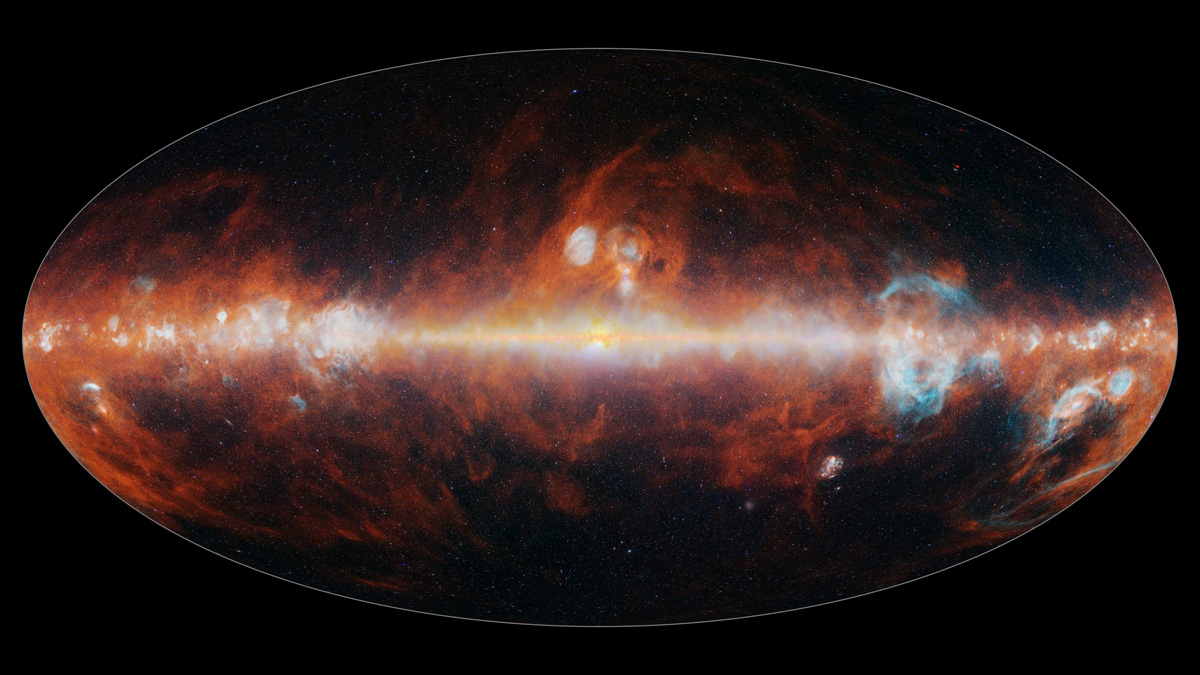
NASA’s SPHEREx space telescope has completed its first infrared map of the entire sky! This is the most comprehensive spectral view of the infrared sky, with 102 colors (or wavelengths) of infrared light from observations made between May and December 2025.
Caltech IPAC tweet media
English
1
8
24
1.6K
ExploreAstro at Caltech IPAC retuiteado
Caltech IPAC
Caltech IPAC@caltechipac·
IPAC scientist finds evidence for a planet in the same star system as #Avatar's Pandora! If confirmed by additional observations, "Its very existence [...] would challenge our understanding of how planets form, survive, and evolve in chaotic environments." ipac.caltech.edu/news/nasa-s-jw…
Caltech IPAC tweet media
English
1
5
14
1.4K
ExploreAstro at Caltech IPAC retuiteado
Caltech IPAC
Caltech IPAC@caltechipac·
Betelgeuse’s Companion Star May Have Been Seen at Last 👯‍♀️ ipac.caltech.edu/news/betelgeus… "It always amazes me how much we still have to learn. Even stars like Betelgeuse, which we have studied for literally thousands of years, can still surprise us," said David Ciardi.
Caltech IPAC tweet media
English
1
2
12
1K
ExploreAstro at Caltech IPAC retuiteado
TED Fellows
TED Fellows@TEDFellow·
Have you ever wondered if humans could live on another planet? 🤔 @NASA’s chief scientist of exoplanets and TED Fellow, Jessie Christiansen, has helped identify nearly 6,000 exoplanets — some blazing hot, others with the potential to sustain life. She breaks down 3 contenders for life beyond Earth and more in her @TEDTalks: bit.ly/4ePNwWI #NASA #exoplanets #spaceexploration #TEDTalk
English
1
4
5
953
ExploreAstro at Caltech IPAC
ExploreAstro at Caltech IPAC@ExploreAstro·
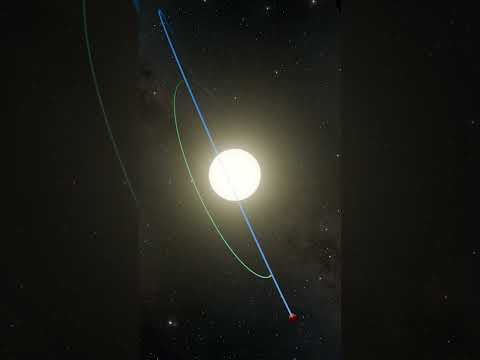
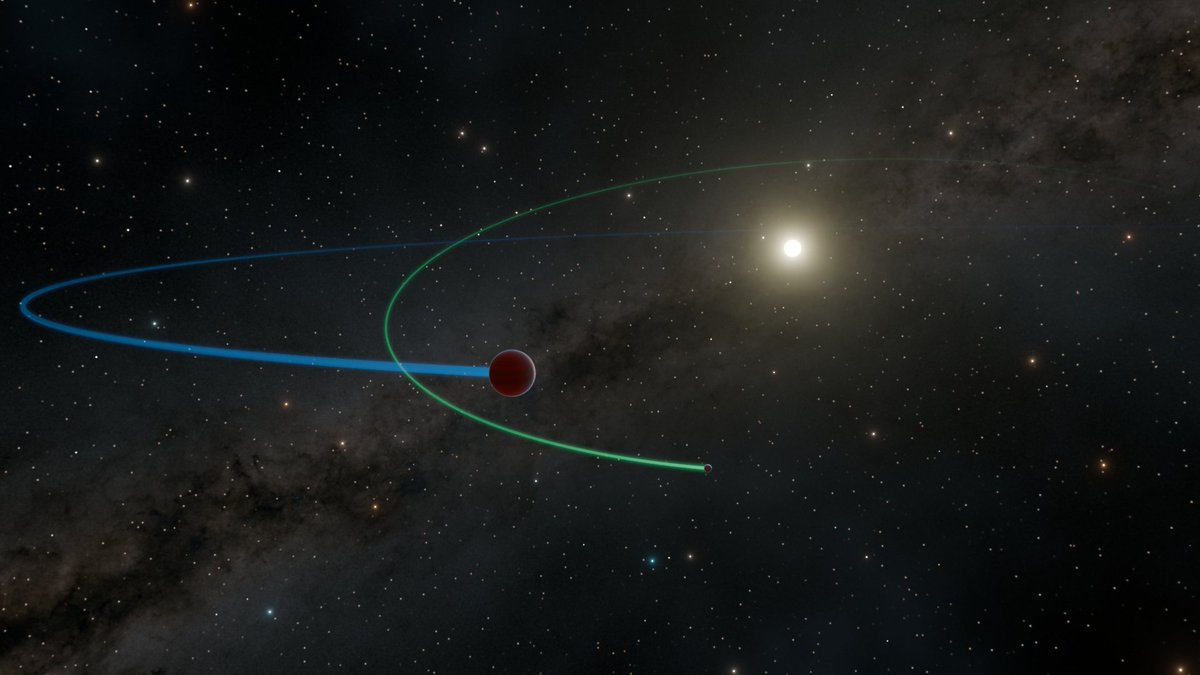
Could a ‘false positive’ planet be hiding a cosmic dance partner? 💃🪩 Scientists recently discovered two planets, KOI-134 b and KOI-134 c. Watch more about this planetary merry-go-round here: youtube.com/shorts/ed3_cg3…
YouTube video
YouTube
ExploreAstro at Caltech IPAC tweet media
English
0
0
8
1K
ExploreAstro at Caltech IPAC retuiteado
Caltech IPAC
Caltech IPAC@caltechipac·
This giant planet orbiting a tiny star is challenging our current theories 🧩🤔 Planet TOI-6894b is a low-density gas giant with a radius a bit larger than Saturn. The host star is the lowest mass star to have a transiting giant planet discovered to date. ipac.caltech.edu/news/discovery…
Caltech IPAC tweet media
English
0
5
16
1.1K
ExploreAstro at Caltech IPAC retuiteado
Caltech IPAC
Caltech IPAC@caltechipac·
Let the science begin! 🥁 On May 1, NASA’s SPHEREx space observatory began regular science operations, which consist of taking about 3,600 images per day. Read more here: spherex.caltech.edu/news/nasa-s-sp…
English
1
4
7
1K
ExploreAstro at Caltech IPAC
ExploreAstro at Caltech IPAC@ExploreAstro·
Diving more into #BlackHoles! This movie shows the approach to a black hole surrounded by an accretion disk. Ripples and waves in the disk are caused by turbulent instabilities in the orbiting material, which is hottest and brightest along the inner edge of the disk.
English
0
3
5
918
ExploreAstro at Caltech IPAC
ExploreAstro at Caltech IPAC@ExploreAstro·
How do physicists visualize #BlackHoles? This conceptual movie illustrates how light is warped by the gravity of a black hole. The light sits within latitude and longitude lines, and is orbited by a rainbow-colored disk. The colors help interpret how light paths are affected.
English
0
2
3
902
ExploreAstro at Caltech IPAC
ExploreAstro at Caltech IPAC@ExploreAstro·
What would it look like to fall into a #BlackHole? Check out this animation! The gravitational warping of the light from background stars is strong, creating the effect of a lens. Light from directly behind the black hole forms an Einstein Ring that encircles the event horizon.
English
0
0
2
1.2K
ExploreAstro at Caltech IPAC
ExploreAstro at Caltech IPAC@ExploreAstro·
Happy #BlackHoleWeek! This animation starts just outside the edge of the accretion disk of gas and dust surrounding a black hole. From higher angles, the material looks more like a circular disk as its light is not as strongly bent around the circular shadow of the black hole.
English
0
1
4
918
ExploreAstro at Caltech IPAC
ExploreAstro at Caltech IPAC@ExploreAstro·
Anyone hungry for a pizza pie on #PiDay? This galaxy’s warped shape reminds us of pizza dough being flung in the air by a chef! 🍕 Galaxy ESO 510-G13 lies in the constellation Hydra, some 150 million light-years from Earth. Read more about it on AstroPix: astropix.org/image/stsci/20…
ExploreAstro at Caltech IPAC tweet media
English
0
1
9
964
ExploreAstro at Caltech IPAC retuiteado
Caltech IPAC
Caltech IPAC@caltechipac·
How many digits of Pi do you know? 3.14...how about galaxy NGC 314? Check it out on @NED_nasa_ipac to celebrate #PiDay2025! NED is like Google for the sky, especially for objects outside the Milky Way, and it's one of IPAC's many science data archives. ned.ipac.caltech.edu/byname?objname…
Caltech IPAC tweet media
English
0
5
17
1.2K