Frank Paul Mora

46.1K posts

Frank Paul Mora banner
Frank Paul Mora

Frank Paul Mora

@InTime_49

Retired Haskell programmer. Was pro drummer & still play hours/day. Science, Philosophy, Literature. DMs blocked unless shared interests.


New Mexico, USA Se unió Aralık 2012
1.3K Siguiendo459 Seguidores
Frank Paul Mora
Frank Paul Mora@InTime_49·
@Naturalphilosy Cancer will never become beautiful unless it serves as a model for robust cell proliferation and zest for life.
English
0
0
0
4
Natural Philosophy
Natural Philosophy@Naturalphilosy·
“Any fool can be happy. It takes a man with real heart to make beauty out of the stuff that makes us weep.” — Clive Barker
Natural Philosophy tweet media
English
6
20
114
2.9K
Ahmed Nashwan𓂆
Ahmed Nashwan𓂆@Ahmed_Nashwan_·
They wanted us dead, but we chose life, our will to live overcame their will for death. Eid Mubarak. Gaza 2026.
Ahmed Nashwan𓂆 tweet media
English
181
2.3K
6.9K
64.7K
Frank Paul Mora
Frank Paul Mora@InTime_49·
Actually, in music and drumming, originality in performance is at a premium. Compositions are original but their execution is not. Even the greatest drummers bore me with time-keeping with the hi-hat and snare. My new technique is fuller and more musical with all the variations possible.
English
0
0
0
9
Hesse Philosophy
Hesse Philosophy@HermannHessed·
“If a man does not keep pace with his companions, perhaps it is because he hears a different drummer.” —Henry David Thoreau, Walden
Hesse Philosophy tweet media
English
1
15
59
1.5K
Frank Paul Mora retuiteado
nature
nature@Nature·
As mice age, changes in the microorganisms in their guts contribute to cognitive decline by altering signalling between the gut and brain go.nature.com/4rItgeo
English
0
19
60
7.5K
Frank Paul Mora
Frank Paul Mora@InTime_49·
@HermannHessed Introspection has an end if it is for a specific purpose. If it is not for a specific purpose then it will not end. Most human activities have limits, when traveling or excercise.
English
0
0
1
80
Hesse Philosophy
Hesse Philosophy@HermannHessed·
“The problem with introspection is that it has no end.” ―Philip K. Dick
Hesse Philosophy tweet media
English
61
348
2.7K
65K
Frank Paul Mora
Frank Paul Mora@InTime_49·
@chunguskitten All religion results in death. If not religion then it would be something else but not as ingrained as religion.
English
0
1
0
19
chunguskitten
chunguskitten@chunguskitten·
Christians of Gaza, before the genocide.
chunguskitten tweet media
English
71
1.9K
6.7K
59.7K
Frank Paul Mora
Frank Paul Mora@InTime_49·
@dwarkesh_sp Funding direction is even more critical now in the U.S. because of draconian research cuts.
English
0
0
0
74
Dwarkesh Patel
Dwarkesh Patel@dwarkesh_sp·
When Copernicus proposed heliocentrism in 1543, it was actually less accurate than Ptolemy's geocentric model - a system refined over 1,400 years with epicycles precisely tuned to match observed planetary positions. It took another 70 years before Kepler, working from Tycho Brahe's unprecedentedly precise observations, replaced Copernicus’s circles with ellipses - finally making heliocentrism empirically superior. Terence Tao's point is that science needs a high temperature setting. If we only fund and follow what's most state of the art today, we kill the ideas that might need decades of work to surpass some overall plateau.
English
83
429
3.4K
272.1K
Frank Paul Mora
Frank Paul Mora@InTime_49·
Metformin and rapamycin are prescription drugs and for them to be completely effective necessitates taking them forever. It would be folly to do so. If dietary restriction is not possible then natural alternatives might better be considered. AMPK activation is as effective an inhibitor of mTOR as rapamycin. Berberine is more effective than metformin and in its most bioavailable form activates AMPK. BHB supplement induce ketosis as well as the keto diet or fasting and activates AMPK. This is not to say AMPK activation always, but cycling between AMPK and mTOR. AMPK induces autophagy but also prevents cellular proliferation. Senescent cells which are more common in age are cells with arrested proliferation which also are inflammatory. A recent study finding that mTOR increases lifespan is also wrong because it is mTOR forever and no room for cellular repair, autophagy/mitophagy. The cycle of mTOR and AMPK can be daily, with mTOR during the day and AMPK at night or it can be 3 days of AMPK activation out of 8 to 10 days of mTOR activation which is the leucine amino acid found in meats, dairy and fish.
English
0
0
0
3
Richard Kollen
Richard Kollen@nuclearball·
Great post. Thank you so much
Healthspan@healthspanmed

Aging follows a predictable pattern. That suggests it's not random damage—it's programmed. Dr. João Pedro de Magalhães @jpsenescence proposes an interesting perspective on the theoretical underpinning of aging: our DNA is the hardware, while the epigenome—the chemical tags that turn genes on or off—acts as software. Over time, this software may become maladaptive, driving aging rather than merely reacting to damage. Here's what you need to know. 👇 🔍 The Research In his paper "Ageing as a software design flaw," Dr. de Magalhães compares the epigenome to computer software executing genetic instructions. Early in life, this developmental program orchestrates growth from a single cell to a fully formed adult. But after reproductive prime, these same genetic scripts might start working against us—suggesting aging may be less about accumulated damage and more about developmental instructions gone awry. Key Concepts: • DNA as Hardware: Our genetic code remains mostly stable, like a computer's unchanging foundation. • Epigenome as Software: Chemical marks dynamically switch genes on and off, like software toggles. • Developmental Programs: These processes guide cell division and tissue formation but may later trigger deterioration. 📊 Core Findings 1️⃣ Epigenetic Clocks (Horvath Clock) • Dr. Steve Horvath's work reveals that roughly 400 genome sites can predict chronological age with remarkable accuracy. • This clock starts ticking almost from conception, suggesting aging isn't random—it follows an orderly pattern written into our developmental script. 2️⃣ Predictable, Not Random • Aging markers like grey hair or bone density loss unfold predictably, not chaotically. • Across species—from mice to humans—the pace of development correlates with lifespan. Mice live fast and die young because their growth software runs at breakneck speed. 3️⃣ Maladaptive Developmental Software • Presbyopia—the stiffening of the eye's lens—illustrates how growth processes beneficial in youth (lens expansion) become harmful in mid-to-later life. • Similar dynamics appear in other tissues through hormone changes and immune shifts past reproductive age. 📖 Why This Matters Traditional theories treat aging as a linear accumulation of damage. But if aging is part of a developmental program, wear and tear isn't the sole culprit. Instead, we're dealing with a quasi-programmed decline, where the very instructions ensuring reproductive success later drive degeneration. • Antagonistic Pleiotropy: Genes advantageous early in life (promoting growth, rapid cell division) can have detrimental effects later, once survival for reproduction is achieved. • Evolutionary Limitations: Natural selection strongly favors traits that help us pass on genes, but it's less concerned with what happens afterward—so flaws in the software persist. 🛠️ Interventions & Practical Applications If developmental software inadvertently fuels aging, slowing or resetting it could boost healthspan: 1️⃣ mTOR Inhibition (Rapamycin) • mTOR drives cell growth and metabolism—crucial for development early in life. Later, overactive mTOR can accelerate tissue damage. • Rapamycin, by dialing down mTOR, extends lifespan in yeast, worms, flies, and mice—and is being explored in humans. 2️⃣ GH/IGF-1 Modulation (Metformin, Caloric Restriction) • High GH/IGF-1 fosters rapid growth but can promote diseases in old age. • Metformin and calorie restriction both reduce IGF-1 levels, correlating with improved metabolic health and increased longevity in animal models. 3️⃣ Cellular Reprogramming (Yamanaka Factors) • Shinya Yamanaka's breakthrough showed that four transcription factors (Oct3/4, Sox2, Klf4, c-Myc) can revert adult cells to a stem-cell-like state, effectively resetting epigenetic age. • Full reprogramming poses cancer risks, but partial or cyclical approaches may offer a factory reset on aging without unchecked cell growth. 💡 Key Takeaway When we view aging as a continuation of developmental processes rather than random decay, a new frontier for intervention emerges. Rather than playing whack-a-mole with diseases as they appear, we can aim to modify genetic and epigenetic programs before pathology sets in. From targeting pathways like mTOR/GH/IGF-1 to exploring partial cellular reprogramming, the prospect of true anti-aging therapies may rest on hacking the same software that built us in the first place. 🔗 Read the Full Review Curious to dive deeper into the idea of aging as a developmental software flaw? Explore our analysis to learn how epigenetic clocks, cancer paradoxes, and species-wide comparisons all converge on one notion: aging might be a predictable, programmable process that we can slow—or even reset. gethealthspan.com/science/articl…

English
0
0
0
31
Frank Paul Mora retuiteado
Sáfárné Hatrágyi Henrietta
Sáfárné Hatrágyi Henrietta@HatragyiSafarne·
➡️"Among 12- to 21-year-old US females between 2003 and 2020, iron deficiency affected almost 40%..."
English
0
4
1
64
Frank Paul Mora retuiteado
Sáfárné Hatrágyi Henrietta
Sáfárné Hatrágyi Henrietta@HatragyiSafarne·
Feeding microbes to feed the Gut: inulin reprograms intestinal epithelial metabolism and proliferation through HIF1α 👇 #d1e292" target="_blank" rel="nofollow noopener">tandfonline.com/doi/full/10.10…
English
0
2
1
26
Frank Paul Mora retuiteado
Louisa Nicola
Louisa Nicola@louisanicola_·
The hidden drivers of Alzheimer’s are not in your brain New science shows Alzheimer’s may be shaped by an organ-brain axis, where the gut, lung, liver, and bladder influence brain inflammation. 1. In Alzheimer’s, immune changes outside the brain may help drive: - chronic neuroinflammation - blood-brain barrier breakdown - harmful microglia and astrocyte activation 2. The gut-brain axis is especially important: - Healthy gut microbes support anti-inflammatory immune balance - Gut dysbiosis can shift immunity toward Th17-driven inflammation - This may worsen brain immune activation and neuronal damage 3. Key protective gut metabolites like SCFAs help: - strengthen the blood-brain barrier - support regulatory T cells - maintain healthy microglia function 4. Other microbial signals, such as AhR-related pathways, may also help suppress excessive inflammation in both the gut and brain. The big takeaway: Alzheimer’s progression may be influenced not only by amyloid and tau, but also by system-wide immune dysfunction. The future of Alzheimer’s treatment may not stop at the brain, it may start with the body.
Louisa Nicola tweet media
English
12
37
145
4.4K
Frank Paul Mora retuiteado
ESC & iPSC News
ESC & iPSC News@ESC_iPSC_News·
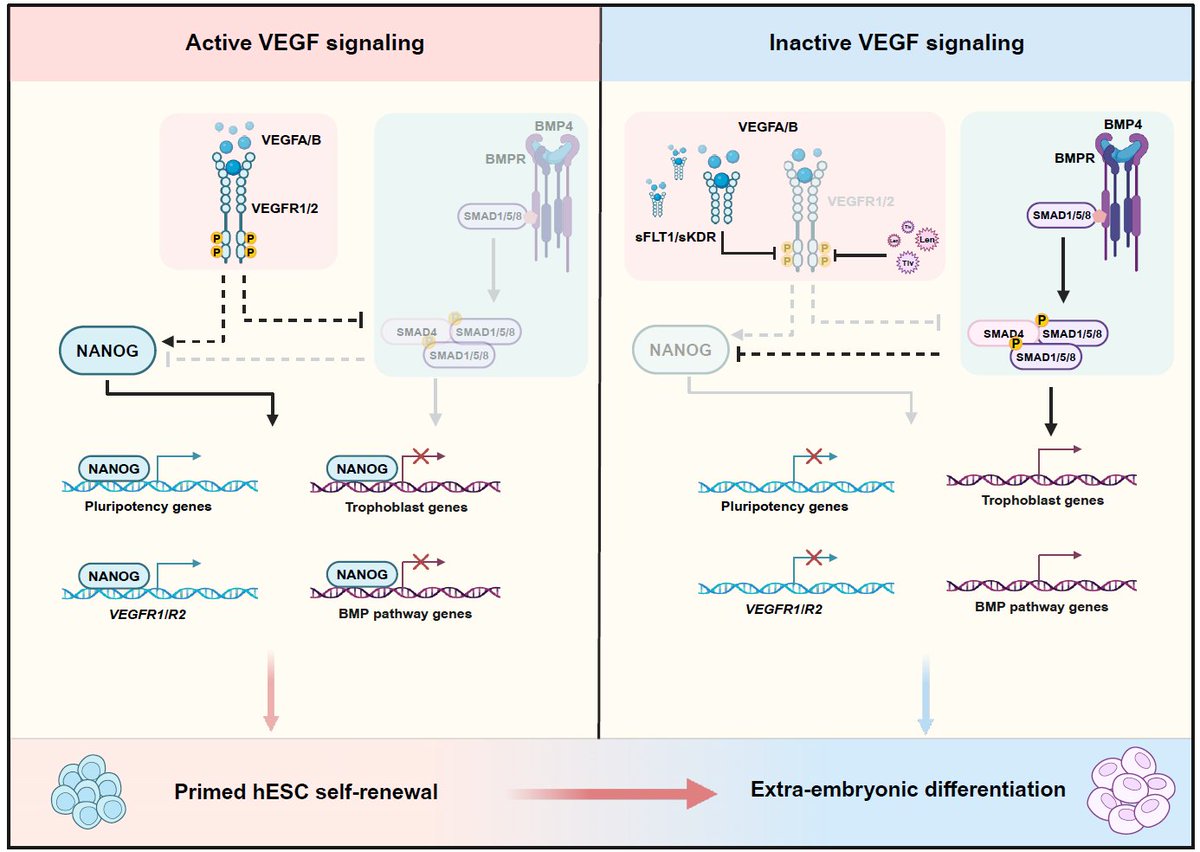
Researchers show that endogenous VEGF signaling safeguards human primed pluripotency, maintaining stem cell self-renewal and preventing differentiation into trophoblast-like cells. 📕 @NatureComms 🔖 go.nature.com/4smiH1J
ESC & iPSC News tweet media
English
0
2
2
261
Frank Paul Mora retuiteado
Putrino Lab
Putrino Lab@PutrinoLab·
@chydorina @loscharlos Hi! We are slated for first-in-human mitochondrial transplantation this year. AND my announcement about the MMT therapy was 100% home-based. I’m excited to provide all sorts of options to all patients. My role is to build functional, actionable toolkits, not to sell magic bullets
English
17
31
263
5.1K
Frank Paul Mora retuiteado
Benji Backer
Benji Backer@BenjiBacker·
Medellín, Colombia dropped its city's warming temps by a whopping 4 degrees Fahrenheit. How? They created "green corridors" of trees and plants throughout the built city. It cost $6.50 per resident, and will save the city millions of dollars each year. We need more of this!
Benji Backer tweet mediaBenji Backer tweet media
English
142
3.5K
15.4K
341.6K