
Basic Financial Literacy

4.1K posts

Basic Financial Literacy banner
Basic Financial Literacy

Basic Financial Literacy

@LiteracyBasic

I talk about personal finance, investing, and how to make more money. Quoted in @time, @financialtimes, @businessinsider and @usatoday

Se unió Eylül 2020
111 Siguiendo2.9K Seguidores
Basic Financial Literacy
Basic Financial Literacy@LiteracyBasic·
Deflation is one of the worst things that can happen to an economy. You’re seeing it play out in China right now, and it’s a slow bleed that can take years to reverse. Here’s why deflation is such a problem, in simple terms. 1. Prices fall. Sounds good, but it’s not. When prices drop across the board, people wait to spend because they think things will be even cheaper later. Less spending means less revenue for businesses. 2. Businesses respond by cutting. Lower revenue leads to layoffs. Lower wages. Lower investment. Lower growth. 3. Debt becomes heavier. If your income falls but your debt stays the same, that debt gets harder to pay. Households, companies, and entire governments get squeezed. 4. The whole economy slows down. People spend less. Businesses earn less. Banks lend less. Everyone pulls back at the same time. That’s the deflation spiral. So what exactly is deflation? It’s the opposite of inflation. Inflation is when prices rise. Deflation is when prices fall for a sustained period. A one-off drop in the price of eggs is not deflation. A broad, long-term drop in prices across the economy is. Why China matters here: China’s consumer prices have been falling. Its property market is collapsing. People are saving instead of spending. Businesses are pausing investment. Local governments are buried in debt. This is exactly the type of environment where deflation takes hold and gets harder to escape. Deflation is dangerous because it changes behavior. People stop spending. Businesses stop hiring. Debt gets heavier. And the economy drifts downward. Once that mindset sets in, it becomes extremely difficult to reverse.
English
3
0
6
387
Basic Financial Literacy
Basic Financial Literacy@LiteracyBasic·
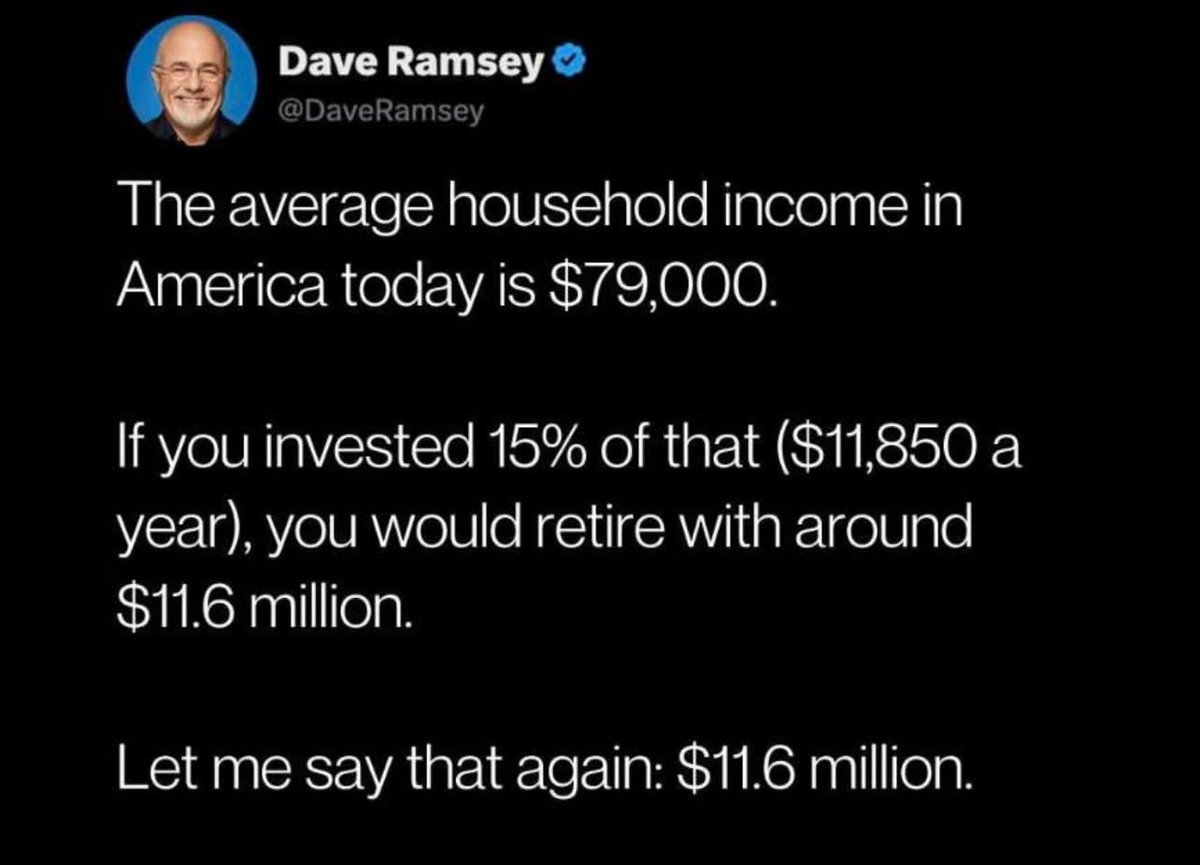
You can end up a multi millionaire by following what Ramsey (and any other finance personality) says: “Spend less than you make and invest the difference” Can an average household hit $10 million+ by investing 15% of their income? No. The numbers are inflated to catch your eye and spark a debate and engagement. But the principles are correct.
English
0
0
1
266
Basic Financial Literacy
Basic Financial Literacy@LiteracyBasic·
Is investing $987 a month or making $79k at age 20 realistic? Probably not. Is a 11% return realistic? Also no. 7-8% (especially when you factor in inflation) is a better estimate The verdict:
English
1
0
2
297
Basic Financial Literacy
Basic Financial Literacy@LiteracyBasic·
Dave Ramsey says if you invest 15% of your income, you’ll retire with $11.6 million dollars. Let’s break down the numbers to see how true this is:
Basic Financial Literacy tweet media
English
1
0
4
452
Basic Financial Literacy
Basic Financial Literacy@LiteracyBasic·
Bottom line: You might get a $2,000 check. To me, this feels like a response to election results and the number one issue on American’s minds: affordability
English
0
0
0
240
Basic Financial Literacy
Basic Financial Literacy@LiteracyBasic·
There are also questions: Who counts as “high income”? When will it be paid? Does Congress approve it? Right now, no one knows.
English
1
0
1
235
Basic Financial Literacy
Basic Financial Literacy@LiteracyBasic·
Breaking: Trump just posted every American will get a $2,000 “tariff dividend” funded by import tariffs. He added: “not including high income people.” Here’s how that would actually work (or not).
English
1
0
2
331
Basic Financial Literacy
Basic Financial Literacy@LiteracyBasic·
@granthpaulsen I love Jayden, but he’s starting to feel like a high end sports car that constantly needs to be at the mechanic.
English
3
0
3
389
Grant Paulsen
Grant Paulsen@granthpaulsen·
I love the Commanders ruling Jayden Daniels out right away, today. The dog and pony show of 'is he practicing' and 'will he or won't he' is an unnecessary distraction. It also makes it harder for Mariota to own the week. If he's out just say it and keep it moving. Well done.
GIF
English
51
18
409
26.5K
Basic Financial Literacy
Basic Financial Literacy@LiteracyBasic·
Running out of money in retirement is a legitimate fear many people feel. To help you, I put together a free guide: The 10 Most Expensive Retirement Planning Mistakes (and how to avoid them) Download it in my profile link.
English
0
0
1
270
Basic Financial Literacy
Basic Financial Literacy@LiteracyBasic·
Your Guaranteed Income Social Security is your safety net…not your plan. The average couple gets around $4,000–$5,000 a month combined. For most, that barely covers essentials.
English
1
0
1
311
Basic Financial Literacy
Basic Financial Literacy@LiteracyBasic·
If you’re 50 or older and afraid of running out of money in retirement… You’re not alone. Even people with $1–2 million saved feel it. Because in this economy, even that might not be enough. There are 3 numbers that decide if your money lasts or runs out too soon—->
English
1
0
1
359
Basic Financial Literacy
Basic Financial Literacy@LiteracyBasic·
It’s the mistakes that drain your savings before you even get there. That’s why I put together a free guide: “The 10 Biggest Retirement Planning Mistakes” 👉Download it in my profile link and avoid the errors that keep most people stuck.
English
0
0
0
176
Basic Financial Literacy
Basic Financial Literacy@LiteracyBasic·
That’s how much you can safely withdraw from your investments each year without running out of money: •$115,000 → $4,600 per year •$200,000 → $8,000 per year That’s barely enough to live on. For many households, the real goal isn’t $200K. It’s $1–2 million+, depending on your lifestyle, location, and healthcare needs. The biggest danger isn’t the number
English
1
0
0
204
Basic Financial Literacy
Basic Financial Literacy@LiteracyBasic·
Are you on track for a comfortable retirement? Most people aren’t…and the numbers prove it. Median retirement savings in America (Federal Reserve SCF): •Under 35: $18,880 •35–44: $45,000 •45–54: $115,000 •55–64: $185,000 •65–74: $200,000 Sounds okay… until you apply the 4% rule.
English
1
0
2
269
Basic Financial Literacy
Basic Financial Literacy@LiteracyBasic·
Most tax planning is built for business owners… but if you’re making $200K+, you still have options most people ignore. Here are 13 tax moves W2 high earners miss (and what it costs you): Not maxing pre-tax 401(k) → higher taxable income every year Skipping the Mega-Backdoor Roth → losing out on $66K of tax-advantaged savings Dismissing the Backdoor Roth IRA → thousands per spouse left untaxed Ignoring HSAs → missing the most tax-advantaged account that exists Donating stock after you sell → triggering unnecessary capital gains Overlooking real estate depreciation → writing bigger checks to the IRS Failing to do Roth conversions in low-income years → higher taxes later Ignoring tax-loss harvesting → compounding tax drag in your brokerage Bad asset location → putting the wrong assets in the wrong accounts Forgetting dependent care FSA → paying more for childcare than you need to Skipping Opportunity Zone investing → passing up deferral and tax-free growth Not bunching donations → losing deductions you could be stacking Not coordinating with your spouse → paying the IRS more than you should If you miss even just one of these...it adds up to tens or hundreds of thousands lost over time. -Patrick
English
0
0
1
241
Basic Financial Literacy
Basic Financial Literacy@LiteracyBasic·
It’s the mistakes that drain your savings before you even get there. That’s why I put together a free guide: “The 10 Biggest Retirement Planning Mistakes” Download it in my profile link and avoid the errors that keep most people stuck.
English
0
0
0
158
Basic Financial Literacy
Basic Financial Literacy@LiteracyBasic·
That’s how much you can safely withdraw per year without running out of money. $313,220 = $12,528/year $609,230 = $24,369/year That’s barely enough to live on. The problem is averages don’t equal security. They hide the truth: most people are way behind. For many households, the real goal isn’t $600K. It’s $1–2M+ depending on lifestyle, location, and healthcare needs. The biggest danger isn't the number...
English
1
0
0
180
Basic Financial Literacy
Basic Financial Literacy@LiteracyBasic·
Are you on track for a comfortable retirement? Most people aren’t...and the numbers prove it: Average retirement savings in America (according to the Federal Reserve): Under 35: $49,130 35–44: $141,520 45–54: $313,220 55–64: $537,560 65–74: $609,230 Sounds okay… until you apply the 4% rule:
English
1
0
1
286