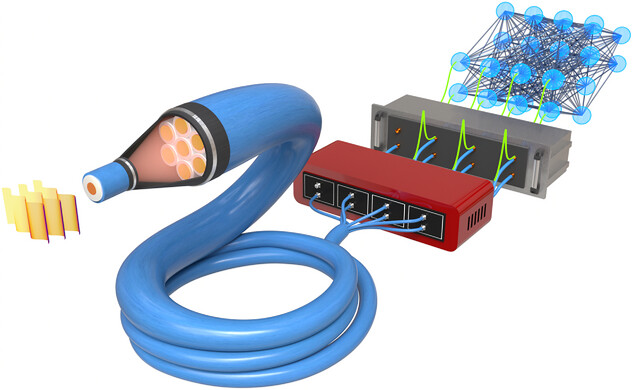
Our new work in Laser & Photonics Reviews: an all-fiber microsensor measures light polarization at the single-photon level using deep learning. Compact, stable, real-time, and quantum-sensitive. #Wileydoi.org/10.1002/lpor.2…@OpticsOlomouc@TweetMartas
Our paper "Measurement-device agnostic quantum tomography" was published in Quantum Science and Technology and introduces a new method for self-calibrating the preparation and measurement of quantum states doi.org/10.1088/2058-9…@QuantSciTech@TweetMartas@OpticsOlomouc
A new paper, published in PNAS, suggests that "large groups of editors and authors...cooperated to facilitate publishing fraud." The authors used statistical analyses and huge databases of papers to figure this out.
But first, some context on paper mills. There is a well-known industry in science where companies (called paper mills) sell fake science papers. They mass-produce bogus research papers and sell them to desperate scientists who need publications to get jobs, grants, or promotions. For a fee, you can buy your name on a paper, or get a paper custom-written to match what a journal might accept. The fraud is all-encompassing: there are brokers, middlemen, editors, and even entire journals working on this scam.
An Indian company, ARDA, charges between $250 and $500 for a paper. Scientists submit a paper on ARDA's website (anything will do) and ARDA coordinates with editors at journals to get it published quickly. ARDA is so brazen, in fact, that they openly publicize the journals they work with on their website.
So here is what this new PNAS paper shows:
First, the authors used statistical tests to figure out whether certain editors are likely to be working with paper mills. They wanted to use statistics to find traces of coordination between paper mills and editors.
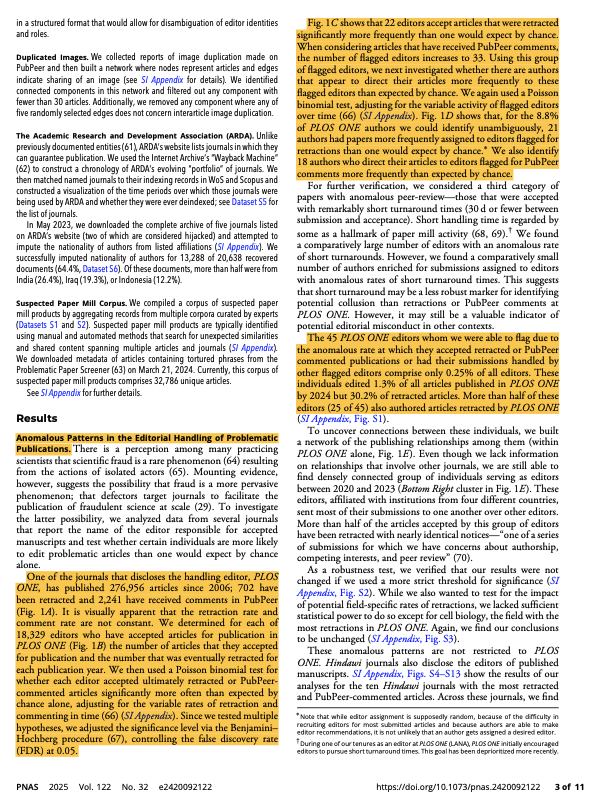
They used PLOS One as a case study because it discloses which editor accepted each paper. PLOS One has published more than 276,000 articles since 2006, 702 of which have been retracted. During that time, a total of 18,329 editors have accepted articles for publication.
Using a Poisson binomial test, the authors of this PNAS paper calculated "whether each editor accepted ultimately retracted...articles significantly more often than expected by chance alone." The answer was yes: 22 editors at PLOS One accepted articles "that were retracted
significantly more frequently than one would expect by chance."
This tiny portion of editors were responsible for just 1.3% of all articles published in the journal, and yet those articles accounted for 30.2% of all retractions! This is not proof of coordination, of course, but it seems pretty damning.
Here are some other surprising takeaways from the paper:
1. ARDA is growing fast, expanding from 14 journals in Jan 2018 to 86 journals by Mar 2024. "Seventeen (9.0%) of these journals are suspected to be 'hijacked journals,' where a journal was once legitimate but a
paper mill has gained complete editorial control over the journal
and its indexed content."
2. Many articles published in the journals listed by ARDA are well outside the journal’s stated scope (e.g. an article about roasting hazelnuts in a journal about HIV/AIDS care). In a sample of five journals, 34% to 98.7% of articles were out of scope.
3. "...the number of retracted articles has been doubling every 3.3 years...while the total number of publications has been doubling every 15.0 years." Suspected paper mill outputs are doubling every ~1.5 years.
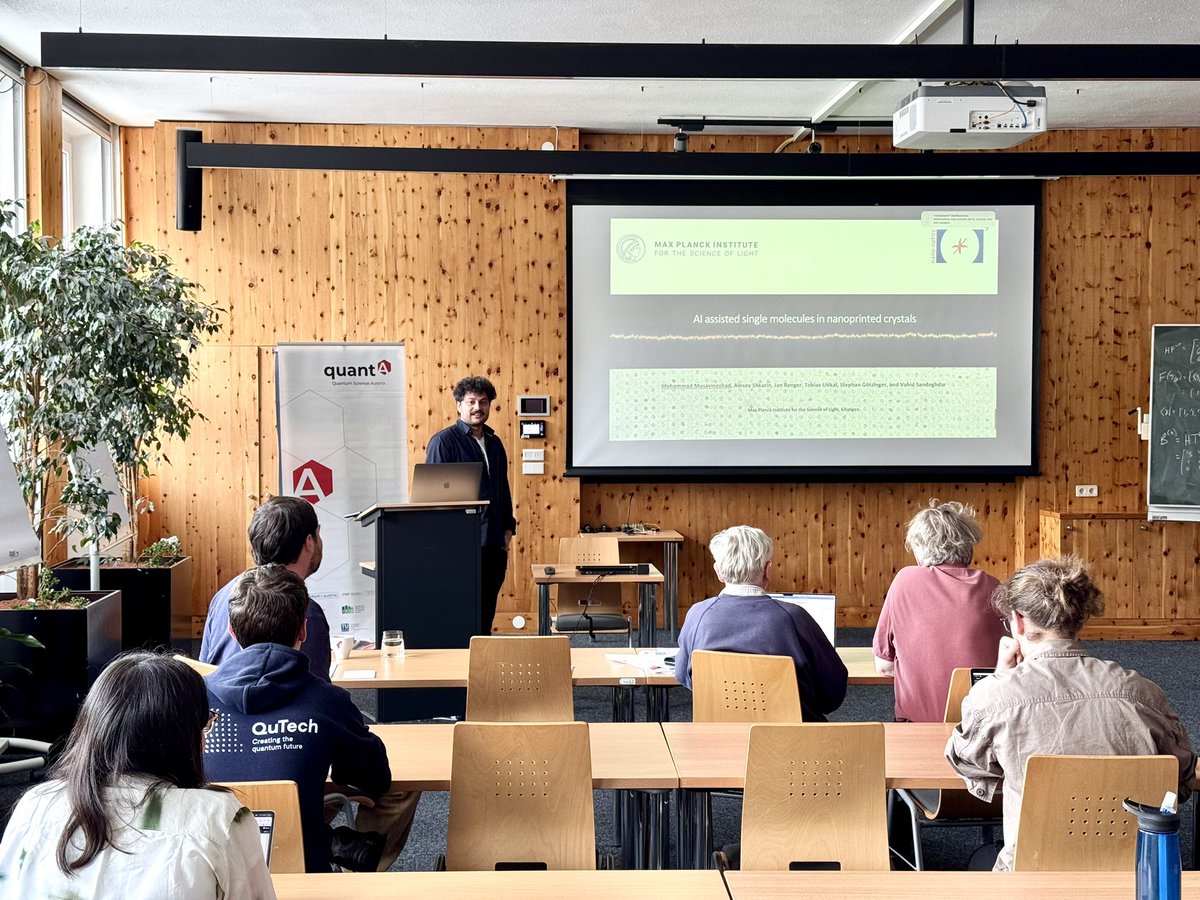
My talk on device-agnostic super-resolving imaging from stars to molecules. The project of our great team @DVasinka , Filip Juráň, Jaromír Běhal, and with additional molecular data by @DostalovaAnezka and Robert Starek. #MLQP#Obergurgl@tu_wien@OpticsOlomouc