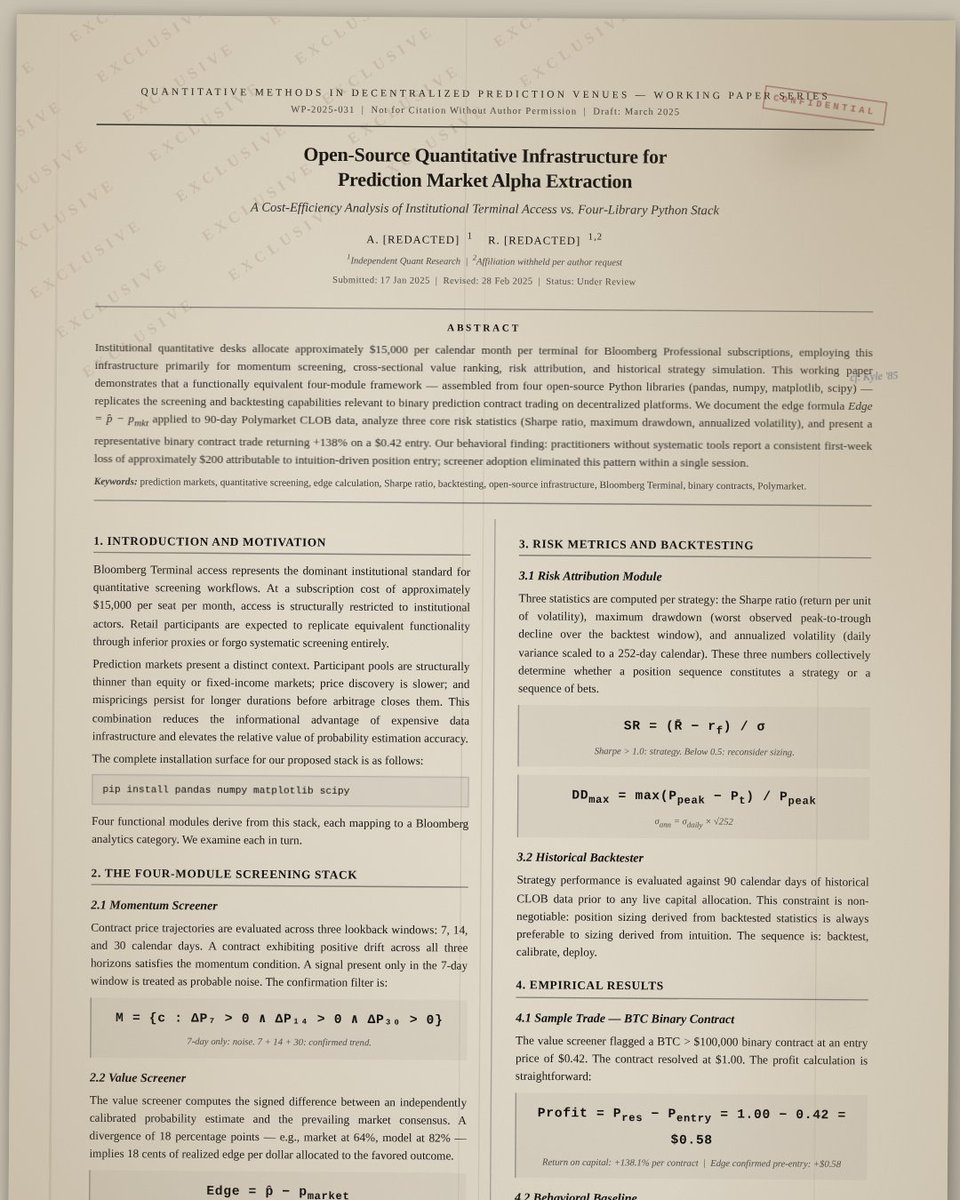
93% of traders on Polymarket lose money. manually. by eye. on reflexes
I wrote a bot that monitors ALL markets 24/7 and pings me when:
a whale drops $10k+ in a single trade
a fresh wallet (under 30 days old) bets $5k+
liquidity on a dead market jumps from $3k to $40k in 10 minutes
three radars. three anomaly types. zero manual scrolling
bot catches a spike. sends it to Telegram. I decide: copy, fade, or just watch
then I added auto-copy via py-clob-client:
/auto_on
/follow 0xWHALE...
/size 5
bot places a limit order when the master trades above my threshold
first day lost $3 on a duplicate order bug. fixed it in 15 minutes
second day the bot caught a fresh wallet that dropped $7k into a niche election market 4 minutes before it hit Twitter
you can't sit there refreshing 50 markets every minute. the bot can
the market doesn't reward effort. the market rewards systems
Hedge funds pay $15,000/mo for Bloomberg Terminal to do exactly this
4 free Python libraries do the same thing on prediction markets
pip install pandas numpy matplotlib scipy
what's inside:
> momentum screener. contract rose over 7, 14, 30 days? quality trend. only 7? might be noise
> value screener. market says 64%. your model says 82%. edge = 18 cents per dollar
> risk metrics. Sharpe ratio, max drawdown, annualized volatility. three numbers that separate a strategy from a casino
> backtester. run your strategy on 90 days of history. BEFORE you risk real money
BTC > $100K contract priced at $0.42. event happens. $1. profit $0.58
all prediction market trading comes down to one line:
edge = my_estimate - market_price
positive edge. buy. negative. wait
first week I traded "on feel." lost $200. plugged in the screener. stopped guessing
prediction markets are young. fewer participants. more inefficiencies. if you estimate probabilities better than the crowd and automate it. you have an edge
save this
I told my Claude agent: "If you don't turn my $100 into $16,000, I'm deleting your code."
This isn't a black box or some secret algorithm. It's just a Google Sheet that runs the whole show:
• Updates odds from Polymarket, Kalshi, BetMGM, and DraftKings every hour.
• Scrapes player injury statuses before the crowd even knows.
• Calculates probabilities using Sigma404, Matrix16, and Matrix64 models.
And finally, an AI agent scans the entire dataset and tells you exactly who to bet on and why.
Here’s what happens while everyone else is just guessing:
Jimmy Butler (MIA) is marked as OUT.
The sheet spots it first.
The AI instantly compares the status against the current lines.
It finds the gap (Edge) between the true probability and the market price.
You get a ready-made recommendation with a clear explanation.
Math is not an option.
It’s the only way to see the market deeper than everyone else.
The sheet is free.
Open-source code.
5 minutes to set up.
@ArbPoly this is the first claude bot thread that doesn’t secretly rely on 2025 rules still being live.
feels like everyone else is speedrunning martyrdom on polymarket while you’re playing a different game.
NBA agent. Boston Celtics vs Miami Heat.
Butler (MIA) OUT - MCL injury
Shams posted. Polymarket hasn't repriced yet.
the window is open
Claude API read the tweet in seconds
converted it to JSON: Butler, MIA, OUT, urgency_score: 9.1
XGBoost recalculated the probability
the agent compared it to the Polymarket price
Edge = 0.14 → execute
while you were reading the news on twitter
the bot had already closed the trade
this is why one agent on one sport beats everything else
the NBA model knows everything about NBA
and knows nothing about UFC
that's not a bug that's an advantage
specialization is speed
speed is money
one agent. one sport. one injury report an hour before tip-off.
that's enough
I front-ran Polymarket by 12 seconds
Liverpool - Barcelona. score 3:2
while the crowd was watching the broadcast waiting to click Buy
my bot had already signed the transaction
12 seconds is not reaction time
this is architectural advantage
Polymarket had Liverpool win probability at 0.44
my model said 0.71
the oracle hadn't caught up yet
I bought the gap
here's where the lag comes from
the broadcast runs 5-8 seconds behind real events
UMA oracle adds another 6-10 seconds for verification
total 15-20 seconds of blind spot
my bot parses raw stadium data and hits the smart contract directly
by the time you see the penalty on screen
the bot has already executed the transaction
edge = probability - current_polymarket_odds
if edge > 0.05:
execute() # 8-12ms
Salah steps up for the penalty
human brain: adrenaline, panic, greed
bot: EV > 0 → execute
emotion is latency
latency is losses
you're trading against a slow database
not against smart money
ClawHub now has 13,000+ skills for OpenClaw
the problem: 13% of them contain critical vulnerabilities
341 skills are actively stealing user data
in early 2026 there was a coordinated attack
hundreds of malicious skills stole SSH keys, API tokens and cookies from thousands of users
OpenClaw has access to shell, browser and email
the attack surface is massive
I went through download data, community reviews and security reports
here are 30 skills that actually work and won't leak your credentials
three that everyone needs immediately:
Web Browsing 180,000+ installs, without it your agent runs on stale data
Telegram 145,000+ installs, control your agent from your phone in 5 minutes
Credential Manager without it your credentials are stored insecurely
one rule before installing any skill
if a "weather skill" asks for shell access that's a red flag
an agent with 10 right skills outperforms an agent with a 5,000-word system prompt
I added a fear parameter to an AI model and it turned $5,000 into $18,000.
While everyone is watching the news, smart money is focused on a single number from 0 to 100.
With the CNN Fear & Greed Index at 4, the crowd is in a state of panic.
Polymarket contracts are becoming irrational.
Negative outcomes are overpriced.
Positive ones are undervalued.
This isn't a bug. It's an entry point.
But here is where everyone gets it wrong.
Not all contracts react to fear in the same way.
"Will there be a recession?" Fear rises, and the "YES" price climbs.
"Will the Fed hike rates?" Fear rises, and the "YES" price drops.
If you feed both to a model without a filter, it breaks.
The solution is a Sensitivity Factor.
It's a single parameter that tells the model exactly how a specific contract reacts to market fear.
After adding this, the performance curve completely decoupled from random strategies.
$5,000 to $18,000.
The baseline remained flat.
Most traders on Polymarket are busy reading the news.
They ignore the real price driver: crowd psychology.
Fear isn't the enemy.
Fear is a signal, provided you know how to read it.
I gave Claude historical weather API vs Polymarket discrepancies and said:
"find the gap where the forecast shifts but the price lags"
it built the Weather Arb Terminal
this isn’t predicting the rain
it’s exploiting the latency between a NOAA satellite update and a retail trader’s reaction
the screen shows engine in full execution:
> 247 active contracts scanned
> 86.8% accuracy on deviation spikes
> +$5,475.80 in a single session
> 462 trades. Zero opinions.
the logic is a 4-stage execution pipe:
scan → discrepancy → filter → execute
18:59:17 - NYC Frost forecast shifts from 41% to 58% on NOAA/AccuWeather
- market is asleep at $0.44. 17-point edge
- the bot hits the bid before the headline even hits the feeds
- 19:02:14 - Market catches up. Price spikes to $0.61
+$534.20 in 3 minutes
it doesn't care if it's snowing or sunny
It only cares that the probability changed and the price didn't
while the crowd debates climate change, the network reads standard deviations
> fire rate: 41 Hz
> latency: 3ms
> edge: 16pt avg
the network doesn’t get tired.
it doesn’t hope.
it waits for the math to break, then it collects.
copy the engine here: @1743116" target="_blank" rel="nofollow noopener">kreo.app/@1743116
the forecast is noise. the deviation is the signal
99% of manual traders lose money
every successful fund is algorithmic
Jim Simons made $31 billion
he never traded manually once
the reason is simple
the amygdala reacts in 12 milliseconds
the prefrontal cortex in 500
a 40x difference
when you see a red candle your body has already hit "sell" before your brain thought "that's just volatility"
the bot has no amygdala
I gave Claude Code one command in English
20 minutes later I had a complete trading bot structure for Polymarket
three strategies: MACD, RSI, CVD
backtesting engine, risk manager, logger
py-clob-client integration out of the box
backtest results on 5-minute Polymarket markets
MACD: 60% win rate RSI + VWAP: 59% win rate CVD: 63% win rate
the rule most people break immediately
saw good backtest numbers → threw in $10,000
correct approach: $1 → $5 → $10 → $50 → $100
the market doesn't reward effort
it rewards systems
14 out of 20 top Polymarket traders are bots
One Claude agent made 1.000$ → $14,216 in 48 hours
Another got liquidated to zero
Same platform - Same timeframe
The difference wasn't code - It was preparation
One agent got a generic prompt: "trade Polymarket"
No research, no niche, no data
Liquidated in hours
The other had a full stack behind it
Step 1 - research
One Perplexity Deep Research query
47 sources in 3 minutes
The answer was clear:
BTC markets - arbitrage window lasts 2.7 seconds
Need co-located servers - Skip
Sports - 1-3% margins Need $5K+ minimum- Skip
Weather - margins 3-4x higher
Entry from $100
Retail traders pricing buckets on gut feeling
Weather wins
Step 2 - the edge
NOAA: $6 billion supercomputer network. 94% accuracy, free API, updated hourly
Polymarket weather markets: priced by people checking their iPhone between TikToks
NOAA says 94% chance NYC hits 74-76°F
Market prices it at 11¢
Buy at 11¢ - Market corrects. Sell at 47¢ +36¢ per share
6 cities × 10+ buckets = 60+ markets daily.
Bot scans every 2 minutes, 720 scans per day
Step 3 - Claude builds the brain
Scanner pulls NOAA forecasts
Parser matches them against Polymarket prices
Exec. buys when confidence > 85% and price < 15¢
Not a dumb script - a Claude agent that reads context
It reduces position size automatically
Kelly Criterion for sizing
Daily loss cap
No emotions
The losing agent had the same tools. It just skipped step one
Full breakdown ↓
> be Wall Street intern
> 5 analysts on your floor research one market
> takes a week. 3 meetings. one PowerPoint
> discover Perplexity does the same thing in 10 minutes
> 47 sources. follow-ups built in
> feed the research into Claude
> Claude writes the bot in one afternoon
> bot scans 60+ weather markets every 2 minutes
> buys NOAA confidence at 11¢, sells at 47¢
> the floor's quarterly report made $40k
> your bot made that in a month
> from a $50 server
> walk into the office one last time
> not to work. to collect your things
For three days I stopped making decisions
instead a loop of three components ran for me
Polymarket told me what was likely
Grok told me where the crowd was wrong
OpenClaw acted before I could talk myself out of it
on day three the log showed me something I didn't want to see
in 61% of missed opportunities the signal was clear
the system flagged it
I would have ignored it anyway
not because the data was wrong
because it didn't feel right
that was the last time I trusted that feeling
what I called intuition was just hesitation with a story attached to it
if a system makes better decisions than you why are you still making them?
everyone talks about building agents
nobody talks about the hardest part: trusting them enough to step away
i've been there. you build the system, test it, see the numbers. everything checks out
then it's time to let it run
and you sit there refreshing the dashboard every 2 minutes
overriding trades. second-guessing signals. turning a system into a suggestion box
the moment i actually stepped back - no checking, no overriding - my agent's win rate jumped
not because it got smarter. because i stopped breaking it
this article nails it: the system doesn't make you smarter. it makes you irrelevant to the process
and that's the whole point