Stock Bookworm

531 posts

Stock Bookworm banner
Stock Bookworm

Stock Bookworm

@StockBookworm

Investor with a long term mindset. Disclaimer: My tweets and retweets are not financial advice. I may be invested in the companies I discuss.

USA Se unió Ekim 2020
442 Siguiendo3.2K Seguidores
Stock Bookworm
Stock Bookworm@StockBookworm·
$ASML and $APH are my two favorite ways to invest in AI. Here is why:   1. AI technology is rapidly evolving. If technological history is a guide, the early leaders in AI might not remain leaders. Forecasting who will have the best LLMs, the best chips for AI, and the best AI enabled applications and what the economics of those businesses might look like is a task that I find to be very difficult and comes with a high degree of uncertainty. 2. How then can I invest in AI given this conundrum? By looking for more picks and shovels companies, the kind of companies that can benefit no matter which companies ultimately supply the AI applications and hardware. If the current leaders like $NVDA, $AVGO, and $GOOGL stay leaders, I want to be able to benefit. If new leaders emerge, I want to still be able to benefit. 3. $ASML fits this criterion wonderfully. $ASML is the backbone of chip production via its EUVs (where it is a monopoly) and DUVs (where it is the leading player). AI can’t grow without chips, and cutting-edge chips can’t be produced at scale without $ASML. I don’t need to predict if $NVDA, $AMD, $AVGO, $AMZN, $GOOG, or others are designing the best chip. It doesn’t matter. Whichever companies design the chips that fuel the future of AI, $ASML will be needed and stands to benefit. 4. $APH is another picks and shovels AI beneficiary. $APH manufactures connectors and various other critical products like busbars, sensors, antennas, and cable assemblies. Connectors are needed at multiple layers to enable AI, whether that is in enabling data to be transferred, enabling power to be distributed at the rack level, or helping racks with thermal management. $APH is not the flashiest or most well-known name, but its breadth of products, technological innovations, customer relationships, and reputation for reliability make it a trusted and important supplier to the AI industry. 5. AI is about more than data centers and LLMs. AI has the potential to be incorporated into a wide variety of products, such as autonomous vehicles, robotics, and consumer electronics. All of these products will need chips and connectors, meaning that $ASML and $APH stand to be key players as AI expands more broadly outside of data centers. $ASML and $APH are two companies that are agnostic to which company makes the best chip or creates the best LLM. They stand to benefit from more than just the buildout of data centers, being critical suppliers that will enable AI to be deployed at the device level. While neither will likely be the very fastest growing company in the AI space, I believe these two companies with strong moats, good management, and multi-decade tailwinds are well positioned to do well in the long-term.   This is not financial advice. This is just my opinion. I am long $APH and $ASML.
English
0
1
6
628
Stock Bookworm
Stock Bookworm@StockBookworm·
When a company makes a reliable product that is critical to performance but only accounts for a small percentage of total production costs, customers rarely switch. The risk of disruption isn't worth the marginal savings.   High switching costs = high-risk Marginal potential savings = low-reward The end result? A very sticky product. Some companies that fall into this category:   $APH Amphenol $TEL TE Connectivity $TXN Texas Instruments $ADI Analog Devices $NSIS Novonesis $GIVN Givaudan   This is not financial advice. I am long $APH.
English
0
0
5
404
Stock Bookworm
Stock Bookworm@StockBookworm·
I did make changes. I realized that I had been trying to follow the investing philosophies of Dev Kantesaria and Chris Hohn too closely. What I strive to do is learn what I can from studying various great investors and then formulate my own approach. This is not financial advice.
English
0
0
1
71
Stock Bookworm
Stock Bookworm@StockBookworm·
Many high quality stocks are seeing declines in the market. Fear is rising, the bear cases are getting louder, and, in some cases, Wall Street analysts are following trends by reducing their price targets. $NU and $MELI are two examples of stocks that I think have become very attractively priced. Both companies have been getting stronger, they are continuing to make intelligent, smart investments into their businesses, and they are executing exceptionally well. They both benefit from secular long-term tailwinds and have multiple avenues for growth. Unless something fundamentally changes which has a significant impact on the future of these two companies, which currently I do not believe is the case, I see no valid reason for the increase in pessimism about these two. This is not financial advice. This is just my opinion. I am long $NU and $MELI.
English
1
0
13
764
Stock Bookworm
Stock Bookworm@StockBookworm·
Keep costs low. Pass the savings on to the customers. Offer a great product that is easy to use and very practical. Be customer centric. This is the formula $NU has used to be successful in Latin America, and this is the formula that it will use to be successful in the USA. The banking market dynamics are significantly different in Latin America compared to the United States, but this basic formula is still applicable. Nu’s core business model is strong and transferable across borders. $NU will have to make adaptations and adjustments when entering the United States market, but it has the foundation necessary for success.   This is not financial advice. This is just my opinion. I am long $NU.
English
0
0
4
421
Stock Bookworm
Stock Bookworm@StockBookworm·
I respectfully disagree. I think that $MELI has a lot of runway for future growth plus many tailwinds benefitting it. Thus, I believe $MELI deserves a higher valuation because it has a very reasonable chance to be able to grow very considerably over the next 5+ years without having to make outrageous assumptions. The market seems to me to be punishing $MELI because the company is prioritizing investing for growth over short-term profitability. This is not financial advice. This is just my opinion. I am long $MELI.
English
1
0
1
110
I, Bayes
I, Bayes@i_bayes·
@StockBookworm I agree that MELI is an exceptional business and their investments totally make sense. But I don't agree that the market is short-sighted right now. The price around 2000 is simply too high. To justify such a price, the company needs a favorable environment for a long time.
English
1
0
2
54
Stock Bookworm
Stock Bookworm@StockBookworm·
The market doesn’t appear to view $MELI quarterly results positively, mainly because of less than anticipated profitability. However, a few things to consider: 1.     $MELI profitability was less than expected not because of a revenue shortfall but because the company is aggressively investing for future growth. 2.     $MELI is a company growing very quickly with many opportunities for continued growth. It is not, and should not, be optimizing for short-term profitability. 3.     $MELI is investing simultaneously in multiple initiatives in both e-commerce and FinTech. This is a positive, not a negative. It is a rare occurrence when a business at the scale of $MELI has so many enticing opportunities to invest capital for growth. 4.     $MELI is not burning cash. Rather, it is a profitable company with a leadership team that has a strong track record of executing on growth initiatives. 5.     $MELI is not spending money on bizarre projects. Rather, all the areas it is investing in, such as enhancing logistical capabilities, free shipping, credit cards, etc., are all directly related to its core businesses and strengthen the company’s ecosystem. In short, the market is acting short-term minded, like it often does. It focuses on short-term profits over looking at the long-term. I thought the quarter was very strong. The company is growing quickly, at scale, and doing so profitably. It is investing for growth, and it is strengthening its ecosystem and its moat. The company has grown into what it is by focusing on the long-term, and I am glad that it is continuing to do so.   This is not financial advice. This is just my opinion. I am long $MELI.
English
2
2
19
1.4K
Stock Bookworm
Stock Bookworm@StockBookworm·
3 Questions for $MELI for Its Upcoming Earnings Report on Tuesday, February 24, 2026: 1. Has $MELI seen any increased pressure from competitors? There is concern that $SE (Shopee) is putting pressure on $MELI. Personally, I think Mercado Libre’s breadth of product availability, logistical capabilities, and ecosystem of services gives it a moat that separates it from $SE, $AMZN, and any other company in its key markets, but any additional insight on this question would be welcome. 2. How is the use of robotics progressing? $MELI has been utilizing robotics in its warehouses in a limited manner. With advances in AI and robotics, it would be nice to get more insight into how this has progressed and how management sees robotics being used over the next few years. 3. What is the roadmap for Mercado Pago’s future offerings? $MELI has been putting more and more emphasis on trying to become consumers' principal financial institution. I would like to hear more about how management sees the future of Mercado Pago’s consumer offerings evolving over the next few years and what new products and services the company plans to introduce. This is not financial advice. I am long $MELI.
English
0
0
10
1.1K
Stock Bookworm
Stock Bookworm@StockBookworm·
AI poses a serious disruption risk to software companies, but not in the way that the market currently expects.   The current narrative driving the market is that AI will allow companies to build their own software cheaply and quickly, resulting in companies deciding to build rather than buy software. I find this thesis unconvincing because internally built software would likely lack feature parity and be expensive and complex to maintain.   However, there is another, bigger risk that AI poses to software companies. AI is a powerful tool that can greatly enhance productivity if used correctly. Most software will need to integrate and utilize AI in some way in order to stay competitive. This is where the risk lies.   Software companies that fail to properly integrate AI into their offerings will become less competitive to other software companies that do a better job of utilizing AI. In other words, AI won’t make software companies in general obsolete. However, it does present an opportunity for current software companies to be disrupted by rival software companies that are more successful in harnessing the power of AI.   Incumbent leaders have a number of advantages. They have the resources to deploy AI, and many will still benefit from switching costs. However, some may suffer from the Innovator’s Dilemma and from complacency, and integrating AI into legacy systems might prove challenging.   Startups have the advantage of being able to integrate AI when building software, allowing their software to be AI native. Also, startups can be more nimble, more quickly making changes as AI technology advances. On the downside, startups might lack data to properly train some AI, and they still face the challenge of building a sales network and convincing companies to switch from their current software providers.   Leadership will play a big role in which software companies thrive and which struggle in the AI era. Software companies led by long-term minded, visionary, and responsive leadership teams will, more often than not, be able to adapt to the AI era and can thrive. Those that are led by leadership teams that are more focused on short-term profits and struggle with strategic shifts might find themselves losing market share.   This is not financial advice. This is just my opinion.
English
0
0
6
424
Stock Bookworm
Stock Bookworm@StockBookworm·
$SPOT has done exceptionally well over its history, having grown into the global music streaming leader. It is a high quality business. But does it have a moat and pricing power?   Does it have a moat? This is the question which has kept me hesitant about $SPOT. At first glance, the answer would appear no. It doesn’t offer anything fundamentally different than competitors except for perhaps some exclusive podcasts. For most people, they could switch to competing services from $AMZN, $AAPL, or $GOOGL among others and have a relatively similar experience. However, it does have two very valuable traits, brand recognition and switching costs. Spotify is the biggest streaming service in the world. When people think of streaming music, many think of Spotify. This gives them an advantage as people looking to get a streaming service are more likely to go with the leader, the company they have heard about and associate with streaming music. It is a very simple, but also powerful, marketing tool, analogous to how (though not quite as pronounced) people associate internet searches with Google. The second trait is switching costs. People who use Spotify get used to it. They know how to use the app, have already constructed a library of their favorite music, and perhaps have it connected to their smart speakers. Changing streaming services would mean getting used to a new app, recreating playlists and your library, and connecting the service to your smart speakers. None of this is inherently difficult, but it is annoying. Many people are just content to stick with what they have because it is the path of least resistance. Unless given a big reason to change, many people will just stay with Spotify. Brand recognition and switching costs are real, but they are not the strongest sources of moats in this instance. Spotify’s moat sources can be eroded more easily than some other moat sources. Therefore, I think Spotify’s moat is significant and intact but on the lower end of the moat spectrum.   What about pricing power? Can Spotify raise prices and not see a big loss of customers? This answer is complex and nuanced. I think it can raise prices because of the switching cost moat mentioned above. If they raise prices by $1 or $2 a month in the USA, would people still think they are getting a lot of utility out of Spotify for the price? Most likely. Would people think it is worth the hassle to switch streaming services to save an extra $1 or $2? Probably not for a lot of people. Hence, Spotify does have some pricing power in my opinion. But the pricing power gets capped fairly quickly. I don’t think Spotify can keep raising prices year after year. If it gets too expensive, people will look for alternatives, of which there are plenty. Plus, since many competitors, like $AAPL, $AMZN, and $GOOG, bundle their streaming services with other services and view it at least partially as a tool to get more engagement with customers, Spotify’s competitors do not have as much incentive to raise prices and can afford to be very competitive on pricing. Hence, Spotify has to be careful with pricing. Their pricing power is more than a pure commodity good, but not as strong as some companies offering more irreplaceable goods or services. I think there are many reasons to be bullish about Spotify. It benefits from raising global wealth, since as people become wealthier around the globe more people can afford to pay for streaming services. Furthermore, it is very unlikely that people will ever stop wanting music, so its core service will likely continue to see demand for decades. It also has the potential to significantly improve its advertising business, something it is actively working on. It has a moat and pricing power, although both are on the lower end of the spectrum.   This is not financial advice. This is just my opinion.
English
0
1
9
1.4K
Stock Bookworm
Stock Bookworm@StockBookworm·
Google releasing Project Genie has caused shockwaves in the market around video game companies. However, I believe fears about AI displacing video game companies are largely overblown and based on a fundamental misconception of what makes a game popular. While AI will have a significant impact on the industry, I believe it will strengthen, rather than disrupt, the top video game companies. The Creative Moat: Video games are creative works. Idea conception, storytelling, art direction, level design, and world-building are all components of modern games that are rightly considered creative endeavors—areas where humans possess a unique strength over AI. Humans are inherently creative beings; we have been crafting innovative stories for thousands of years. We understand what it means to be alive, and we express that experience through our art. Video games are simply the newest medium for this expression. AI, conversely, lacks true creativity. It digests massive datasets and regenerates them in slightly different forms. It cannot express humanity because it is not human. If art is understood as a reflection of the human soul, AI is incapable of producing it. AI cannot independently create inventive stories, build awe-inspiring worlds, design varied levels, or create an aesthetic that perfectly matches a game’s feel. At best, AI generates content that is structurally coherent but ultimately generic and dull. The Power of IP: Beyond creative depth, intellectual property serves as a moat that AI cannot breach. Top video game companies own valuable IP that cannot be disrupted overnight. What is the value of Mario to Nintendo $NTDOY or Spider-Man to Sony $SONY? Even if AI could technically produce a game similar to those of Nintendo or Sony, their established IP would still command more popularity than a generic, AI-produced competitor. Recent Case Studies: Recent successes highlight this point. Consider Hogwarts Legacy, the top selling game of 2023. Its success relies on the immensely popular Harry Potter IP—something no AI can replicate or displace. Another example is Clair Obscur: Expedition 33. This game is a work of art, featuring a creative story, an engaging world, and an aesthetic that fits its tone perfectly. Although created by a smaller team, the developers' care is evident. AI simply cannot produce a creative work with that level of intentionality and care. AI as a Tool, Not a Replacement: AI will serve as a tool to make game development quicker and cheaper. This benefits strong video game companies rather than hurting them. The value of Harry Potter, Mario, or Spider-Man only grows if the IP holders can produce high-quality games more frequently and at a lower cost. This will shift industry dynamics: elite companies will produce more content and capture more market share, while lackluster developers will struggle as consumers spend less time on mediocre games.   This is not financial advice. This is just my opinion.
English
0
0
1
387
Stock Bookworm
Stock Bookworm@StockBookworm·
Third Point, led by Daniel Loeb, is looking to shake things up at CoStar $CSGP. Third Point believes that $CSGP has done a poor job of capital allocation and that the company’s decisions have led to disappointing results for shareholders. I agree. $CSGP has a terrific core business in commercial real estate (CRE) via CoStar Suite and LoopNet: ·      CoStar Suite is a near-monopoly in data, while LoopNet is the clear CRE marketplace leader. ·      They are viewed as essential by agents. ·       Due to this indispensable role, CoStar has considerable pricing power, especially with CoStar Suite. $CSGP could raise prices substantially and likely see very little churn. Apartments.cоm is also a great business. It has a massive network effect and is a cash cow. The strength of $CSGP’s core businesses means the company should be excelling. Unfortunately, $CSGP has been spending massively to expand Hоmes.cоm. It is trying to use the same playbook it used with Apartments.cоm to transform Hоmes.cоm into a dominant marketplace. However, the competitive landscape is very different. Apartment rentals had an amalgamation of fragmented and weak competitors offering uninspiring and incomplete offerings. Residential real estate does not. It already has a clear, strong leader in Zillow. Furthermore, as Loeb’s January 2026 letter points out, there is little to differentiate Hоmes.cоm—nothing that would make people want to switch from Zillow. Essentially, $CSGP is relying on massive marketing spending to win, a strategy that rarely works when challenging a company with a deep-seated network effect. CoStar Suite, LoopNet, and Apartments.cоm are highly profitable, moaty businesses. Hоmes.cоm lacks a moat and is highly unprofitable due to massive marketing spend. $CSGP needs to focus on its core businesses instead of wasting resources on Hоmes.cоm. I agree with Loeb on this. I think CoStar has significant potential if it drastically improves its capital allocation. I have $CSGP on my watchlist and would consider starting a position if I see signs that capital allocation is going to significantly improve. This is not financial advice. This is just my opinion.
English
1
0
6
1.7K
Stock Bookworm
Stock Bookworm@StockBookworm·
I’m still pondering this topic and don’t have a definitive idea yet of how many stocks I think is most ideal for me. I am comfortable with my current situation where I have 7 stocks in my portfolio, but I would add a few more stocks if I find opportunities that interest me. 11-12 stocks would probably be the upper range of how many different stocks I would want in my portfolio before I would think I’m starting to drift too far away from my strategy. This is not financial advice. This is just my opinion.
English
0
0
0
35
Bram Van Genechten
Bram Van Genechten@BramVGenechten·
The longer my investment journey continues, the less stocks I own. I'm a believer that you have to concentrate if you want to outperform. E.g. Chris Hohn, Dev Kantesaria, Buffett is his early years. But this isn't the only way. Francois Rochon and Peter Lynch show(ed) that it's possible with more stocks. My current believe: 5-10 stocks with 5-15% position. But I'm not there yet, working on it. What about you?
English
1
0
1
124
Stock Bookworm
Stock Bookworm@StockBookworm·
My portfolio as of time of writing on January 22, 2026.   $FICO 20% $GE 17% $SPGI 15% $MCO 15% $V 15% $MA 15% $ASML 3%   This is not financial advice.
English
43
6
292
72.4K
Stock Bookworm
Stock Bookworm@StockBookworm·
If Netflix ever did start trying to focus on making their content more optimized for ads rather than trying to focus on quality, that would be a significant change. You raise a very interesting point about this. Do you think this is likely to occur? Or do you view it as a possible but unlikely scenario?
English
1
0
3
201
Therationalmind
Therationalmind@Rationalmind__·
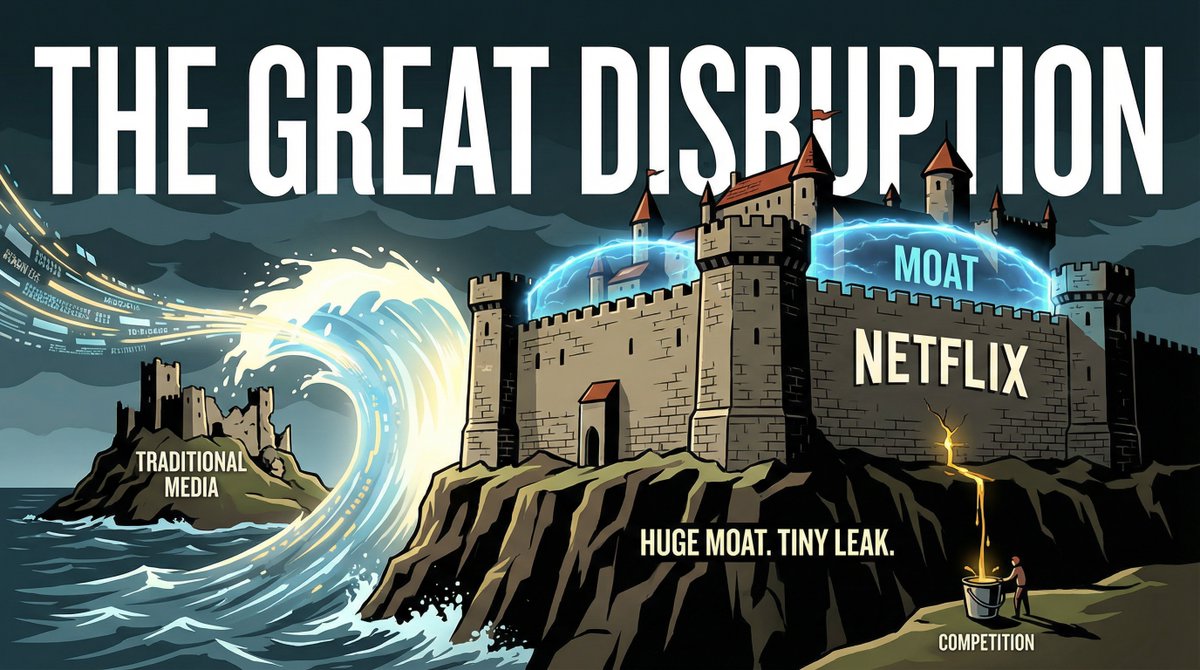
Yes Netflix ( $NFLX ) still has a moat today, but the direction of the business is changing in a way that should make long term investors at least a little uncomfortable. Ok $NFLX is winning the streaming war… by slowly becoming the thing it disrupted. Here me out, for years Netflix’s moat was simple: ⚫️Best product UX (no ads, no cable style friction) ⚫️The default “what do we watch tonight?” app ⚫️Global scale to amortize content spend ⚫️Data driven content machine + distribution advantage And that moat is still real today. It remains the engagement king and the platform most households keep when they cancel everything else.​ But if we play the devil’s advocate: Netflix is shifting from “premium subscription utility” to “hybrid media platform” and that has consequences. 1) Ads: is a growth driver… paying an UX tax Netflix’s ad business is clearly working. Generated about $1.5B in ad revenue in 2025 and management expects it to double in 2026. That’s bullish near term: - New revenue stream - Monetizes price sensitive users - Raises ARPU without pushing subscription prices too hard But strategically, it also means Netflix’s product starts looking closer to the ad heavy platforms it used to beat on simplicity. And once ads become meaningful, you risk optimizing for ad inventory and engagement hours in ways that can slowly degrade the premium feel they fought so hard to obtain 2) Password sharing crackdown: a one time tailwind Cracking down on password sharing worked, Netflix converted a lot of non paying users into paying customers and even stopped reporting subs in 2025 to steer the narrative toward engagement and profit. Yes...but, that conversion is not infinite. If part of recent strength is pull forward from converting freeloaders, the market will eventually want to see sustainable growth without that lever.​ 3) The moat is shifting: from “best app” to “best bundle” As streaming matures, competition becomes less about “who has the best originals” and more about: - Who bundles cheapest - Who has the best ad stack - Who owns distribution (Prime bundling) - Who can subsidize content with other profits Prime Video can subsidize with retail, Disney + can monetize franchises across parks/merch, Apple can treat content as a feature, not a profit center. So Netflix is the pure-play...which means it must keep executing perfectly. 4) Market share dominance may erode even if $NFLX stays great Some tracking data suggests Netflix and Prime have seen US share soften from early 2025 peaks, while Disney+ gained share year over year.​ That doesn’t mean Netflix is dying, it means the future might look like: still a top platform, but not the dominant “everyone must have it” subscription forever. 5) Ok bro...so why own it now? Because today Netflix is still doing the hard things right: - Building an ad business that’s scaling (and improving targeting/measurement) - Using live events (e.g., WWE and NFL Christmas games) to create premium ad inventory and retention hooks​ - Expanding monetization without breaking the product (yet) In other words, the present looks strong, the stock can be reasonably valued on rising profit + ads, but the long term debate is whether Netflix’s “no-ads, clean UX” identity was part of the moat and what happens as that advantage narrows.
Therationalmind tweet media
English
1
0
6
3.6K
Stock Bookworm
Stock Bookworm@StockBookworm·
I recently had an evolution in my investing style, and I subsequently changed portfolio significantly. Therefore, these are all fairly new positions for me. My purchase price is similar to what they are currently trading at. I wrote a post explaining why I made the change. This is not financial advice. x.com/stockbookworm/…
English
0
0
1
422
Stock Bookworm
Stock Bookworm@StockBookworm·
@Sr_Phileas Thank you! I also enjoy listening to and reading the writings of Terry Smith.
English
0
0
0
17
PFogg
PFogg@Sr_Phileas·
@StockBookworm Great post. For me, both Chris Hohn and Terry Smith are the two best money managers to emulate in our time. I try to read whatever they write and listen to whatever they say
English
1
0
1
54
Stock Bookworm
Stock Bookworm@StockBookworm·
I view $V and $MA as essentially toll-roads for global digital payments. By owning both, I can capture more of the total market without having to worry about slight execution problems causing one or the other to gain or lose market share. A similar type of rationale applies for why I invest in both $SPGI and $MCO. Plus, with my portfolio being so concentrated, owning both helps me to reduce the risk of operational problems in one of the companies. This is not financial advice.
English
1
0
3
118
Stock Bookworm
Stock Bookworm@StockBookworm·
@tj7731541503 What do you think about valuation? Do you think most of these are currently undervalued, fairly valued, or overpriced?
English
1
0
0
85
tj77
tj77@tj7731541503·
@StockBookworm Pretty good. Own all these except SPGI
English
1
0
1
100