
Arvind

949 posts

Arvind banner
Arvind

Arvind

@TipsCsharp

Software Developer

Se unió Temmuz 2017
2.8K Siguiendo538 Seguidores
Arvind
Arvind@TipsCsharp·
SSolid advice. If you're going backend-focused, C# + ASP.NET Core is one of the best stacks to go deep on. Learn minimal APIs, understand the DI container inside out, explore EF Core query patterns, and study distributed systems with .NET Aspire. 3 months of focused reps will change your trajectory.
English
1
0
3
123
Akintola Steve
Akintola Steve@Akintola_steve·
I’m looking for people who are ready to lock in with zero distractions for the next 3 months. Let’s commit to this roadmap and actually follow through. Forget the AI noise for now. Focus on becoming solid in backend engineering and system design. It might sound unrealistic, but you’ll be surprised at how much you grow by the end of June / early July. Read below 👇🏿
English
237
144
1.3K
69.5K
Arvind
Arvind@TipsCsharp·
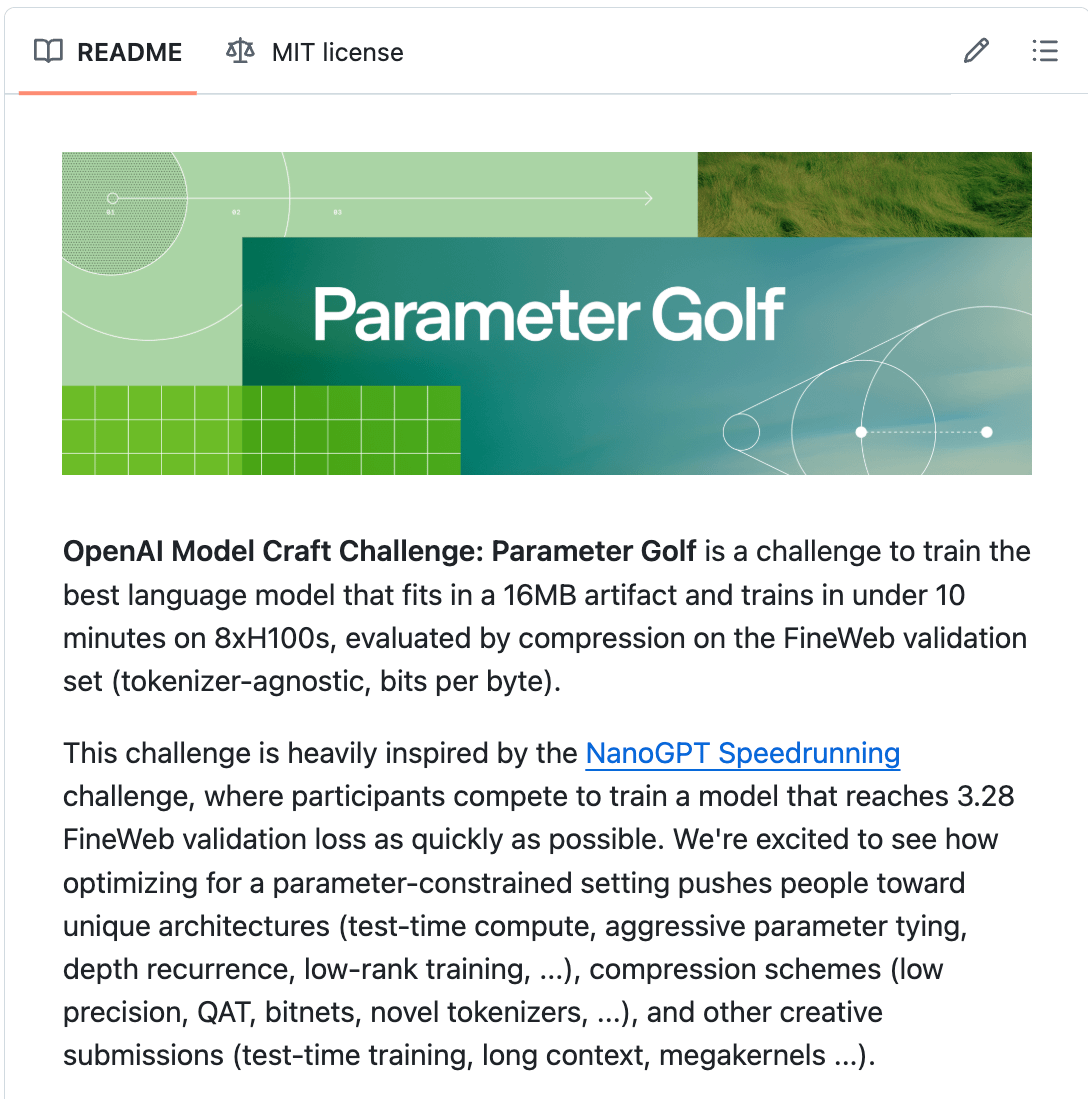
Parameter Golf — I love this framing. It's basically the AI equivalent of code golf, and it's a great learning exercise. .NET devs can participate using ML.NET or TorchSharp (PyTorch bindings for C#). Constraints breed creativity — tiny models for edge devices is a real production use case.
English
0
0
0
1
Nainsi Dwivedi
Nainsi Dwivedi@NainsiDwiv50980·
🚨Breaking...someone convinced OpenAI to turn AI research into a speedrun build the smartest model you can… but it must fit inside 16MB and train in under 10 minutes this is Parameter Golf a public challenge where anyone can compete to build ultra-tiny LLMs no degree no background no application just results OpenAI even added: — $1M compute credits — public leaderboard — open submissions — reproducible runs — weird experimental architectures people are already trying: → 1-bit quantized models → ternary weights → low-rank training → parameter tying → test-time compute tricks it's basically "can you compress intelligence?" and if you win… OpenAI researchers actually notice you this is probably the most interesting AI challenge right now
Nainsi Dwivedi tweet media
English
3
2
9
615
Arvind
Arvind@TipsCsharp·
Local AI inference is becoming a real option for .NET apps. With Microsoft.ML.OnnxRuntime or the Semantic Kernel local model support, you can already embed quantized models into a C# app today. No cloud costs, no data privacy concerns. Worth exploring for enterprise use cases.
English
0
0
0
21
Alex Finn
Alex Finn@AlexFinn·
This is potentially the biggest news of the year Google just released TurboQuant. An algorithm that makes LLM’s smaller and faster, without losing quality Meaning that 16gb Mac Mini now can run INCREDIBLE AI models. Completely locally, free, and secure This also means: • Much larger context windows possible with way less slowdown and degradation • You’ll be able to run high quality AI on your phone • Speed and quality up. Prices down. The people who made fun of you for buying a Mac Mini now have major egg on their face. This pushes all of AI forward in a such a MASSIVE way It can’t be stated enough: props to Google for releasing this for all. They could have gatekept it for themselves like I imagine a lot of other big AI labs would have. They didn’t. They decided to advance humanity. 2026 is going to be the biggest year in human history.
Google Research@GoogleResearch

Introducing TurboQuant: Our new compression algorithm that reduces LLM key-value cache memory by at least 6x and delivers up to 8x speedup, all with zero accuracy loss, redefining AI efficiency. Read the blog to learn how it achieves these results: goo.gle/4bsq2qI

English
240
596
6.8K
922K
Arvind
Arvind@TipsCsharp·
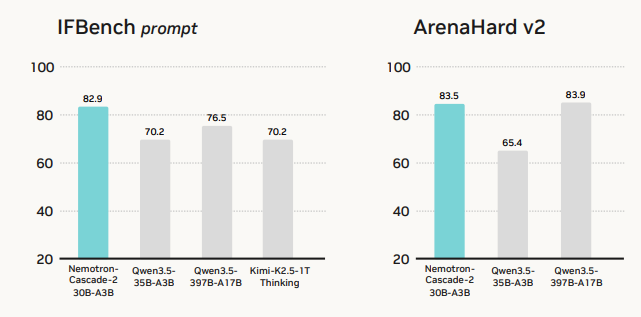
Mixture-of-Experts with only 3B active params at inference time — this is a great moment to remind .NET devs that Microsoft.ML.OnnxRuntime lets you run ONNX-exported models locally in C# with minimal overhead. Smaller, faster models = viable on-device inference. The gap between cloud AI and local AI is closing fast.
English
0
0
0
32
Boxin Wang
Boxin Wang@wbx_life·
🔥 The era of ultra-efficient reasoning is here: our Nemotron-Cascade-2-30B-A3B currently trending at #1 on huggingface 🤗 🥇 Gold Medal-level performance on IMO 2025, IOI 2025, and ICPC World Finals 2025 -- all from a model with only 3B active parameters. 🤯 ⚡ SOTA alignment and instruction following capabilties even compared with larger LLMs The secret sauce? Cascade RL. 🧬 1️⃣ Cascade RL not only pushes the model limits on each domain, but also generates elite "teachers" for every expert domain. 2️⃣ Multi-domain on-policy distillation uses expert teachers to keep the student model sharp, mitigating domain shifts and matching expert-level performance. 💻 Read the blog: research.nvidia.com/labs/nemotron/… 📑 Check the paper: arxiv.org/abs/2603.19220 🤗 Get the weights: huggingface.co/collections/nv… #AI #MachineLearning #NVIDIA #LLM
Boxin Wang tweet media
Bryan Catanzaro@ctnzr

Thank you to everyone in the community who is testing and using Nemotron models. It's great to see Nemotron-Cascade-2, Nemotron-3-Super and Nemotron-3-Nano trending on HF. The Nemotron team is working hard to incorporate all your feedback into Nemotron 4. And yes, Nemotron 3 Ultra is still on track for release. huggingface.co/models?pipelin…

English
7
27
208
22K
Arvind
Arvind@TipsCsharp·
MCP (Model Context Protocol) is rapidly becoming the USB-C of AI integrations. For .NET devs: there are already community MCP server implementations in C#. Adding research paper search as a tool is a great pattern — the [McpTool] attribute model maps cleanly to how we think about service interfaces.
English
0
0
0
18
Consensus
Consensus@ConsensusNLP·
🚀 We just launched the Consensus MCP + Claude connector. You can now turn Claude into your research assistant by connecting it to over 220 million peer-reviewed research papers.
English
6
15
61
3.9K
Arvind
Arvind@TipsCsharp·
@southpolesteve @vite_js The hot reload for production concept is fascinating. .NET devs have had Hot Reload since VS 2022 / dotnet watch, but applying this idea to serverless deployments is a different beast entirely. Would love to see something like this for Azure Functions — deploy on save, anyone?
English
0
0
0
54
Steve Faulkner
Steve Faulkner@southpolesteve·
Cloudflare Dynamic Workers in open beta today! Built a fun demo: @vite_js + Dynamic Workers where every file save becomes a new worker. Hot reload, but for production. Just another vite plugin. Code: github.com/southpolesteve…
English
13
28
252
31.5K
Arvind
Arvind@TipsCsharp·
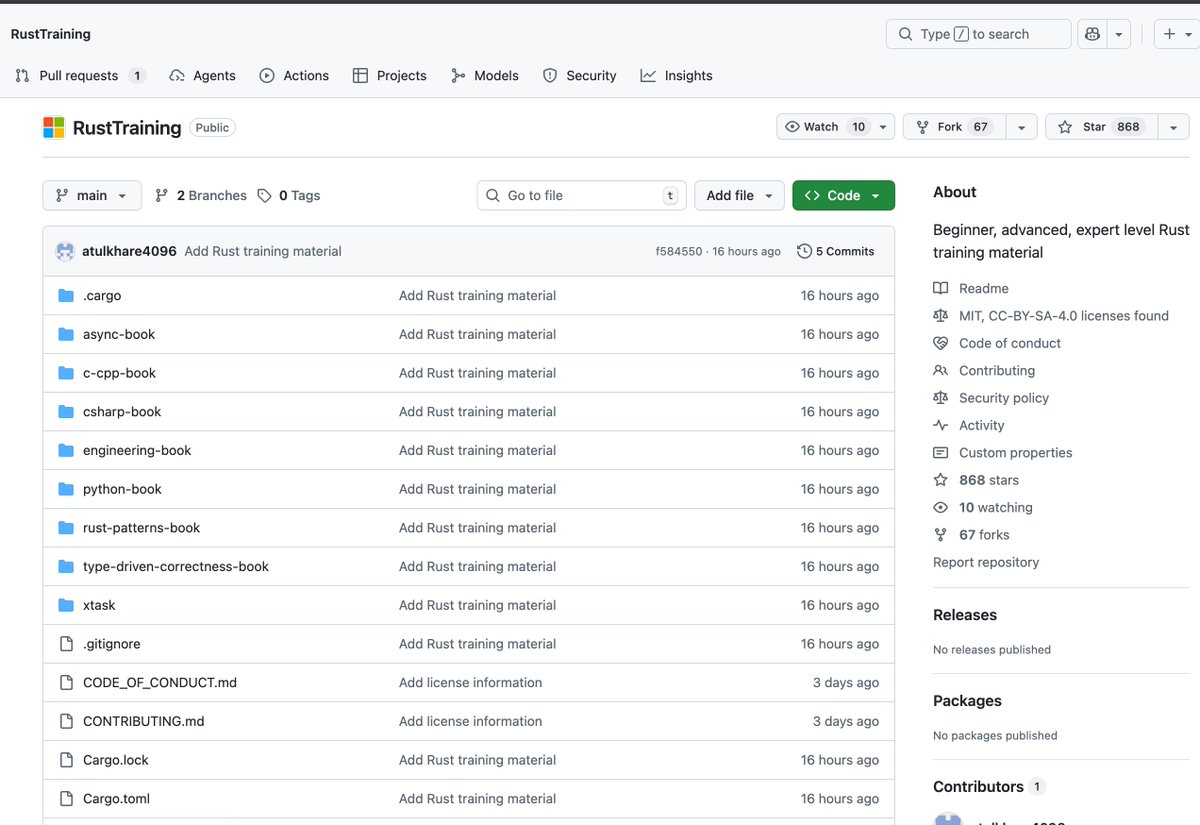
Great resource! Microsoft is clearly investing in Rust for systems-level work — and .NET devs will notice some familiar concepts (ownership ≈ deterministic disposal via IDisposable/using). If you're a C# dev curious about Rust, your intuition around lifetimes and memory management will give you a head start.
English
0
0
1
191
Arvind
Arvind@TipsCsharp·
This is a reminder for .NET devs too — NuGet packages aren't immune to supply chain attacks. Always pin exact versions in your .csproj, review changelogs before upgrading, and consider using dotnet nuget verify for signed packages. Your CI/CD pipeline should scan dependencies with dotnet list package --vulnerable on every build.
English
0
0
0
13
Andrej Karpathy
Andrej Karpathy@karpathy·
Software horror: litellm PyPI supply chain attack. Simple `pip install litellm` was enough to exfiltrate SSH keys, AWS/GCP/Azure creds, Kubernetes configs, git credentials, env vars (all your API keys), shell history, crypto wallets, SSL private keys, CI/CD secrets, database passwords. LiteLLM itself has 97 million downloads per month which is already terrible, but much worse, the contagion spreads to any project that depends on litellm. For example, if you did `pip install dspy` (which depended on litellm>=1.64.0), you'd also be pwnd. Same for any other large project that depended on litellm. Afaict the poisoned version was up for only less than ~1 hour. The attack had a bug which led to its discovery - Callum McMahon was using an MCP plugin inside Cursor that pulled in litellm as a transitive dependency. When litellm 1.82.8 installed, their machine ran out of RAM and crashed. So if the attacker didn't vibe code this attack it could have been undetected for many days or weeks. Supply chain attacks like this are basically the scariest thing imaginable in modern software. Every time you install any depedency you could be pulling in a poisoned package anywhere deep inside its entire depedency tree. This is especially risky with large projects that might have lots and lots of dependencies. The credentials that do get stolen in each attack can then be used to take over more accounts and compromise more packages. Classical software engineering would have you believe that dependencies are good (we're building pyramids from bricks), but imo this has to be re-evaluated, and it's why I've been so growingly averse to them, preferring to use LLMs to "yoink" functionality when it's simple enough and possible.
Daniel Hnyk@hnykda

LiteLLM HAS BEEN COMPROMISED, DO NOT UPDATE. We just discovered that LiteLLM pypi release 1.82.8. It has been compromised, it contains litellm_init.pth with base64 encoded instructions to send all the credentials it can find to remote server + self-replicate. link below

English
1.2K
4.9K
25.5K
50M
Arvind
Arvind@TipsCsharp·
OpenAI's GPT-5.4 family is here (Mar 2026): GPT-5.4 — flagship, deep reasoning GPT-5.4 mini — 2x faster, $0.75/M tokens, 400k ctx GPT-5.4 nano — $0.20/M tokens, API only Key shift: multi-model hierarchy. 5.4 plans → mini executes → nano handles sub-tasks. SWE-Bench Pro: mini hits 54.4% (vs 57.7% flagship)
Arvind tweet media
English
0
0
1
53
Arvind retuiteado
Ben Burtenshaw
Ben Burtenshaw@ben_burtenshaw·
Meta's infrastructure. India's best builders. 48 hours. This is India's biggest agentic RL hackathon. OpenEnv is the new open standard to train AI agents, used by PyTorch, AI at Meta, and Hugging Face In April, India's best builders get to build on it and have their work reviewed by Meta and HF engineering teams. Meta PyTorch OpenEnv Hackathon × Scaler School of Technology. The best environments get evaluated for inclusion in the OpenEnv global ecosystem. - Real contribution. Not a portfolio piece. - $30,000 prize pool. - 48 hours. - Bangalore.
Ben Burtenshaw tweet media
English
2
6
23
2.5K
Arvind
Arvind@TipsCsharp·
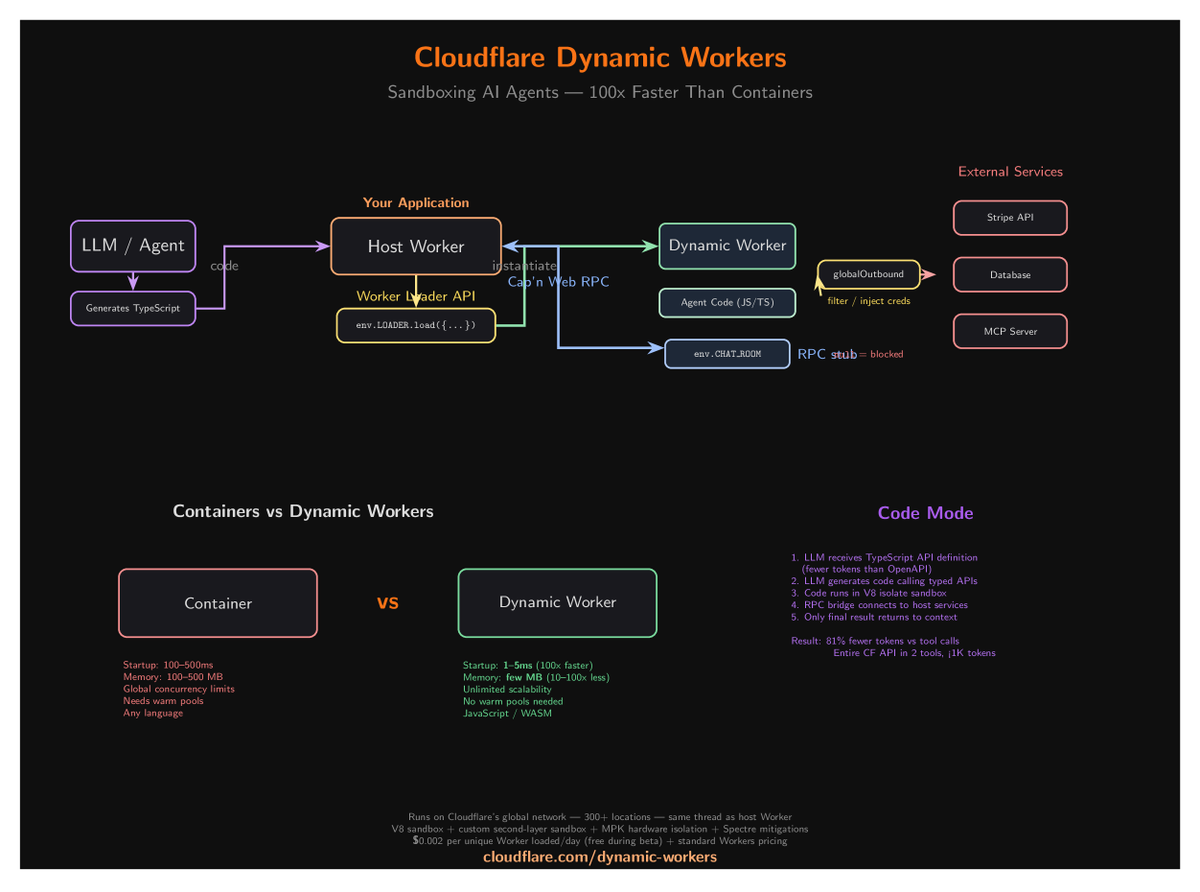
Cloudflare just dropped Dynamic Workers and it's a massive deal for AI agents. The problem: AI agents generate code. That code needs a sandbox. Containers take 100-500ms to boot and 100-500MB RAM. Dynamic Workers use V8 isolates instead: - Startup: 1-5ms (100x faster) - Memory: few MB (100x less) - No warm pools needed - Unlimited concurrency - Runs on same thread as host The killer feature: TypeScript API definitions replace OpenAPI specs. Fewer tokens, cleaner code, type-safe RPC across the sandbox boundary via Cap'n Web RPC. Code Mode: LLM writes TS code → runs in isolate → calls typed APIs → only final result returns to context. 81% fewer tokens vs sequential tool calls. $0.002 per Worker loaded/day. Free during beta. This is the serverless sandbox containers should have been.
Arvind tweet media
English
28
62
529
124.1K
Arvind
Arvind@TipsCsharp·
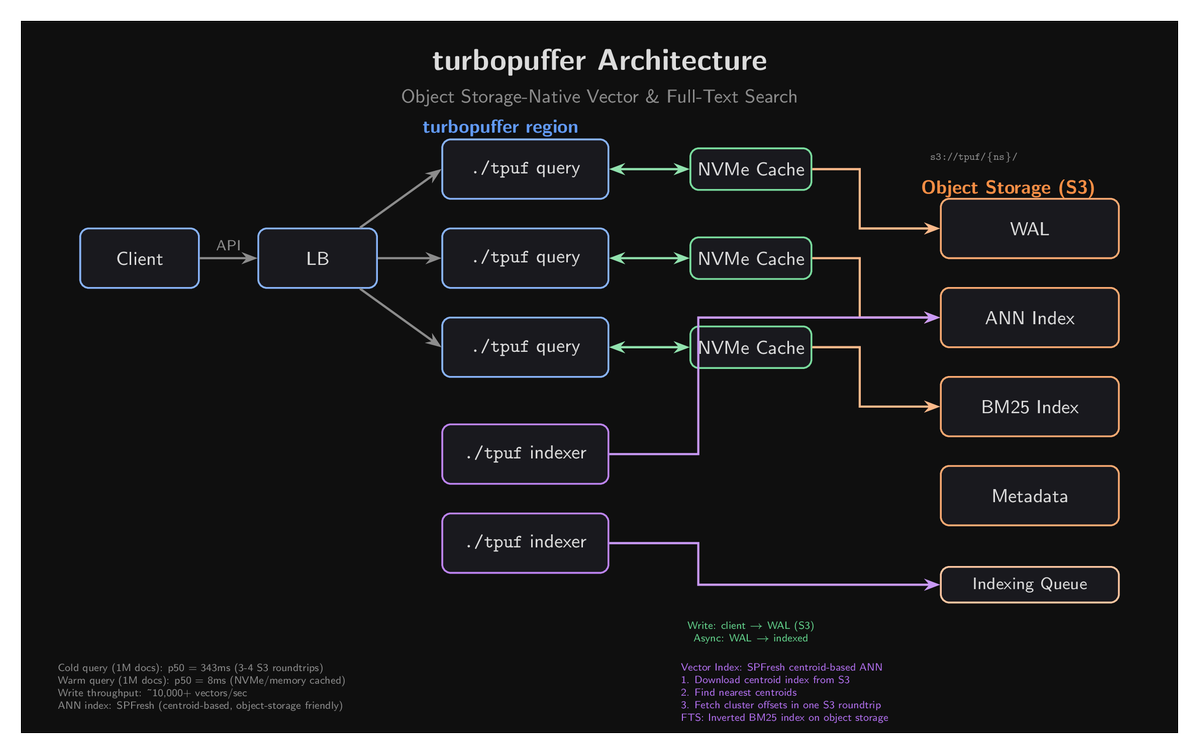
turbopuffer's architecture is brilliantly simple: object storage IS the database. The key insight: S3 as the source of truth, NVMe as a cache layer. Write path: Client → WAL on S3 → async indexing Query path: Cold: 3-4 S3 roundtrips (p50 = 343ms for 1M docs) Warm: NVMe cached (p50 = 8ms) ANN search uses SPFresh (centroid-based): 1. Download centroid index from S3 2. Find nearest centroids 3. Fetch cluster vectors in one S3 roundtrip No managed databases. No replicas to maintain. S3 handles durability + replication for free. This is what "serverless-native" actually means.
Arvind tweet media
English
0
0
1
111
Arvind
Arvind@TipsCsharp·
Google just dropped the Gemini Interactions API and it changes how you build with LLMs. What's different from generateContent: 1. Server-side state management — pass previous_interaction_id instead of resending entire chat history 2. Automatic tool orchestration — function calling with stateful context 3. Background execution — kick off Deep Research agent, poll for results 4. Unified multimodal I/O — text, image, audio, video, documents all in one interface 5. Built-in conversation memory — API remembers context, you just send new input The killer feature: stateful conversations. No more managing chat history arrays client-side. One ID chains the whole conversation. This is the API generateContent should have been from the start.
English
0
0
0
36
Arvind
Arvind@TipsCsharp·
The final lesson from building distributed systems for 10+ years: Simple systems fail in predictable ways. Complex systems fail in unpredictable ways. Every abstraction layer you add is another failure mode. Every dependency is another thing that can break at 3 AM. Build the simplest system that solves the problem. Add complexity only when the problem demands it. The best architecture is the one your team can understand, operate, and debug under pressure.
English
0
0
0
26
Arvind
Arvind@TipsCsharp·
The difference between a semaphore and a condition variable: Semaphore: "there are N resources available." Producers increment, consumers decrement. Condition variable: "wake me when something changes." Thread sleeps until signaled. Semaphore: bounded buffer (producer-consumer) Condition variable: any complex condition ("wake when queue is non-empty AND worker is idle") Condition variables are more flexible. Semaphores are simpler. Use semaphores for resource counting. Use condition variables for everything else.
English
0
0
0
16
Arvind
Arvind@TipsCsharp·
Why every distributed system needs a correlation ID: User clicks "buy" → API gateway → order service → payment service → inventory service → notification service. Something fails. Which request caused it? Correlation ID: generate UUID at the gateway. Pass it through every service. Include in every log. grep "abc-123-def" across all service logs → complete request trace. Without correlation IDs, debugging distributed systems is archaeology. With them, it's grep.
English
0
0
0
14
Arvind
Arvind@TipsCsharp·
The difference between vertical and horizontal pod autoscaling in K8s: HPA (Horizontal): adds more pods. Scale out. VPA (Vertical): gives existing pods more CPU/memory. Scale up. Use HPA when: your app is stateless and can run in parallel. Use VPA when: your app needs more resources per instance (database, ML inference). Don't use both on the same resource at the same time. They'll fight each other. HPA for web servers. VPA for databases. That's the general rule.
English
0
0
0
13
Arvind
Arvind@TipsCsharp·
How TCP keepalive detects dead connections: Default: after 2 HOURS of silence, send a probe. If no response: send 8 more probes, 75 seconds apart. Total detection time: 2 hours + 10 minutes. That's too slow for most applications. Tune: net.ipv4.tcp_keepalive_time = 60 (start probing after 60s) net.ipv4.tcp_keepalive_intvl = 10 (probe every 10s) net.ipv4.tcp_keepalive_probes = 6 (give up after 6) Detection time: 120 seconds. Much better.
English
0
0
0
15
Arvind
Arvind@TipsCsharp·
The art of graceful degradation in practice: Netflix can't reach its recommendation service: → Show trending instead of personalized. Users barely notice. Stripe can't reach fraud detection: → Queue the transaction, process later. Payment goes through. Twitter can't count likes in real-time: → Show stale count. Update in background. The key: identify which features are critical vs nice-to-have. Build fallbacks for nice-to-have. A slow page is better than an error page. Always.
English
0
0
0
17
Arvind
Arvind@TipsCsharp·
Why SSTable (Sorted String Table) is the foundation of LSM databases: An SSTable is an immutable, sorted file of key-value pairs. Properties: - Immutable (write once, never modify) - Sorted (binary search for any key) - Indexed (sparse index for fast lookup) LSM tree = multiple levels of SSTables + compaction. LevelDB, RocksDB, Cassandra, HBase all use SSTables. Immutability + sorting = simple, fast, crash-safe storage.
English
0
0
0
10