BitCluster

976 posts

BitCluster banner
BitCluster

BitCluster

@bit_cluster

Sustainable solutions for #bitcoinmining. Data centers network since 2017.

Moscow Se unió Haziran 2020
981 Siguiendo1.5K Seguidores
BitCluster
BitCluster@bit_cluster·
$14.16B in Bitcoin Options: How One Date Reshaped Market Volatility On March 27, Bitcoin options worth approximately $14.16 billion expired on Deribit—nearly 40% of the exchange’s total open interest. The concentration of positions around the $75k strike created a “magnet” effect for price: market makers intensified delta hedging, while spot BTC repeatedly tested the $67–70k range amid extreme market fear. Derivatives define liquidity and the volatility range, and large expirations increasingly act as standalone macro events for the crypto market. In this environment, mid-term strategies are shifting away from “buy and hold” toward active risk management around the options calendar and portfolio rebalancing

BitCluster tweet media
English
0
0
1
21
BitCluster
BitCluster@bit_cluster·
On March 21, the Bitcoin network experienced one of the largest difficulty drops of 2026 — a sharp 7.76% decrease to ~133.79T, with the average hashrate around 930–940 EH/s. This marks the second major decline this year following February’s −11.16%, bringing the metric to nearly 10% below the end of 2025 At the same time, BTC output per TH/s is increasing at the same level of computing power. We’re also observing a structural shift: large public miners are selling off reserves and reallocating infrastructure toward AI workloads, which reduces competition in mining
BitCluster tweet media
English
0
0
0
13
BitCluster
BitCluster@bit_cluster·
Scheduled maintenance on site: the on-duty team inspects racks with ASIC miners, checks configurations, connections, and temperature to keep the farm running smoothly with no downtime. This is the routine part of mining that usually stays off camera, yet it is exactly what ensures stable hashrate and readiness of the infrastructure for peak loads
English
0
0
0
25
BitCluster
BitCluster@bit_cluster·
Morning shift at the data center site. The team is checking the racks and the cooling system’s engineering units, monitoring the sensors and the steady supply of air. Off screen, the usual hum of the infrastructure and the smooth operation of the miners
English
0
1
1
37
BitCluster
BitCluster@bit_cluster·
💥Mining market forecasts According to a report by The Business Research Company, the global cryptocurrency mining equipment market is estimated at 5.1 billion USD in 2025 and is forecast to grow to 6.74 billion USD by 2030, with a compound annual growth rate of 5.6% The report notes that key growth drivers include demand for energy‑efficient solutions, the expansion of mining operations powered by renewable energy sources, and the increasing professionalization of mining operations. A separate 2026 market analysis indicates that the broader crypto mining segment is expected to continue attracting investment over the coming years, while major players are already reallocating part of their capacity to high‑performance computing and AI to increase data center utilization and diversify revenue streams
BitCluster tweet media
English
0
0
1
49
BitCluster
BitCluster@bit_cluster·
Happy International Women’s Day! Mining is not only about hardware — it’s about the people who keep the infrastructure, security, and quality of service running every day. At BitCluster, women work across various teams — from marketing to engineering and operations at our data center in Ethiopia Thank you for your professionalism, attention to detail, and calmness in situations where the industry often operates under “high voltage” — both literally and figuratively. Congratulations on March 8th! We wish you energy, growth, and results as reliable as a well-tuned infrastructure
BitCluster tweet media
English
0
0
1
26
BitCluster
BitCluster@bit_cluster·
Bitcoin’s Price Has Halved from Its Peak On the morning of February 24, Bitcoin (BTC) fell to around $62,700 — that’s 50% below its peak reached four months ago, when the price was about $126,000. This drop serves as a reminder that Bitcoin cannot rise endlessly: every rally eventually enters a phase of overheating and a painful correction In such moments, it makes sense to think ahead — not about an “eternal bull market,” but about the rules of the game: how to partially lock in profits near the highs and at what levels you’re ready to buy more on dips. The market doesn’t owe anyone a return to its peak, so strategies of partial exits and gradual re-entry at lower levels aren’t about greed — they’re about surviving the next −50% without illusions or panic.
BitCluster tweet media
English
0
0
1
55
BitCluster
BitCluster@bit_cluster·
Happy Valentine's Day 2026!
BitCluster tweet mediaBitCluster tweet mediaBitCluster tweet mediaBitCluster tweet media
English
0
0
1
49
BitCluster
BitCluster@bit_cluster·
Bitcoin is heading toward its largest mining difficulty decrease since the shocks of 2020–2022, when the network went through the COVID crisis, China’s hashrate migration, and energy disruptions Already in the first adjustment of 2026, difficulty dropped by about 2.6%, and analysts expect further downward corrections — the fifth consecutive decline and a potential double‑digit cumulative drop since the late‑2025 peak. The pressure comes from a wave of miner capitulations after a tough post-halving year, as well as a sharp hashrate decline caused by a winter storm in the U.S. that temporarily shut down a significant share of American mining capacity For the mining economy, this marks a “unit‑economics reset.” The falling difficulty increases the amount of BTC earned per unit of hashpower, partially offsetting the doubled scarcity after the 2024 halving — but it also makes the market increasingly binary: efficient operations with cheap, stable energy can reach acceptable ROI, while players with expensive electricity and outdated equipment are being forced out of the game
English
0
0
2
102
BitCluster
BitCluster@bit_cluster·
🌥️The video shows our data center in Ethiopia Here, a team of specialists works around the clock to ensure the stable, reliable, and uninterrupted operation of all infrastructure, equipment, and critical processes
English
0
1
3
139
BitCluster
BitCluster@bit_cluster·
⚡ Hashprice and the Real Profitability of Infrastructure Hashprice is the price of 1 TH/s per day — in other words, the number of dollars generated by one unit of a miner’s computing power. Unlike Bitcoin’s spot price, which is volatile and driven by the global market, hashprice reflects the actual mining profitability: it factors in BTC price, block reward, network difficulty, and pool fees As of early 2026, the hashprice remains around $0.038–$0.04 per TH/s per day (or roughly $38–$40 per PH/s). At the current difficulty level, this gives a miner with 1 TH/s a gross yield of about 0.00000043 BTC per day before electricity costs. Simply put, this is the miner’s “daily revenue” per terahash, expressed in dollars The BTC spot price still affects the hashprice: if you mine the same ~0.00000043 BTC per TH/s per day but Bitcoin’s value drops, your dollar-denominated income falls; if BTC rises, your income increases. However, as network difficulty grows, BTC output per TH/s decreases — which can offset price gains. That’s exactly what happened in 2025: despite a high BTC price, many miners were operating near break-even levels That’s why, for miners, the hashprice is the main KPI — it directly shows whether electricity and equipment depreciation are being paid off
BitCluster tweet media
English
0
0
1
95
BitCluster
BitCluster@bit_cluster·
The current Bitcoin network difficulty is 146,472,570,619,931, with about 1,034 blocks remaining until the next adjustment (roughly 7 days and 20 hours). The projected next difficulty is 139,149,957,609,670 (-5.00%) Essentially, this means the protocol sees the current network conditions as follows: with the present hashrate, blocks are being found slightly faster than the 10-minute target. As a result, the upcoming adjustment will ease computational conditions by those few percent. For miners, this has a direct effect — assuming BTC price and energy rates stay the same, profitability per 1 TH/s will increase by roughly 4–5% thanks to the lower difficulty On the infrastructure side, such movements don’t change strategic plans but expand the operational corridor for calculations. The cash flow model over the coming months can now be built not only around BTC price scenarios but also within a difficulty range — from the current 146 T down to the expected ~140 T. This provides a more realistic view of mine fleet ROI and helps plan upgrades and scaling strategies without relying on a single “ideal point” in network parameters
English
0
0
2
72
BitCluster
BitCluster@bit_cluster·
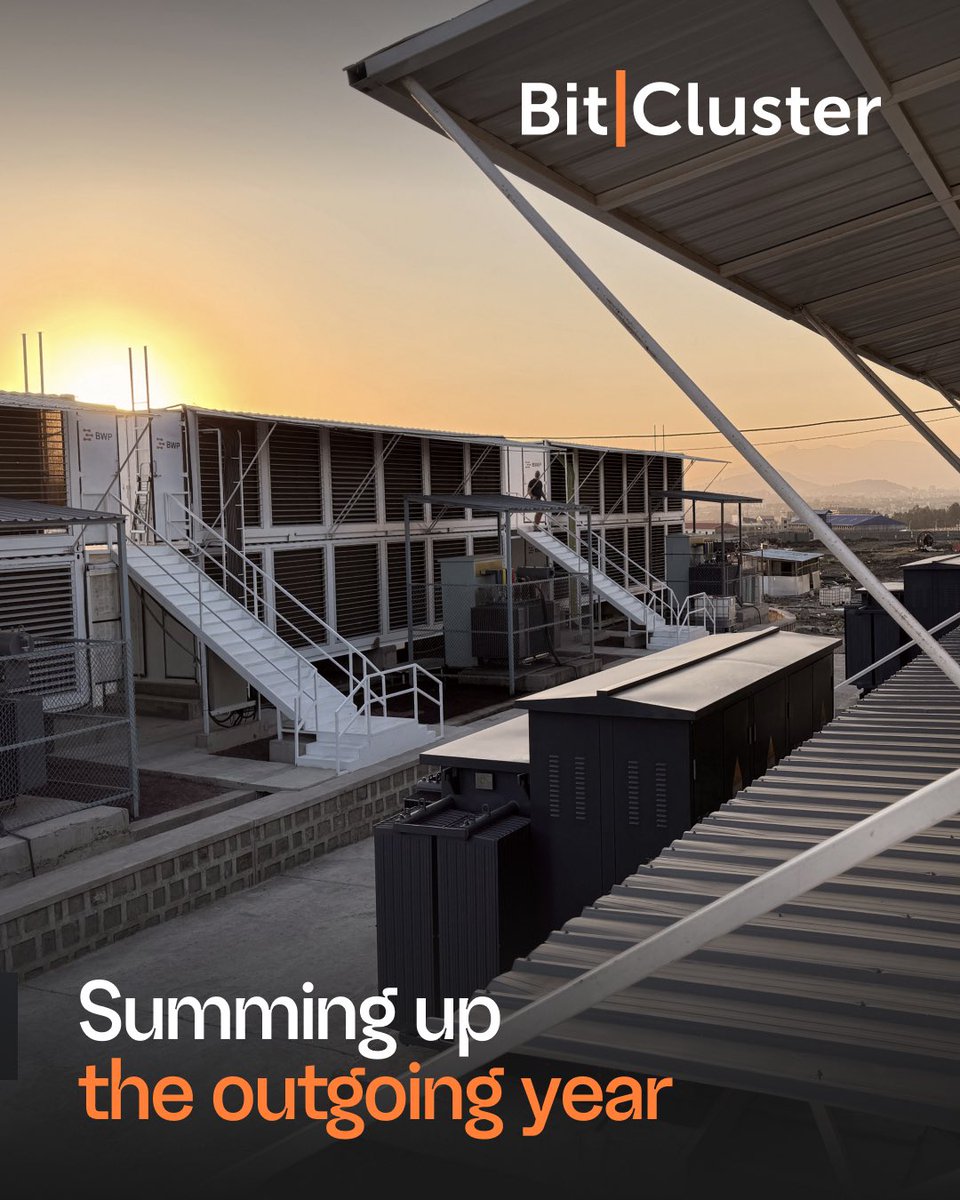
🔥 Summing up the outgoing year 🔸 +70 MW of new capacity commissioned 🔸 Thousands of new S21 and M60 devices successfully deployed and already generating hashrate 🔸 Opened a new service center 🔸 The total computing power of our data centers has exceeded 5 Exahash (EH/s)
BitCluster tweet media
English
0
0
2
55
BitCluster
BitCluster@bit_cluster·
🪙 How Much Is Bitcoin Really Worth? When you look at the #BTC chart, what you’re seeing is the fear and greed of millions of people. Today they’re eager to buy at $100K, and tomorrow they panic-sell at $70K. But behind those numbers lies a fundamental metric that’s often overlooked — the Cost of Production Every #Bitcoin represents millions of kilowatt-hours of energy and the depreciation of expensive equipment. That’s the price floor. Historically, whenever the market price drops close to the cost of mining, miners either stop selling their coins (why give away an asset for less than it cost to produce?) or shut down inefficient hardware, reducing supply Right now, the market is testing our resilience. Yes, volatility can be painful in the short term. But for miners with efficient hardware and low electricity costs, this is an accumulation phase. You’re acquiring an asset that takes immense global resources to produce — but you’re doing so at your own internal cost, not at the price tag the market dictates #Mining isn’t a game against the price — it’s a game for owning an asset whose emission is mathematically limited and becoming ever more expensive to obtain
BitCluster tweet media
English
0
0
2
57
BitCluster
BitCluster@bit_cluster·
🐋 Who’s selling Bitcoin right now? The main selling pressure is coming from the Short-Term Holders — addresses that have held their coins for less than 155 days. This is a classic panic reaction from newcomers who bought the asset at an emotional peak and are now locking in losses out of fear At the same time, Long-Term Holders and wallets holding more than 1,000 BTC continue to accumulate aggressively. Institutional players, including BlackRock’s ETF, are using this correction as an opportunity to buy the asset at a discount. While the retail investor hesitates, hoping to “re-enter lower,” their Bitcoin is being scooped up by funds with a ten-year investment horizon. Don’t hand your future to Wall Street for pennies 💡 Want to invest like an institutional? Start with BitCluster.com’s reliable infrastructure
BitCluster tweet media
English
0
0
2
80
BitCluster
BitCluster@bit_cluster·
⚡ Hashrate at an All-Time High There’s an old industry rule: “price follows hashrate.” If you’re looking for a fundamental signal of network strength, just look at its computing power. Despite the news noise, the hashrate confidently holds above 1.1 ZettaHash/s What do these numbers tell us? Large industrial players aren’t stopping the conveyor — on the contrary, gigawatts of new capacity are being brought online. This is a clear indicator that the industry is preparing for the next growth cycle by expanding its production base. However, for miners it’s important to understand that a record-high network hashrate is a double-edged sword: with every new megawatt added, competition for blocks increases, hashprice hits new lows, and each individual terahash earns fewer bitcoins In this environment, the key factor is no longer the absolute hashrate, but how you are connected to the network and which pool you use to monetize your power. The FPPS model used by leading pools distributes rewards not based on the “lucky/unlucky” block-finding principle, but on the number of submitted shares, tying payouts to current difficulty and the network’s theoretical revenue This smooths out statistical variance and makes daily cash flow more predictable — even during periods when difficulty sets new records and total monthly miner revenue drops to yearly lows If at some point part of the network starts shutting down equipment and difficulty goes down, those who continue stable mining without jumping their hashrate between pools will be in the strongest position: with the same power they will receive slightly more BTC per unit of hash, and reduced competition will partially offset pressure from price and fees In the long run, the winners are not those trying to “time the perfect moment,” but those who build a disciplined strategy: keep equipment running, periodically upgrade their fleet, rely on a transparent payout model, and treat the network not as a casino but as an industrial process 👉 If you share this approach to mining and value predictability, join our FPPS-model pool at pool.bitcluster.com
BitCluster tweet media
English
0
0
2
56
BitCluster
BitCluster@bit_cluster·
⚙️ The market is moving down. What does this actually mean for a miner? The main fear every beginner has sounds like this: “What happens if the price drops below the production cost and the network shuts down?” Let’s break down why this scenario is technically impossible thanks to Bitcoin’s brilliant self-regulating mechanism. The network’s economy works like a perfect balance scale. When the price falls to critical levels, miners with expensive electricity (for example, $0.08/kWh in the US) are forced to switch off to avoid operating at a loss. The network hashrate decreases, and the algorithm automatically lowers mining difficulty. For those who remain online, mining becomes significantly easier. Your BTC-denominated yield increases, offsetting the drop in the fiat price. Right now the market is in a unique position: prices for top-tier hardware have fallen alongside Bitcoin, creating a window of opportunity for smart capital. Investors have two rational paths — take advantage of lower equipment prices and increase hashrate if you’re already mining, or use the market correction to buy Bitcoin directly and build a long-term strategic position. Moments when the majority panic-sell and prices fall below fair value often become the starting point of a new cycle for those who can see further. While the market searches for equilibrium, the simplest decisions often turn out to be the most effective. And remember — the history of mining and Bitcoin itself has proven many times that volatility is where the best opportunities are born.
BitCluster tweet media
English
0
0
2
51
BitCluster
BitCluster@bit_cluster·
⚡️🇪🇹 Fresh footage from our data center in Ethiopia The weather is perfect right now: up to +21°C during the day, cloudy
BitCluster tweet mediaBitCluster tweet mediaBitCluster tweet mediaBitCluster tweet media
English
0
1
3
86
BitCluster
BitCluster@bit_cluster·
😁 This is Gentlemen! On this day in 2014, an overly enthusiastic Reddit user accidentally skipped one word — and in doing so, forever etched his name into the strange and amusing history of Bitcoin culture 👉 Join BitCluster.com
BitCluster tweet media
English
0
0
2
63
BitCluster
BitCluster@bit_cluster·
💰 If miners disappear — will Bitcoin disappear too? We often hear similar questions — especially from those who are just beginning to explore the industry: “What if the government shuts down #Bitcoin?” or “What if #mining becomes unprofitable after the halving?” These concerns are understandable, but they come from a misunderstanding of how a decentralized system actually works Bitcoin doesn’t belong to any company or government. It’s a network distributed across thousands of devices — data centers, nodes, and miners all over the world. To “turn off” Bitcoin, one would have to stop all of these machines at once — something that’s impossible both technically and organizationally If some miners shut down their operations, the Bitcoin network self-regulates. Mining difficulty decreases, making it profitable again for the remaining participants. This automatic adjustment keeps the network balanced, ensuring uninterrupted operation and blockchain stability When the last of the 21 million bitcoins is mined, miners will continue to earn transaction fees. This model is already built into the protocol: every transaction requires confirmations — and confirmations require miners’ work. The economic incentive remains, and the network continues to function Miners are not just equipment operators — they are the infrastructure backbone of the decentralized economy. Thanks to them, the network is secure, transactions are irreversible, and trust is replaced by mathematics 👉 BitCluster.com ensures the uninterrupted operation of mining data centers around the world — keeping decentralization not just an idea, but a reality
BitCluster tweet media
English
0
0
2
77