Tweet fijado
Roman Samoilov | Rage
63 posts

Roman Samoilov | Rage
@codewithrage
Building Rage - a modern Ruby runtime for non-blocking I/O, infrastructure simplicity, and long-term stability.
United Kingdom Se unió Ocak 2026
25 Siguiendo33 Seguidores

@SergioRocks Hey ChatGPT, can you share the recipe of an apple pie?
The constraints have moved, but not in the way you describe - the hard parts you outlined have always been the hard parts. It’s never been about the code.
English

Ticket-driven software development is slowly dying.
For years, the workflow looked like this:
- PM writes the ticket
- Engineer picks it up
- Engineer ships the code
Repeat.
That model made sense when writing code was the bottleneck. But it isn’t anymore.
AI tools can generate large chunks of implementation.
Scaffolding, tests, refactors, even entire features.
The constraint moved. The hard part is now:
- Choosing the right problem to tackle
- Structuring the system correctly
- Deciding what not to build
That is why engineers are increasingly expected to own outcomes, not tickets.
Instead of:
- “Implement this API endpoint.”
The work becomes:
- What problem are we actually solving?
- What’s the smallest thing we can ship that users will use?
- How do we know it worked once it’s live?
The engineers who adapt to this shift will thrive.
English

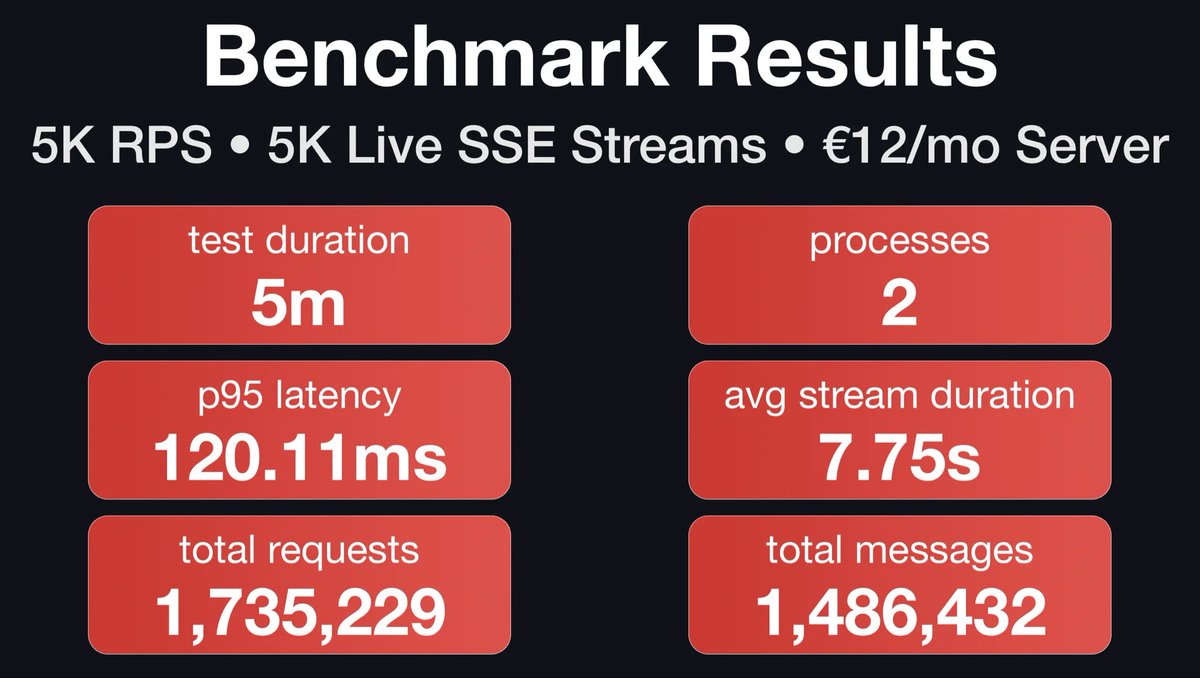
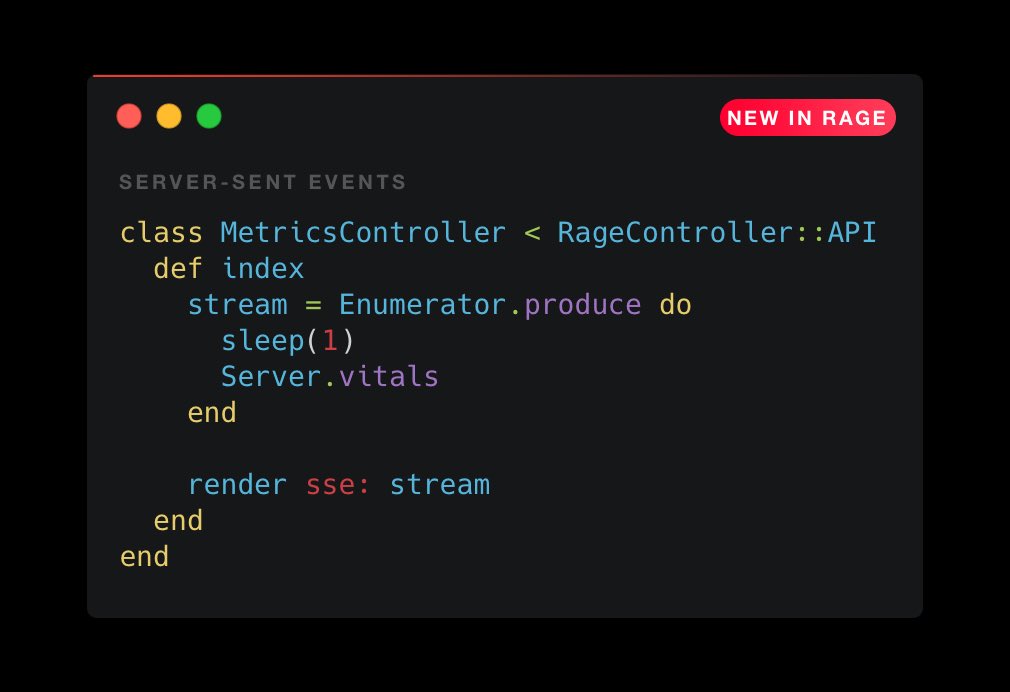
How much are you paying to handle 5K concurrent SSE streams + 5K HTTP DB requests in your Ruby app?
I just did it on a €12/mo server using Rage.
You don’t have to leave the Rails ecosystem to get Go-like performance.
Roman Samoilov | Rage@codewithrage
Rage just benchmarked: ✅ 5K active SSE streams ✅ 5K HTTP reqs/sec hitting the DB Simultaneously. In 2 processes. On the cheapest €12/mo Hetzner server. This is how Ruby can and should perform.
English

I’d argue it happens daily in large monoliths. The more complex the codebase, the faster the idea of figuring out what’s inside the variable by looking at its name crumbles. Retrofitting types is a massive, error-prone headache. Which is why most (non-Ruby) teams treat types like tests - embedded from day one.
English

@codewithrage @brian_scanlan This kind of thing happens once in 5 years
English

The best Rage features are driven by the community. Thank you @megatux for pushing this through!
English

Rage hit the #1 spot in Ruby Weekly last week!
But the hardest part hasn’t been the async I/O. It’s been trying to explain to my wife (who designed the logo) that this doesn’t actually make her famous…
Huge thanks to Peter Cooper and the community for the incredible support!
English

Background jobs shouldn’t require setting up a separate worker process and a message broker just to get started.
With Rage::Deferred, you get a zero-setup background processing system built straight into your web process.
• A write-ahead log ensures your jobs survive server restarts.
• Fibers allow jobs to run efficiently alongside your web requests.
We’re collapsing the stack so you can focus on writing Ruby, not managing infrastructure.
English

@5katkov I’ve been test-driving Codex for around a month, and I’m going back to Opus - Codex likes to overengineer quite a bit.
English

I was never fully satisfied with Opus, and been running multiple models in parallel.
But Codex became my primary coding companion. I canceled subscriptions for all other models.
Mitchell Hashimoto@mitchellh
I know this is pretty well established at this point, but Codex 5.3 is a much more effective model than Opus 4.6. I went back and forth on both for a bit, but haven’t touched Opus at all now for a full week. First model to get me off of Opus… ever. Good job Codex team.
English

@getplainai I’m not convinced it’s a tradeoff. Both humans and agents struggle in the same environments.
Good design is readable by anyone - human or machine.
English

@codewithrage Underrated insight. The real infra tradeoff for agent frameworks: do you optimize for developer ergonomics or agent comprehension? Most frameworks chose humans first. But agents need structured context, not clever DSLs. First frameworks to nail both win the next wave.
English

Is this how you currently work, or just the future you envision? Because in my bubble, the SDLC hasn’t changed much.
Design is still there - I’m the one suggesting ideas to an agent and iterating on its proposals. Review and testing aren’t going anywhere either - highly autonomous AI code means I’m reviewing tests more rigorously. Ultimately, management relies on people to be accountable, not AI.
How does this compare to your day-to-day at Cloudflare?
English

the software development lifecyle is dead
requirements → design → code → test → review → deploy → monitor
this loop is finished
I wrote down my thoughts
boristane.com/blog/the-softw…
English

Rage is officially part of Google Summer of Code 2026 as part of the Ruby org!
If you want to work on async runtimes, observability, and real backend infrastructure - explore project ideas and start shaping your proposal.
Let’s push Ruby forward.
#GSoC
github.com/rage-rb/rage/d…
English

@bradgessler @dorianmariecom Makes sense if the failure mode is deploy -> disconnect -> no app-level replay. Would love to see how you handle it.
English

@codewithrage @dorianmariecom The more practical concern for Rails devs re: thinking WebSockets are “enough reliability” is what happens during deployments.
During that time, WebSockets connections will reset and messages can get dropped.
For some apps it’s not a big deal, for others it’s a huge deal.
English