Cindy Sridharan

11.7K posts

Cindy Sridharan banner
Cindy Sridharan

Cindy Sridharan

@copyconstruct

San Francisco, CA Se unió Temmuz 2010
161 Siguiendo45.7K Seguidores
Cindy Sridharan
Cindy Sridharan@copyconstruct·
Asked Claude to debug an easily repro-able bug; it spent 2h suggesting increasingly preposterous “root causes”. Went old-fashioned, attached a debugger, and 5 mins later after some careful inspection of state, knew the problem, which was a far cry from anything Claude suggested.
English
30
9
396
23.8K
Cindy Sridharan
Cindy Sridharan@copyconstruct·
Went out to touch grass, but alas if you live in or around downtown San Francisco, there’s no escaping any discussion of AI, GPUs, agents etc, in public places. 😒 Maybe will try Marin or Sausalito the next time. At least the nosh (Gochujang Pimento Cheese Twist) was superb.
Cindy Sridharan tweet media
English
4
0
28
2.9K
Cindy Sridharan
Cindy Sridharan@copyconstruct·
Pre AI, people wrote poor commit messages, but you could still read a bunch of them and generally know what people were trying to do. AI writes commits so verbose I’m in the “I ain’t reading all that. I’m happy for you tho, or sorry that happened” territory. “More” ≠ “better”
English
7
9
115
4.5K
Cindy Sridharan
Cindy Sridharan@copyconstruct·
If you believe “humans should deeply understand what they’re building with AI”, it follows that AI generated code should be optimized for “human cognition” Yet, often AI written code is actively hostile to this goal, and worse, a ton of “best practices” encourage this hostility.
English
13
5
80
5.6K
Cindy Sridharan
Cindy Sridharan@copyconstruct·
It’s funny to think Elon made just a huge deal out of bots when he was trying to acquire Twitter. Only for X to be overrun with AI bots on a scale never seen on ye olde Twitter. You’d think xAI would be adept at pruning the bots on its own platform, but clearly not.
English
5
1
32
3.2K
Cindy Sridharan
Cindy Sridharan@copyconstruct·
All the vibecoding startups: AI will write all the code and put most devs out of a job. AI *infra* startups: record growth, our customers are vibecoding/AI startups who use our compute platform, databases etc. 😅 Even the vibecoding companies aren’t vibecoding their own infra.
Gergely Orosz@GergelyOrosz

So damn excited to share that @turbopuffer is a season sponsor of The Pragmatic Engineer Podcast! I first heard of them when talking to the Cursor team about how they scaled up their production systems last year. They told me about this incredible DB that scaled with their massive load, while also reducing their bill by 95% called turbopuffer... where they (Cursor) was the first-ever customer (!!) It seemed almost too good to be true. So, of course, I had to meet cofounder @Sirupsen to figure out how they did it. The BIG idea behind turbopuffer is that they built it on object storage - something that few to no startups did before turbopuffer, even though it's very clever. And added wicked smart optimizations, like smart caching on NVMe SSDs. They now have companies like Anthropic, Notion, Linear, Ramp and others using them. Oh, they just crossed $100M ARR... with less than $1M in venture capital raised (!!) All from Canada. I'll bring more details on all the wicked cool stuff they do, now that I'll work a lot closer with them. Love the team. Puff puff!!

English
1
4
44
8.3K
Cindy Sridharan
Cindy Sridharan@copyconstruct·
Many of the old skills I learned the hard way are not … relevant anymore (eg, manually git rebasing). Agents are generally more methodical and faster than I was, and I used to think I was good. In time, ‘git’ itself will become a niche skill of a bygone era of software dev. 😞
English
8
1
94
6.9K
Cindy Sridharan
Cindy Sridharan@copyconstruct·
Bearish on companies that (citing AI driven “productivity”) - refuses to hire juniors - thinks the “engineering management” function can be obviated - requires non-engineers to submit production code *on principle* All this when existing ICs aren’t even properly vetting AI slop
English
6
5
76
4.9K
Cindy Sridharan
Cindy Sridharan@copyconstruct·
@vaastav05 One a regression, which was quite subtle. Another broke a critical functionality, which didn’t have end-to-end testing. Unit tests didn’t exercise codepaths that only activate given a specific matrix of inputs + configs. Oh, a test harness was testing the wrong version of code
English
1
0
6
1K
Vaastav Anand
Vaastav Anand@vaastav05·
@copyconstruct Out of curiosity, were these bugs regression bugs or end-to-end bugs in new functionality? And were they not caught because there were no tests for testing that functionality?
English
1
0
0
1K
Cindy Sridharan
Cindy Sridharan@copyconstruct·
Might be anecdotal, but just this week multiple AI generated PRs with subtle bugs got merged that required several additional days and a lot of manual verification to fix. “Velocity” isn’t going up when you consider how much effort was spent fixing things post-merge, pre-deploy.
English
9
20
161
19K
Cindy Sridharan
Cindy Sridharan@copyconstruct·
@SeanTAllen Indeed! It was always my preferred form of testing, even if I felt very much like being in the minority. Not for much longer.
English
1
0
8
4.1K
Cindy Sridharan
Cindy Sridharan@copyconstruct·
end-to-end testing > unit tests, in the vibecoding era. A massive, almost entirely agent-coded refactor passed all unit and pre-merge tests but broke a critical feature. It was only caught due to my own excessive paranoia making me run end-to-end tests before the prod deploy.
English
29
29
381
125.7K
Cindy Sridharan
Cindy Sridharan@copyconstruct·
@VicVijayakumar Unless one is genuinely interested in building crypto products or fully buys into the “mission”, don’t get why anyone would want to work for coinbase. 🤷‍♀️ For the past several years, they’ve been doing layoffs, rescinding offers, etc. there are far more stable “mid sided” orgs.
English
0
0
9
2.1K
Vic 🌮
Vic 🌮@VicVijayakumar·
Coinbase has laid off 14% of the company because crypto is volatile (unprecedented)
Brian Armstrong@brian_armstrong

This is an email I sent earlier today to all employees at Coinbase: Team, Today I’ve made the difficult decision to reduce the size of Coinbase by ~14%. I want to walk you through why we're doing this now, what it means for those affected, and how this positions us for the future. Why now Two forces are converging at the same time. We need to be front footed to respond to both. First, the market. Coinbase is well-capitalized, has diversified revenue streams, and is well-positioned to weather any storm. Crypto is also on the verge of the next wave of adoption, with stablecoins, prediction markets, tokenization, and more taking off. However, our business is still volatile from quarter to quarter. While we've managed through that cyclicality many times before and come out stronger on the other side, we’re currently in a down market and need to adjust our cost structure now so that we emerge from this period leaner, faster, and more efficient for our next phase of growth. Second, AI is changing how we work. Over the past year, I’ve watched engineers use AI to ship in days what used to take a team weeks. Non-technical teams are now shipping production code and many of our workflows are being automated. The pace of what's possible with a small, focused team has changed dramatically, and it's accelerating every day. All of this has led us to an inflection point, not just for Coinbase, but for every company. The biggest risk now is not taking action. We are adjusting early and deliberately to rebuild Coinbase to be lean, fast, and AI-native. We need to return to the speed and focus of our startup founding, with AI at our core. What this means To get there, we are not just reducing headcount and cutting costs, we’re fundamentally changing how we operate: rebuilding Coinbase as an intelligence, with humans around the edge aligning it. What does this mean in practice? - Fewer layers, faster decisions: We are flattening our org structure to 5 layers max below CEO/COO. Layers slow things down and create coordination tax. The future is small, high context teams that can move quickly. Leaders will own much more, with as many as 15+ direct reports. Fewer layers also means a leaner cost structure that is built to perform through all market cycles. - No pure managers: Every leader at Coinbase must also be a strong and active individual contributor. Managers should be like player-coaches, getting their hands dirty alongside their teams. - AI-native pods: We’ll be concentrating around AI-native talent who can manage fleets of agents to drive outsized impact. We’ll also be experimenting with reduced pod sizes, including “one person teams” with engineers, designers, and product managers all in one role. In short: AI is bringing a profound shift in how companies operate, and we’re reshaping Coinbase to lead in this new era. This is a new way of working, and we need to leverage AI across every facet of our jobs. To those who are affected I know there are real people behind these decisions — talented colleagues who have poured themselves into this company and our mission. To those of you who will be leaving: thank you. You’ve helped build Coinbase into what it is today, and I am sincerely grateful for everything you've done. All impacted team members will receive an email to their personal account in the next hour with more information, and an invitation to meet with an HRBP and a senior leader in your organization. Coinbase system access has been removed today. I know this feels sudden and harsh, but it is the only responsible choice given our duty to protect customer information. To those affected, we will be providing a comprehensive package to support you through this transition. US employees will receive a minimum of 16 weeks base pay (plus 2 weeks per year worked), their next equity vest, and 6 months of COBRA. Employees on a work visa will get extra transition support. Those outside of the US will receive similar support, based on local factors and subject to any consultation requirements. Coinbase prides itself on talent density. Our employees are among the most talented people in the world, and I have no doubt that your skills and experience will be highly sought after as you pursue your next chapters. How we move forward To the team that is staying, I know this is a difficult day. We’re saying goodbye to colleagues and friends you've been in the trenches with. But here’s what I want you to know as we move forward together: Over the past 13 years, we have weathered four crypto winters, gone public, and built the most trusted platform in our industry. We’ve made it this far by making hard decisions and by always staying focused on our mission. This time will be no different – nothing has changed about the long term outlook of our company or industry. And most importantly, our mission has never been more important for the world. Increasing economic freedom requires a new financial system, and we’re building it. The Coinbase that emerges from this will be more capable than ever to achieve our mission. Brian

English
8
1
84
7.3K
Cindy Sridharan
Cindy Sridharan@copyconstruct·
@jdub TIL. What’s the whole point of a “Following” feed if that’s going to be polluted with bullshit. And it’s not even popular content I’d care about, but just garbage. 🤮
English
0
0
0
96
Jeff Waugh
Jeff Waugh@jdub·
@copyconstruct “Following” has two modes, so now the dipshit’s site conveniently forgets our preference and keeps flipping back to “For you” AND “Popular”.
English
1
0
1
155
Cindy Sridharan
Cindy Sridharan@copyconstruct·
Code generation becoming super fast and cheap is going to spell the slow death of libraries. Old, established ones (like Python requests or Rust tokio) will be still be around, but it’s unlikely to see new ones (unless super niche) establish themselves.
English
15
0
53
8.8K
Cindy Sridharan
Cindy Sridharan@copyconstruct·
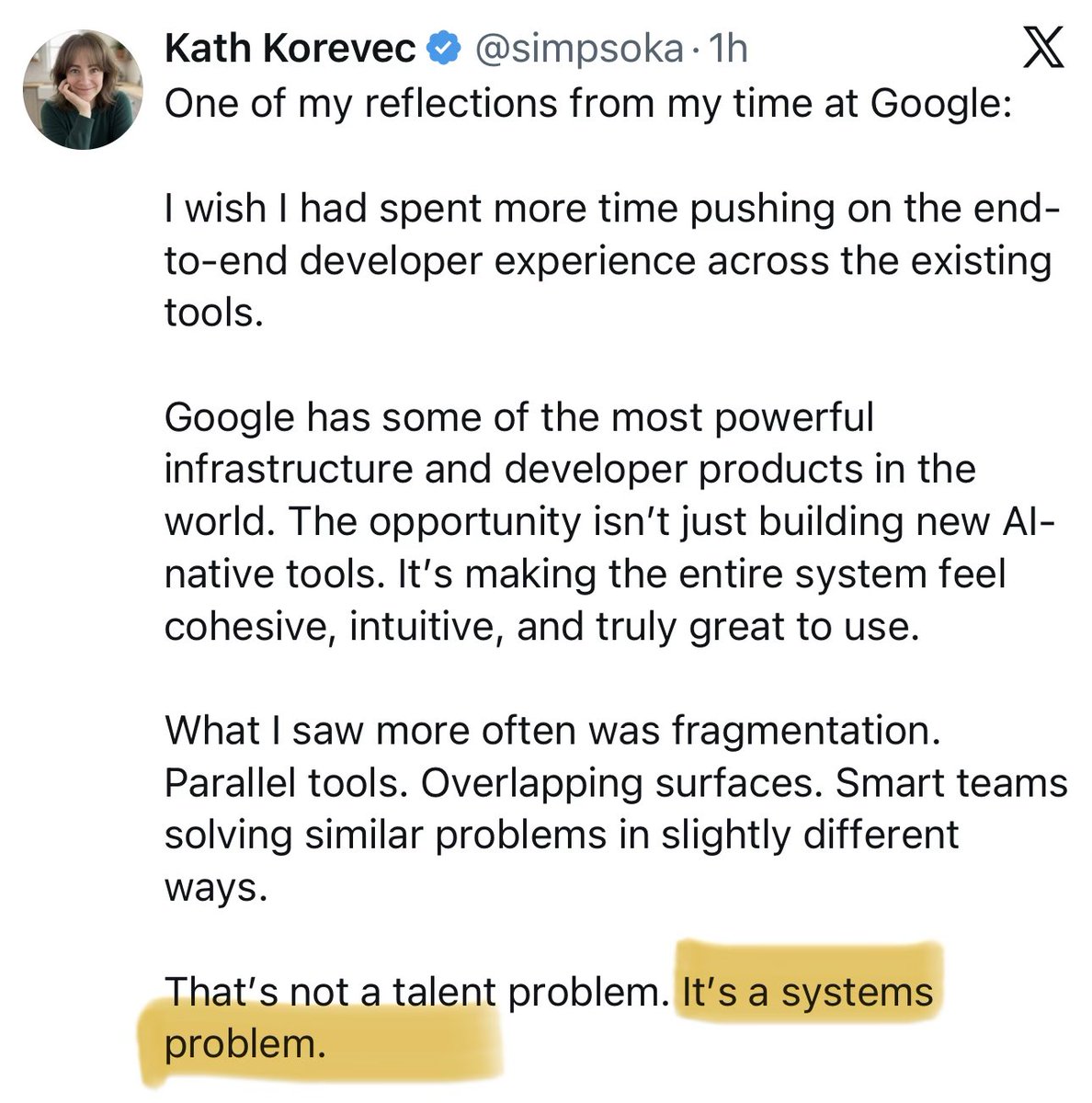
Sure, you can put processes in place to build more cohesive things across orgs, but that will lead to a bunch of people whining about “bureaucracy” and how Google moves slowly. There’s no winning here. Ultimately, having individual DRIs act as BDFL’s might be the only solution.
English
3
0
12
2.3K
Cindy Sridharan
Cindy Sridharan@copyconstruct·
It’s a “people problem”, the oldest problem in the industry, not just a Google problem. The cost of generating code going to zero *incentivizes* teams to unblock themselves ASAP, rather than dealing with the friction of coming up with cohesive, holistic, “cross-team” solutions.
Cindy Sridharan tweet media
English
10
6
77
6.6K