David Zaldumbide 🚀

23K posts

David Zaldumbide 🚀 banner
David Zaldumbide 🚀

David Zaldumbide 🚀

@davidavidu

🏛PhD(c) UCAB Msc @jcu 🇦🇺 Mkt @ESPEU lecturer&researcher 📰 🤖 #AI | Innovation travel&tourism🏖 entrepreneur | ❗@ABREC_ec❗

Latinoamérica Se unió Ocak 2010
5.1K Siguiendo4.4K Seguidores
Tweet fijado
David Zaldumbide 🚀
David Zaldumbide 🚀@davidavidu·
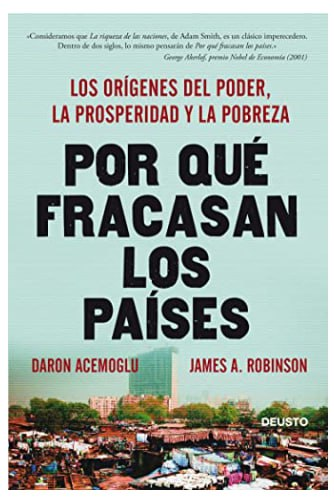
Este libro debería ser de lectura obligatoria para todas las carrera conseguí una copia digital y si lo deseas comenta este post para enviártelo 🫡🧠
David Zaldumbide 🚀 tweet media
Español
831
211
938
115.9K
David Zaldumbide 🚀
David Zaldumbide 🚀@davidavidu·
¿Sientes que no eres lo suficientemente bueno? ¿Te cuesta dormir pensando que todo puede salir mal? ¿Te sientes solo, incluso rodeado de gente? No es solo tu caso. 📊 Un estudio lo revela
Español
1
0
0
14
David Zaldumbide 🚀
David Zaldumbide 🚀@davidavidu·
🔥 “Nadie te lo dice antes de empezar un #PhD…” 📊 Un estudio reciente revela que: -45% de los doctorandos presentan síntomas de depresión moderada a severa -39% sufren ansiedad significativa -1 de cada 3 está en riesgo de suicidio Y no, no es porque “no aguanten la presión”
David Zaldumbide 🚀 tweet media
Español
1
0
0
54
David Zaldumbide 🚀
David Zaldumbide 🚀@davidavidu·
La ciudadanía dividida pierde poder de negociación colectiva. Y una frase que resume todo: “Cuando la sociedad se divide en bandos, el poder no necesita imponerse: le basta con esperar
Español
0
0
0
6
Diógenes Tejero Franco
Diógenes Tejero Franco@youssufsabaly·
@davidavidu Hombre el acabó alcohólico perdido y encocado hasta las cejas, no se si es un buen ejemplo de autocontrol
Español
1
0
0
2
David Zaldumbide 🚀 retuiteado
Elias Al
Elias Al@iam_elias1·
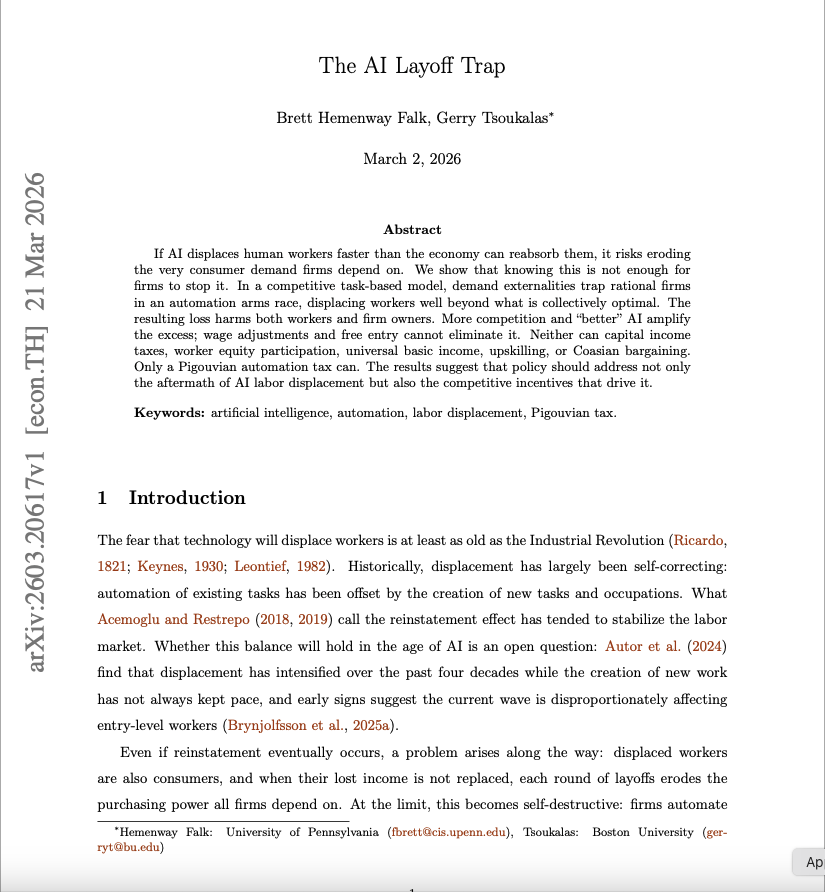
Two economists just published a mathematical proof that AI will destroy the economy. Not might. Not could. Will — if nothing changes. The paper is called "The AI Layoff Trap." Published March 2, 2026. Wharton School, University of Pennsylvania. Boston University. Peer reviewed. Mathematically modeled. The conclusion is one sentence. "At the limit, firms automate their way to boundless productivity and zero demand." An economy that produces everything. And sells it to nobody. Here is how you get there. A company fires 500 workers and replaces them with AI. A competitor fires 700 to keep up. Another fires 1,000. Every company is behaving rationally. Every company is following the incentives correctly. And every company is building a trap for itself. Because the workers who were fired were also customers. When they lose their jobs faster than the economy can absorb them, they stop spending. Consumer demand falls. Companies respond by cutting costs — which means automating more workers — which means less spending — which means more falling demand — which means more automation. The loop has no natural exit. The researchers tested every proposed solution. Universal basic income. Capital income taxes. Worker equity participation. Upskilling programs. Corporate coordination agreements. Every single one failed in the model. The only intervention that worked: a Pigouvian automation tax — a per-task levy charged every time a company replaces a human with AI, forcing them to price in the demand they are destroying before they pull the trigger. No government has implemented this. No major economy is seriously discussing it. Meanwhile the numbers are already tracking the curve. 100,000 tech workers laid off in 2025. 92,000 more in the first months of 2026. Jack Dorsey fired half of Block's workforce and said publicly: "Within the next year, the majority of companies will reach the same conclusion." Nobody is doing anything wrong. Companies are following their incentives perfectly. That is exactly the problem. Rational behavior. At scale. Simultaneously. With no mechanism to stop it. Two economists built the math. The math leads to one place. Source: Falk & Tsoukalas · Wharton School + Boston University · arxiv.org/pdf/2603.20617
Elias Al tweet media
English
1K
3.6K
9.1K
1.1M
David Zaldumbide 🚀 retuiteado
Informal Economy
Informal Economy@EconomyInformal·
Self-Employment Rate Colombia🇨🇴: 45.8 Mexico🇲🇽: 30.8 Greece🇬🇷: 30.7 Türkiye🇹🇷: 28.8 CR🇨🇷: 25.8 Chile🇨🇱: 23.8 Korea🇰🇷: 22.9 Italy🇮🇹: 21.2 Poland🇵🇱: 19 NZ🇳🇿: 18.6 Spain🇪🇸: 14.8 France🇫🇷: 13.3 Japan🇯🇵: 9.2 Australia🇦🇺: 8.5 Germany🇩🇪: 8.3 Denmark🇩🇰: 8 Canada🇨🇦: 6.7 US🇺🇸: 6.2 @OECD
Informal Economy tweet media
Română
8
64
117
5.7K
David Zaldumbide 🚀 retuiteado
Stevie Gamboa Valladares 🇪🇨
El @nytimesworld ha publicado una investigación que evidencia la facilidad con la que estructuras criminales extraen, procesan y comercializan oro de origen ilícito, incluso ingresando al mercado de EE. UU. como si fuese de procedencia local. El reportaje expone debilidades en los sistemas de control estatal, efectos adversos de ciertas prohibiciones de carácter proteccionista y vacíos institucionales que terminan favoreciendo la ilegalidad. Aunque el caso analizado corresponde a Colombia, se trata de una dinámica que se replica en Ecuador y varios países de la región.
Español
2
42
52
2.8K
David Zaldumbide 🚀
David Zaldumbide 🚀@davidavidu·
Mariana Mazzucato: “Los años de hegemonía de Estados Unidos han terminado, estamos viendo el final del Imperio Romano”
David Zaldumbide 🚀 tweet media
Español
1
0
0
44