Planetary Society

21.5K posts

Planetary Society banner
Planetary Society

Planetary Society

@exploreplanets

Find your place in space. Become a member today at https://t.co/DNYphy7mtd

Pasadena, CA Se unió Eylül 2010
857 Siguiendo242.2K Seguidores
Planetary Society
Planetary Society@exploreplanets·
We've only visited a handful of comets — and every single one has surprised us. Here's what we've learned so far. Read the full story in our March issue of The Planetary Report: planetary.org/articles/messe…
English
0
15
43
2.2K
Planetary Society retuiteado
NASA History Office
NASA History Office@NASAhistory·
A 2.5-second rocket flight that heralded decades of discovery in space! Today marks 100 years since the first successful test of a liquid-fueled rocket. Robert H. Goddard's achievement would have appeared unimpressive by most measures: His rocket flew just 41 feet in the air, landing in a nearby cabbage patch. Liquid-propelled rocketry has been the backbone of spaceflight ever since. 📷 by Esther Goddard on March 16, 1926 (Clark University Archive)
NASA History Office tweet media
English
181
1.3K
6.7K
610K
Planetary Society
Planetary Society@exploreplanets·
The definition of "planet" has changed more times than you'd think — and Pluto wasn't the first to get cut. Read the full story in our March issue of The Planetary Report. ⬇️ planetary.org/articles/how-d…
English
2
12
37
2.7K
Planetary Society
Planetary Society@exploreplanets·
Gentry Lee spent nearly 50 years at @NASAJPL helping lead some of the most ambitious missions in space exploration. The documentary “Starman” traces his career—and the question that drove it: Is there life beyond Earth? Lee worked on every NASA mission that landed on Mars, helped Carl Sagan bring the Universe to TV with “Cosmos,” and later served as Chief Engineer for JPL’s Solar System Exploration Directorate. Listen as Sarah Al-Ahmed sits down with Lee at The Planetary Society headquarters on Planetary Radio. 🎙️ planetary.org/planetary-radi…
Planetary Society tweet mediaPlanetary Society tweet media
English
3
21
99
3.8K
Planetary Society
Planetary Society@exploreplanets·
🚨 URGENT 🚨 Most people don't know this process exists. Did you know every year, Congress opens a window for constituents to submit formal NASA funding requests — before appropriations decisions are made? We built a tool to make those funding requests easy, but many offices require submissions by end of business this Friday, March 6th. You have about 24 hours. Find your rep, check if they have a form, fill it out — done. 👉  Try it: dashboards.planetary.org/appropriations…
English
1
9
19
2.4K
Planetary Society
Planetary Society@exploreplanets·
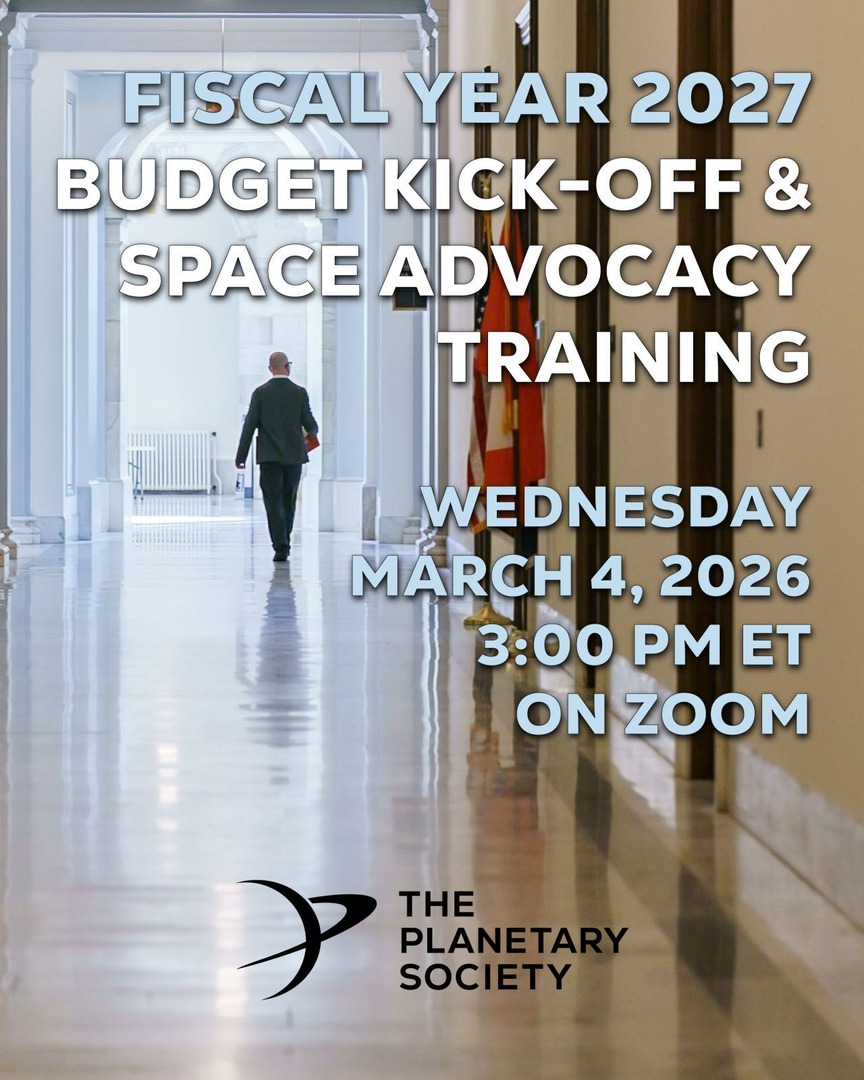
Can everyday people actually influence NASA's federal budget? Yes — and here's how. Join The Planetary Society's Space Policy and Advocacy team this Wednesday, March 4th at 3:00 PM ET for a free Zoom webinar covering: ➡️ How the annual appropriations process works. ➡️ What we know so far about the upcoming President's Budget Request ➡️ Concrete steps YOU can take to make your voice heard Space exploration is funded by public dollars, and Congress listens when constituents speak up. Register: us06web.zoom.us/webinar/regist…
Planetary Society tweet media
English
0
6
20
2K
Planetary Society
Planetary Society@exploreplanets·
Is a planetary parade the same thing as a planetary alignment? Here’s what those terms actually mean and why planets appear to line up in our sky. planetary.org/articles/what-…
English
1
8
25
2.2K
Planetary Society
Planetary Society@exploreplanets·
🚨 New image released of the center of the Milky Way galaxy. This stunning view was captured by the Atacama Large Millimeter/submillimeter Array (ALMA), a powerful network of radio telescopes in Chile. What you’re seeing is the crowded, chaotic heart of our galaxy, a region packed with cold gas and dust, the raw material that forms new stars. The image maps an area called the Central Molecular Zone, stretching more than 650 light-years across. This is the largest image ALMA has ever created. Why this matters: ➡️ This area surrounds the supermassive black hole at the center of the Milky Way. ➡️ It contains some of the most extreme environments in our galaxy. ➡️ It lets scientists study how stars are born under intense conditions. Because the Milky Way’s center is relatively close to Earth, it’s the only galactic core we can study in this level of detail. By understanding how stars form here, astronomers can learn how galaxies grow and evolve across the Universe. 📸: ALMA(ESO/NAOJ/NRAO)/S. Longmore et al. Background: ESO/D. Minniti et al.
Planetary Society tweet media
English
5
55
189
6.1K
Planetary Society
Planetary Society@exploreplanets·
In 1980, Carl Sagan had a simple idea: that ordinary people (not just governments or scientists) should have a say in humanity's future in space. So he helped found The Planetary Society along with Bruce Murray and Louis Friedman. Today, more than 45 years later, our members are the reason we can advocate for bold space exploration, fund cutting-edge science, and make sure the public's voice is heard in the halls of Congress. If you believe space exploration matters, there's a place for you here. We're just a few members away from hitting our goal — and we have until February 28 to get there. Join us at planetary.org 📸: From left to right: Bruce Murray, Carl Sagan, and Louis Friedman discuss The Planetary Society at the very desk that still sits in our headquarters today.
Planetary Society tweet media
English
3
27
108
5.6K
Planetary Society
Planetary Society@exploreplanets·
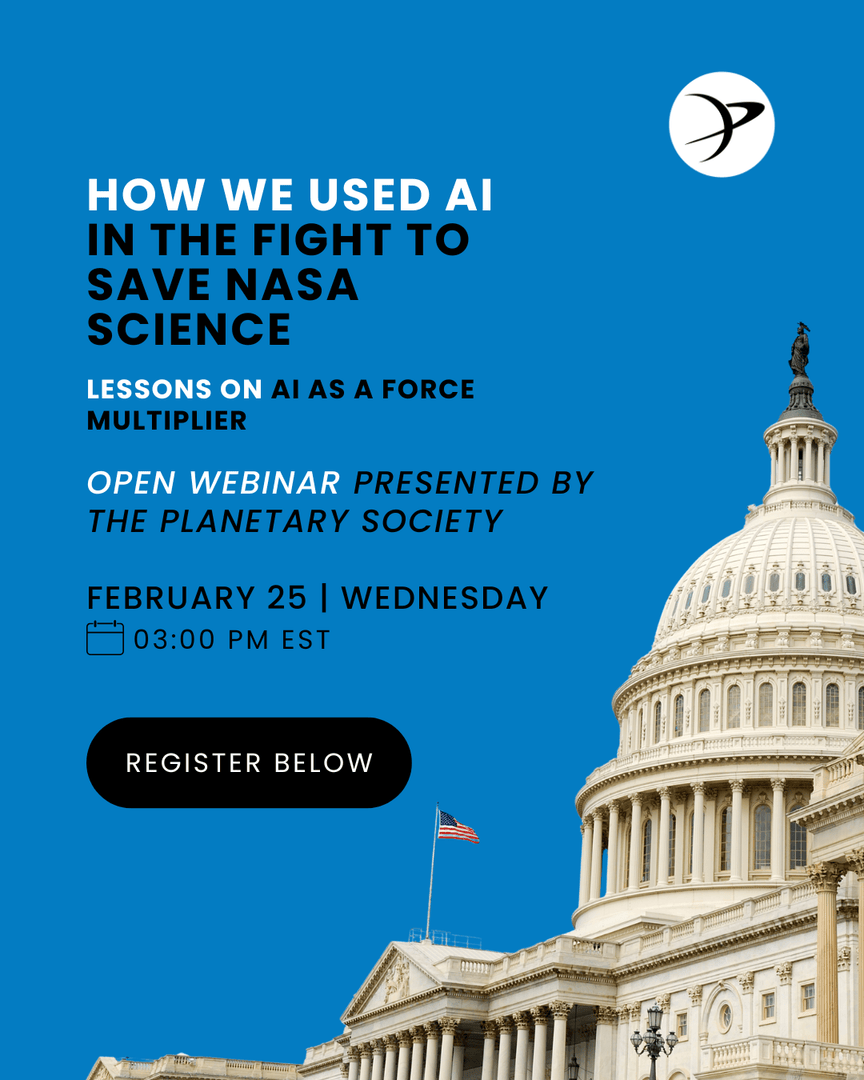
AI didn’t save NASA Science, but it did help our two-person policy team fight like one twice its size. In 2025, AI helped The Planetary Society’s advocacy team scale research, analysis, writing, and communications during the fight to Save NASA Science, performing on par with far larger teams at a fraction of the cost. Join us for this free webinar to learn how AI was used as a force multiplier for advocacy work. ➡️ 1-hour webinar + live Q&A with Casey Dreier & Jack Kiraly. Register: us06web.zoom.us/webinar/regist…
Planetary Society tweet media
English
1
3
10
1.8K
Planetary Society
Planetary Society@exploreplanets·
Meet our new CEO Jenn Vaughn.👏  This week on Planetary Radio, host Sarah Al-Ahmed sits down with outgoing CEO Bill Nye and incoming CEO Jennifer Vaughn — formerly the COO — for a candid conversation about The Planetary Society's long-planned leadership transition. planetary.org/planetary-radi…
Planetary Society tweet media
English
2
4
43
2.8K
Planetary Society
Planetary Society@exploreplanets·
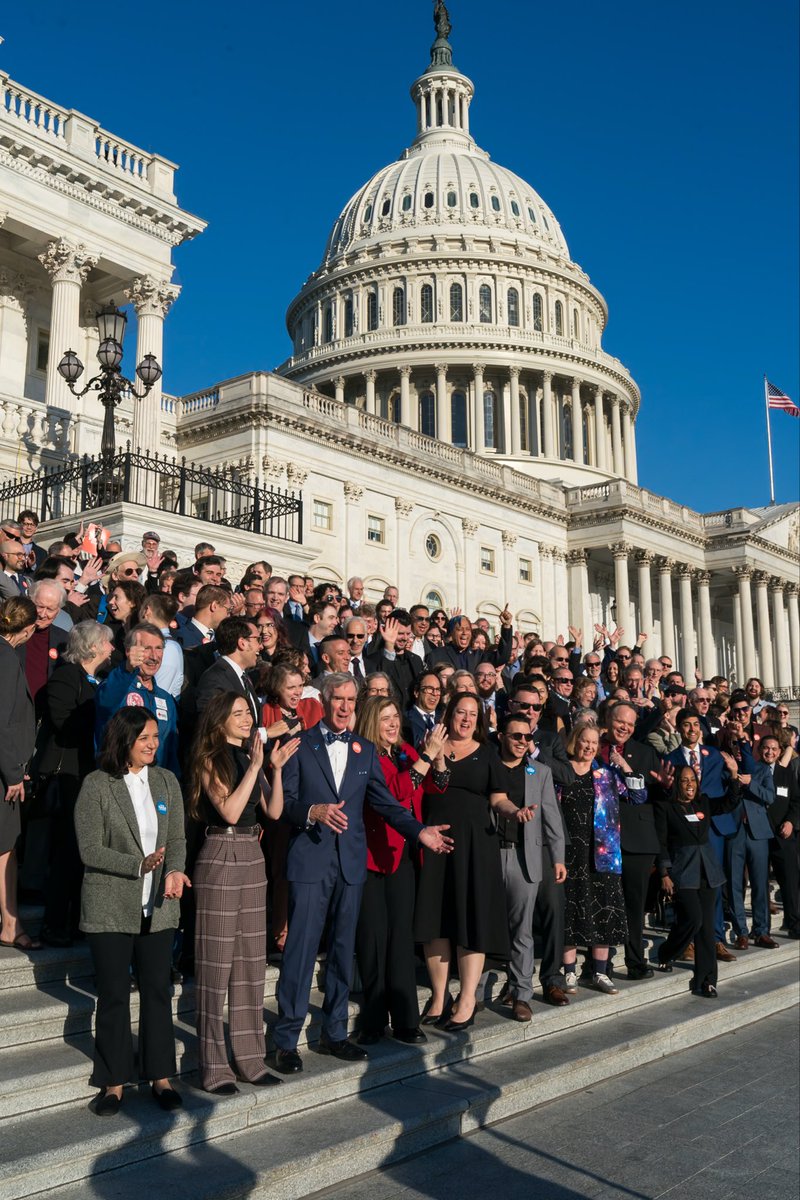
Last year, you helped save NASA science. Now, the next budget cycle is beginning — and like every spring, we'll be showing up to advocate for space. We've shown what's possible when people stand together for NASA Science. By April, the next budget request will be out and Congress will be in the middle of developing the next NASA budget. That's why we need to show up. The 2026 Day of Action is April 19-20 in Washington, D.C. Will you be there? Learn more about the Day of Action: planetary.org/advocacy/day-o…
Planetary Society tweet media
English
0
13
68
2.7K
Planetary Society
Planetary Society@exploreplanets·
After 15 years of leadership, Bill Nye is stepping down as The Planetary Society's CEO and moving into a newly created role as our Chief Ambassador — continuing to champion space science, curiosity, and public engagement in the way only Bill can. At the same time, we’re thrilled to share that Jennifer Vaughn will step into the role of CEO on February 17, 2025. Jennifer has spent more than two decades helping shape nearly every part of The Planetary Society as our Chief Operating Officer, and she’s been a steady, thoughtful leader behind so much of our growth and impact. It's hard to put into words all the things Bill has done during his tenure at The Planetary Society, but here are some highlights: ☀️ Championed and launched LightSail 2, proving solar sailing works 🌱 Pushed forward the search for life beyond Earth through exoplanet research and new science grants  🛰️ Advocated for major NASA missions like New Horizons, Europa Clipper, and Mars microphones ☄️ Advanced planetary defense and asteroid discovery ⚖️  Built a stronger voice for space science in Congress 👨‍🔬 Expanded The Planetary Society’s public engagement through events, education, and digital communities 🪐 Grew an amazing team doing meaningful, mission-driven work And so much more (including moonlighting as our handyman and fixing anything that needed fixing). We’re so grateful for Bill’s leadership and for his continued support as our Chief Ambassador, we are also excited for what’s ahead with Jenn at the helm. Onward. 🚀 Learn more: planetary.org/articles/the-n…
Planetary Society tweet mediaPlanetary Society tweet mediaPlanetary Society tweet mediaPlanetary Society tweet media
English
7
29
218
8K
Planetary Society
Planetary Society@exploreplanets·
IT IS OFFICIAL! The President just signed the H.R. 6938 budget bill securing NASA funding in 2026 🎉 It is officially law, meaning that we successfully defeated the budget cuts in FY 2026. There’s still a lot of work to do, but let’s celebrate this collective accomplishment!
Planetary Society tweet media
English
20
82
560
22.7K
Planetary Society
Planetary Society@exploreplanets·
A pioneering spacecraft has gone missing around Mars, and NASA says the mission is probably unrecoverable. This is the first time NASA has accidentally, physically lost a spacecraft orbiting around another planet. Here's everything you should know ⬇️ planetary.org/articles/nasa-…
English
6
33
174
25.8K
Planetary Society
Planetary Society@exploreplanets·
A real glimpse of what may one day be the fate of our own Solar System. This is a close up on the Helix Nebula, one of the closest planetary nebulae to Earth. Astronomers study it to understand the final moments of a dying star. This image, captured by JWST, reveals the intricate structure of gas being shed as the star reaches the end of its life. At the center of the nebula (not seen in the image) is a white dwarf, the exposed core left behind after the star has cast off its outer layers. Our Sun is expected to meet a similar fate billions of years from now. There are several bright blue stars, some stars with diffraction spikes, scattered throughout. You can see a few larger stars on the right side, zoom in further to see galaxies in blue as well. The hot ionized gas glows closer to the center, cooler molecular hydrogen lies farther out, and dense pockets of dust create sheltered regions where more complex molecules can begin to form. This process matters because these recycled elements become the building blocks for future stars and planets elsewhere in the galaxy. 📸: NASA, ESA, CSA, STScI, A. Pagan (STScI) Download the Image here: esa.int/ESA_Multimedia…
Planetary Society tweet media
English
4
10
80
4K