This is how SIG (Susquehanna), one of the world's top options trading firms, trained traders to spot opportunities in real time.
They built a mock trading pit.
Several instructors would act as brokers, shouting different orders at the same time:
• Buy this call spread
• Sell this put spread
• Trade this straddle
• Buy a synthetic put
All happening simultaneously. The goal wasn't to memorize formulas.
The goal was to instantly recognize where pricing mismatches existed.
A small move in one option could create an opportunity somewhere else.
The best traders could connect the dots in seconds, execute multiple trades, hedge the risk, and lock in a profit before anyone else noticed.
Over time, the gap became obvious. Some traders saw opportunities immediately. Others didn't.
As one SIG trader put it:
"You could see who was seeing the matrix faster than everyone else."
To prepare, trainees drilled put-call parity and options math relentlessly.
15 questions.
20-25 seconds.
About one second per answer.
Because in a live market, speed isn't a luxury.
It's the edge.
Chris Camillo, featured in Unknown Market Wizards, turned roughly $20,000 into more than $70 million over 18 years.
His edge wasn't financial statements.
It wasn't valuation models.
It was paying attention to what people were actually buying.
One of his biggest winners was $ELF.
He discovered the company after a beauty influencer's video went viral, claiming an $8 ELF product was as good as competitors selling for $60.
Instead of opening a spreadsheet, Camillo went to local stores and watched customers clear ELF products off the shelves.
Then he called a Wall Street analyst covering the stock.
"What do you think about the viral influencer video?"
The analyst had never heard of it.
At that moment, Camillo knew he had information the market wasn't paying attention to.
$ELF went on to become one of the biggest winners in the market.
The lesson is bigger than one stock.
Lloyd Blankfein's edge comes from decades of relationships and industry knowledge.
Chris Camillo's edge comes from social trends, consumer behavior, and internet culture.
Different worlds.
Same principle.
As former Jane Street trader Agustin Lebron put it:
"Edge is something you understand and can act on that the marginal participant doesn't understand or can't act on."
The question isn't where someone else's edge comes from.
The question is:
What's yours?
Robert Carver shares one of the simplest and most overlooked robustness tests in trading.
Take your strategy.
Add a deliberate delay between the signal and the execution.
Then, measure how much the performance deteriorates.
If a small delay destroys the results, your edge may not be as robust as you think.
Strong strategies should survive imperfect execution.
Here's the test explained in 58 seconds:
Lloyd Blankfein, former CEO of Goldman Sachs, has one of the simplest investing setups you'll ever see.
No team, No Bloomberg terminal, No complex models.
Just an iPad, a phone, and decades of experience.
His portfolio is almost entirely in risky assets, with most of it concentrated in individual stocks.
His focus?
Technology.
Energy.
Financial services.
The sectors he understands best.
He gets ideas by talking to people.
A text turns into a call.
A conversation turns into research.
A research idea turns into a position.
And yes, he says he's outperformed the market for years.
Not because he found a secret indicator.
Not because he built a fancy system.
But because he stayed focused on a few industries he knows deeply.
That's the lesson.
You don't need to know everything.
You need to know something better than almost everyone else.
Sometimes the edge isn't technology.
It's decades of pattern recognition and a network built over a lifetime.
ALERT:
THE GUY WHO MADE OVER $1 BILLION IN 30 DAYS JUST REVEALED HIS NEXT AI BETS.
LEOPOLD ASCHENBRENNER IS NOW BETTING BIG ON:
BLOOM ENERGY $BE
NEBIUS $NBIS
IREN $IREN
HE WAS EARLY TO THE SEMICONDUCTOR TRADE.
NOW HE IS BETTING ON THE NEXT BOTTLENECK.
HE DEFINITELY KNOWS SOMETHING.
One of the biggest insider buys I've seen in months just happened.
$SMMT (Summit Therapeutics).
The biotech company is developing ivonescimab, a next-generation cancer treatment currently in Phase 3 trials.
On June 12, both co-CEOs made massive open-market purchases.
• Robert Duggan bought 3.81 million shares
• Mahkam Zanganeh bought 3.81 million shares
Purchase price: $13.12 per share.
That's roughly $50 million each.
$100 million combined.
Same day. Same stock. Open market.
When two CEOs commit that much of their own capital at the same time, the market pays attention.
Whether they're right or wrong, that's a level of conviction you don't see very often.
Ken Griffin, CEO of Citadel, shared a lesson that applies far beyond AI.
Ken Griffin runs a $60B hedge fund. When AI hype exploded, his team presented him with nearly 200 GenAI projects.
His answer was simple:
"Pick five."
The other 195 were killed immediately.
Not because they were bad ideas.
Because attention is limited.
Resources are limited and execution matters more than brainstorming.
Citadel focused on five projects, pushed them hard, and got meaningful results from more than half of them.
That's a lesson most traders need to hear.
You don't need 20 strategies.
You don't need 50 indicators.
You don't need a new setup every week.
Pick a few ideas.
Test them properly.
Refine them relentlessly.
The traders who win aren't always the ones with the most ideas.
They're the ones who execute a small number of ideas exceptionally well.
Lloyd Blankfein, former CEO of Goldman Sachs, built his career running one of the most powerful balance sheets in the world.
When asked what separates elite performers from everyone else, his answer was surprisingly simple
“The difference between someone who is really, really good and someone who can’t make it is not that great.”
He compared it to sports and entertainment
In golf, the winner might finish just one stroke ahead of several others.
In Hollywood, the difference between a top actor and someone waiting tables can be razor thin.
Even in sports, the best high school athlete may never make it past the minor leagues where only a tiny fraction ever reach a stable professional career.
His point was simple: at the top, everyone is highly skilled. The gaps are small.
The same applies in trading.
The difference between a consistently profitable trader and someone who blows up often isn’t talent.
It’s a few small but critical choices repeated over time
• Position sizing
• Risk control
• Discipline during drawdowns
• Patience when nothing is happening
At the highest level, survival is the edge.
And survival comes down to consistency in the small things.
Lloyd Blankfein @lloydblankfein, former CEO of Goldman Sachs, made an important point about risk.
Most people think risk management is about stopping people from taking risks.
It's not.
Sometimes, the best risk managers encourage risk-taking because that's where growth comes from.
No risk equals to no progress.
If your goal is simply to avoid losses, you'll also avoid many opportunities.
The same applies to trading.
After a drawdown, many traders become overly defensive. They cut size, stop trading, or abandon a system that's working.
But if the edge is still intact and the drawdown is within expectations, pulling back may be the real mistake.
Good risk management isn't about avoiding risk.
It's about taking the right risks and surviving long enough to benefit from them.
This might be one of the wildest finance stories you'll ever read.
Sam Bankman-Fried built one of the biggest failures in crypto history.
But some of Alameda's investments were unbelievably good.
When FTX collapsed, Alameda held stakes in companies like:
• Anthropic
• Cursor
• SpaceX
• Robinhood $HOOD
• Genesis Digital Assets
If those positions had simply been held and FTX never imploded, they could be worth well over $100 billion today.
Think about that.
One of the biggest blowups in financial history was also sitting on some of the best venture investments of the decade.
Being right about what to buy is only half the game.
Surviving long enough to benefit from it is the other half.
BREAKING: FED WILL ANNOUNCE THE U.S. INTEREST RATE DECISION AT 2:00 PM ET.
IF RATE IS BELOW 3.50% → MARKET WILL EXPLODE IF RATE IS 3.75% → MARKET WON’T MOVE IF RATE IS ABOVE 4.00% → HUGE CRASH IS COMING
ALL EYES ARE ON RELEASE TODAY!!
THIS IS ABSOLUTELY INSANE.
$SNDK has reached a monthly RSI of 99.19.
That's one of the most extreme overbought readings ever recorded in the U.S. stock market.
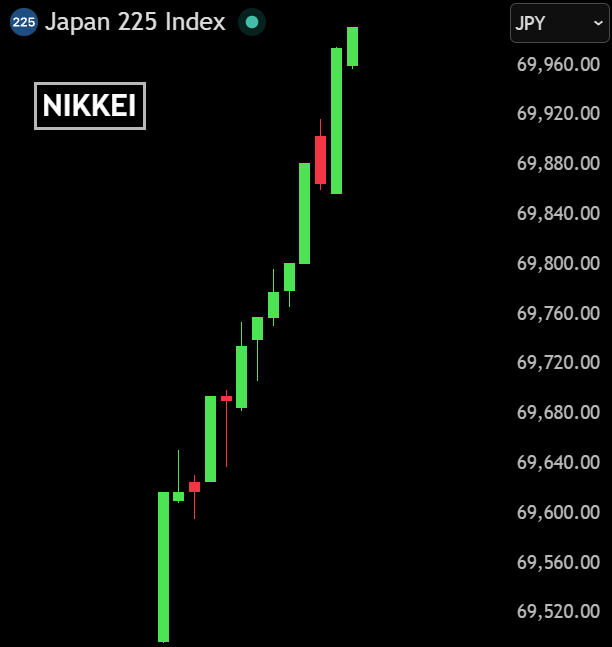
Over ¥13,585,000,000,000 ($82 BILLION) added to Japan's stock market in the last 30 MINUTES as the Nikkei surged +0.95%.
This move comes after the Bank of Japan raised interest rates to 1%, the highest level since 1995.