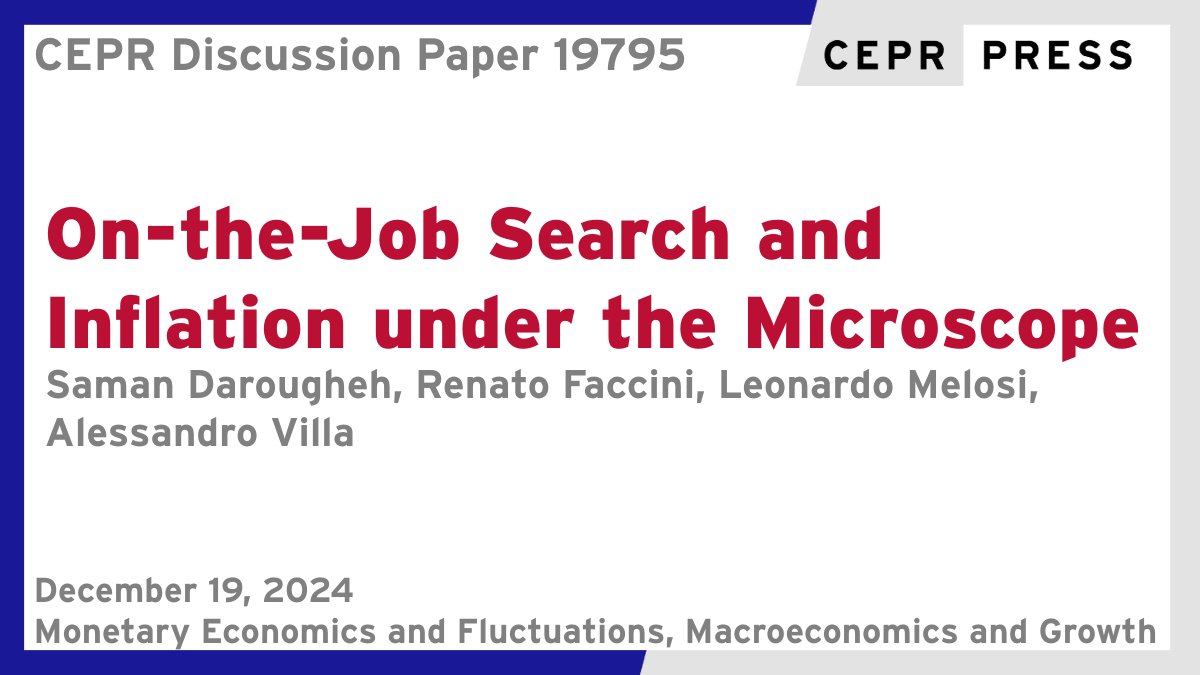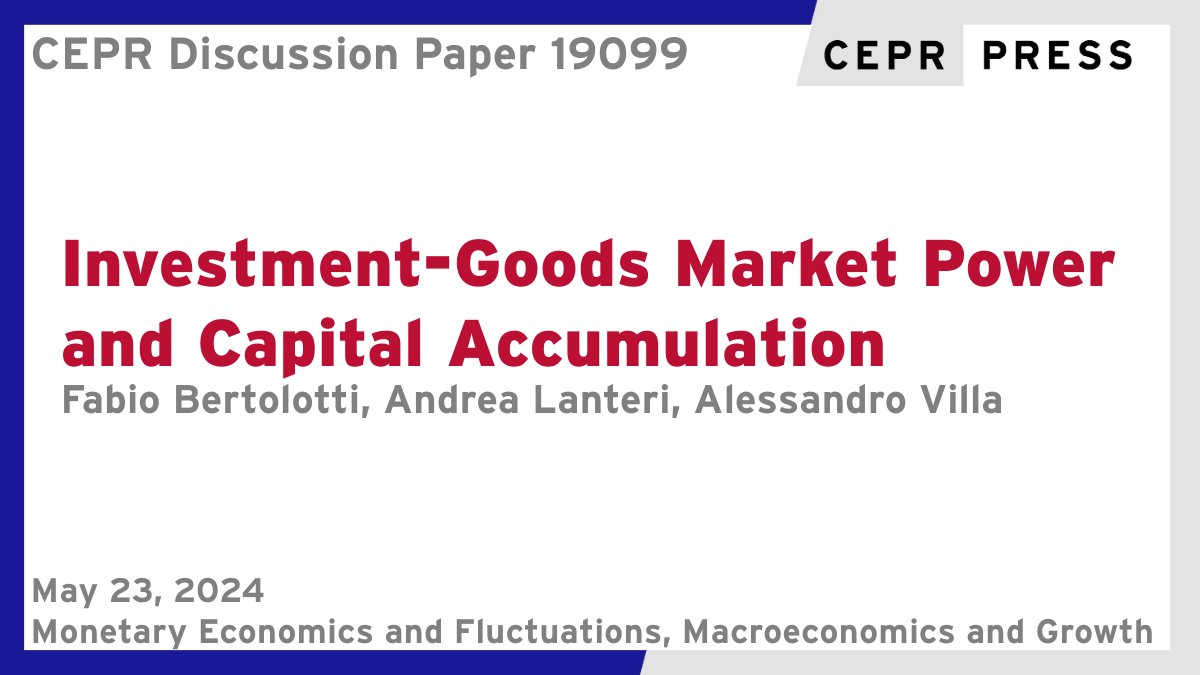
Alessandro T. Villa

73 posts

Alessandro T. Villa banner
Alessandro T. Villa

Alessandro T. Villa

@forket86

Research Economist @ChicagoFed. PhD @DukeEcon. Interested in Macroeconomics, Financial Economics, Optimal Policy and Computational Methods.

Chicago, IL Se unió Ocak 2013
573 Siguiendo644 Seguidores
Alessandro T. Villa retuiteado

Gustavo de Souza
Gustavo de Souza@GusMicrotoMacro·
This is my overall take on research: follow your calling. Write a paper that only you could have written. Each of us is a unique, complex individual. We have our own experiences, knowledge, curiosity, interests, fears, loves, and traumas. These rich personal idiosyncrasies, if well channeled, can translate into a new angle on any topic. If it’s a question someone else could have answered, in a way someone else could have done it, written as someone else would have written it, LET SOMEONE ELSE DO IT. That is not your calling. There is something out there, in the space of all knowledge to be gained, that only YOU could have taught the world. Your mission is to find that and teach us.​​​​​​​​​​​​​​​​ And I, honestly, look forward to that.
Eduard Talamàs@EduardTalamas

what's your advice for PhD students thinking about doing research on AI's economic impacts? Where are the blue oceans (opportunities)? Any red oceans (bloodbaths) to avoid?

English
3
10
117
15.4K
Alessandro T. Villa retuiteado
ChicagoFed
ChicagoFed@ChicagoFed·
Interested in becoming a research assistant? Join our research team on April 17 for Fed Life Unlocked – a virtual event focused on what life is like as an RA here at the Chicago Fed. bit.ly/4tgErw5
ChicagoFed tweet media
English
0
4
6
2.2K
Alessandro T. Villa retuiteado
Yucheng Yang
Yucheng Yang@YuchengYang1993·
⏰⏰Apply by next Monday (Apr 6) for ML for Macro & Finance Summer School in Beijing! • HA basics+computation (Maliar) • Deep Eqm Nets (@comp_simon & Kübler) • DeepHAM+SRL (@ben_moll & me) • Continuous-time method (Payne & Gopalakrishna) Daily tutorials: from theory to code🚀
Yucheng Yang@YuchengYang1993

🚨🚨Application open: PKU-Zurich PhD Summer School on 𝐌𝐚𝐜𝐡𝐢𝐧𝐞 𝐋𝐞𝐚𝐫𝐧𝐢𝐧𝐠 𝐟𝐨𝐫 𝐌𝐚𝐜𝐫𝐨 & 𝐅𝐢𝐧𝐚𝐧𝐜𝐞 📍Beijing, July 6–10 Coherent lectures by @ben_moll @comp_simon Weinan E, Kubler, S Maliar, Payne, Gopalakrishna & me. Apply by April 6 forms.gle/c28uSndiUvqXtm…

English

0
8
26
5.1K
Alessandro T. Villa retuiteado
Jesús Fernández-Villaverde
Jesús Fernández-Villaverde@JesusFerna7026·
A guide for students of economics: Ten statements that demonstrate that someone does not understand modern economics or what an equilibrium is, and that you can safely ignore everything else they say. 1. “Equilibrium means the economy is stable or at rest.” Many assume that an equilibrium is a peaceful state with no forces at play. Instead, an equilibrium is just an arrangement of actions and expectations over time that are mutually consistent. It can be locally unstable, explosive, or fragile. Nothing in the definition of equilibrium implies stability. 2. “Equilibrium implies optimality or social efficiency.” Equilibrium is often conflated with efficiency, but equilibrium merely reflects decentralized consistency, not welfare maximization. Market power, externalities, incomplete markets, nominal rigidities, and frictions routinely produce inefficient equilibria. I often teach a first-year macro graduate course, and not a single one of the equilibria I define is efficient. 3. “Equilibrium is a unique outcome.” Many often expect models to have one equilibrium. In reality, multiple equilibria arise naturally in dynamic, strategic, and incomplete-market environments. Models of coordination failures, self-fulfilling expectations, bubbles, overlapping generations, and liquidity traps all hinge on the existence of equilibrium multiplicity. 4. “Equilibrium requires perfect foresight or perfect information.” Equilibrium does not assume agents know the future. In fact, equilibria are often stochastic. The definition of equilibrium only requires that beliefs are consistent with the (perceived) stochastic laws of motion implied by the model. Bayesian learning, noisy signals, ambiguity, and subjective uncertainty all fit well within an equilibrium framework, provided beliefs converge to an internally consistent (but possibly incorrect) distribution. Bonus point: equilibria are compatible with agents having diverging beliefs that never converge to a single Dirac distribution. 5. “Real economies are rarely in equilibrium, so the concept is unrealistic.” Equilibrium is not meant to describe the daily state of the world. It is a conceptual device used to understand the outcome of our models under the assumptions we make. Also, see point 1 above. 6. “Equilibrium requires agents to be fully rational in a psychological sense.” Equilibrium only assumes internal consistency: agents optimize given preferences and constraints. It does not assume realism about human cognition. We can and do define equilibria in models with behavioral biases, bounded rationality, inattention, or rule-of-thumb behavior. We only need to ensure that the resulting actions and beliefs are mutually compatible. 7. “Equilibrium eliminates dynamics or learning.” Equilibrium is sometimes misinterpreted as a static state in which nothing evolves. In fact, many equilibria are sequences of probability distributions over states driven by shocks, policy rules, and endogenous responses. Learning dynamics (Bayesian updating, adaptive rules, experience-based expectations) can occur within equilibrium if the evolution of beliefs is self-consistent. 8. “Equilibrium renders expectations unimportant.” A common misconception is that equilibrium mechanically determines outcomes. In reality, expectations are often central: they determine investment, consumption, asset prices, and policy responses. Many equilibria differ only in their expectations. This is why communication, credibility, and forward guidance matter even in fully rational models. 9. “Equilibrium excludes policy intervention.” Some interpret equilibrium as a laissez-faire concept. In fact, equilibrium analysis is the foundation of modern policy evaluation. Fiscal, monetary, and regulatory interventions work through equilibrium responses (prices, wages, interest rates, quantities) and must satisfy equilibrium conditions to be credible. Equilibrium is a tool for policy design, not a barrier to it. 10. “Equilibriums…” Aequilibrium is a Latin neuter noun of the second declension, which forms a nominative plural in “a”. It is composed of aequus (equal; the same root as equality or equity) and libra (balance or scales or the name of several currencies over history). A final thought: “equilibrium” is a term of art. Its meaning in economics differs from its use in the natural sciences or in everyday language. Terms of art are ubiquitous across academic disciplines, and the first act of intellectual diligence when one starts studying a discipline is to learn what they mean.
Jesús Fernández-Villaverde tweet media
English
78
494
1.9K
630.2K
Alessandro T. Villa retuiteado
Joao Guerreiro
Joao Guerreiro@jptguerreiro·
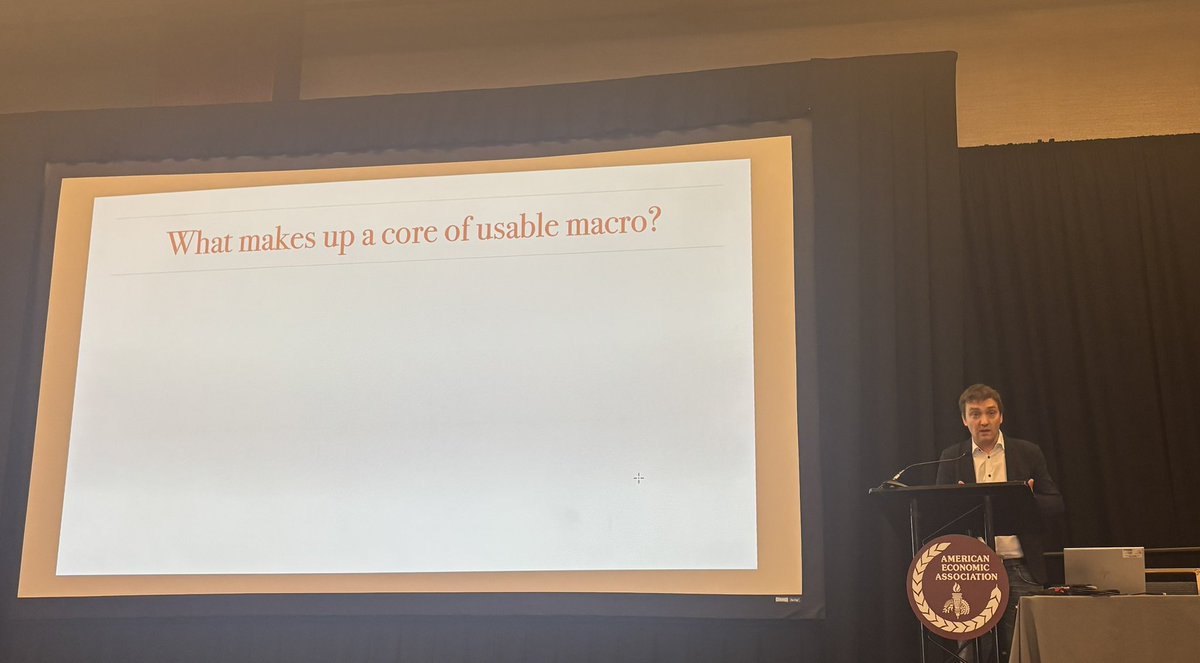
A fantastic session asking whether there is a “core of usable Macroeconomics we should all believe in” with contributions from @a_auclert, @EichMartin, @JonasDMFisher, @BHobijn, @forket86, and Ayse Imrohoroglu. Worth reading and rereading the papers!
Joao Guerreiro tweet mediaJoao Guerreiro tweet mediaJoao Guerreiro tweet mediaJoao Guerreiro tweet media
English
3
14
103
12.5K
Alessandro T. Villa retuiteado
Paolo Martellini
Paolo Martellini@MartelliniPaolo·
The 3rd LAEF Junior Macro Conference ends at Hot Springs Canyon Trail. Thank you to the organizers!
Paolo Martellini tweet media
English
0
2
53
5.3K
Alessandro T. Villa retuiteado
Gustavo de Souza
Gustavo de Souza@GusMicrotoMacro·
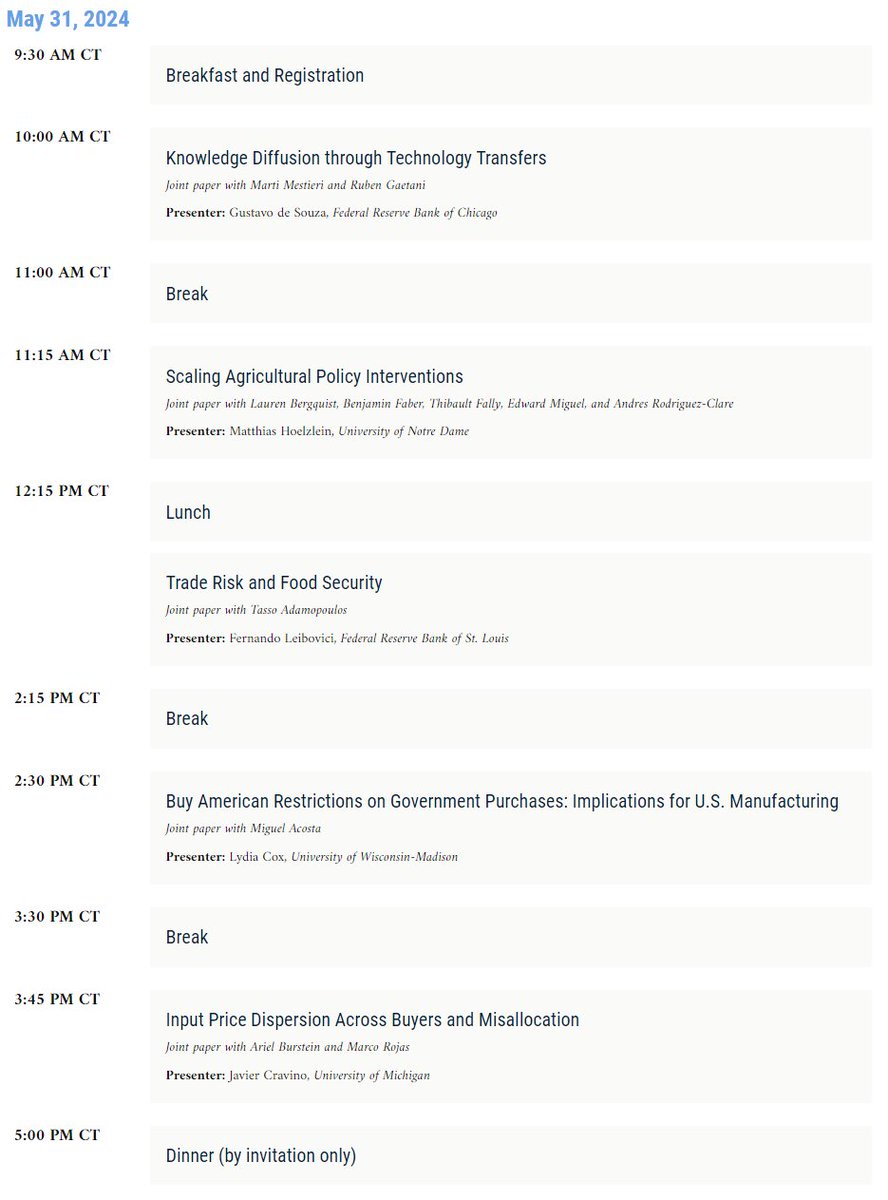
.@ChicagoFed Workshop on International Economics We are bringing back a workshop series on International Economics! Our revival edition features great papers by Matthias Hoelzlein (@NotreDame), @LeiboviciF (@stlouisfed @STLFedResearch), @lyd_cox (@UWMadison), Javier Cravino (@UMich), and myself. If you want to join us, register here: web.cvent.com/event/a17ac046… People from neighboring departments are especially welcomed! @NorthwesternU @KelloggSchool @UChicago @ChicagoBooth @nd_econ
Gustavo de Souza tweet mediaGustavo de Souza tweet media
English
0
4
33
2.8K
Marlon Azinovic-Yang
Marlon Azinovic-Yang@MarlonAzinovic·
I am over the top happy, grateful, and excited to share that I will join the Macro group at the Economics Department of the University of North Carolina at Chapel Hill (@UNC ) as Assistant Professor this fall.
Marlon Azinovic-Yang tweet media
English
37
7
313
27.5K
Alessandro T. Villa retuiteado
Fabio Ghironi
Fabio Ghironi@FabioGhironi·
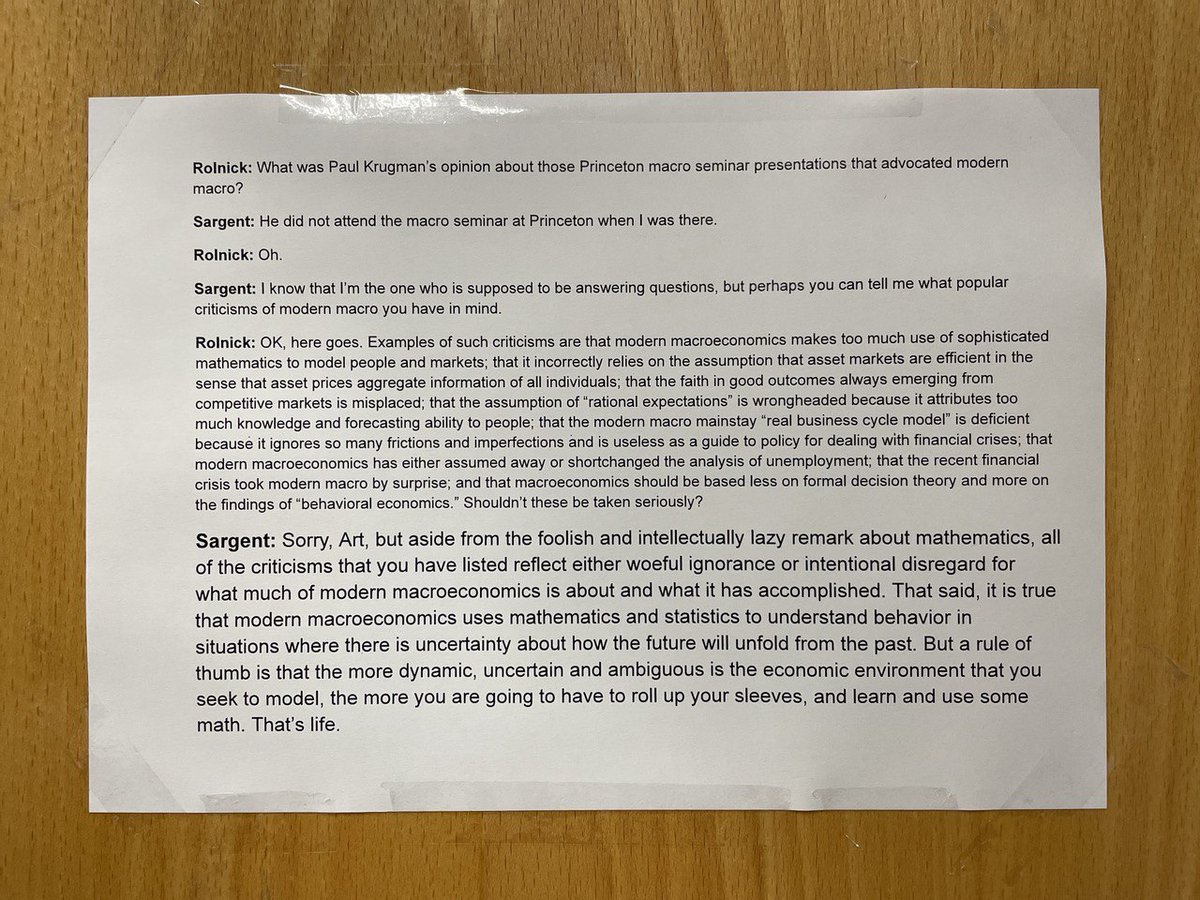
Priceless Tom Sargent. ht @mvazcar
Fabio Ghironi tweet media
English
3
21
120
29.4K
Alessandro T. Villa retuiteado