Quant

2.7K posts

Quant banner
Quant

Quant

@quantnetwork

The infrastructure of money. Building on #Overledger? Follow @OverledgerDev.

London Se unió Ekim 2016
1.3K Siguiendo165.2K Seguidores
Quant
Quant@quantnetwork·
The shift toward Treasury-as-a-Service represents more than organisational restructuring. It reflects the reality that modern #treasuryoperations require technology infrastructure capable of delivering instant liquidity visibility, automated #cashmanagement, and seamless integration with both banking partners and internal systems, capabilities that legacy #treasurymanagement systems were never designed to provide. Read the full article to learn why TaaS is becoming the new operating model for group treasury, what capabilities it unlocks, and how organisations are making the shift: quant.network/perspectives/t… #CorporateTreasury #ProgrammableMoney
English
0
74
272
5.1K
Quant
Quant@quantnetwork·
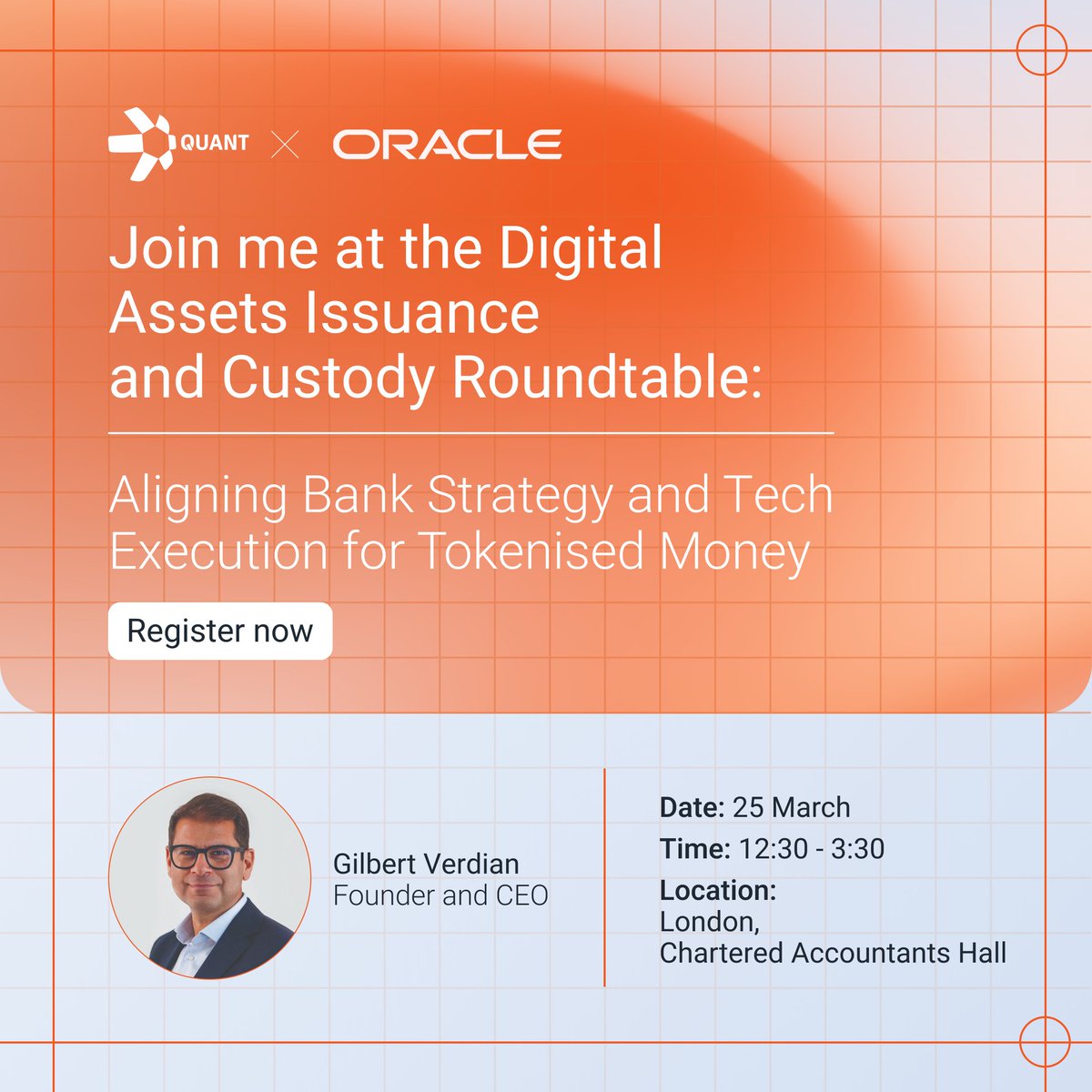
Next Wednesday, our Founder and CEO, @gverdian, will be speaking at the @Oracle AI World Tour London Executive Roundtable on Digital Assets Issuance and Custody, sharing insights from the UK Tokenised Sterling Deposits Pilot. 📍 Chartered Accountants Hall, London 🗓️ 25 March 2026, 12:30 - 3:30PM The event will explore how #banks, asset managers, #capitalmarkets, and global financial institutions are exploring the expanding role of #digitalassets - specifically #tokeniseddeposits and #stablecoins - and seeking optimal strategies for integrating them into the financial product and services ecosystem through digital asset platforms. Register here: eventreg.oracle.com/profile/web/in… #GBTD #TokenisedMoney
Quant tweet media
English
0
87
384
9.2K
Quant
Quant@quantnetwork·
In the second instalment of our three-part series on #programmablemoney, fintech commentator @Chris_Skinner sat down with Lenna Russ, Chief Commercial Officer at Quant, to explore the real-world practicalities of implementing #programmableliquidity in #treasuryoperations. The conversation moved well beyond theory, covering live infrastructure, #corporatetreasury transformation, the threat from #stablecoins, and what it takes to move from pilot to production. Here are the five key takeaways: quant.network/events/program…
Quant tweet media
English
0
123
475
14.4K
Quant
Quant@quantnetwork·
Tokenised deposits promise to transform #bankinginfrastructure, but fragmentation could undermine the entire project. Every major institution is building its own protocols and compliance controls in isolation, reproducing the very inefficiencies they were supposed to solve. History is clear: every payment innovation that achieved scale got there through neutral clearing infrastructure, not proprietary networks. The technology is not the bottleneck. The collective will to prioritise #interoperability over proprietary advantage is. Learn more: quant.network/perspectives/w… #TokenisedDeposits #Blockchain
Quant tweet media
English
0
139
613
17.4K
Quant retuiteado
Gilbert Verdian
Gilbert Verdian@gverdian·
A decade in the making, we have published an ISO standard for blockchain interoperability. This is a milestone I've been working towards since 2015, Remitt was founded with the conviction that blockchains could transform financial services but only if the industry solved interoperability and harmonised around global standards. Without that, blockchain would remain fragmented, siloed, and locked out of mainstream institutional adoption. In April 2016, we published what was the world's first proposal for a blockchain standard (remitt.com/blog/2016/04/2…) a bold move at a time when the industry was still largely focused on proofs of concept and competing protocol narratives, not standardisation. The idea was simple but ambitious: if blockchains were going to serve global markets, they needed a common framework that transcended any single protocol or vendor. Central to this thinking from the very beginning was the concept of a multi-gateway architecture, leveraging the know-how of 20 years of experience in cybersecurity to frame the principle that interoperability shouldn't depend on a single bridge or point-to-point connection, but on a layered gateway model that could abstract away the differences between underlying DLTs and connect them through a common interface. This was the architectural foundation of what would become Overledger, and it was also the design philosophy we brought to the standards process. The belief was that a viable international standard for blockchain interoperability had to be protocol-agnostic and gateway-driven, enabling any DLT to communicate with any other DLT (any-to-any) and with existing networks, without requiring those ledgers to change how they operate. The standard and the technology were born from the same insight. That same year, I worked closely with the team from @standardsaus (Standards Australia), who had the foresight in 2015 to champion the initiative at the international level. Together, we pushed for ISO to establish a dedicated Technical Committee for blockchain and not to be absorbed into an existing committee, but to stand on its own as a recognition that this technology warranted its own global standards programme. The industry demand was there, the use cases were multiplying, and the fragmentation was becoming a real barrier. In September 2016, the New Work Item Proposal (NWIP) received global approval, and ISO formally gave the green light to establish a new Technical Committee (remitt.com/blog/2016/09/1…). TC 307 — Blockchain and Electronic Distributed Ledger Technologies — was born (remitt.com/wp-content/upl…). The inaugural meeting was held in Sydney in April 2017, and from that moment the real work began. As the standards work progressed internationally, the mission at Remitt was evolving too. What started as an effort to use blockchains for financial services and solve interoperability grew into something far larger, a full enterprise infrastructure platform for connecting any blockchain to any network. Remitt became Quant, and we built Overledger, the world's first blockchain operating system to deliver on that original vision. The multi-gateway architecture that informed the standards thinking became the core of Overledger's design: a technology layer that sits above all blockchains, providing institutions with a single integration point to access any DLT, any network, and any existing system. The interoperability challenge that drove the standards work was the same challenge we set out to solve commercially and the two efforts reinforced each other throughout. For close to a decade since TC 307's formation, subject matter experts across the world have contributed their time and expertise to Working Group 7 — Interoperability is the committee I chair. International standards are not built quickly they are built through consensus, technical debate, and relentless refinement. The same methodology and rigour that created the Internet, through publishing standards. The result is a published international standard for blockchain interoperability. 🔗 iso.org/standard/82098… A huge thank you to @isostandards as the international standards developing organisation, to the team at @standardsaus who started the initiative in 2015 and worked tirelessly to get TC 307 approved and established globally, and to every subject matter expert who contributed to Working Group 7 over the years. This would not exist without that collective effort. From a blog post proposing the world's first blockchain standard in 2016, to a published ISO standard in 2026 and from Remitt to Quant, from an architectural concept of multi-gateway interoperability to Overledger and a global standard, this has been a decade-long journey of building both the standards and the technology to make blockchain interoperability a reality for institutions worldwide. There is still much more work ahead. More standards to develop, more to evolve, and more to build. But today, we mark a significant milestone. #Blockchain #ISO #Interoperability #Standards #TC307 #DLT #Quant #Overledger
English
112
390
1.4K
187K
Quant
Quant@quantnetwork·
Financial institutions adopting #DLT interoperability need infrastructure that integrates with existing systems rather than replacing them. Quant’s #Overledger platform addresses this challenge by providing a comprehensive #interoperability layer that connects any distributed ledger technology while maintaining the privacy, scalability, security, and operational resilience that #financialservices demand. Find out how in this article: quant.network/perspectives/h…
Quant tweet media
English
0
111
509
27.8K
Quant retuiteado
Chris Skinner
Chris Skinner@Chris_Skinner·
Today is the day!
Quant@quantnetwork

Just one week to go! Join our Chief Commercial Officer, Lenna Russ, and leading financial technology commentator, @Chris_Skinner next Thursday for a live webinar on how #programmablemoney is solving real #treasury challenges today. Discover the most compelling use cases where #programmableliquidity is addressing real operational challenges, and which applications are progressing from pilot to production. Register here: quant.network/webinar/progra…

English
6
26
186
10.4K
Quant
Quant@quantnetwork·
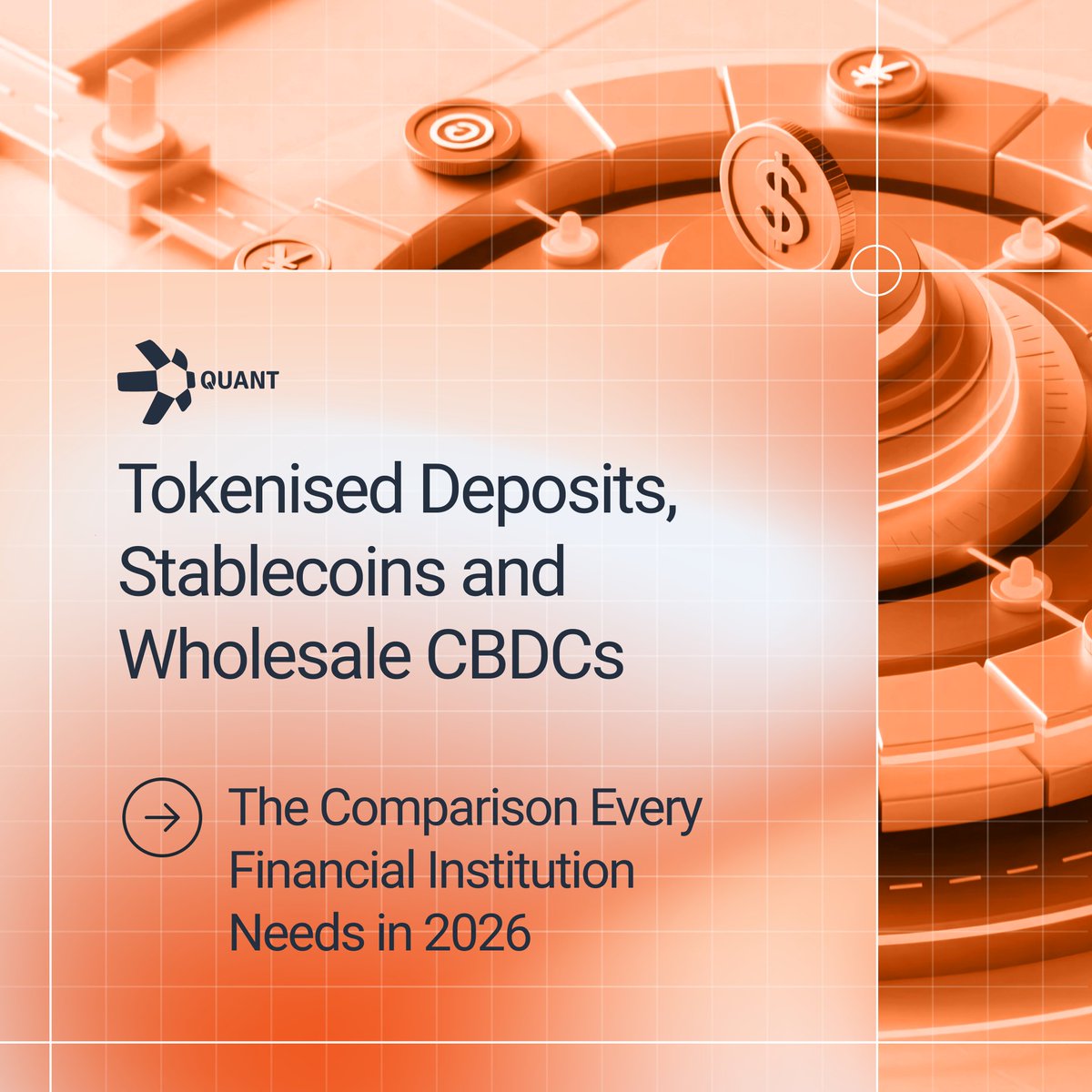
The global financial system now has three distinct forms of programmable #digitalmoney, and they are not interchangeable. #Stablecoins, wholesale #CBDCs, #tokeniseddeposits. Each has a different issuer, different regulatory status, and different use cases. Financial institutions in 2026 need to understand which instrument is right for which job, and what infrastructure is required to connect them. We've broken down the full comparison, the three-layer architecture, and what it means for your institution in our latest article: quant.network/perspectives/t…
Quant tweet media
English
0
173
623
22.7K
Quant
Quant@quantnetwork·
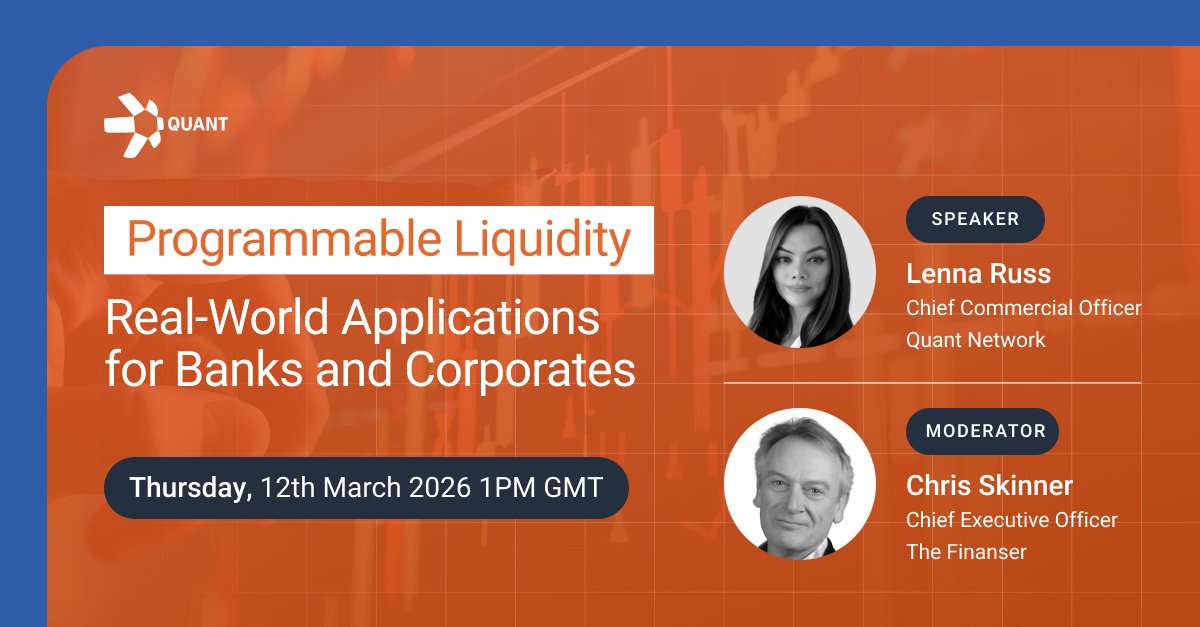
Just one week to go! Join our Chief Commercial Officer, Lenna Russ, and leading financial technology commentator, @Chris_Skinner next Thursday for a live webinar on how #programmablemoney is solving real #treasury challenges today. Discover the most compelling use cases where #programmableliquidity is addressing real operational challenges, and which applications are progressing from pilot to production. Register here: quant.network/webinar/progra…
Quant tweet media
English
0
58
340
18K
Quant
Quant@quantnetwork·
Hong Kong Financial Secretary Paul Chan announced the city will issue its first #stablecoin licences in March 2026. The headline focused on stablecoins, but the real story is what #HongKong is building underneath: a three-layer #digitalmoney architecture that mirrors an identical pattern emerging across every major financial centre. This isn’t just about Hong Kong. It’s about infrastructure fragmentation becoming a global problem whilst everyone builds the same thing. Discover why #tokenisation success depends on horizontal infrastructure that works across all platforms: quant.network/perspectives/h…
English
0
142
588
19K
Quant
Quant@quantnetwork·
Our Founder and CEO, @gverdian, was recently quoted in @thoughtworks' latest article on #stablecoin infrastructure, highlighting a fundamental shift in how financial institutions must operate: "Banks face a critical choice: lead in the #programmablemoney era or be left behind as the infrastructure shifts beneath them. The future will feature bank and commercial stablecoins, #tokeniseddeposits and wholesale #CBDCs operating side by side with universal interoperability, each playing a different role." Read the full article: thoughtworks.com/insights/artic…
English
0
139
583
30.1K
Quant
Quant@quantnetwork·
The @FT highlights how Lloyds Banking Group and other lenders such as Natwest, Barclays & HSBC are leading UK banking into a new era through tokenised deposits and programmable money, a shift that could fundamentally reshape how money moves, settles, and is used across the economy. Tokenised deposits bring real cash onto blockchain infrastructure, enabling automation, real-time settlement, and smarter financial products from mortgages to payments and capital markets. At Quant, we’re proud to be working with leading banks on this transformation. As our CEO @gverdian notes in the article, tokenised deposits represent the evolution of electronic money into digital, programmable money - unlocking efficiency, liquidity, and interoperability across the financial system. This is about more than innovation. It’s about building the next generation of money and the infrastructure that underpins it securely, at scale, and connected across institutions. Article: ft.com/content/671afe… #TokenisedDeposits #ProgrammableMoney #Tokenisation #DigitalAssets #FinancialInfrastructure #Blockchain #FutureOfFinance
English
0
147
515
16.9K