

Tattfoo
3.9K posts
Tattfoo
@tattfoo
As an artist I deployed the creative process of LEARN, PRACTICE, TEACH on issues relating to ecology, sustainability and healthy living.
New York Se unió Nisan 2009
676 Siguiendo556 Seguidores
Tattfoo retuiteado
On to Loeb Give-away IV: Homer's Iliad & Odyssey, Hesiod & the Homeric Hymns, Cicero on the gods, Catullus & Tibullus on love and loss, Ovid lustily on the same (sometimes roleplaying as famous women), and Marcus Aurelius' tutor on all sorts. Just RT this before draw on 11 July!

Antigone Journal@AntigoneJournal
Just bought all 558 Loebs, so prepare for a Spare Loebs Giveaway Haul this summer! 📚📚☀️📚📚
English
Tattfoo retuiteado

In 2014, Shawna Hammond from Oklahoma sought to have her driver's license photo taken with a spaghetti strainer on her head.
She argued that wearing the colander was a religious requirement as a member of the Pastafarian faith. Surprisingly, her request was approved because the colander is recognized as the official headwear for Pastafarians, making it permissible under the state's guidelines for religious attire.
Pastafarianism, founded by an Atheist in 2005, emerged as a protest against the inclusion of Creationism in school curricula.
When questioned about her adherence to Pastafarianism, Shawna identified herself as an Atheist, emphasizing her belief in freedom of thought. She explained that to her, 'the colander represents freedom.’

English
Tattfoo retuiteado

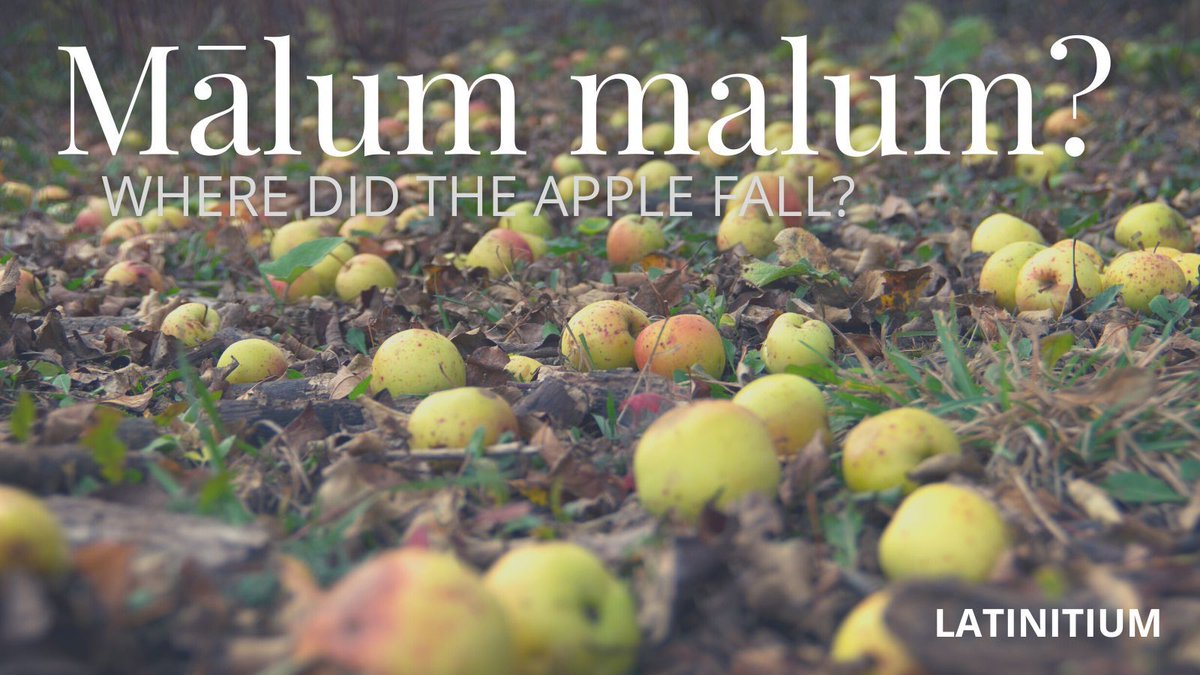
"Mālum malum", means "a bad apple", where mālum (notice the long "ā") means "apple" and "malum" means "bad".
The sign above the "ā" is used to indicate a vowel is long and is called "macron".
English
Tattfoo retuiteado

Do you know why Passive Voice is so natural to Sanskrit?
Read it here;
Do you know why Passive Voice is so natural to Sanskrit?
linkedin.com/pulse/do-you-k…
English
Tattfoo retuiteado

“Reality is perfect, complete. But we are lost in its perfection, trapped in its completeness while imagining we are free. And there is nothing we can do to change it — to make it less perfect, or more — except by making one decision. The only choice we have, our single real freedom, is to decide whether to participate in it consciously or be at its mercy; whether to help complete the circle through our own awareness or just stay lost inside it.”
PETER KINGSLEY
Reality

English
Tattfoo retuiteado

The 13th Century CE, Indian poet and saint Gyandev created a children's game called Moksha Patam. The British later named it as Snakes and Ladders instead of retaining the original Moksha Patam.
Originally, the game was used as a part of moral instruction to children. The squares in which ladders start were each supposed to stand for a virtue, and those housing the head of a snake were supposed to stand for an evil. The snakes outnumbered the ladders in the original Hindu game. The game was transported to England by the colonial rulers in the latter part of the 19th Century CE, with some modifications.
In the original one, a ‘hundred squares game board’, the 12th square was faith, the 51st square was reliability, the 57th square was generosity, the 76th square was knowledge, and the 78th square was asceticism. These were the squares where the ladders were found and one could move ahead faster.
The 41st square was for disobedience, the 44th square for arrogance, the 49th square for vulgarity, the 52nd square for theft, the 58th square for lying, the 62nd square for drunkenness, the 69th square for debt, the 84th square for anger, the 92nd square for greed, the 95th square for pride, the 73rd square for murder and the 99th square for lust. These were the squares where the snake waited with their mouth open.
The 100th square represented Nirvana or Moksha.The tops of each ladder depicted a God, or one of the various heavens (Kailash, Vaikunth , Brahmalok) and so on. As the game progressed various actions were supposed to take you up and down the board as in life..The game had been interpreted and used as a tool for teaching the effects of good deeds versus bad ones.
The game was popular in ancient India. It was also associated with traditional Sanatan philosophy contrasting karma and kama, or destiny and desire. It emphasized destiny, as opposed to games such as pachisi, which focused on life as a mixture of skill and luck. The underlying ideals of the game inspired a version introduced in Victorian England in 1892.
The modified game was named Snakes and Ladders and stripped of its moral and religious aspects and the number of ladders and snakes were equalized. In 1943, the game was introduced in the US under the name Chutes and Ladders.
- Subscribe for Weekly Newsletter -
archaeo-histories.beehiiv.com/?_gl=1*1dhkanl…
#archaeohistories

English
Isn't it humorous that
People spend their entire lives
Trying to become a better story?
When the story is recognized to be
Just a story,The energy directed toward
Maintaining the story dissipates.
Then, there is nothing that
Can be pointed to and claimed:
This is what I am.
無心
English