CloudLlama retuiteado
CloudLlama
243 posts

CloudLlama retuiteado

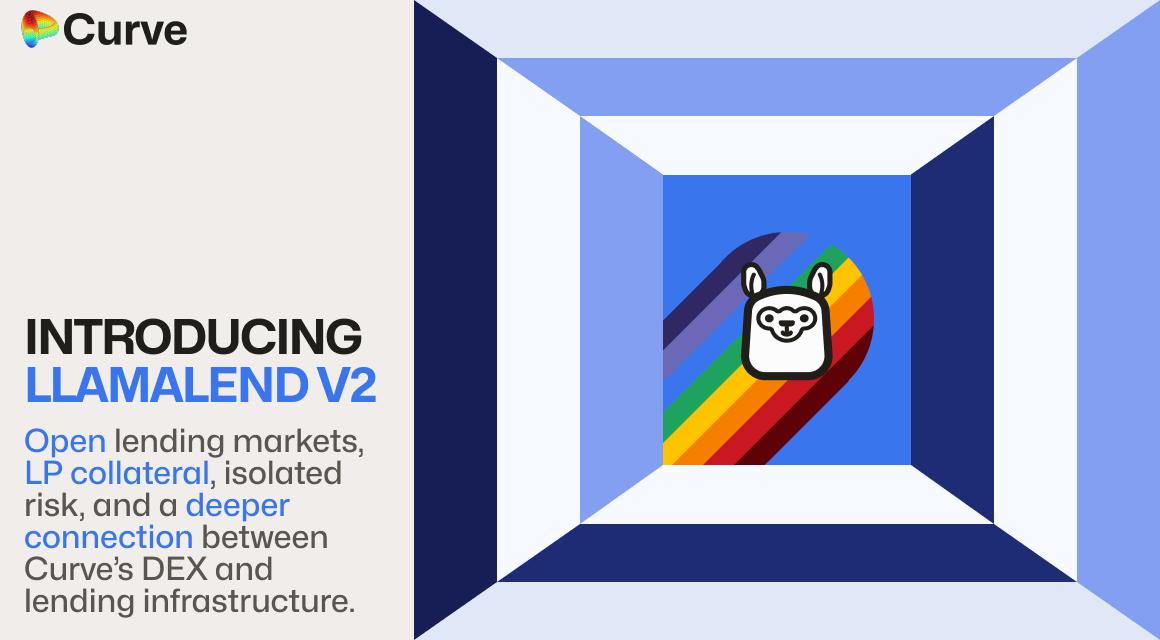
LlamaLend V2 is live on @Optimism.
New markets are open, with OP rewards for eligible positions distributed by @merkl_xyz.
Borrow, lend, or loop through isolated markets powered by Curve’s LLAMMA.
Only on Curve — the home of stablecoins.
curve.finance/llamalend/opti…

English

Exactly! I tried to simplify it down, but this could be a strategy used by vaults for sure.
It hinges on yp LPs being able to mint crvusd. However, I don’t know why you would let them? They main issue is you want pristine collateral (not shitcoins) so you don’t get bad debt. But since the underlying is still BTC or ETH and you can withdraw or deposit atomically into yb what’s the difference for arbitrage bots liquidating/deliquidating?
Maybe @newmichwill can tell why it might be dangerous.
English

you could also (1) have only BTC, (2) flashloan crvUSD (3) mint YB LP, (4) borrow crvUSD against it, and (5) repay the crvUSD flashloan
as long as the crvUSD borrow rate is below the YB LP + scrvUSD rate that should be profitable
maybe a @yearnfi vault could do that? (and then used as collateral as well lol)
English

The scaling unlock for @yieldbasis is almost complete.
It needed many parts to fully scale and the last piece is llamalend v2.
V3 Pools:
These new pools are optimized to recover fast and keep the pools in balance more often. This keeps APRs more consistent and the pools healthier.
However, these pools rely on the crvusd peg to be stable. If they get to large without equally big supply sinks for crvusd, they can make the peg more volatile during periods of high volatility.
That created the second problem. How to scale the credit line. The solution to that was…
Hybrid Vaults:
these allow users to deposit crvusd into scrvusd and create a personal cap in their corresponding yb pool. This creates a supply sink for crvusd and helps stabilize the peg and offset the crvusd borrowed for the yb pool.
But these hybrid vaults are not very capital efficient. Currently, you need 45% of your BTC value to open up the cap to deposit.
The third problem is how to make hybrid value more capital efficient. Enter…
Llamalend V2
The solution is to allow you to borrow crvusd against your yb pool lp position. By doing this, you can run a carry trade and cover your hybrid vault requirement.
The strategy looks like this:
1. Deposit 45k of crvusd into the hybrid vault to open 100k BTC cap in the yb pool.
2. Deposit 100k of BTC
3. Borrow 45k of crvusd from llamalend with n=50
You now have covered your hybrid vault and netted out only having 100k BTC.
Your loan is a 45% LTV. Fairly safe. With llamalend and a high N factor, even if BTC dips you can easily have your BTC converted to crvusd and back automatically. Just pay a little bit to keep your health above 0 with your yield.
Here is the SUPER COOL part…the more yb pools scales, the stronger crvusd gets and the cheaper the interest rates for crvusd are.
This improves the carry trade.
It also drives huge liquidity to crvusd, making soft liquidation even more efficient.
Only caveat: it requires yb lp tokens to be able to mint crvusd. @CurveFinance might feel that’s too dangerous.
English

My point was that propAMMs are competing for the same users as CEXs.
Professional traders who need great execution and deep liquidity.
You’re assuming these traders want to come on-chain. Why? What benefit does that give them over using CEXs besides no KYC?
I think propamms will struggle to get integrations with aggregators, but some aggregators will build their own in house to capture the mev.
English

@xcloudllama @haydenzadams > It doesn’t and you missed the point.
State your point and lets see how obvious it is in hindsight given your statement
> With those I understand the price I’m executing at.
And what pray tell makes you think you can't have price transparency with PropAMMs?
English
CloudLlama retuiteado

The shittiest thing about AI as a SWE is that while it's not the 10x nitro-boost that all the AI hypebeast grifters on here claim it is, it *is* a net ~30% productivity gain (once you factor in all the review, code slop clean up, etc.), which is *just* enough of a boost where you cannot justify not using it.
This is a letdown because using AI after years of learning to code without it is of course an ongoing humiliation ritual, (counterintuitively) *more* exhausting/draining than coding by hand, and way less enjoyable in general.
English

@Mawuko @haydenzadams It doesn’t and you missed the point.
With those I understand the price I’m executing at.
English

@xcloudllama @haydenzadams PropAMMs don't require you to have a third-party custody your funds just so you can access them.
PropAMMs don't lock your accounts because you connected from a geographic region they have a problem with
PropAMMs are very different from Coinbase or Binance.
Hope this helps
English
CloudLlama retuiteado

@llamaintern attention to all @yieldbasis LP’s!
more than 70% of btc TVL has already migrated.
if you were waiting for a good moment, this might be it!
v2 is legacy.
please, migrate ASAP.
English
CloudLlama retuiteado

LlamaLend v2 just shipped, and we see it as a serious unlock for the Frax × Curve stablecoin stack.
v2 is now live on @Optimism, with an @Ethereum mainnet deployment planned for later this year.
It evolves @llamalend from a crvUSD‑centric lending system into a broader framework of isolated lending markets. Lending pairs are no longer required to include $crvUSD. Now any governance‑approved asset pair can form its own market. Curve LP tokens and other yield‑bearing positions can be used as collateral, while they continue to earn trading fees and rewards.
The LLAMMA range‑based soft‑liquidation model remains at the core, so positions are unwound gradually across a price band instead of being hit by a single cliff‑edge liquidation.
For the @fraxfinance ecosystem, the key unlock is simple: markets can now be configured so that users borrow $frxUSD directly against productive Curve LP collateral, once those markets move through governance. That turns $frxUSD from “just” core liquidity in PegKeeper and routing pools into an asset that can also sit on the debt side of the system, adding a clean new source of organic borrowing demand.
PegKeeper pools that use $frxUSD can, in principle, be plugged into isolated v2 markets: you provide liquidity, earn swap fees and incentives, and then post the same LP as collateral in a LlamaLend v2 market to borrow a governance‑approved asset (potentially $frxUSD itself). Your capital stays fully deployed on @CurveFinance while unlocking additional borrowing power, exactly the kind of money productivity $frxUSD is designed for.
Net‑net, LlamaLend v2 is another step toward a tighter Frax–Curve feedback loop, where $frxUSD acts both as the liquidity backbone and as a high‑class borrowing asset inside a soft‑liquidation, isolated‑market framework.
We believe future infrastructure for global DeFi is being built exactly at this intersection.


English
CloudLlama retuiteado

I think Curve has the most durable Cashflows in whole crypto and the whole world. Immutable unstoppable DEFI not even @newmichwill could stop it at this point. The daily volumes in this catastrophcical environment are still decent, imagine what will happen when we get good times.
English
CloudLlama retuiteado

Introducing Llamalend v2
A new lending framework built around Curve liquidity
- Use Curve LP tokens as collateral
- Isolated market risk
- Improved range-based liquidations powered by LLAMMA
- Better market security
Launching first on Optimism.
news.curve.finance/introducing-ll…

English

@FirepanHQ @CurveCap @newmichwill @CurveFinance Why are you miss quoting him? It wasn’t critical. This marketing fear mongering is very off putting.
x.com/newmichwill/st…
Michael Egorov@newmichwill
Not a critical one, but was definitely worth fixing. AI does help with smart contract security apparently
English

Thanks to @newmichwill for collaborating on this latest report! @CurveFinance is one of the most heavily audited protocols in crypto history.
Firepan’s AI still found a critical vulnerability in their newest AMM before mainnet.
✅ No funds lost.
✅ Patched before deployment.
This is the future of smart contract security: continuous, AI-native verification operating faster than attackers can evolve.
Firepan@FirepanHQ
English
CloudLlama retuiteado

I’ve been accumulating $CRV.
Every financial system runs on one thing, liquidity. It’s the bloodstream.
Without it, settlements stall, pegs break, cross-border flows stop.
The protocol that has been building the deepest, most battle-tested stablecoin liquidity infrastructure in DeFi for years is @CurveFinance.
Curve is purpose-built for one job, moving stablecoins and same-priced assets with minimal slippage at scale.
A specific architectural choice that makes it the go-to venue for DAOs rebalancing treasuries, protocols defending pegs, and market makers running tight spreads.
The AMM has been live since 2020, survived multiple market cycles, a major exploit, and still processes billions in volume every month.
The PegKeeper system is where this gets particularly interesting.
PegKeepers are specialized smart contracts engineered by Curve that dynamically manage stablecoin supply directly inside Curve pools to enforce price stability.
$frxUSD runs on this exact infrastructure.
The frxUSD PegKeeper has already crossed $1 billion in trading volume, with PegKeeper TVL at $50M+.
A live system executing at scale, before the broader market has noticed.
And this is where the future of finance becomes concrete. In April 2026, Polygon Labs, Frax, Curve, and DFB Network launched a full suite of onchain FX liquidity pools on Polygon.
frxUSD as the base dollar pair against $BRZ (Brazilian Real), $IDRX (Indonesian Rupiah), $tGBP (British Pound), $AUDF (Australian Dollar), $KRWQ (Korean Won), and $USDT.
Sub-$0.01 transaction fees. 2,600 transactions per second. 24/7 settlement.
Direct access to global currency pairs, fully onchain.
The global FX market moves $6.6 trillion per day. The onchain share of that is a rounding error today.
What Polygon, Frax, Curve, and DFB built is the first serious, full-stack attempt to route real-world currency flows through DeFi rails. Curve’s FXSwap as the exchange layer, frxUSD as the dollar settlement asset, DFB as the market-making bridge connecting local stablecoin issuers to the pools.
This is an infrastructure story.
Every serious stablecoin protocol that wants to defend its peg, manage liquidity, or enable onchain FX needs what Curve already provides.
The more stablecoins exist DeFi-native, institutional, local-currency the more all of them converge on the same place for deep, efficient liquidity.
That’s how network effects compound over years, not months.
veCRV captures the value of all of this: fees, gauge control, protocol revenue.
The more volume flows through Curve pools, the more accrues to those who hold.
Accumulating a stake in the settlement layer that onchain finance is quietly being built on top of.
$CRV 🩸


Diphunter ¤@Diphunter18
Still quietly accumulating $CRV, $AAVE, $FRAX here. In my view these are some of the strongest infrastructure plays in DeFi right now, deeply integrated, battle‑tested, and still massively mispriced vs the rails they’re building for the next cycle. Trillions are coming...be positioned!
English
CloudLlama retuiteado