CodeMultiversX

1.3K posts

CodeMultiversX banner
CodeMultiversX

CodeMultiversX

@CodeMultiversX

For developers, by developers. Follow for important @MultiversX technical updates, news, dev content, tools. Support: https://t.co/94bvdEIXit

Start your journey 👉 Inscrit le Eylül 2023
222 Abonnements3.5K Abonnés
Tweet épinglé
CodeMultiversX
CodeMultiversX@CodeMultiversX·
The Battle of Nodes: New Dawn is underway... now what? We put together a little explainer. 📜👇 What to Expect from Battle of Nodes Battle of Nodes is a staged competition designed to put the MultiversX network through progressively more demanding conditions, culminating in the activation and stress testing of Supernova under real-world conditions. Here is how it unfolds and why each phase exists. Phase 1: Onboarding and Stabilization The competition opens with validators joining the network and getting their nodes running. This phase is not passive. It includes structured stress testing under pre-Supernova conditions, pushing the network to establish a performance baseline before the upgrade activates. The reason this comes first is straightforward: before we activate a major protocol upgrade under live competition conditions, we need to know the network holds. This phase answers that question. It is also worth noting what kind of network this is. Battle of Nodes does not run on a devnet or testnet. It runs on a shadow fork of mainnet — a fork that copies the actual state of the MultiversX mainnet. The conditions are as close to real as possible without being mainnet itself. That distinction matters for the validity of everything that follows. Phase 2: Supernova Activation Once the network has proven stable under load, the upgrade activates, transitioning to Supernova. This means going from 6s to 600ms block times live, with validators already running and competition already underway. This is the technical centerpiece of Battle of Nodes. Activating Supernova under real load, with real participants, is the only way to know how the upgrade performs in conditions that matter. Phase 3: Post-Supernova Stress Testing After activation, validators continue proving network stability at 600ms while Guild Wars challenges are specifically designed to push the network's performance and capacity to its limits. The distinction between the two tracks is intentional. Validators test stability and capability. Guild Wars tests performance and capacity. They are complementary by design: validators establish that the network holds, guilds then find out how hard it can be pushed. Phase 4: Closing and Final Submissions Once all challenges are complete, the competition moves into its final window. Validators submit final reports and comparison data. Guild scores are computed. Everything closes and the leaderboards are finalized and move to their evaluation phase. The Security Track: Open the Entire Time Running across all phases, 24 hours a day, is the Security Track. There are no timed windows and no structured challenges. If you think you can find a vulnerability, probe an edge case, or find a way to stress the network outside of the validator and guild frameworks — that is exactly what this track is for. Submit findings through the portal at any point during the competition. Why This Structure? Networks do not fail under normal conditions. They fail under spikes, competition, adversarial behavior, automation, and economic pressure. Battle of Nodes is designed to produce all of those conditions in sequence, with a major protocol upgrade in the middle. The phased structure reflects the real dependency chain: you cannot stress what is not stable, and you cannot validate an upgrade without a proven baseline to compare against. Help us battle test the biggest upgrade in our history. bon.multiversx.com
CodeMultiversX tweet media
English
5
36
126
11.2K
CodeMultiversX
CodeMultiversX@CodeMultiversX·
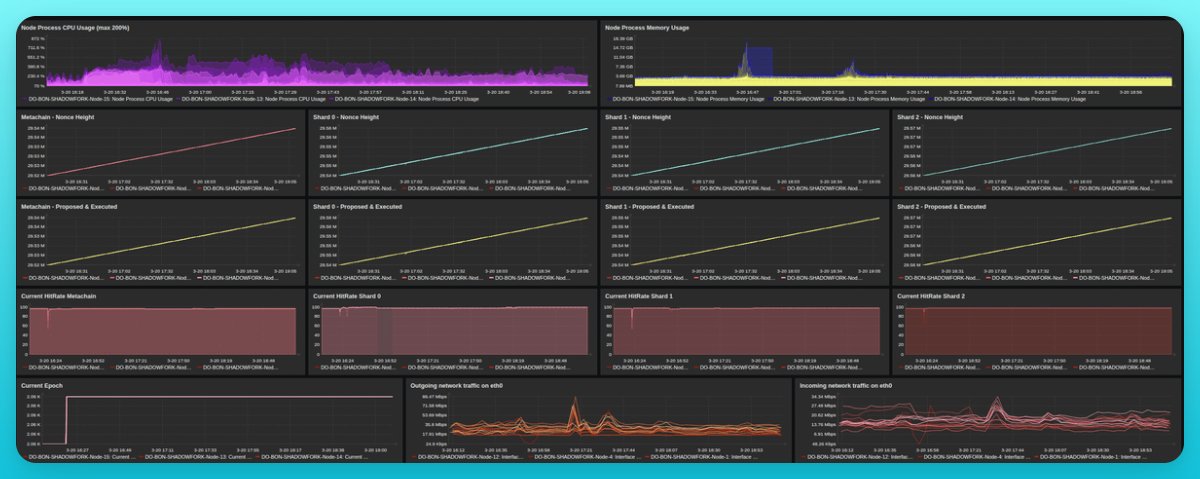
Challenge #6 has wrapped. The network remained healthy throughout the stress test. In total, the network processed 7,221,856 transactions throughout the challenge window, including intra-shard, cross-shard, and relayed transactions, as well as simple and relayed SC calls.
CodeMultiversX tweet media
English
3
18
76
2.6K
CodeMultiversX
CodeMultiversX@CodeMultiversX·
Challenge #6 is well-underway with many participants already reaching the 50,000 transactions required for Window A. Supernova looking good here.
CodeMultiversX@CodeMultiversX

Validator Challenge #6 goes live in 30 minutes at 14:00 UTC! Five different transaction types to test the Supernova upgrade after establishing the baseline last week. Validators, get ready!

English
0
11
42
622
CodeMultiversX
CodeMultiversX@CodeMultiversX·
Validator Challenge #6 goes live in 30 minutes at 14:00 UTC! Five different transaction types to test the Supernova upgrade after establishing the baseline last week. Validators, get ready!
CodeMultiversX tweet media
English
2
11
69
2.5K
CodeMultiversX
CodeMultiversX@CodeMultiversX·
What's next ▪ The hard fork included several fixes beyond the root cause — these need to be validated under the same real-world conditions ▪ Validator challenges continue today, Guild Wars resumes next week ▪ Security track remains open 24/7 ▪ Competition extended through March 30 Jump in: bon.multiversx.com
English
0
3
33
375
CodeMultiversX
CodeMultiversX@CodeMultiversX·
More learnings from BoN ▪ Under Supernova, the tx pool retains transactions longer, reducing space for new ones — during one Guild Wars challenge, throughput was similar to pre-Supernova despite 10x faster blocks because the tx pool was the bottleneck, not the network ▪ Tx pool capacity has been increased and optimizations were added to ensure transactions propagate before being proposed in blocks ▪ The API gateway hardware was underspecced for the volume participants generated — stale data under load caused duplicate nonce submissions, adding noise ▪ Users stress the network differently than we do internally — one challenge saw participants spend over 20,000 EGLD in gas fees on cheap spam transactions, a load pattern that's hard to simulate but immediately useful
English
1
1
19
321
CodeMultiversX
CodeMultiversX@CodeMultiversX·
Insights from the Supernova Engine Room 10 days of Battle of Nodes. Real load, real participants, real findings. A recap 🧵 from today's space 👇
CodeMultiversX tweet media
English
3
25
101
4.6K
CodeMultiversX
CodeMultiversX@CodeMultiversX·
Join us tomorrow for an update from the Supernova Engine Room with core engineers @AdrianDobrita & @radu_chis. 📆 March 20 ⌚ 9 AM UTC Set your reminders 👇
CodeMultiversX tweet media
English
1
15
75
3.1K
CodeMultiversX
CodeMultiversX@CodeMultiversX·
What to do now: ✦ Review previous challenges ✦ Write and test your scripts Best practice: ✦ Re-fund at the start of each window — best practice to ensure clean attribution ✦ Send test transactions to verify everything works Jump in: bon.multiversx.com/validators-tra…
English
0
0
5
142
CodeMultiversX
CodeMultiversX@CodeMultiversX·
Log upload: → Restart your main validator node within 1 hour before Window A → Restart again within 1 hour after Window E ends → Upload the log generated between the two restarts to the BoN platform
English
1
0
6
155
CodeMultiversX
CodeMultiversX@CodeMultiversX·
Battle of Nodes Validator Challenge #6 goes live on March 20 at 14:00 UTC. Sunday's Challenge #4 set the baseline pre-Supernova. Tomorrow, we'll run it back. But faster. 2,000 points available. Validators, get ready. 👇
CodeMultiversX tweet media
English
2
20
78
8.1K