Alexander W. Dowling

84 posts

Alexander W. Dowling banner
Alexander W. Dowling

Alexander W. Dowling

@DowlingLab

Associate Professor in @NDCBE at @NotreDame. Process Systems Engineering. Computational Optimization. Data Science. Statistics.

Notre Dame, IN Inscrit le Mayıs 2020
156 Abonnements282 Abonnés
Alexander W. Dowling
Alexander W. Dowling@DowlingLab·
@StaKLoPR @ReadTheSyllabus I started using Poll Everywhere to ask questions (active learning) and I end the first questions with 2 minutes of class starting. This lets me factor it into the grade.
English
0
0
9
621
StaKLo (Childless Cat Lady)🤬
Professor friends: do you have a rule for late students? If so, what is it and how do you enforce it? I have students arriving 45-60 minutes late to an 80-minute class. Super disruptive. Makes me insane.
English
15
0
14
7.3K
Alexander W. Dowling
Alexander W. Dowling@DowlingLab·
@CoryMSimon Love it, although it does not take into account buying the skis as a commitment mechanism. A few summers ago, we bought a state park pass. At the end of the summer, we went to a beach on Lake Michigan five Sundays in a row to “get our money out of it”. Great family memories!
English
1
0
1
284
Cory Simon
Cory Simon@CoryMSimon·
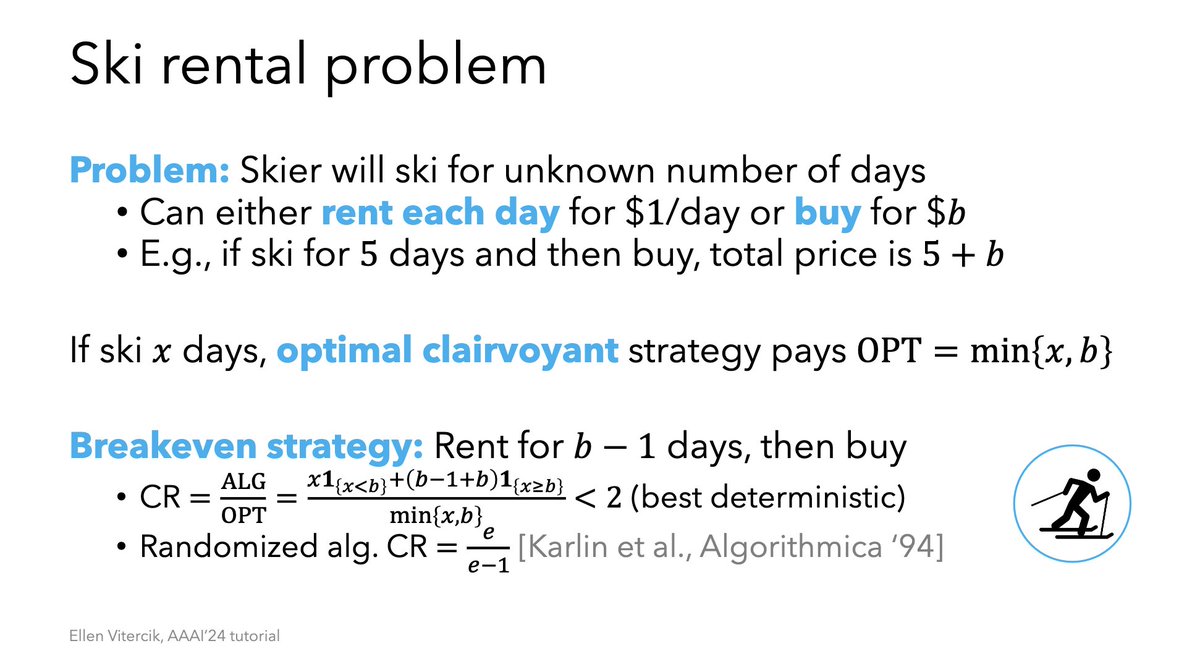
the ski rental problem 😍
Cory Simon tweet media
English
1
0
4
845
Cory Simon
Cory Simon@CoryMSimon·
fully agree. I think our first-year computer programming course is framed as one in "computational thinking and problem-solving" instead of "computer programming", which I like. > computational thinking refers to the thought processes involved in formulating problems so their solutions can be represented as computational steps and algorithms. in education, CT is a set of problem-solving methods that involve expressing problems and their solutions in ways that a computer could also execute. plus, proficiency in e.g. Julia is quite transferable to other languages.
English
1
0
3
134
Alexander W. Dowling
Alexander W. Dowling@DowlingLab·
@schmaidt Globalization including line search and trust region. Linear algebra review, e.g., eigendecomposition to characterize curvature of Hessian.
English
0
0
0
217
Alexander W. Dowling
Alexander W. Dowling@DowlingLab·
@CoryMSimon I do not know of any. But we should chat more over the summer. A great excuse to collaborate! Our course is designed around the temperature control lab. This gives a hands-on example that completes Transport II (heat, mass) the students are taking concurrent.
English
1
0
1
227
Cory Simon
Cory Simon@CoryMSimon·
@DowlingLab awesome, this is the way to do it! next year, I'm thinking to redesign my process dynamics & control sequence to keep it in the time domain. in addition to your open textbook, do you know of other textbooks in the field of ChemE that teach control theory in the time domain?
English
1
0
2
94
Cory Simon
Cory Simon@CoryMSimon·
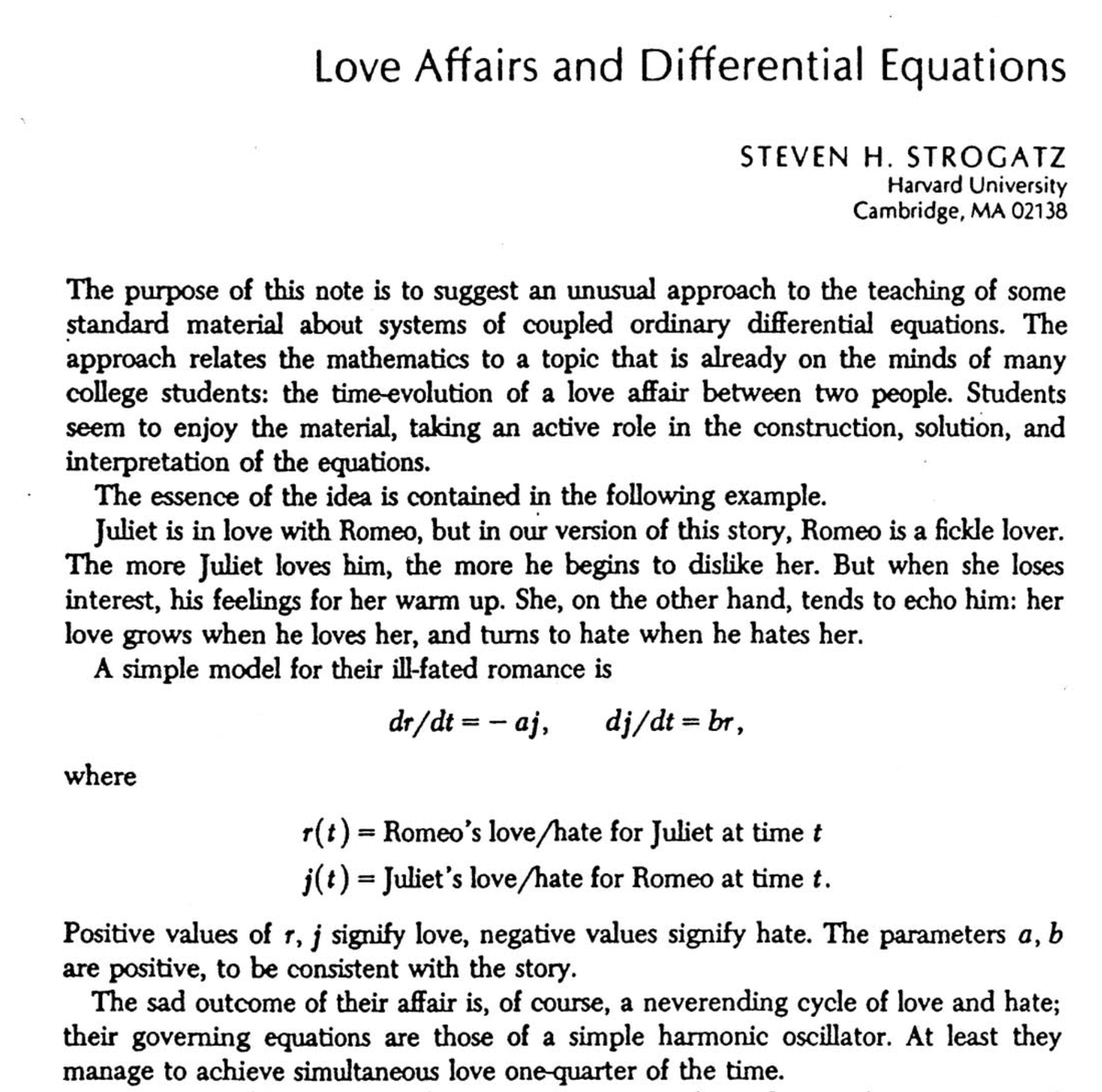
the topic for lecture after Valentine's day was second order transfer functions arising from two coupled, linear, first-order ordinary differential equations. so, showed my class S. Strogatz's famous "love affairs and differential equations" article. a rare case where we wish for the poles of the transfer functions to have positive real parts---so both involved fall in love in response to a moment of attraction.
Cory Simon tweet media
English
2
0
14
1.2K
Christopher E. Wilmer
Christopher E. Wilmer@DrChrisWilmer·
Asking for a friend, are hyperlinks still not allowed in NSF grant proposals?
English
3
0
1
856
Shanti Rao
Shanti Rao@shantirrao·
Is anyone teaching an ODE + Control Theory class for undergrads? This is a sorely missed opportunity to level up all the engineers.
English
8
1
16
7K
Cory Simon
Cory Simon@CoryMSimon·
@shantirrao @lpachter 🤚 I do! process dynamics & control = a sequence of two required courses for chemical engineering undergrads at Oregon State University.
English
1
0
5
219
Alexander W. Dowling
Alexander W. Dowling@DowlingLab·
Really looking forward to 1.5 days of discussion on self-driving labs!
Alexander W. Dowling tweet media
English
0
1
13
693
Cory Simon
Cory Simon@CoryMSimon·
👍 with disclaimer: P(rejection | Nobel Prize winning work) != P(Nobel Prize winning work | rejection)
Andrew Akbashev@Andrew_Akbashev

A list of papers that were rejected before going viral ( = winning a Nobel Prize). It just shows how #science works sometimes. ▫️ 1. Richard Ernst, Chemistry (1991), for NMR spectroscopy The paper that described our achievements was rejected twice by the Journal of Chemical Physics to be finally accepted and published in the Review of Scientific Instruments. ▫️ 2. Andre Geim, Physics (2010), for graphene “First, we submitted the manuscript to Nature. It was rejected and, when further information requested by referees was added, rejected again. According to one referee, our report did 'not constitute a sufficient scientific advance'." ▫️ 3. Paul Boyer, Chemistry (1997), for enzymatic mechanisms underlying the synthesis of ATP His proposed resolution of a major unsolved problem in biochemistry threatened to "change the paradigm," Boyer remembers, and "the leading journal" in his field - The Journal of Biological Chemistry - declined to publish his work. ▫️ 4. Herbert Kroemer, Physics (2000), for semiconductor heterostructures "I wrote up the idea and submitted the paper to Applied Physics Letters, where it was rejected. I was talked into not fighting the rejection, but to submit it to the Proceedings of the IEEE, where it was published, but ignored. I also wrote a patent, which is probably a better paper than the one in Proc. IEEE." ▫️ 5. John Polanyi, Chemistry (1997), for describing the dynamics of chemical elementary processes PRL rejected the paper as lacking scientific interest. Shortly thereafter they rejected T. Maiman's report of the first operating laser, on the same grounds. Polanyi read about this second rejection, quite by chance. [Later] he submitted the identical manuscript to the Journal of Chemical Physics, where it was promptly published. ▫️ 6. Kary Mullis, Chemistry (1997), for the PCR method (!!!!) "And Dan Koshland would be the editor of Science when my first PCR paper was rejected from that journal and also the editor when PCR was three years later proclaimed Molecule of the Year." ▫️ 7. Rosalind Yalow, Medicine (1977), for the radioimmunoassays of peptide hormones From the rejection letter: “The experts in this field have beer particularly emphatic in rejecting your positive statement that the "conclusion that the globulin responsible for insulin binding is an acquired antibody appears to be inescapable”. ▫️ 8. Hans Krebs, Medicine (1953), for the citric acid cycle The rejection letter from Nature is in the picture. 🤦‍♂️ ▫️ ❗ My point is simple: Rejections by editors are NOT rejections by the research community. Believe in your results. Bring them to the public. Post your study as a preprint. Show it to the world and let the world decide. ▫️ (This list compiled by Josh Nicholson + bit from me). #AcademicTwitter #phdlife

English
2
0
1
848
Alexander W. Dowling retweeté
Notre Dame CBE
Notre Dame CBE@NDCBE·
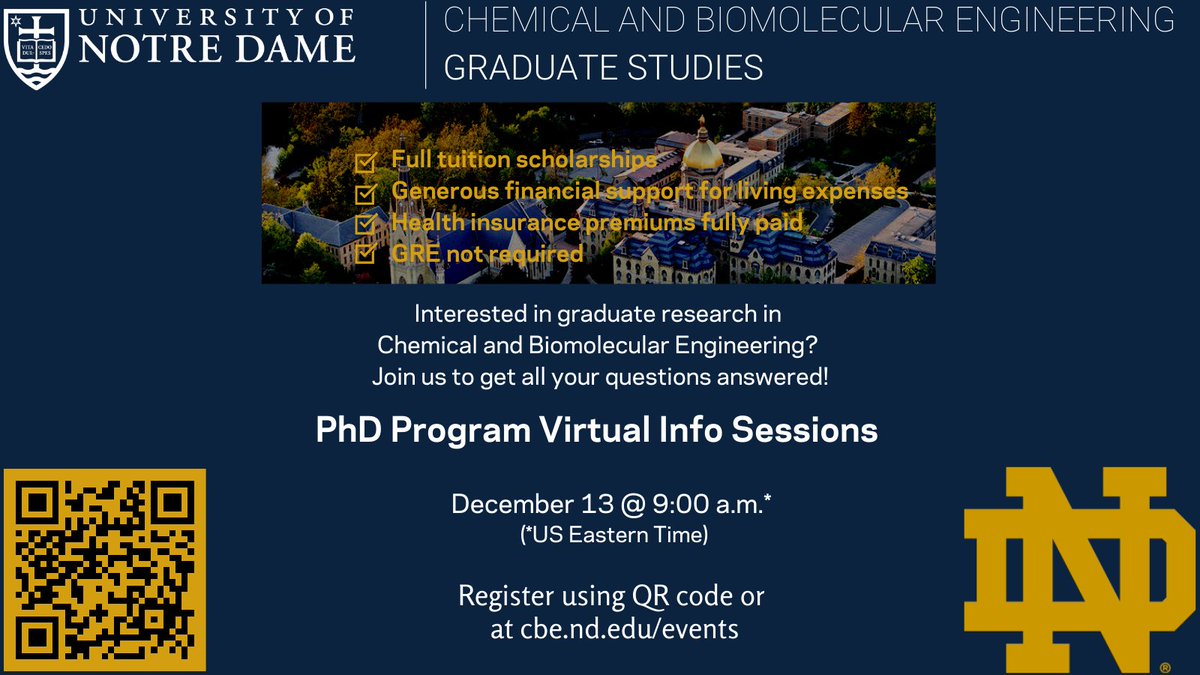
University of Notre Dame Chemical and Biomolecular Engineering's Virtual Visit - last virtual event to find out all you need to know to complete your Ph.D. application! Dec. 13th @ 9 am EST. @NDCBE
Notre Dame CBE tweet media
English
0
7
5
1.3K
Alexander W. Dowling
Alexander W. Dowling@DowlingLab·
@CoryMSimon For algorithms, yes I think it is common to share code or work on packages. Application specific analyses vary widely. It takes a lot of training to get a researcher writing good code. And I don’t think that is fully valued by the academic community.
English
0
0
0
115
Cory Simon
Cory Simon@CoryMSimon·
is releasing code expected in the optimization community? in my view, for most projects, the code doesn't have to be a super user-friendly piece of software to release it (you know, formatted doc strings on every function, describing every detail, made into a package, etc.). eg. for some minor optimization project, sharing the Pluto notebook with the JuMP.jl code is sufficient. so it shouldn't be much extra time to release the code, in this case. ideally, we'd always develop modular, decently-commented, organized code for our projects---for ourselves, to make it easier to verify, hunt down bugs, test, and build upon after we open it months/years later. (😇 <--- since it doesn't always go this way.)
English
1
0
0
285
Cory Simon
Cory Simon@CoryMSimon·
possible reasons researchers may not want to publish the code used to generate the results in their scientific paper: ⭐️ "my code is poorly-written, -organized, and -documented. ie., releasing this hot mess would be an embarrassment." ⭐️"since my code is messy and not well-tested, I'm afraid other researchers will find a bug in my code, bringing my results into question." ⭐️ "we want to inhibit other research groups from conducting a follow-up study we have planned; we have a head-start with this code!" ⭐️ "I want to hide the fudge factor/custom settings/trial-and-error procedure I used to get the results I want. this would bring the robustness of my method into question." ⭐️ "I want to inhibit other researchers from comparing other, simpler models with my model, in case, embarrassingly, eg. linear regression outperforms my Rube Goldberg machine." ⭐️"I spent all this effort to write this code, so others should have to suffer to calculate this quantity, too!" ⭐️ "I used MATLAB." (the last one is a joke) 🚩 but really, lots of motivators to not release the code used to produce scientific results, and most of them are antithetical to making science correct, transparent, reproducible, and fast-accelerating (as a whole).
English
4
9
34
8K